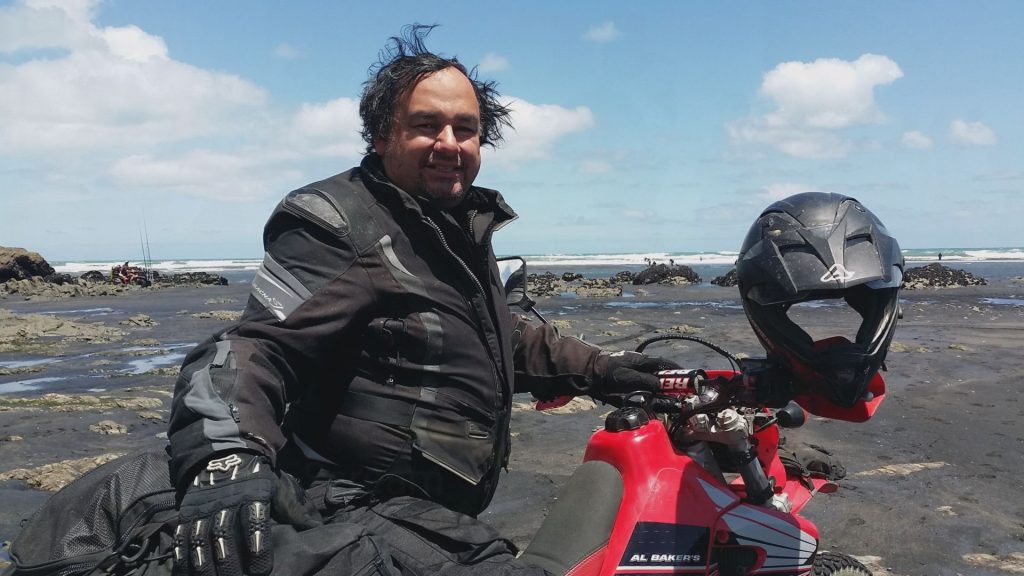
A Sixties Scoop Survivor who was taken from a northern Manitoba
community in 1975 and sent to New Zealand, wants to return home to learn
his history. But with little government support, he may have to pay out
of pocket to return to the country that he claims once sold him away.
“As I’m older now and am looking into it, it’s obviously affected a
lot of people in a lot of different ways, so for me, it’s an emotional
roller-coaster, it’s up and down,” said Jonathan Hooker.
Dan Hooker. (Photo Courtesy: Dan Hooker)
Hooker was 18-months-old when he was taken from his Indigenous family
and adopted by a New Zealand couple in 1975 as part of the Sixties
Scoop. A practice from the 1950s to 1980s where Indigenous children were
forcibly placed in non-Indigenous homes across Canada and beyond.
“Deep down inside me there was always the connection to the Indigenous side of it, but again I didn’t understand it.”
Marilyn Ringland longs to know circumstances of her birth: 'Maybe I'm hoping that you'd found someone'
*
Dear Irene,
I must apologize for using your
name instead of calling you "mom." I didn't get the chance to know you
in the way a child knows their mother.
I do hope you
had the opportunity to hold me, and that you got to choose my name —
a name that my parents, the ones who raised me, kept as is to honour
you. I was promised to people who you knew would love me as their own.
I am slowly finding out your story through records and archives. I don't know which residential school you went to.
Marilyn
Ringland shows a photo of her birth mother, Irene Monias, who was a
patient at the sanitorium in Ninette, Man. 'I hope that I can be the
voice that you didn’t have the chance to be,' Marilyn writes in a letter
to the mother she never knew. (Trevor Brine/CBC)
I only knew that you contracted tuberculosis and were residing at the Ninette, Man., sanatorium when you got pregnant with me, and were there until your demise.
Demise. I can't even say the words "death" or "dying."
Maybe
it's because of what you went through in the short time that you were
here. Spending your adulthood in an institution should not, cannot be
the end. I can only say that you do live on through me and my children.
Did you know you have three grandchildren? I wish you had the chance to meet them.
Also,
my husband. We've been together for more than 30 years. I smile and
think that he's crazy to be stuck with me all this time.
I am doing more sleuthing to find out about your life.
- Marilyn Ringland
I
was very fortunate to be with the family you picked out for me.
You knew my mom was Anishininikwe, like you, and my dad a WASPy kind of
guy. Both of my parents came from large families. I don't know how much
stigma they went through as a mixed couple, but my grandparents were
accepting, and that was what mattered to my parents.
I
was told at a very young age that I was adopted, and I felt comfortable
enough to let people know that it wasn't such a big deal, and no one
asked me if it was. My brother was also adopted, though under different
circumstances. I also had an older sister and two other siblings, and
all three have since died.
'Finding out bits and pieces'
My
search for you in earnest happened after my mom passed away. I don't
know how she would have felt, but I do know that I would have let her
know what I was doing. I guess because I knew I was adopted and my
family life was content, until that point, there wasn't that need or
want to find out where I came from.
Finding out bits and
pieces of your life has been frustrating. The people who might have
known you and your family are gone. I know that I had an uncle, your
brother Walter, and a grandmother when you passed.
I have a picture of you at a hospital, but I'm not sure of which one — either Brandon or Ninette.
A
photo of Irene Monias, taken at a hospital. Ringland hopes her mother
found companionship with 'someone with the shared experience of being
away from home.' (Submitted by Marilyn Ringland)
I
don't have the patient records, but I am doing more sleuthing to find
out about your life. I do know where your resting place is — Glen
Eden Memorial Gardens.
I had mentioned to my daughters
that you might be buried in one of the cemeteries that line Highway 9,
north of Winnipeg. My mom had mentioned this one time and that stayed
with me. I didn't have the courage to ask which cemetery, but my
daughter was inquisitive enough to phone around and find you.
'Maybe you had a moment with each other'
Now I am looking for information on my birth father. What will I find once I have his name?
At first, through Manitoba Post-Adoption Services,
the post-adoption registry could give me his age but legally, nothing
else. At least, not until he turned 101 or had died. (Really? That was
the remarkable information that I received from the registry.)
Well,
if he is still alive, he would have turned 101 this spring. So now I
can find out his name, but that won't tell me what kind of person he
was.
Maybe
I'm hoping that you found someone who, like you, was stuck in a place
that wasn't of your choosing. You found someone with the shared
experience of being away from home, lonely and not being able to have
the life that you should have had.
And so maybe you had a moment with each other — and that was enough.
Finding
out that information is what I'm willing to risk, in order to find out
the circumstances of what you went through to have me. A lot of
questions that might not be answered.
As I close this letter to you, I hope that I can be the voice that you didn't have the chance to be.
Your loving daughter,
Marilyn
This First Person article is the experience of
Marilyn Ringland, an Anishiniew woman who has family roots in Garden
Hill First Nation and was raised in Selkirk, Man. For more information about CBC's First Person stories, please see this FAQ.
The
sense of cultural identity lost to Marvin Terry as a child of the ’60s
Scoop is emerging now through his art, helping him on his path to
self-discovery.
“Art
has become my medicine, my healing,” said Oakville’s Terry, one of nine
Indigenous artists whose work was selected by the City of Burlington to
be permanently displayed in Spencer Smith Park.
“I
am a Sixties Scoop survivor who has lost their culture, language and
now (I’m) in the midst of reclaiming that part that was taken from me as
a child, along with my siblings. My birth parents were both in a bad
way and we were just another challenge to them.”
An
Ojibwe man from Treaty 2 Territory in Manitoba who spent his youth in
foster homes until he was adopted at the age of 14, Terry has always
“been drawn to art.” Many might recognize his name from editorial
cartoons in major Canadian newspapers, including the Toronto Star. His
artistic leanings go back even further though, from drawings his nurses
asked him to sign as a young hospital patient to illustrating school
projects for friends.
Mixed with his editorial cartoons were sports-themed comics and pet portraits for family and friends.
Art
has always been a way to express his creative side, but never a career,
said Terry, who is a mechanical salesperson by profession. It has only
been recently that he’s had “a yearning for my own Indigenous art.”
In March of this year, he created his first Indigenous piece titled “Chinook Salmon.”
“I posted it on my Instagram and Facebook page and all of a sudden I had people asking to purchase a signed copy.”
As a knowledge-carrier, his sister Viola helps him with questions pertaining to the images he creates.
“One
can't just throw something down on paper, add pretty colours and hope
that people will like and will want to buy it. Each piece I create, I
need to be completely immersed in the real meaning behind it. I am an
Ojibwe person by birth but I know very little about the Ojibwe culture
or history because I grew up in foster homes and group homes run by
non-Indigenous people for the most part.”
His hope is that his art sparks conversations about Indigenous issues both past and present.
Terry is researching his Ojibwe culture, which he said will be reflected in future pieces.
“I am looking forward to seeing what becomes of all this. It's a continued journey of discovery.” (source)
Fifty-one-year-old Lori-Ann Lucas made a discovery that filled
a void she says she’d long looked to fill in her life. She was a part
of the ’60s Scoop. Abigail Turner reports.
“I always felt a little different and I could never put my finger on
it. I knew there was just something — I belonged, but I didn’t belong.”
Lucas is adopted. Three months ago she began searching for her birth family.
She
discovered her adoption papers, including her birth mother’s name.
Using social media, she posted the papers online and asked for help
connecting her with relatives.
“When the first one came in and they told me about how we’re
related, I literally dropped to my knees and just started crying and I
went, ‘These are the pieces that I’m missing.’”
I run across comments by adoptive parents and PAPS (potential adoptive parents) all the time on why is it wrong for non-Natives to adopt Native kids? Volumes have been written about this, on this blog, and in medical studies and published reports but we STILL have people who don't understand.
I'm watching this documentary right now on demand. Its about these two
Native American boys (now adults) who were adopted from foster (care) in Canada
to an American (CC) family in Redding, PA. They were adopted as young
boys so they remembered being with the bmom and now one of the boys is
making a film about being between both families.
I thing that bothers me is the younger
brother has basically at 18 yrs old left his adoptive family and went
back to Canada to bio family and he hasn't talked to his AP's in 8
years. His issues are growing up without his NA identity and racism he
dealt with being NA in a all CC environment. Actually both boys are
living in Canada now. The older brother still has a relationship with
his AP's.
As an AP I would take it as a slap in the
face if my kid just left and wouldn't talking to me for 8 yrs. Its like
these boys bio mom was an alcoholic who had her kids taken away because
she was neglecting them. She said herself she would be drunk for 6 weeks
straight and have no idea what day or month it is. Also leaving these
babies at home by themselves while she's out partying and they have to
change each diapers etc... So you have this family come in and give you a
stable home and love and yet because they are CC you just leave?? Im
wondering if this something that happens more often with older kids
adoption from foster care? Like I said earlier it really annoys me but a great watch anyways. LINK
A Place Between – The Story of an Adoption is a 2007 documentary film dealing with cross-cultural adoption and aboriginal life in Canada. It was directed by First Nations adoptee Curtis Kaltenbaugh and produced by the National Film Board of Canada.
Curtis and Ashok Kaltenbaugh were born in Manitoba and are of First Nations ancestry. After the 1980 death of their younger brother, at ages of 7 and 4 respectively, they were removed from the custody of their birth mother and placed for adoption with a middle-class white family living in Pennsylvania.
The film chronicles their search for identity and the meeting of their adoptive and birth families.
The film won Best Public Service Award at the Annual American Indian Film Festival, held in San Francisco during November 2007.[wiki]
Marla Gordon says she hopes to travel to Manitoba from
Saskatoon to meet her birth mother in person. (Marla Gordon)
A woman born in Winnipeg and put up for adoption as a child is one step closer to meeting her biological mom.
Last month, the Manitoba government pushed through new legislation
that makes it easier for children put up for adoption to find out the
identities of their birth parents.
Making adoption records publicly available has helped lead Marla
Gordon from Saskatoon, where she grew up, back to Manitoba, where she
was born, to search for answers about her blood-relatives.
It didn't take long before Gordon discovered the name of her birth
mother and that she once lived in a home on Coventry Road
in Charleswood.
And last week, with a simple call to 411, Gordon came away with a
phone number that turned out to belong to her biological aunt. She told
Gordon her birth mother would give her a call.
That call came Sunday night, and during the conversation, Gordon
learned she also has two full siblings. She and her mom are now
arranging a reunion to bring everyone together.
"I was pretty shocked. It hasn't sunk in yet," said Gordon. "I just couldn't believe it after this much time."
Gordon said her mom was 17 when she became pregnant and wasn't in a position to raise her.
"I understand why she gave me up, I have no grudge against her or
anything," said Gordon. "I think it's a good thing; if you can't take
care of a child, it's probably the most unselfish thing to give a baby a
better life."
Over the years in Saskatoon, where Gordon still resides, she felt out of place and often wondered who her biological family was.
"I'm so different from my siblings; there was nobody like me," she said.
It was that sense of curiosity, paired with the new legislation, that motivated Gordon's search for answers.
Royden Kading with LINKS Post Legal Adoption said he sympathizes with
people like Gordon. He, too, was put up for adoption as a child.
"An adoptee sort of lives a lie all their life," said Kading. "To find out what your background is means a lot to people."
When Darcy Truthwaite, a nurse in Fisher Branch, cold-called her
birth family in Winnipeg, she didn’t plan on blurting out the reason.
"I said to the man who answered, ‘I don’t want to interfere, but
my search for my birth family has led me to you,’ " said Truthwaite.
"He said, ‘You’re not interfering.’ That was the perfect thing to say."
An hour later, Truthwaite found herself on the phone with three
aunts, all asking her questions at the same time. An hour after that,
her birth mother called from Alberta. The next week, they met in
Medicine Hat.
That scenario, hopefully as happy, could be replayed hundreds of
times this summer as the Manitoba government prepares to unseal 70 years
worth of adoption records.
The Selinger government will announce legislation passed
last year will come into force June 15. Already, roughly 1,000 people
have applied to see their files. Provincial staff have begun pulling the
records so the documents can be released quickly after changes to the
Adoption Act and the Vital Statistics Act are proclaimed into law.
Meanwhile, fewer than 60 people, mostly mothers, have filed
disclosure vetoes asking the province to keep their records secret.
That’s a small number amid an estimated 50,000 files, but roughly the
number provincial officials expected.
"This is about the right to identity, but not necessarily a right
to a relationship," cautioned Janice Knight, manager of adoption and
post-adoption programs in the Family Services Department. "If you’re
going to say, ‘No, this is the secret of my life, I don’t want to share
it,’ we really respect that."
Manitoba’s adoption records have been sealed since 1925. In 1999,
the province took a half-measure toward fully open adoption records,
allowing anyone born after 1999 to see their file once they reach
adulthood. Since then, adoption advocates have lobbied Manitoba to
follow other provinces and unseal all records, even though the province
originally promised birth parents they’d be kept secret. Come June 15, adoptees and birth parents will have access to birth
records, adoption documents and other identifying information.
Debbie McMechan says she wishes adoption records had been unsealed when
she was searching for her birth father. (PHIL HOSSACK / WINNIPEG FREE Press)
Torn Apart 32 Years Ago By Canadian Policy Toward Aboriginals, A Mother And Son Met For The First Time.
September 21, 2003|
BY MARGO HARAKAS STAFF WRITER (Florida Sun-Sentinel)
He called himself Lost Cub, and for years he tried futilely to find his way home. Then last year, feeling that at last he was closing in, Wayne Snellgrove hired a private investigator to follow up on the final four names on his list. He needed a shield, a buffer from the searing pain of renewed rejection. When the Canadian investigator finally telephoned her news, Snellgrove took the phone to the bedroom, closed the door, and, lying down on the bed, braced himself. "I found your mother," she said. Then it all tumbled out. Nora Smoke, a Saulteaux Indian living on a reserve in Saskatchewan, told the investigator, she loved Wayne, always had, that it was the happiest day in her life that he had found her. She had never forgotten the child she'd never seen.
"Please tell my son," Smoke pleaded with the investigator, "I've always thought of him."
And the 6-foot-3-inch, 225-pound athlete sobbed, sobbed like a baby, sobbed with 32 years of repressed emotion, sobbed like a kidnapped child returned to his bereft mother. The search had ended; however, the story of a newborn's disappearance three decades ago was yet to be told. Snellgrove, like many Canadians, calls it kidnapping. Others call it cultural annihilation or cultural genocide. Officially, it's been dubbed the Sixties Scoop. Throughout the 1960s, 70s and into the mid-80s, thousands of Native children were separated from their mothers and adopted out to middle-class, non-Native families in the United States, Europe and elsewhere. "Some communities lost an entire generation," says Darrell Racine, professor of native studies at Brandon University, in Manitoba, Canada. At best, say the critics, the action of the Children's Aid Societies, authorized at the time to administer Canada's child welfare services, was misguided. At worst, it was racism. "It goes back to the usual manifest destiny complex white people have over red people and the idea they are more civilized than aboriginal people. They thought they were doing the aboriginals a favor," says Emma LaRocque, professor of native studies at the University of Manitoba. The problem was those removing the children were usually white and, because of bias or ignorance of Aboriginal culture, they were, say critics, unqualified to determine what was in the best interest of the native child.