BLOGGER changed, not allowing us to UPDATE this back-up blog

(UPDATED 726/2025) issues with blogger are preventing this
Showing posts with label Michigan boarding school. Show all posts

Sunday, January 7, 2024

MICHIGAN | A Harbor Springs boarding school worked to erase Odawa culture until the 1980s

LISTEN

Michigan Radio | By Stateside Staff

You have probably heard the phrase “school of choice” used when describing public education options in Michigan, but what about a “school of no choice?” That was the case for many native Michiganders for over a century.

With November being Native American History Month, Stateside welcomed Eric Hemenway, director of archives and records for the Little Traverse Bay Bands of Odawa Indians in and around Harbor Springs, and Sandra Clark, director of the Michigan History Center.
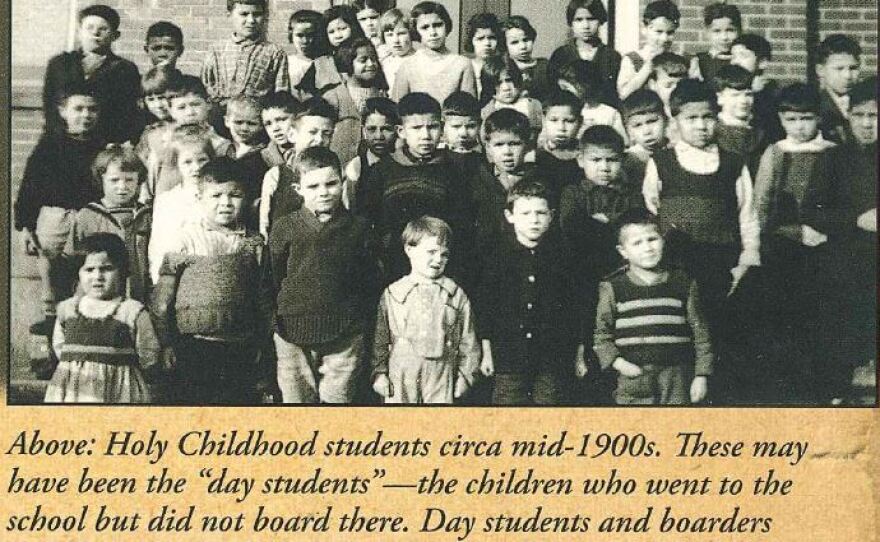
On the creation of Indian boarding schools

During the westward expansion of the United States, in which large populations of American Indians were killed, the government decided to establish a number of Indian boarding schools around the country to force the adoption of American culture.  More importantly, the schools tried to erase the American Indians’ cultures.

“The idea is to found these Indian boarding schools where Indian children will basically not be allowed to be Indian children anymore,” says Clark.

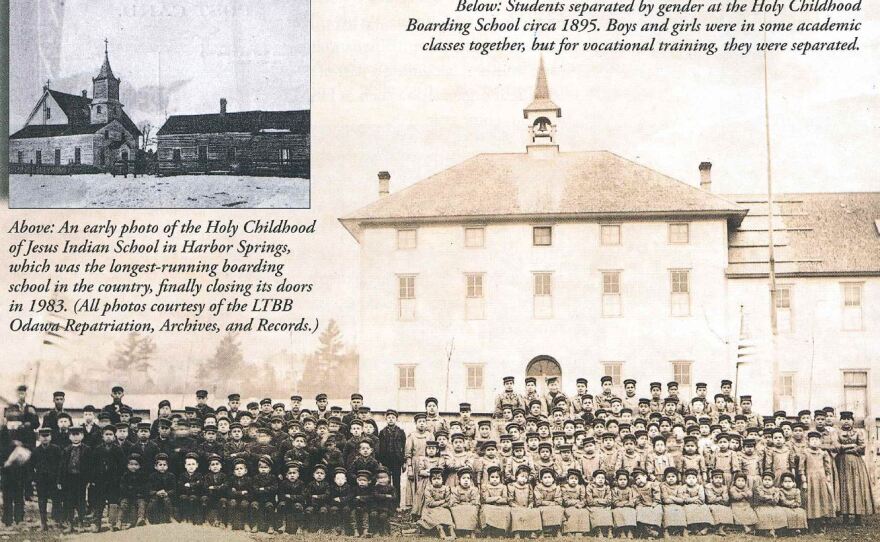
“The boarding schools varied from community to community, but we had one here up in Harbor Springs,” says Hemenway.  The school, Holy Childhood, “started out as a mission school that was in conjunction with the tribe and the local Catholic Church. But as federal policies dictated Indian education into the 1880s, the policy said that Indian language was forbidden, Indian dress was forbidden.”

At the boarding schools, Indians were generally taught to be laborers, not any higher professional aspiration like doctors or lawyers, says Hemenway.  The students were taught to read and write, but the schools also aimed to “uneducate them on being Odawa.”  Students were reprimanded, adds Hemenway, for practicing their culture.

On the schools’ closings

Most of the schools closed in the 1920s, but almost certainly not for moral reasons. The U.S. government didn’t think of the American Indians as much of a threat, and World War I led the U.S. government to reconsider funding the schools because “they were very, very expensive,” says Clark.

“But what makes Holy Childhood an anomaly is that it keeps going for another 60 years,” says Hemenway. “It doesn’t close until 1983 and it’s the last Indian boarding school to do so.”

On impacts on American Indian communities

The large-scale forcing of American Indian children into abusive schools undoubtedly had massive impacts on those communities.

“Loss of language I think is one of the biggest impacts,” says Hemenway. “When these kids were at the school they were forbidden to speak their language, and [there was a] loss of culture, tradition, spiritual beliefs, community ties, family skills.”

Repercussions are still felt today.

Hemenway explains, “We hear devastating stories of kids who survived the school and they grow up to be our elders and, you know, they talk about the situations they went through and how that affected their ability to raise children and develop relationships with other people because of what happened to them at the boarding schools.”

This segment is produced in partnership with the
Michigan History Center.

Tuesday, October 12, 2021

Residential School Survivors of the Holy Childhood School of Jesus Indian Boarding School


NBC News: Survivors Of Native American Boarding Schools Discuss Dark History In The US

This 21 minute video features interviews with survivors of the Holy Childhood School of Jesus of Harbor Springs, Michigan. Both of my grandparents (Henry “Hank” Shenanaquet and Laureen Peters) also attended Holy Childhood. Appearing in the video are Yvonne Walker-Keshick (Little Traverse Bay Bands of Odawa Indians); Eric Hemenway, Director of LTBB Department of Repatriation, Archives and Records; and Fred Kiogima (LTBB). 

Photo above: Yvonne Walker-Keshick speaks with an NBC News correspondent about the Holy Childhood School of Jesus Indian Boarding School of Harbor Springs, MI.

Monday, June 13, 2011

VIDEO: Tribe remembers boarding school era, begins healing (Michigan)

VIDEO: themorningsun.com http://t.co/VkbByNu
By MARK RANZENBERGER


Willie Johnson looked over at the old, crumbling, red-brick building and recalled his grandparents.
They attended the Mt. Pleasant Indian Industrial School, one of many across North America with the avowed purpose of “taking the Indian out of the child” beginning in the late 19th century. Now, in the second decade of the 21st century, the land and the buildings belong to the Saginaw Chippewa Indian Tribe, and Tribal leaders and elders say it’s time for healing.
The Tribe accepted eight acres of property and six historic buildings from the state of Michigan. Monday, a day-long service of honoring, healing and remembrance began the Tribe’s ownership.
Johnson was one of four people who read the names of nearly 150 children believed to have died at the school during the 40 years it operated. Officially, just five children died, but many more are believed to have buried quietly somewhere on the approximately 300 acres of land now owned by the city of Mt. Pleasant and the Tribe.
The aim of the Indian schools was to “enlighten” the Native children, force them to learn English and forget their Native language, introduce them to Christianity and Western values, and teach them useful trades. Many children were forcibly separated from their families and sent to the schools.
Experts say the boarding school experience resulting in the wholesale destruction of Native values and near-loss of Native culture.
The school closed in 1934. The state of Michigan converted the property to a state hospital for the developmentally disabled, which is now closed.
Lorraine “Punkin” Shananaquet, a healer and a member of the Tribal Council of the Match-E-Be-Nash-She-Wish Band of Pottawatomi Indians, said the echoes of the grief, pain and loss continue across the generations.
“My muscle and my blood remember things,” Shananaquet said. She said the day of remembrance could bring emotional, mental, spiritual and physical healing as Native people struggle to regain their language, family, culture and ceremony.
The Tribe has yet to decide how it will use the property. Tribal spokesman Frank Cloutier said the healing and remembrance had to come first.
“Today,” Cloutier said near the end of the ceremonies, “the place is no longer what it was before.”

click

Contact Trace

Name

Email *

Message *

NO MORE UPDATES

GO TO:  https://blog.americanindianadoptees.com/  for updates and news. THIS BLOG cannot be updated...