The raging wildfires in the Los
Angeles area have so far killed five people, spreading over almost 30 square
miles. The fires are the city’s most destructive
to date: More than 2,000
structures have burnt down, including homes, businesses and historic buildings.
According to a Wednesday statement by California State Parks, fires that spread through Will
Rogers State Historic Park engulfed
the eponymous 1930s actor’s ranch house. And blazes that swept through Topanga
State Park destroyed the iconic Topanga Ranch Motel—once
owned by 20th-century newspaper publisher William
Randolph Hearst. State park employee residences at
Topanga and Will Rogers parks were also razed by these blazes belonging to the
Palisades Fire, which ripped through the Pacific Palisades neighborhood, west
of downtown Los Angeles.
“California State Parks mourns the
loss of these treasured natural and cultural resources, and our hearts go out
to everyone impacted by the devastating fires in the Los Angeles area,” says
State Parks director Armando Quintero
in the statement. “We are directing all available resources into the emergency
response effort and working to secure and protect as much as we can at affected
nearby state parks.”
Rogers
was a cherished renaissance entertainer: movie star, radio personality, writer,
philanthropist, aviation
enthusiast and “cowboy philosopher;” the parks
department referred to him as “America’s most beloved citizen.” Born in 1879 as
a citizen of the Cherokee Nation, in territory that later became Oklahoma,
Rogers traveled the world before purchasing land in the Palisades in the 1920s.
By the time Roger died in 1935, he’d developed a sprawling ranch on his
359-acre property. The estate included a 31-room mansion, houses for guests,
stables and corrals, a golf course and horse-riding trails. In 1944, Rogers’
wife, Betty, donated the property to California, and it became a historic park.
The estate included a mansion,
stables and horse corrals. California State Parks
State park employees were able to
evacuate the ranch’s horses and some artifacts, including pieces of art, from
Rogers’ ranch. But the fires destroyed the entire building, save some stone
chimneys and walls. As Cherokee Principal Chief Chuck Hoskin Jr. says in a statement,
“Rogers is among our most beloved Cherokees and a legacy of our people.” He
lauded the protectors of the Will Rogers ranch, who have preserved history over
the years.
As of Thursday afternoon, first
responders have made gains battling the Sunset Fire, which forced residents of
the Hollywood Hills
to evacuate, per the Los Angeles Times. Extreme wind speeds have contributed to the fires’
spreading. As Los Angeles Fire Department Chief Kristin
Crowley said at a Wednesday press
conference, “We are absolutely not out of
danger yet.”
Top of Form
Bottom of Form
Sonja Anderson is a writer and
reporter based in New York City.
Today, the city of Los
Angeles is home to nearly four million people, and the county a stunning 10
million. And it’s on fire.
Members of the Native community in
Los Angeles, Calif. gathered Monday evening, for a prayer and healing circle as
wildfires continue to burn in Southern California.
The gathering at United American
Indian Involvement (UAII) was intended to bring together community members and
raise awareness about the resources being provided to those in need by the
urban Indian organization.
UAII has set up an emergency
response center – among efforts the organization is providing temporary
shelter, coordinating housing, distributing emergency supplies, and
coordinating transportation for those impacted by the fires.
The organization held a press conference
before the gathering.
UAII board member Laura Escobar says
that, among challenges they’re hearing from Native community members in fire
zones, there are power outages – and people unable to leave secured areas and
not being able to get necessities like food and water.
UAII board member and elder Keith
Vielle says their effort is what community is all about that even though they
may be far away from their reservations, they have Native values and
traditional ways, which include helping one another.
They’re also offering hotel
accommodations and meals, and working on long-term plans to offer assistance
after the fires.
The organization is accepting
donations and has a telephone helpline for those impacted by the wildfires.
According to the UAII, it serves a
large urban Native population with more than 200,000 Native people living in
Los Angeles County.
Neighboring
tribes are among those offering
support to fight the wildfires.
San Manuel Band of
Mission Indians sends fire crew to neighbors in LA
Neighboring tribes are among those
offering support to fight the wildfires. The San Manuel Band of Mission Indians
in San Bernardino County says as its neighbors face overwhelming challenges of
the devastating wildfires in Los Angeles County, the tribe is responding to
mutual aid requests.
It has sent the San Manuel Fire
Department to the Eaton Fire in Altadena to help battle the blaze.
In a statement, the tribe says
during this difficult time, the tribe “stands united with the courageous first
responders, fully committed to help safeguard homes, loved ones, and the spirit
of community.”
Other California tribes and tribes
across the country have sent fire trucks and crews to help battle the
wildfires.
California Wildfires and Climate Solutions: A Klamath River Perspective
Fox News host Jesse Watters
connected dam removals requested by Native American tribes to California's
wildfire crisis, saying Governor Gavin Newsom removed four dams “because the
Native Americans told him to do it.”
During the January
8 broadcast of “The Five,” Watters criticized California's fire response,
noting that crews “have contained 0% of this fire.” He then pointed to dam
removals, saying Newsom “tore more dams down — four — than anybody in the
history of this country. Because the Native Americans told him to do it,
because it would save some salmon. Now look at this.”
Native American children in California’s foster care system are
frequently placed in non-relative, non-native homes. Although the U.S.
Supreme Court upheld the 1978 Indian Child Welfare Act, ensuring child
welfare agencies investigate ancestry, contested cases still emerge. This story explores the long-standing issues and the ongoing fight to
protect Native foster care rights in California. Read the full story.
Flooding
in North Carolina following Tropical Storm Helene. (Courtesy Sgt. 1st
Class Leticia Samuels / North Carolina National Guard)
Over the weekend, President Joe Biden approved
a Major Disaster declaration for North Carolina, including for the
Eastern Band of Cherokee Indians, to help people access funds and
resources to recover from Hurricane Helene.
The funds are available for essential items like food and water, repairs, or a temporary place to stay.
In preparation for the storm, the Eastern Band of Cherokee Indians declared a state of emergency last week.
The tribe still plans to hold its Cherokee Indian Fair this week.
In
a statement issued by tribal leaders, they said they’re moving forward
with the fair with a deep understanding of the devastation caused by the
hurricane to surrounding areas.
They said the fair represents a time to gather, reconnect, and strengthen bonds.
The tribe will gather supplies during the fair to help those in need.
VIMEO: https://ebci.com/live-streams/
*
(Courtesy Asm. James Ramos / Facebook)
On Friday, California Native American Day, Gov. Gavin Newsom (D-CA) signed seven tribal bills.
The
bills introduced by Assemblymember James Ramos (Serrano/Cahuilla/D-CA)
include protections for the Indian Child Welfare Act, strengthens the
Feather Alert for missing Indigenous persons, and requires schools to
teach about the impacts of Missions and the Gold Rush.
Native American children in California's foster care system are frequently placed in non-relative, non-native homes. Although the U.S. Supreme Court upheld the 1978 Indian Child Welfare Act, ensuring child welfare agencies investigate ancestry, contested cases still emerge. This story explores the long-standing issues and the ongoing fight to protect Native foster care rights in California.
Tribal leaders and California state lawmakers pressed top California State University officials Tuesday about returning nearly 700,000 Native American human remains and items to tribes.
They held a press conference at the state capitol, followed by a committee hearing on findings from a state auditor’s report released in June.
Tribal leaders and lawmakers say the university is failing to return the remains, which they say is violating federal and state law.
The university’s interim president and four other campus representatives are scheduled to testify.
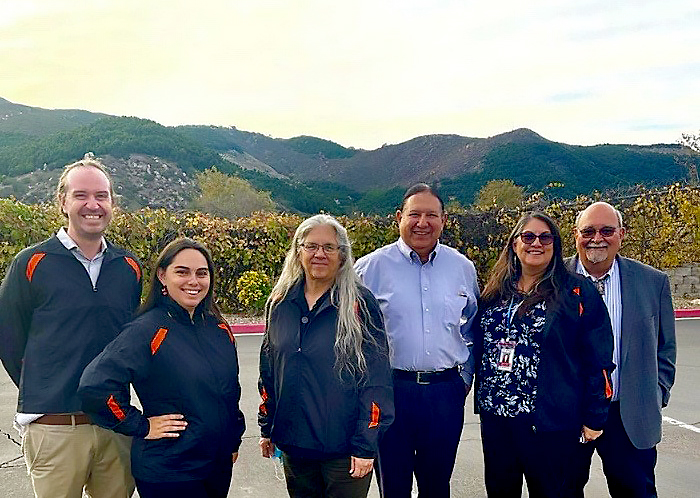
From left, Jeremy Braithwaite, Lizzie Lycett, Cori Biggs, Art Martinez,
Karan Thorne and Judge Bill Thorne during a training session with Indian
Health Council staff. Provided photo.
Twenty years ago, a group of Indigenous tribes in Southern California
had nearly 500 of their children in local foster care systems. Today,
according to Indian Health Council data, the number is closer to 30.
A main driver in recent years is My Two Aunties, a program that draws on
family legacies and kinship traditions to wrap support and guidance
around vulnerable parents and children living in a consortium of nine
tribes.
Key to the approach is a pair of home-visiting workers, known as
aunties, who are as steeped in tribal customs as they are in mandated
reporting and making active efforts to reunify families after a foster
care separation.
“Instead of ‘What’s wrong with you?’, they ask ‘What’s strong with
you?’” said Karan Thorne, a member of the Rincon Band of Luiseño
Indians who developed the program.
A report released Monday by a northern California
civil grand jury finds that the local child welfare system routinely
misses court deadlines, creating “an unnecessary amount of stress” for
children and families — particularly members of tribal communities who
are overrepresented in the foster care system.
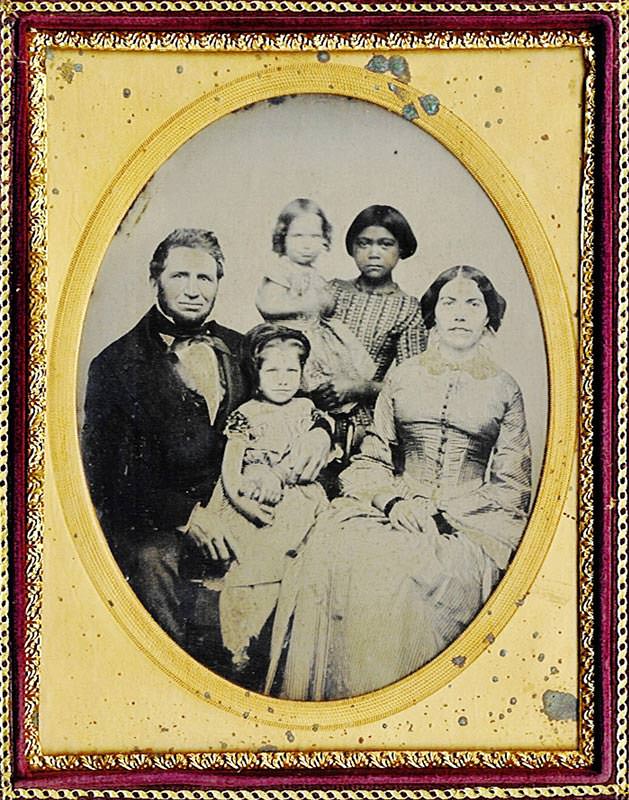
Photo of Kate Camden, a Native girl who at age 10 was forced into
servitude for a white family living in Shasta County. Photo is one of
few records that exist showing Native children entrapped by California's
apprentice and guardianship laws // Credit: Camden Family Portrait,
circa 1857-1859 courtesy of Whiskeytown National Recreation Area, WHIS
9066
New
Episode of ACLU Gold Chains Podcast Examines Indigenous Child Slavery
in 19th century California, Connects to Upcoming U.S. Supreme Court
Case Brackeen v. Haaland
How the "free" state of California enslaved Native children
SAN
FRANCISCO, CA – California came into the Union as a free state in 1850
with a constitution that banned slavery. So how did white settlers in
the mid-19th century get away with enslaving Indigenous
children, some of them as young as 2 years old? And why does this little
known, terrible chapter of California history matter today?
Today, the ACLU of Northern California released the third episode of Gold Chains, our podcast about California’s hidden history of slavery. “Indigenous Injustice”examines a 19th
century state law called the Act for the Government and Protection of
Indians that effectively legalized Indigenous child slavery and
encouraged kidnappers to snatch Native children from their tribal
communities.
“The
horror of what happened in California, the genocidal violence against
Native people, and especially the enactment of that violence against
children, is unfathomable,” said historian Stacey Smith, who appears as a
guest on the show.
“Indigenous
Injustice” isn’t just ancient history. Over time, the practice of
forcibly separating Native children from their tribal communities has
taken on many forms. There were the so- called Indian Boarding Schools. A
variety of other government-sanctioned adoption schemes have funneled
Indigenous children into Non-Native, mostly white households.
Currently,
there’s a landmark case scheduled to be heard by the U.S. Supreme Court
on Nov. 9 – Brackeen v. Haaland – that deals with the very same issue
of the forced removal of Native children from their families, tribes and
tribal culture. It threatens to dismantle the Indian Child Welfare Act (ICWA), which was passed to prevent Native children from being removed from their communities.
The American Civil Liberties Union, along with 12 ACLU affiliates (including the ACLU of Northern California) have filed an amicus brief with the U.S. Supreme Court, urging the court to uphold the constitutionality of the Indian Child Welfare Act.
“Indigenous Injustice” is a timely story that connects the dots between Indigenous child slavery in California to the present.
California joined the Union as a so-called free state in 1850.
So how did white settlers get away with enslaving Native children until
they were young adults?
We explore a little-known California state law called the Act
for the Government and Protection of Indians that unleashed genocidal
violence against Indigenous children. And we connect the dots between
that terrible past and a landmark upcoming U.S. Supreme Court case.
We’d like to thank our wonderful guides Stacey L Smith, William Bauer and Tedde Simon.
Our associate producers are Lisa P. White and Carmen King.
A special thanks also to our voice actors Pauline Schindler, William Freeman, and Avi Frey.
Elize Manoukian provided fact-checking and production assistance.
Field recording was done by Julie Conquest, Ron George and Eric Gleske.
We’d also like to thank the following members of our Gold
Chains team: Brady Hirsch, Gigi Harney and Eliza Wee. Thank you also to
Abdi Soltani, executive director of the ACLU of Northern California.
A special thanks to World Affairs, Oregon State University and
the University of Nevada, Las Vegas for providing us with recording
studios.
Archival sound was provided courtesy of Periscope Films and Prelinger Archives.
The
city of Palmdale, California is moving forward on a housing project
that keeps siblings in foster care housed together. Photo by Annie
Spratt via unsplash.com.
If children must enter foster care while their
parents sort out mental health crises, violent relationships or
addiction, the trauma of abuse and neglect, and the pain of separation
can be long-lasting. But there’s one clear way to minimize the impact:
keeping siblings together.
Public officials in a high-desert bedroom community north of downtown
Los Angeles have committed to building housing that facilitates those
critical family ties. Within a year, according to local and county
officials, the city of Palmdale will be the first site in California to
begin construction of a development built specifically for sibling
groups in foster care.
The aim of these temporary homes and the staff who will oversee them,
said Mike Miller, director of neighborhood services for the city of
Palmdale, is to get the children safely back to their families once
problems at home have been sorted out.
“They’re helping the children, but they’re also working with the
parents because ultimately I think our wish for all foster kids and
parents is that this family stays together,” he said. “These aren’t kids
just getting thrown into a home somewhere,” he added. “This is also
about valuing the family, and keeping the kids together. That’s
transformational.”
The $19 million project will include a dozen three-bedroom townhomes. Up to six siblings will live in each home, together with a specially
trained professional caregiver. The housing project will also include
two units for young adults transitioning out of foster care, and offices
for case managers and support staff.
Last week, in accordance with its goal of creating “quality
affordable housing” for “low, very low and extremely low-income”
residents, the Palmdale City Council and Housing Authority authorized a
$1.2 million “acquisition and pre-development” loan for the project. The
Los Angeles County Development Authority has also committed to a
$500,000 loan, with the remaining costs covered by private financing,
according to a city staff report.
The project, which will be constructed on the north side of McAdam
Park on 30th St. East in Palmdale, is being developed by SOS Children’s
Villages. The more than 70-year-old agency describes its aim as building
families for orphaned, abandoned and other vulnerable children in 135
countries, including the United States.
SOS Children’s Villages is now a global organization, but it began
humbly, its first “village” built in 1949 in Imst, Austria to house
children left behind during World War II. The group now operates more
than 550 “villages” serving approximately 13 million children, youth and
families.
Los Angeles County Supervisor Kathryn Barger
Palmdale will be the first location of its type to open in
California, but the developer of the site runs three similar housing
projects in Illinois, and one in Florida.
“I’m a proud supporter and funder of the SOS Children’s Villages
project in Palmdale,” L.A. County Supervisor Kathryn Barger said in an
email to The Imprint, adding that she met with the project’s leadership
at length. “I’m impressed by their long-standing commitment to family
reunification efforts, and to providing compassionate care to foster
youth and those at risk of entering the system.”
Keeping siblings together
The hazards of failing to keep siblings in foster care are widely
acknowledged, and “placing siblings in the same home should always be
the priority,” states a 2019 federal Children’s Bureau bulletin.
Although the relationships can be expansive in definition —
biological siblings, step siblings, foster siblings, or other close
relatives or nonrelatives with whom they have lived, even siblings
they’ve never met — maintaining an attachment is essential to the
children’s well-being.
“For some siblings in care,” the bulletin says, “their separation or
infrequent visiting can cause those relationships to wither, sometimes
to the point of permanent estrangement.”
When foster children stay close to their siblings, they are more
likely to remain in stable homes, and more likely to “achieve
permanency” through family reunification, adoption or legal
guardianship. The pairing of siblings helps them adapt to new living
situations, whatever they may be, in part because they are less worried
about where their other family members are and how they are doing.
Researchers have also found
that contact with brothers and sisters soothes the trauma of childhood
abuse and neglect, as well as the traumatic experience of being
separated from parents and the only home a child has ever known.
Children who have positive relationships with siblings are less likely
to suffer behavioral problems, such as anxiety and depression.
For siblings who can’t be housed together, child welfare experts
encourage close placement, frequent visits and ongoing contact through
letters, email, social media, cards and phone calls.
Numerous federal laws aim to promote sibling connections.
The Fostering Connections to Success and Increasing Adoptions Act of
2008 was the first federal law stressing the importance of sibling
relationships in the foster care system. It requires that any child
welfare agency relying on federal funding to seek placements that keep
siblings in the same home or, if that’s not possible, provide ongoing
contact and visits.
In 2014, the Preventing Sex Trafficking and Strengthening Families
Act required that the parents of siblings be included as people to be
notified when a child needs placement, as a means to keep children
within extended kin networks.
Four years later, the Family First Prevention Services Act
passed, allowing states to waive the number of children who can be
placed in a single foster home, as a way to better accommodate sibling
groups.
Changing the profile of Antelope Valley
The region known as the Antelope Valley — which includes the cities
of Palmdale and Lancaster — has some of the highest poverty and child
maltreatment rates in Los Angeles County. Three horrific and highly
publicized child deaths
in the area over a six-year period put the child welfare agency’s
delayed response to household warning signs under a harsh spotlight. The
area has also experienced a relatively high level of turnover among
social workers and CPS line staff.
Referring to the torture and killing of 8-year-old Gabriel Fernandez in 2013 — crimes committed by his mother and her boyfriend — Miller said the tragedy also spurred action.
“It really heightened our community to tell us that we need to do
more,” he said. “And the community’s really stuck to that promise of
trying to do more for the kids. So this SOS project is just right on
that path of commitment that came as a result of that tragedy.”
Miller said the sibling housing project will take some time to
complete, given the complexity of the project’s funders, agencies
involved and unique requirements. But he expects construction will begin
within a year.
“These projects really do take time but this one just strikes to the
heart and it has such momentum and support,” Miller said. “What we’re
hoping is that this is a model that other government entities here in
California will use to do the exact same thing up and down the state.”
Tim McCormick, CEO of the SOS Children’s Villages Illinois, got
esoteric in describing the project. He said it’s meaningful that the
site will be located in the high desert, and the architecture will be
environmentally friendly and reflect the region’s natural colors and
hues.
“There’s really an intrinsic beauty of life out there,” McCormick said. “It’s kind of a hidden gem.”
McCormick also noted that the sibling groups who will live at the
site more than likely will have come from impoverished households. But
once built, their temporary home will serve as a resource center for
these low-income children and families. It will also nourish cultural
life, with an outdoor theater for the arts, music and spoken word —
“almost like a Greek auditorium,” McCormick described. “So that’s what
we hope to do there, is to bring in resources that are outside Palmdale
and inside Palmdale, to blend them together and create and strengthen a
narrative of a child’s life and a family’s history.”
Opened in 1871 by Quaker missionaries, Riverside is the nation’s
oldest boarding school operated by the federal government. It is one of
the 408 across the U.S. identified in Haaland’s recently launched Federal Boarding School Initiative
— described by the Department of the Interior as the government’s first
comprehensive attempt “to shed light on the troubled history of Federal
Indian boarding school policies and their legacy for Indigenous
Peoples.”
Haaland has pledged to document the schools’ troubled pasts, address
their intergenerational impact and fully account for the trauma they
inflicted throughout Indian Country.
The ACLU of Northern California in collaboration with radio station
KQED, the California Historical Society and the Equal Justice Society
co-created an educational project directed at highlighting the stories
of slavery throughout California.
Candice Francis, communications director of the ACLU of Northern
California said that the project originally spawned from wanting to
observe the 400th year since enslaved people were brought to the United
States from Africa.
“We were guided to rather than take on that mammoth task, to look more
closely at California because there was a hidden history there,” Francis
said.
One story highlighted on the website surrounds California’s first
governor, a white supremicists named Peter Hardeman Burnett. Burnett
advocated for the genocide of Native Americans as well as the exclusion
of African Americans and other minority groups in California.
Native children often suffered
horrific abuse as a result of a law that professed to send them to white
families for self-improvement but instead created a form of legalized
child slavery. The case of Rosa, in Mendocino County, is just one
example of how the Act for the Government and Protection of Indians brutalized Native, and sometimes black children.
Rosa was between 10 and 12 years old
and was believed to be from either the Yuki or Pomo tribe. In the winter
of 1862, she was beaten and left to die in a snowstorm by a woman who
had been granted legal custody of her under the law. The woman,
identified in Mendocino County public records as “Mrs. Bassett,” had
locked the child outside in freezing temperatures. Her partially clothed
corpse was found in a box outside the woman’s home. Mendocino County
authorities never brought charges, even though Bassett’s neighbors
testified that she had left Rosa outdoors, causing the child’s death.
Before her death, Rosa had been forced to work in the Bassett home as an
indentured servant. According to an 1862 report in the Alta California
newspaper, kidnappers could sell children for “$30 to $150 depending on
their quality.” That same year, a child trafficker came to Ukiah
with 16 children, ages six to 13. After he was arrested, the children
became public wards. But instead of returning them to their families,
county officials offered them to local white residents as “apprentices.”
Bassett was among the more than 100 people who applied to become
guardians of the children.
Letter from Major John Bidwill of Butte County on how widespread slavery of native people was: “[native people] all amoung us, around us, with us – hardly a farm house – a kitchen without them.”
Report from Indian Affairs Superintendent: Superintendent
of Indian Affairs, George M. Hanson, an ally of Lincoln and opponent of
slavery, once found several white men making their way back from
Humboldt County with native children in tow. The men said that the
children were orphans, and they were providing them with homes and
safety. When asked how they knew the children were orphans. The
kidnappers replied that they had killed the parents themselves.