BLOGGER changed, not allowing us to UPDATE this back-up blog

(UPDATED 726/2025) issues with blogger are preventing this
Showing posts with label Roman Catholic Church. Show all posts

Tuesday, October 31, 2023

Senate Committee shocked by difficulties faced gathering residential school records from Catholic Church

 October 26th, 2023 

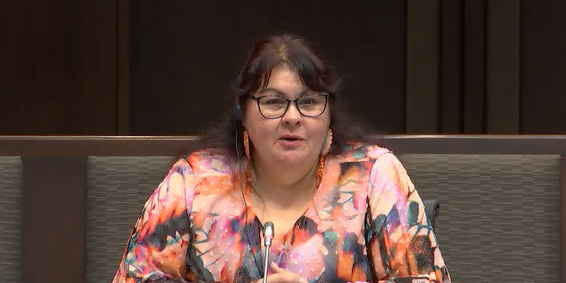
Saskatchewan Treaty Commissioner Mary Musqua-Culbertson
 
By Shari Narine | Local Journalism Initiative Reporter | Windspeaker.com

Saskatchewan Treaty Commissioner Mary Musqua-Culbertson didn’t mince words when she spoke to members of the Senate Committee on Indigenous Peoples Oct. 25 about the difficulty in accessing Catholic Church records for Indigenous residential schools.

Not only has her office come up against barriers in trying to acquire student records for four of the former Indian residential schools in the Prince Albert diocese, but staff had to sign a non-disclosure agreement (NDA) for 21 years in order to access the diocese records they were told were housed at St. Paul University in Ottawa. However, she says, Prince Albert diocese records were never found there.

“Who specifically asks for a 21-year NDA? Who within their organization needs to die within that 21 years that is being protected?” asked Musqua-Culbertson, a lawyer who added that 21 years is not a usual timeframe.

“There is still people who are responsible for sexual abuse and deaths that are still alive that are still out there and they’re walking about within our institutions and in churches and in religious organizations. I do believe that religious organizations are there to protect religious organizations and the people within them,” she said.

Musqua-Culbertson drew the connection between persons of interest (POI) who were named by survivors during the Independent Assessment Process (IAP). The IAP was used as part of the Indian Residential Schools Settlement Agreement (IRSSA), signed in 2006. Through the IAP, survivors had to recount how they were sexually or physically abused in order to receive compensation beyond what the base common experience payment was.

Musqua-Culbertson served as legal counsel during the IAP.

“So you have these vast lists of POIs. Where is that database? Could that be a database? Because POIs are still protected…Those are people who were named as abusers,” she said.

She also pointed out that the IAP records will be destroyed unless survivors state otherwise.

Musqua-Culbertson recounted numerous incidents where the diocese gave her staff difficulties as they tried to access residential school records, including promising to release records and then reneging on those promises.

“When we come back up against this (many) barriers when it comes to the graves of missing children, it’s very disheartening,” she said.

The Office of the Treaty Commissioner of Saskatchewan officially built its library and archives in 2020, although documents began to be collected in 1989. In the past few years, the office has started to collect documents and church records relating to the four Indian residential schools of Delmas (west of Thunderchild First Nation), St. Anthony’s (Onion Lake Cree Nation), Beauval (English River La Plonge Reserve) and St. Michael’s (Beardy’s and Okemasis and One Arrow First Nations).

Raymond Frogner, head archivist for the National Centre for Truth and Reconciliation (NCTR), also recounted the frustrations involved with working with the Catholic Church. Centre researchers are combing through the oblate records housed at Société historique de Saint-Boniface (Manitoba) and Deschâtelets-NDC Archives (Quebec).

“We….are currently funding researchers to go into their archive, go through their records and tell them what records they have that they’ve been holding for decades. Tell them which ones are actually relevant to residential schools…They’re also asking us to pay for the digitization of those records because they aren’t digitized,” said Frogner.

“We all know the Catholic Church did not pay the compensation that they originally were assigned to pay up for the IRSSA.”

Four churches were signatories to the settlement agreement.  While the Anglican, United, and Presbyterian churches have paid their agreed-upon negotiated amounts, the Catholic Church has fallen well short.

Frogner said that the archive at the NCTR held approximately four million records largely focused on the daily administration and operation of the schools.

“There is not a single one of the 141 schools that were part of IRSS agreement …that has a complete set of admission records, discharge records or quarterly returns. This is because, partly, the quality of record keeping was abysmal, to put it lightly,” he said.

Frogner recommended moving away from the legal perspective set out for the records to start to search the more expansive Indian residential school experience.

He suggested documentation be collected from five different fields.

Education would document curriculum, development and staffing at the schools, along with a focus on evangelical curriculum development and projects undertaken by the protestant and Catholic missionaries.

He pointed to health care records, much of which fell under provincial jurisdiction. Disease and pandemics forced children from the schools to hospitals where many died.

He noted that records are being held up in the court system because of ongoing or pending legal action. While court proceedings prevented the release of the records, Frogner said, a file list could be requested and then the records acquired when they were no longer restricted by the court.

A list could also be made of where records are being held in semi-active disposition awaiting processing within government offices or Library and Archives Canada, which would eventually be acquired by the National Truth and Reconciliation Centre.

Frogner’s proposed wider expanse could get limited support from the new Residential School Documents Advisory Committee headed by former Cowessess First Nation chief Cadmus Delorme. The committee has been mandated to work with federal government departments and agencies to scope out their documents in order to identify which are to be transitioned to the NCTR.
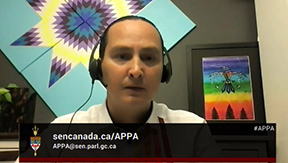
A man sits in front of colourful wall of art. He wears headphones.
Cadmus Delorme

Delorme told the Senate Committee there are “grey areas” when it comes to which records the committee can transition. Records that deal with the 141 Indian residential schools acknowledged through the IRSSA are the targets. Other documents, like hospital records or records in the justice system, both of which will identify children, are not included in the committee’s “main mandate.”

However, Delorme said, “we can identify on the sideline other things that are going on because there will probably be other mandates similar to what we are doing. So let’s make sure we identify those (other records).”

Healthcare records were part of the work undertaken by Anne Panasuk, who was mandated for two years by the Secretariat for Relations with First Nations and Inuit of Quebec, as special advisor for support for families of missing children.

Panasuk told the committee about Bill 79, the Quebec legislation adopted in 2021 that gave Indigenous families the ability to get information about their children who went missing from health institutions in Quebec in the 1950s to the 1980s. This included children who were sent from residential schools to healthcare facilities.

The bill, said Panasuk, “unlocks medical archives and religious archives and it forces institutions to provide medical files…It bypasses the act of protecting information for the health department. Some religious organizations managed hospitals in the past—the diocese, the parishes, the cemeteries. So all these institutions are now obligated to provide information requested by the family.”

However, she said, as the bill is provincial, families do not have access to the records of children who were transferred to health institutions outside of Quebec.

Panasuk suggested that similar bills be adopted by other provinces and territories.

Musqua-Culbertson also suggested legislation that could be useful in addressing “when there is protectionism and when there is barriers put in place.”
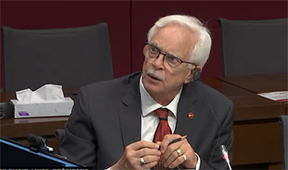
A man in a suit holds his hands in front of him as he speaks in a meeting.
Senator David Arnot

Senator David Arnot, former chief commissioner of the Saskatchewan Human Rights Commission and federal treaty commissioner, referred to what the Senate Committee had heard as a “litany of frustration with the non-compliance truculent stonewalling purposeful barriers” that was being faced by those trying to gather records from the Catholic Church.

What the Senate Committee heard Oct. 25 was in direct contrast with what they were told on Sept. 27 by Father Ken Thorson, provincial superior of the Oblates of Mary Immaculate (OMI) Lacombe Canada.

See our story here: https://windspeaker.com/news/windspeaker-news/senator-digging-delay-res…

Thorson said that since the 215 unmarked graves had been identified at Kamloops Indian Residential School, the Catholic Church’s “commitment has been renewed and strengthened” to work with researchers and survivors.

However, Arnot called what they had heard from Musqua-Culbertson and Frogner of their interactions with the Catholic Church as “incomprehensible conduct.”

Other senators described the testimony as “disturbing”, “appalling”, and “shocking.”

The Senate Committee, chaired by Mi’kmaw Senator Brian Francis from Prince Edward Island, is holding a series of hearings as follow-up to recommendations included in their interim report, Honouring the Children Who Never Came Home: Truth, Education and Reconciliation, released last July.

That report was the result of hearings that took place in March where the Senate Committee heard from representatives from the Office of the Independent Special Interlocutor for Missing Children and Unmarked Graves and Burial Sites associated with Indian Residential Schools, and the NCTR about the difficulty in accessing records that could be used to either identify children who died at Indian residential schools or locate where they were buried.

The Senate Committee has invited specific witnesses to answer questions on why all residential school documents have not been disclosed. 

Windspeaker is owned and operated by the Aboriginal Multi-Media Society of Alberta, an independent, not-for-profit communications organization.

source: https://windspeaker.com/news/windspeaker-news/senate-committee-shocked-difficulties-faced-gathering-residential-school

Friday, May 19, 2023

Catholic-Operated Native Boarding Schools in the United States pre-1970


NEW Website :  https://ctah.archivistsacwr.org/


Compiled by a group of archivists, historians, and concerned Catholics, the List of Catholic-operated Native Boarding Schools in the United States, pre-1978, represents the first and most comprehensive source for information on Native boarding schools that were overseen or staffed by the Catholic Church before 1978. Our motivation for assembling this data was to provide a resource to help boarding school survivors, their descendants, Tribal Nations, and the Church itself navigate the history of Catholic involvement with Native boarding schools.

The list has two primary objectives: first, to identify all Catholic-operated boarding schools designated specifically to educate Native American and Alaska Native children in the United States, and second, to identify all Catholic entities that were involved in the operation of each school. We are under no pretense that our list is complete. We have done our best to offer the most accurate information possible, but we also anticipate future revisions as additional information is obtained.


By bringing together basic information about Catholic-run Native boarding schools and the various Catholic institutions involved in their operation, the list responds to the clear request from Tribal Nations for access to archival records in Catholic repositories. Families and communities of boarding school survivors and their descendants deserve prioritized access to information regarding their own histories. The Catholic Church also has an obligation to understand the scope of its own role in this history. Making basic facts about the history of Catholic institutional involvement in the boarding schools more transparent aids in that understanding and facilitates identification of possible sources of archival records as one preliminary step to support information access.

Our goal is for Tribal Nations, families, and individuals to be able to use the list to locate records for schools that members of their communities attended. Our hope is that Catholic institutional archives and Tribal Nations will build relationships to increase understanding about records for Catholic-operated Native boarding schools and further develop the historical record. 


Email Contact: https://ctah.archivistsacwr.org/contact/


Friday, December 2, 2022

Churches starting to face facts on boarding schools

Government, churches begin to address assimilationist education policies

By: - January 13, 2022 5:30 am

June 1900, Phoenix. (U.S. National Archives and Records Administration)

Red Cloud Indian School is taking the lead among Christian-run schools in coming to terms with its assimilationist past.

The Jesuits have given Red Cloud a $20,000 grant to help in the work, including conducting searches with ground-penetrating radar for unmarked graves, and have allocated $50,000 to hire an archivist for one year to examine the order’s boarding school history at its archives in St. Louis.

School leaders are also working with tribal representatives about searching the school grounds on the Pine Ridge Reservation in South Dakota for remains of students who died there.

“The Catholic Church needs to recognize that honesty, being forthright and vulnerable are far more powerful and more healing than being reticent, restrictive and closed,” said Maka Black Elk, Oglala Lakota, executive director for Truth and Healing at Red Cloud Indian School.

Churches are joining the U.S. federal government in facing the often-brutal history of Native boarding schools, which forced children from their families into schools where they were often abused, underfed and used as virtual slave labor. Some died there without ever going home.

U.S. Interior Secretary Deb Haaland (Laguna) launched the Federal Boarding School Initiative in June directing the agency to prepare a report detailing historical records of schools operated by the U.S. government.

Secretary of the Interior Deb Haaland (Laguna). (Photo by Leigh Vogel / Getty Images)

The Initiative, however, has no authority over Christian denominations, which operated about one-third of the approximately 400 Indian boarding schools in the U.S.

With more than 100 schools, various Catholic orders operated most of the Christian Indian boarding schools, some long before President Ulyssis Grant’s 1869 Peace Policy formally created the federal school system.

Christians began operating boarding schools as early as the 1600s when Jesuits and Puritans separated Native children from their families in order to receive “civilizing” Christian instruction.

Christian missionaries were paid by the federal government to operate Indian schools beginning in 1819 with the Indian Civilization Fund Act. But the heyday of federal Indian boarding schools came under Grant’s policy.

Indian Country Today reached out to leadership in the Catholic, Methodist, Presbyterian, Episcopal and Quaker churches, denominations that operated most of the schools, asking what they are doing now to address the history.

Churches starting to face facts on boarding schools

Thursday, July 7, 2022

Blood Money : Indigenous foundation returns $500K to Catholic nuns involved in Kamloops residential school

The Verna J. Kirkness Foundation has severed ties with Sisters of St. Ann

The main administrative building of the Kamloops Indian Residential School is pictured in 1970. (Department of Citizenship and Immigration- Information Division / Library and Archives Canada)

WARNING: This story contains distressing details.

A foundation that provides university scholarships to Indigenous students across Canada has severed its ties with a group of Victoria-based Catholic nuns by returning a $500,000 donation.

The Verna J. Kirkness Education Foundation announced this week that it had decided to give back the endowment, received in December 2017, to the Sisters of St. Ann, a Catholic order whose nuns taught at the former Kamloops Indian Residential School.

Board chair Tony Williams says the foundation launched a year-long investigation into the Sisters of St. Ann after the discovery of 215 suspected unmarked graves near the residential school last May. 

Williams says the foundation met with the Catholic group during the investigation and asked for specifics about the abuses that occurred at the residential school, but the request went unanswered. 

"We want to know there's a more complete acknowledgement that these [residential] schools were very bad places, that there was a lot of harm done here, a lot of children who didn't survive, there wasn't a proper education provided," he said.

"It was setting up an entire generation of Indigenous people for failure and to be marginalized in society."

Sisters of St. Ann's involvement in residential school

The Sisters of St. Ann is an order of Roman Catholic nuns founded in Quebec in 1850. In 1890, nuns from the order began teaching at the Kamloops Indian Residential School, one of more than 100 residential schools across Canada.

The children were removed from their families and not allowed to speak their own languages. Many were sexually, physically or psychologically abused, a situation described by the Truth and Reconciliation Commission as cultural genocide.

During the opening prayer for the foundation's announcement, Secwépemc elder Evelyn Camille said she had initially been excited to go to the Kamloops Indian Residential School at the age of six, but the experience quickly turned ugly.

"They used cattle trucks to bring the students here," Camille said. "When we walked through the door and into the dormitory, they stripped us and poured coal oil over us — because we were lousy savages."

Secwépemc elder Evelyn Camille, shown in a photo from 2015, says she and other children at the former Kamloops Indian Residential School were stripped and had coal oil poured on them. (CBC)

The residential school was permanently closed in 1977. From 2008 to 2015, the Sisters of St. Ann participated in the Truth and Reconciliation Commission hearings on Indian residential schools.

The group, now composed of only 23 nuns, has been selling their assets and giving away millions of dollars for causes that align with their values. 

Tough decision

The foundation's board secretary, DeDe DeRose, says it was a tough decision to cut ties with the nuns and return a generous gift, but the foundation doesn't want its integrity questioned due to a donation from a group that was historically involved in cultural genocide.

"Now we can say we don't have that money anymore, and we're going to work as hard as ever to ensure that Indigenous children continue to have the opportunities that they deserve to at least be equal to all children in Canada and opportunities to be involved in post-secondary education," DeRose said.

Verna J. Kirkness Education Foundation board secretary DeDe DeRose says the organization is returning the endowment to avoid any questions about its integrity. (Verna J. Kirkness Education Foundation)

The foundation, established in 2008 in Cochrane, Alta., says its mission is to address the under-representation of First Nations, Métis and Inuit students in Canadian universities by providing scholarships to Indigenous students. It partners with B.C. universities including UBC, Kwantlen Polytechnic University and University of Victoria.

In an emailed statement to CBC News, Sisters of St. Ann executive director Angela Hudson says her group is saddened by the foundation's decision to return the donation, which she says will be redirected to another organization that also works to create a brighter future for Indigenous people.

Hudson says her group has committed to handing over its residential school records to the Royal B.C. Museum as part of its reconciliation efforts.

"Reconciliation is achieved by listening and learning with humility, and it is always our preference to engage constructively with our critics, while working together towards common goals," she wrote.


Support is available for anyone affected by their experience at residential schools, and those who are triggered by the latest reports.

A national Indian Residential School Crisis Line has been set up to provide support for former students and those affected. People can access emotional and crisis referral services by calling the 24-hour national crisis line: 1-866-925-4419.

Thursday, February 24, 2022

Keeseekoose First Nation says 54 potential graves at former Saskatchewan residential schools


 Healing is not a political event 

Watch


Keeseekoose First Nation in eastern Saskatchewan says 54 potential graves have been found through ground-penetrating radar at the site of two former residential schools.

The chief says the graves were discovered on the grounds of St. Philip’s Indian Residential School and the Fort Pelly Indian Residential School.

“It’s going to be a very tough time for our community, knowing that we had unmarked graves in our community, in our common areas, that we drive every day, that we walk every day,” said Chief Lee Kitchemonia.

Ted Quewezance, project leader, said the ground-penetrating radar had 42 hits suggesting the possibility of unmarked graves on the Fort Pelly site and another 12 at St. Philip’s school.

Quewezance, a former chief who attended the schools, said the discovery supports what people from the community have been saying for years.

“It was not that they could not hear, but they did not believe our survivors,” Quewezance said.

Fort Pelly school ran from 1905 to 1913 on the First Nation near Kamsack, Sask.

The National Centre for Truth and Reconciliation (NCTR) said the principal was fired in 1911 after it was reported he was drunk and threatening everyone at the school. After it was closed, a day school opened in the same building.

The NCTR found St. Philip’s school had a widespread problem with sexual and physical abuse, which led to the dismissal of a school supervisor over the mistreatment of students during the school’s final decade.

St. Philip’s was run by the Roman Catholic Church from about 1927 to 1969 and has been described by survivors as hellish.

“These are not just instances where a principal or a teacher disciplined. These could potentially be murdered children, hidden,” Kitchemonia said. “We don’t know any of these answers.”

St. Philip’s survivor Fred Brass told the Truth and Reconciliation Commission (TRC), which documented stories from survivors from across the country, that the school was dominated by a violent regime of punishment. He said he lived in fear of abuse day and night.

“I saw my brother with his face held to a hot steaming pipe and then getting burned on the arm by a supervisor,” he said.

The TRC, which issued a final report in 2015, has a record of two student deaths at St. Philip’s and two at Fort Pelly.

An estimated 150,000 First Nations, Inuit and Metis children attended residential schools between the 1860s and 1996. The TRC documented at least 4,100 deaths.


Read More: 

Williams Lake research leads investigators into ‘darkest recesses of human behaviour 

Cowesses identifies 300 of 751 unmarked graves 


The St. Philip’s building at Keeseekoose, not far from the Saskatchewan-Manitoba boundary, was used as a boarding house for students from 1902 to 1914 before being closed due to poor conditions.

It was reopened in 1927 as a residential school.

In the TRC’s final report, Elaine Durocher said as soon as she entered the residential school “the abuse started right away.”

“We were stripped, taken up to a dormitory, stripped. Our hair was sprayed ? We were always praying. We were always on our knees. We were told we were little, stupid savages, and that they had to educate us,” Durocher said about her time at St. Philip’s school.

She said she received no meaningful education at the school.

“They were there to discipline you, teach you, beat you, rape you, molest you, but I never got an education.”

The Indian Residential Schools Resolution Health Support Program has a hotline to help residential school survivors and their relatives suffering trauma invoked by the recall of past abuse. The number is 1-866-925-4419.


more here


click

Contact Trace

Name

Email *

Message *

NO MORE UPDATES

GO TO:  https://blog.americanindianadoptees.com/  for updates and news. THIS BLOG cannot be updated...