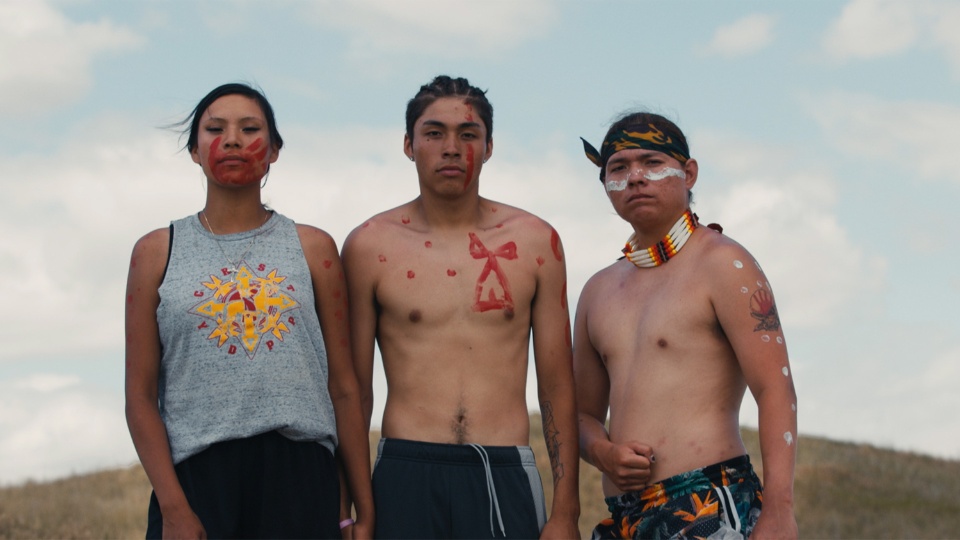
The
National Museum of the American Indian’s Native Cinema Showcase is an
annual celebration of the best in Native film. This year’s theme
highlights films of Indigenous perseverance that inspire, uplift, and
triumph against adversity—stories that prevail against the judicial
system, generational trauma, and cultural appropriation through love and
complex relationships, self-worth, and humor. The showcase provides a
unique forum for engagement with Native filmmakers from Indigenous
communities throughout the Western Hemisphere and Arctic.
All films available on demand:
Aitamaako'tamisskapi Natosi: Before the Sun
L'Inhumain
The Legend of Molly Johnson
Powerlands
Rosie
We Are Still Here
Connections Shorts Program
Future-Focused Shorts Program
Inside Out Shorts Program
Pacifika Shorts Program
This program is funded in part by the San Manuel Band of Mission Indians. Thanks!!
In the United States
government’s long record of broken treaties, land theft, and genocide,
the taking of the Black Hills ranks as perhaps one of the most
disgraceful examples of imperial aggression against an Indigenous
people.
This is not just a historical episode; it is ongoing to this very
day. The magnificently illuminated and stunningly stellar documentary
film Lakota Nation vs. United States tells the story. It was screened at the Belcourt Theater in Nashville from Sept. 1 to 6.
The film was picked up for the Belcourt by Allison Inman, Director of
Education and Engagements at the theater, who saw it at the Milwaukee
Film Festival in April of this year.
Some information on the theater is in order first of all. The
Belcourt is a unique Nashville institution with a historic past and deep
community ties. It is a non-profit cultural facility dedicated to
presenting the most notable of independent, documentary, world,
repertory, and classic cinema. The Belcourt believes in “the power of
film.”
The opening night program for this documentary began with a land
acknowledgment given by Annabelle Littlejohn-Bailey, American Samoan and
President of the Indigenous Scholars Organization of Vanderbilt
University.
Lakota Nation vs. United States kicked off the Doc Spotlight
Series for the fall at the Belcourt. The two-hour documentary
chronicled the perfidious treatment of the Lakota people by the federal
government. Underlying the brazen theft of the sacred Black Hills was
the drive of imperial greed for the resources, primarily gold, beneath
the hallowed earth there, which is regarded with reverence by the Lakota
people.
The documentary, written and directed by celebrated Lakota poet Layli
Long Soldier and co-directed by Jesse Short Bull, is a resounding
herald to the never-ending resistance of the Native people who hold the
Black Hills as a source of resonating identity and existence.
A historical perspective will give the uninitiated viewer a greater
appreciation of this heroic struggle by the Lakota over the decades in
the face-off against the most powerful and predatory enemy ever to trod
the earth, the United States government.
The background to the seizure of the Black Hills is the violation of
the Fort Laramie Treaty of 1868, which promised that the Great Sioux
Reservation, including the Black Hills, would be “set apart for the
absolute and undisturbed use and occupation of the Indians,” meaning, of
course, the Lakota. The treaty ended the conflict known as “Red Cloud’s
War,” in which Indigenous forces defeated the U.S. military.
Following another U.S. defeat in June 1876 at the Battle of the
Little Horn and the subsequent military reversal of the Lakota and their
allies, the U.S. government imposed the Act of February 28, 1877, which
stopped all food rations to the Lakota until they ceded the Black Hills
to the United States.
This infamous legislation, also termed the “Sell or Starve Act,” was a
direct breach of the 1868 Fort Laramie Treaty and became and remains
the main focal point of legal contention over possession of the Black
Hills. This is an ongoing and hideous cardinal treaty violation largely
unparalleled in the odious U.S. history of treaty-breaking.
In June 1979, the U.S. Court of Claims ruled that the 1877 Act that
seized the Black Hills was in violation of the Fifth Amendment
prohibition on taking property without just compensation (which also
implicitly meant that the taking was in violation of the Treaty of
1868). Money was awarded which the Lakota refused to accept because
acceptance would mean termination of the claim that the Black Hills be
returned to the Lakota. The United States appealed the Court of Claims
decision to the U.S. Supreme Court.
In March 1980, the Supreme Court ruled, in United States v. Sioux Nation of Indians,
that just compensation had not been paid for the taking of the land and
ordered that such compensation “be paid.” The Lakota again refused the
money and uncompromisingly demanded the return of the Black Hills to
tribal jurisdiction.
But back to the film. It is filled with historical material,
contemporary footage, and interviews with Indigenous leaders (some of
whom I recalled from being at the Standing Rock protests in 2016). It is
an inspiring reminder that the struggle for Indigenous liberation
continues gloriously, courageously, and brilliantly.
Searching for solutions, Zacharias Kunuk’s latest film takes a grounded, Indigenous approach.
Taqqut Productions
Indigenous people are frequently asked for solutions based on traditional knowledge. From environmental stewardship to psychedelics and mental health,
the thirst for “ancient” answers to contemporary problems can run a
wide gamut. But in legendary Inuit filmmaker Zacharias Kunuk’s latest
animated short, Angakuksajaujuq: The Shaman’s Apprentice, that notion of easy answers is turned on its head.
The film, which was recently shortlisted for the
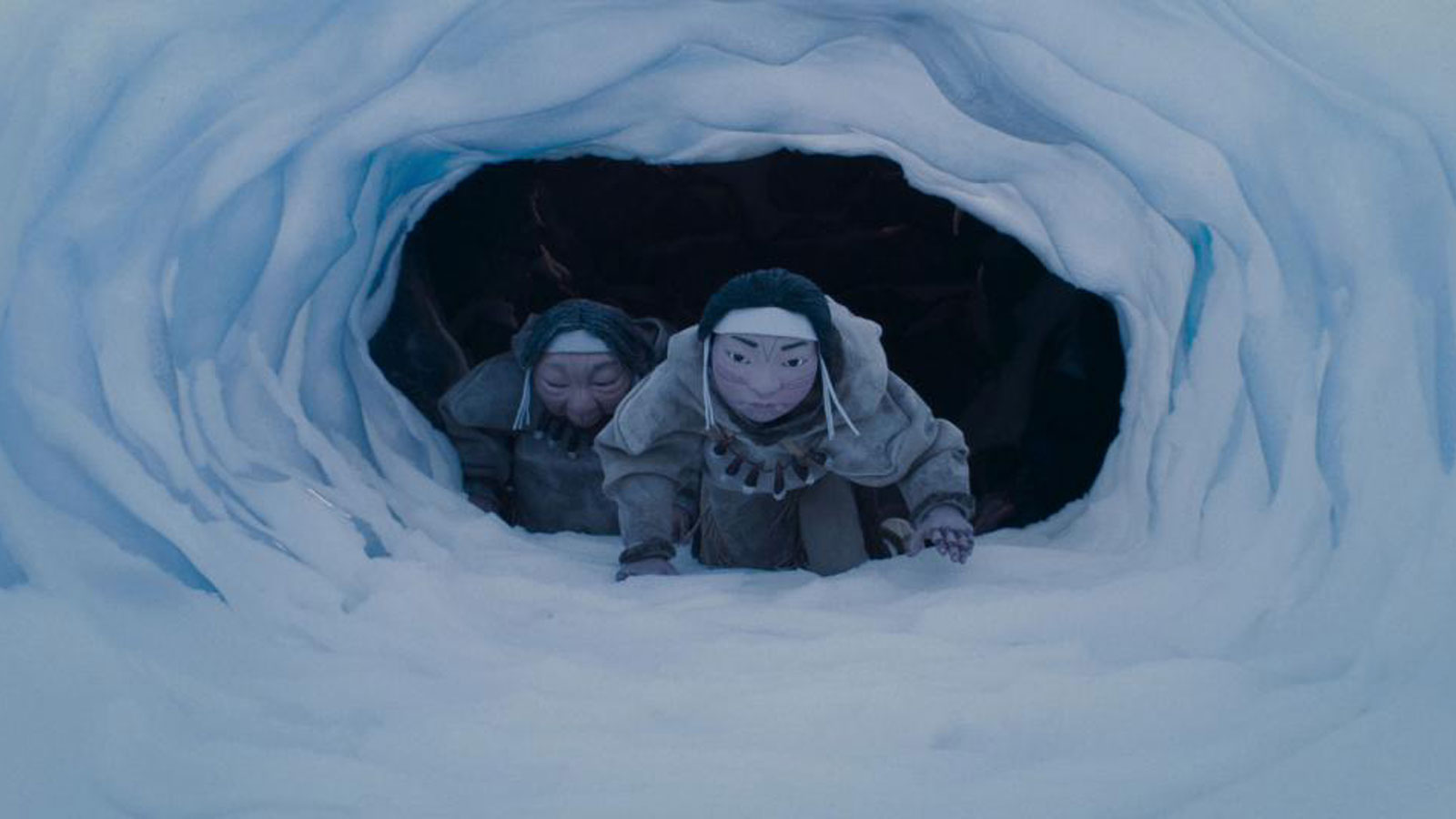
Academy Award for Best Animated Short, follows a shaman and her titular
apprentice after they are summoned to heal a sick community member.
After traveling across the icy landscape, the pair arrive to administer
aid to the patient, a young hunter sick with fever. During their first
attempt to heal the man, the shaman asks him, “Did you do anything to
deserve this?” The unspoken question here is: Is this man living a
proper Inuit life or has he strayed too far away? In this sense, the
shaman and her apprentice act not only as healers but as keepers of
tradition. This will become clearer later in the film as the pair embark
on a trip to the Underground to visit The One Below for answers. They
seek not only to understand the hunter’s dilemma, but also to determine
the next steps in how to fix it.
The Shaman’s Apprentice is not a
“climate” movie per se, but its icy setting and theme – the search for a
solution – will feel highly relevant to climate-concerned viewers. In
this sense, it is likely to draw comparisons to recent disaster films
like Don’t Look Up, which offers funny, easy, and some might say mean-spirited answers to our current climate dilemma. But an Indigenous film like The Shaman’s Apprentice
relies more on interpretation, experience, observation and
introspection than flashy hijinks. The director does not hate on his
subjects; there will be no destroying of a whole arctic village for
laughs. It is clear that Kunuk feels a deep connection to this
community. He does not have the luxury to blithely kill off his subjects
as a cautionary tale.
Many non-Indigenous viewers will not have heard of
Kunuk (which is, again, why Indigenous films like these are important
contributions to our current cinematic landscape) but the 63-year-old
Inuk filmmaker has been making movies for over 20 years. Standouts
include Atanarjuat:The Fast Runner in 2001, and The Journals of Knud Rasmussen in 2006, both of which depict slices of traditional Inuit life and
culture. What makes Kunuk’s films stand out in particular is their
authenticity. They are raw and real. You feel cold when you see his
characters in their arctic conditions. You feel the isolation, the hard
work it must be to live in Inuit country, especially for those of us who
are nowhere near such a region. They deal with very basic things like
love, death, jealousy, trust, and life in a region and community far
away from a local grocery store or hospital.
Kunuk is not known for animated films, but one could say after viewing The Shaman’s Apprentice
that maybe he ought to delve into the genre again. The animation is
mesmerizing. Lines in the elder Shaman’s face are oh-so-subtle: the
droop in her mouth, the way her eyes narrow with concern when faced with
a dilemma. The animators somehow make the Shaman older and wiser in
ways that differentiate her from her younger apprentice. They have
traditional Inuit tattoos. Light and shadow dance off their faces to
illustrate dramatic mood and tone, just as they would on actual human
beings. I’d argue that half the fun of watching a stop motion film such
as this is shouting to yourself or whomever you’re watching the film
with, “How did they do that?”
But for all its artful craft, one might say Kunuk
is more invested in this story, and in that way, humanity at large. He’s
fascinated in the way knowledge is passed on and the ways people must
rely on each other; In the way that humanity can course correct itself
when needed.
Taqqut Productions
In Kunuk’s world, life is beautiful and
complicated. The film draws from a traditional Inuit story, one in which
the protagonists must trust each other and draw upon a faith deep
within. At the beginning of the journey to the Underground, the Shaman
tells her apprentice, “If you lack confidence you may not return, do you
understand?” The apprentice simply looks back with a look on her face
that says, fake it til you make it.
Subtle moments like these remind us that representation is more than an oft-repeated refrain in 2022. Indigenous-made TV like Reservation Dogs and Rutherford Falls
have reinforced just how much better Indigenous films are when they are
made with authenticity. No longer do we have to wonder, “Is this really
an Indigenous point of view?” because the new work being created is
Indigenous made. When we see stories like The Shaman’s Apprentice, that references an Inuit deity from the Underground called Kannaaluk, we can trust that Kunuk is telling us a story from his vantage point, from his community.
And not to beat up on blockbusters like Don’t Look Up, which admittedly made me laugh more than a few times, films like The Shaman’s Apprentice
are likely to stay with you longer. It isn’t just because it’s an
Indigenous film made by an Indigenous director which touches on
Indigenous themes like respect for elders and teachings as well as the
unique ways we pass down knowledge. It has more to do with how films
like Don’t Look Up aim for low hanging fruit that comes from a
detached place of privilege. In contrast, stories like Kunuk’s are
timeless; a more substantial meal as opposed to something fun, quick and
easy to consume mindlessly. GRIST
I run across comments by adoptive parents and PAPS (potential adoptive parents) all the time on why is it wrong for non-Natives to adopt Native kids? Volumes have been written about this, on this blog, and in medical studies and published reports but we STILL have people who don't understand.
I'm watching this documentary right now on demand. Its about these two
Native American boys (now adults) who were adopted from foster (care) in Canada
to an American (CC) family in Redding, PA. They were adopted as young
boys so they remembered being with the bmom and now one of the boys is
making a film about being between both families.
I thing that bothers me is the younger
brother has basically at 18 yrs old left his adoptive family and went
back to Canada to bio family and he hasn't talked to his AP's in 8
years. His issues are growing up without his NA identity and racism he
dealt with being NA in a all CC environment. Actually both boys are
living in Canada now. The older brother still has a relationship with
his AP's.
As an AP I would take it as a slap in the
face if my kid just left and wouldn't talking to me for 8 yrs. Its like
these boys bio mom was an alcoholic who had her kids taken away because
she was neglecting them. She said herself she would be drunk for 6 weeks
straight and have no idea what day or month it is. Also leaving these
babies at home by themselves while she's out partying and they have to
change each diapers etc... So you have this family come in and give you a
stable home and love and yet because they are CC you just leave?? Im
wondering if this something that happens more often with older kids
adoption from foster care? Like I said earlier it really annoys me but a great watch anyways. LINK
A Place Between – The Story of an Adoption is a 2007 documentary film dealing with cross-cultural adoption and aboriginal life in Canada. It was directed by First Nations adoptee Curtis Kaltenbaugh and produced by the National Film Board of Canada.
Curtis and Ashok Kaltenbaugh were born in Manitoba and are of First Nations ancestry. After the 1980 death of their younger brother, at ages of 7 and 4 respectively, they were removed from the custody of their birth mother and placed for adoption with a middle-class white family living in Pennsylvania.
The film chronicles their search for identity and the meeting of their adoptive and birth families.
The film won Best Public Service Award at the Annual American Indian Film Festival, held in San Francisco during November 2007.[wiki]