BLOGGER changed, not allowing us to UPDATE this back-up blog

(UPDATED 726/2025) issues with blogger are preventing this
Showing posts with label victims of genocide. Show all posts

Monday, December 16, 2019

When was American great? Battle of Bad Axe Massacre


When America Was Great, Savage White Un-Settlers Raped a Continent and Assaulted a Planet


(excerpts)
The continent’s First Nations people were highly civilized, unscathed by class rule, and harmoniously connected to the natural environment in ways that hold critical significance for human and other living things in our current age of capitalist ecocide...

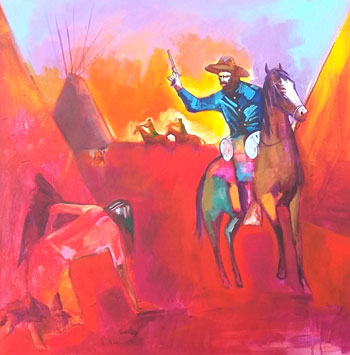
Predator’s massacre chain ran from Connecticut Captain John Mason’s burning and shooting of hundreds of Pequot villagers near Mystic River in May of 1637 through terrible events like the so-called Battle (massacre) of Bad Axe (1832) and the Sand Creek Massacre (1864) to the Wounded Knee bloodbath (the so-called Battle of Wounded Knee) in December of 1891, when the U.S. Calvary killed 150-300 Lakota men, women, and children on the Pine Ridge Reservation in South Dakota.  The United States’ beloved first president, George Washington, was known to the Iroquois as “Town Destroyer.”


Endnote
1) The 1832 “Black Hawk War” was a one-sided affair, typical of the many pitiless mass exterminations committed by supposedly noble “settlers” seeking to “tame the continent.” As penalty for the warrior Black Hawk and his followers’ determination to reclaim rich tribal lands brazenly occupied by whites in northern Illinois, the Sauk and Fox Indians lost 600 people, including hundreds of woman and children. Just 70 soldiers and “settlers” lost their lives. The conflict culminated in the so-called Battle of Bad Axe, on the eastern shore of the Mississippi River, near the present-day community of Victory in southwest Wisconsin.
Better described as a massacre than a “battle,” this American military triumph involved U.S. General Henry Atkinson killing every Indian who tried to run for cover or to flee across the Mississippi River. On August 1, 1832, Black Hawk’s band reached the Mississippi at its confluence with the Bad Axe River. What followed was an atrocity, committed despite the Indians’ repeated attempts at surrender. “While the Sauk refugees were preparing rafts and canoes, the armed [U.S.] steamboat Warrior arrived,” historian Kerry Trask recounts, “whereupon Black Hawk tried to negotiate with its troops under a flag of truce. The Americans opened fire, killing twenty-three warriors.”
“As we neared them,” one US officer who “served” in the U.S. assault recalled, “they raised a white flag and endeavored to decoy us, but we were a little too old for them.”
Hundreds of Sauk and Fox men, women and children were shot, clubbed, and bayoneted to death on August 2nd. “US soldiers scalped most of the dead. They cut long strips of flesh from dead and wounded Indians for use as razor strops.” The slaughter was supported by cannon and rifle fire from the aptly named Warrior, which picked off tribal members swimming for their lives.
By Major Wakefield’s account, the US troops at Bad Axe “shrank not from their duty. They all joined in the work of death for death it was. We were by this time fast getting rid of those demons in human shape… the Ruler of the Universe, He who takes vengeance on the guilty, did not design those guilty wretches to escape His vengeance…”
The top “demon in human shape” – the old Sauk warrior Black Hawk – lived six years beyond the “war” that bore his name.  He was sent to a US reservation in Iowa after US President Andrew Jackson – a Trump favorite and himself a prolific Indian-killer – had Black Hawk paraded as celebrity war booty – as an exotic “savage” and proof of the United States’ military’s alleged great prowess in defeating such barbarian brutes – before gawking crowds in eastern US cities.

At Chicago’s United Center at least 41 times each National Hockey League season, more than 10,000 U.S. whites wear jerseys emblazoned with a caricature-like profile image of “chief” Black Hawk, whose people were obliterated and dispersed so that northern Illinois’s fertile fields and pastures could be turned into the private property of white  farmers, merchants, and industrialists.  Oh, but for the return of the days when America was great!

 
By | November 12th, 2018| Articles

Tuesday, December 10, 2019

Gold Chains: Slavery of California Natives, Child Trafficking

“Gold Chains” unearths the accounts of slavery in California
Faith Petrie, November 28, 2019, Los Angeles Sentinel


The ACLU of Northern California in collaboration with radio station KQED, the California Historical Society and the Equal Justice Society co-created an educational project directed at highlighting the stories of slavery throughout California.

Gold Chains: The Hidden History of Slavery in California includes 13 essays and six audio stories that present the experiences of African Americans and Native Californians during the 1800s.

Candice Francis, communications director of the ACLU of Northern California said that the project originally spawned from wanting to observe the 400th year since enslaved people were brought to the United States from Africa.

“We were guided to rather than take on that mammoth task, to look more closely at California because there was a hidden history there,” Francis said.

One story highlighted on the website surrounds California’s first governor, a white supremicists named Peter Hardeman Burnett. Burnett advocated for the genocide of Native Americans as well as the exclusion of African Americans and other minority groups in California.

continue

Visit Gold Chains Website


Rosa: Kidnapped, Sold, and Killed

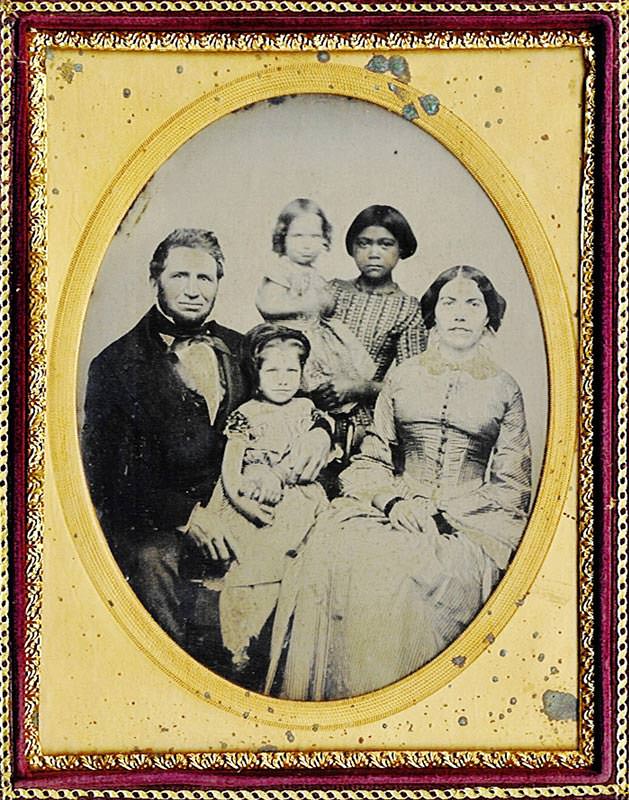
Native children often suffered horrific abuse as a result of a law that professed to send them to white families for self-improvement but instead created a form of legalized child slavery. The case of Rosa, in Mendocino County, is just one example of how the Act for the Government and Protection of Indians brutalized Native, and sometimes black children.
Rosa was between 10 and 12 years old and was believed to be from either the Yuki or Pomo tribe. In the winter of 1862, she was beaten and left to die in a snowstorm by a woman who had been granted legal custody of her under the law. The woman, identified in Mendocino County public records as “Mrs. Bassett,” had locked the child outside in freezing temperatures. Her partially clothed corpse was found in a box outside the woman’s home. Mendocino County authorities never brought charges, even though Bassett’s neighbors testified that she had left Rosa outdoors, causing the child’s death. Before her death, Rosa had been forced to work in the Bassett home as an indentured servant. According to an 1862 report in the Alta California newspaper, kidnappers could sell children for “$30 to $150 depending on their quality.” That same year, a child trafficker came to Ukiah with 16 children, ages six to 13. After he was arrested, the children became public wards. But instead of returning them to their families, county officials offered them to local white residents as “apprentices.” Bassett was among the more than 100 people who applied to become guardians of the children.
Letter from Major John Bidwill of Butte County on how widespread slavery of native people was: “[native people] all amoung us, around us, with us – hardly a farm house – a kitchen without them.”
Report from Indian Affairs Superintendent:
Superintendent of Indian Affairs, George M. Hanson, an ally of Lincoln and opponent of slavery, once found several white men making their way back from Humboldt County with native children in tow. The men said that the children were orphans, and they were providing them with homes and safety. When asked how they knew the children were orphans. The kidnappers replied that they had killed the parents themselves. 

click

Contact Trace

Name

Email *

Message *

NO MORE UPDATES

GO TO:  https://blog.americanindianadoptees.com/  for updates and news. THIS BLOG cannot be updated...