September 8, 2022 | By Albert Bender People's World peoplesworld.org
“States have no criminal jurisdiction in Indian Country over crimes
by Indians against anyone or crimes by non-Indians against Indians.
Crimes by Indians are punishable either by the tribe or the federal
government, and crimes by non-Indians against Indians are punishable
exclusively by the federal government.” Williams v. United States
(1946)
The above passage is from the much-esteemed book,
American Indian Law,
by William C. Canby Jr., Senior Judge of the U.S. Court of Appeals for
the Ninth Circuit. Canby was a former Director of the Office of Indian
Law of the Arizona State College of Law and a foremost authority on
Federal Indian law. The ruling cited by Judge Canby is quite clear— and
on point—in reference to states and criminal jurisdiction regarding
crimes committed by non-Indians against Indians in Indian Country.
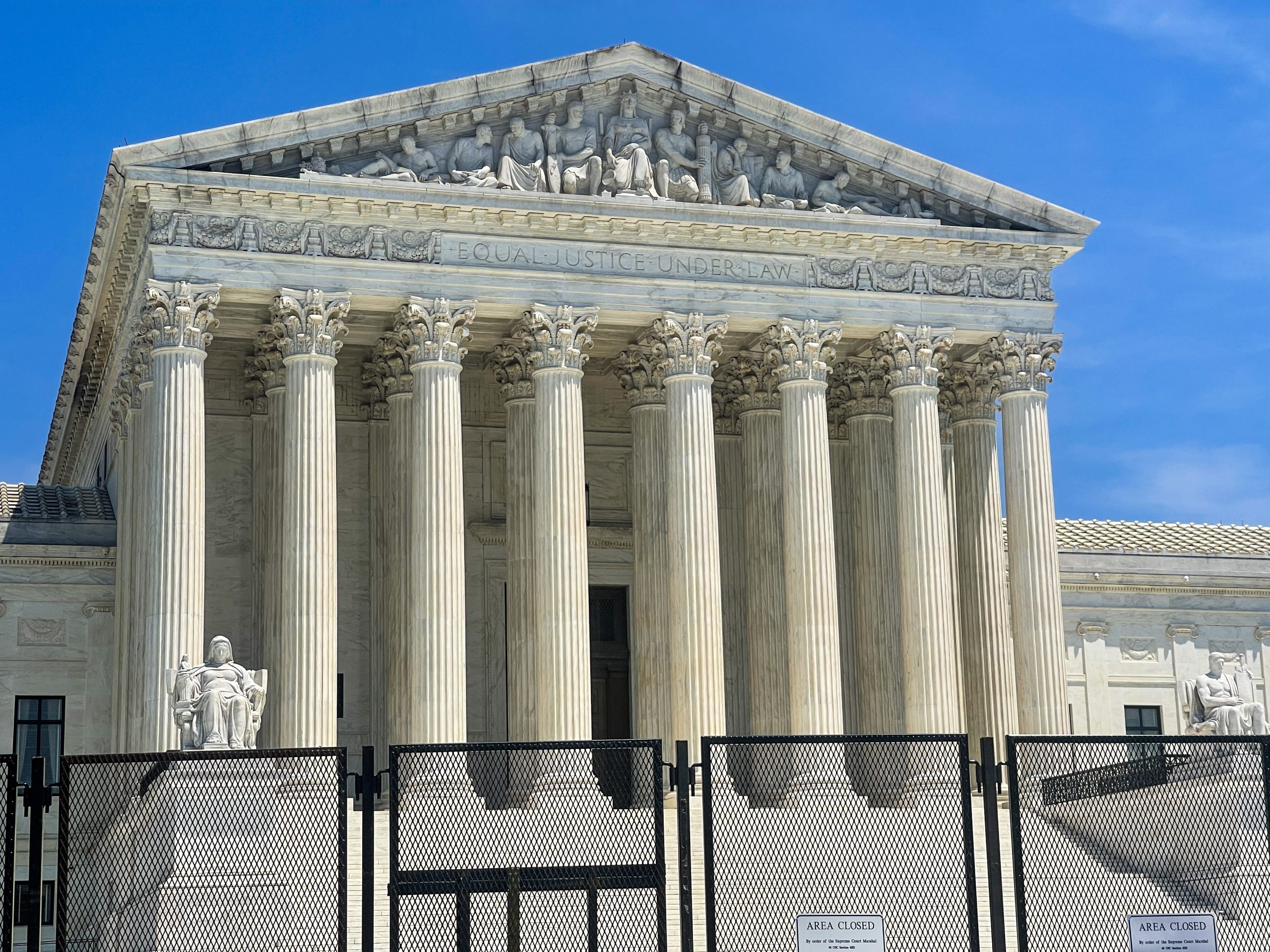
On June 29 of this year, the Supreme Court issued a decision striking an
unprecedented body blow against the Tribal sovereignty of Indigenous
nations. The retrograde Court ruled in the case of
Oklahoma v. Castro-Huerta, that states have concurrent jurisdiction with the federal government in crimes of non-Indians against Indians on Tribal lands.
The Court stated in its inflammatory
decision that Indian Country is part of state territory. This is
incredibly shocking and betrays an apparent complete ignorance of
Federal Indian law.
As an attorney whose specialty is federal Indian law, and having
practiced on a number of reservations, I shall review the recent Supreme
Court decision from the standpoint of its most basic egregious errors,
while also scrutinizing the ruling from the perspective of the scathing
dissent issued by Supreme Court Justice—and Indian law authority—Neil
Gorsuch.
The general foundational rule is that state jurisdiction is limited to
those crimes that do not concern Indians or Indian interests. Hence,
state jurisdiction is limited to crimes committed by non-Indians against
non-Indians in Indian Country. Otherwise, the state has no authority on
Tribal lands absent Congressional authorization. This is clear and
unambiguous.
But it must also be kept in mind that Federal Indian law is filled with
ambiguities, uncertainties, inconsistencies, and nuances, more so than
any other body of law in the entire United States. However, this
discourse addresses the more salient errors and lack of knowledge,
history, and law embodied in the Court’s latest excursion into
Indigenous jurisprudence.

As Long as the Waters Flow by Allan C. Houser (Apache) stands outside the Oklahoma State Capitol Building in Oklahoma City. Photo: Ann W
Supreme Court decision foreshadows Tribal-State conflict
The decision written by Justice Kavanaugh, who has no Indian law
background, is an engagement into the most labyrinthine twists and turns
of Byzantine sophistry in a sordid, awkward attempt to pull the
proverbial “rabbit out of the hat.” It is a clear violation of long
established Federal Indian law.
The granting of states the right to intrude on Native lands in this
respect has no basis in case law, or in the enshrined tenets of statutes
and case law, beginning with the Indian Trade and Intercourse Act of
1790, to the much heralded decision of
Worcester v. Georgia
issued by the John Marshall Court in 1832. This set the standard of a
nation-to-nation relationship between the Tribal nations and the United
States. The Marshall Court stated that the “treaties and laws of the
United States contemplate the Indian territory as completely separated
from that of the states.”
The ruling rendered in
Oklahoma v. Castro-Huerta purports to
give the states a foothold in Indian Country. The legal reasoning
asserted in this decision is stunningly faulty; indeed, one has to
strain to try to make sense of it, and still to no avail.
I shall begin with an issue that is a supporting core of Kavanaugh’s
ruling that is curiously not directly addressed by Justice Gorsuch.
Justice Kavanaugh asserts as one of the foundations of his errant
opinion, that Indian Country is part of and not separate from state
territory. That would be equivalent to saying that New York is part of
Pennsylvania, or Ohio is part of Indiana. Both are, of course, separate
political entities. A state is defined as a territory with its own
government and borders within a larger country.
Justice Kavanaugh’s assertion that a
reservation is part of state territory lowers Tribal land to a
subordinate status and takes away the nation-to-nation status vis-à-vis
the federal government proclaimed in Worcester. Federal Indian
law has held for over 200 years that reservations are separate from the
states. This is founded on treaties, statutes, and case law that the
Tribes are sovereign nations with only Congressional limitations.
In reference to the
Worcester decision, that states have no
jurisdiction in Indian Country, Kavanaugh’s retort is that at the time
of the ruling territorial separation was the reason that state authority
did not extend to Tribal lands. He advances that in the early 1800s
Indian Country was separate from the states, therefore state law did not
apply. Kavanaugh has no idea of what he is talking about, as he has no
knowledge or grasp of history.
Georgia was already a state in the
Worcester case of 1832 and
had been for decades. There was no territorial separation between it
and the Cherokee Nation. The Cherokee Nation was geographically within
the boundaries of the states of Georgia, Tennessee, North Carolina, and
Alabama. Since there was no territory separating those states from the
Cherokee Nation, such an argument is absurd. There was a national
boundary between those states and the Cherokee Nation based upon
treaties with the federal government of the United States.
Keep in mind that Kavanaugh, throughout his bumbling opinion, never
explains what he means by “territorial separation.” We are left to draw
our own reasonable, logical conclusion.
Moreover, the case of
Organized Village of Kake v. Egan
(1962)—which Kavanaugh professes as supporting his argument that
reservations are part of states—is inapplicable because the language in
regard to state authority is dicta and, therefore, non-binding.
Further, it is irrelevant because the land involved in that case was
neither a reservation nor under a treaty.
Kavanaugh further states that the
Worcester ruling of Indian
Country as separate from the state was abandoned in the 1800s. He says
“that after that change, Indian Country in each state became part of the
state’s territory.” What change is he referring to? Again, Kavanaugh
provides no answer and makes no sense.
He continues to prattle on, throughout his opinion, that a reservation is part of a state while citing
Kake, which again is pure dicta no matter how many times it is repeated, and cannot rise to the level of binding precedent.
In reference to legitimate state authority, a state has general criminal
jurisdiction over all persons including Indians, outside Indian
Country. Inside Indian Country, the state’s jurisdiction is generally
limited to those crimes that do not affect Indians or Indian interests.
That has been the long-standing rule. However, it can be clearly seen
that non-Indian crimes against Indians affect and concern Indians and
Indian interests. Hence, the long-standing prohibition against state
involvement, in accordance with Federal Indian law, has to be
maintained. It is also good to keep in mind another general rule: The
state has exclusive jurisdiction over crimes committed by non-Indians
against non-Indians in Indian Country, as these are the only crimes that
normally do not concern Indians or Indian interests. This is as simple
as it should get and as simple as it should stay.
Gorsuch points out in his dissent that the
Castro-Huerta
decision is Oklahoma’s effort to exercise jurisdiction over crimes
involving Tribal members on Tribal lands in violation of the decision of
its own Court of Criminal Appeals. The Justice asserts that this has
been an attempt to portray reservations as “lawless dystopias.” He also
expounds that “the decision is unattached to any colorable legal
authority.”
His dissent maintains that the Court has committed “astonishing errors”’
that are violations of clear principles of precedent, and argues that
only Congress can make a change of the type and magnitude conferred on
Oklahoma by the errant ruling. The majority opinion, propounds Gorsuch,
is a ”string of carefully curated snippets—a clause here, a sentence
there—from six decisions from a galaxy of the Court’s Indian law cases.”
Gorsuch is unrelenting in his scorching criticism of this outlier
ruling. The Court’s reasoning is “mistaken root and branch” he
continued.
The Justice also delves into Oklahoma
Indian history. He cites the famous groundbreaking volume by famed
Oklahoma historian, Angie Debo, entitled And Still the Waters Run: The Betrayal of the Five Civilized Tribes,
to illustrate that state officials and state courts defrauded the
exiled Tribes of land and resources guaranteed by federal treaties.
Gorsuch also cites the “deadliest of enemies” description from United States v. Kagama (1886) to further indicate traditional state enmity toward Tribal nations.
The dissent notes that “in the decades following statehood, many
settlers engaged in schemes to seize Indian lands and mineral rights by
subterfuge.” Gorsuch explains that these schemes resulted in the bulk of
the landed wealth of the Indians ending up in the hands of the new
settlers, and that state officials and courts “were sometimes complicit
in the process.” I would add that this happened more than “sometimes”
considering that the vast amount of Oklahoma Indian land was taken in
stolen allotments.
For Kavanaugh to continue claiming that Indian Country is part of the
state is inflammatory and provocative language that will foster further
conflict and confrontation in Tribal-State relations. Some tribal
communities are already pondering whether the decision means that state
police will enter reservations patrolling and policing for non-Indian
law violators. Will the ruling foster state jurisdictional intrusions
into Indian land and interests?
Will the Court’s decision “that Indian Country is part of a state and
not separate from it” be tested by an overzealous state to further this
intrusion into Indigenous sovereignty?
Supreme Court decision is part of a conservative political agenda
The Supreme Court ruling has less to do with law, than with the
conservative majority’s pursuit of an energized right-wing political
agenda. Its anti-Indian sovereignty ruling will join a conservative
cavalcade of other regressive decisions seen previously with abortion
rights, the Environment Protection Agency’s (EPA) authority to control
carbon emissions, the separation between church and state, and
restricting Miranda rights.
The potential ramifications are huge and far-reaching. It shall remain,
for the time being, a decision issued in infamy and best described by
Gorsuch as “an embarrassing new entry into the anticanon of Indian law.”
Tribal nations must be prepared to combat this judicial onslaught—and
any more to come—from this Court’s conservative anti-Native agenda.
As with all op-eds published by People’s World, this article reflects the opinions of its author.
U.S. Supreme Court Decision in Oklahoma v. Castro-Huerta
Syllabus |
Opinion [Kavanaugh] |
Dissent [Gorsuch] |
Complete Document
U.S. Supreme Court Documents in Oklahoma v. Castro-Huerta
Questions Presented |
Docket Sheet: No. 21-429 |
Oral Argument Transcript |
Day Call
Albert Bender is a Cherokee activist, historian, political
columnist, and freelance reporter for Native and Non-Native
publications. He is currently writing a legal treatise on Native
American sovereignty and working on a book on the war crimes committed
by the U.S. against the Maya people in the Guatemalan civil war He is a
consulting attorney on Indigenous sovereignty, land restoration, and
Indian Child Welfare Act (ICWA) issues and a former staff attorney with
Legal Services of Eastern Oklahoma (LSEO) in Muskogee, Oklahoma.
This article originally appeared on
People's
World. It is published under a
Creative
Commons license.