BLOGGER changed, not allowing us to UPDATE this back-up blog

(UPDATED 726/2025) issues with blogger are preventing this
Showing posts with label Matthew L.M.Fletcher. Show all posts

Monday, November 13, 2023

Louis LaRose Walks On

Matthew L.M. Fletcher |Nov 13| Turtle Talk Blog

Louis LaRose, former chair of the Winnebago Tribe of Nebraska, has walked on. News profile here.

As chairman, Mr. LaRose testified on behalf of the bill that would become the Indian Child Welfare Act. Justice Brennan’s majority opinion in Mississippi Band of Choctaw Indians v. Holyfield quoted extensively from Louis’s testimony. Footnote 25 reads:

In large part, the concerns that emerged during the congressional hearings on the ICWA were based on studies showing recurring developmental problems encountered during adolescence by Indian children raised in a white environment. See n. 1, supra.See also 1977 Hearings at 114 (statement of American Academy of Child Psychiatry); S.Rep. No. 95-597, p. 43 (1977) (hereinafter Senate Report). More generally, placements in non-Indian homes were seen as "depriving the child of his or her tribal and cultural heritage." Id. at 45; see also 124 Cong.Rec. 38102-38103 (1978) (remarks of Rep. Lagomarsino). The Senate Report on the ICWA incorporates the testimony in this sense of Louis La Rose, chairman of the Winnebago Tribe, before the American Indian Policy Review Commission:"I think the cruelest trick that the white man has ever done to Indian children is to take them into adoption courts, erase all of their records and send them off to some nebulous family that has a value system that is A-1 in the State of Nebraska and that child reaches 16 or 17, he is a little brown child residing in a white community, and he goes back to the reservation and he has absolutely no idea who his relatives are, and they effectively make him a non-person, and I think . . . they destroy him."Senate Report at 43. Thus, the conclusion seems justified that, as one state court has put it, "[t]he Act is based on the fundamental assumption that it is in the Indian child's best interest that its relationship to the tribe be protected." In re Appeal in Pima County Juvenile Action No. S-903, 130 Ariz., at 204, 635 P.2d at 189.

Thanks to Lucas LaRose.

Tuesday, July 18, 2023

Ned Blackhawk on How Native People shaped U.S. History (podcast)

 Ned Blackhawk on How Native People shaped U.S. History 

 July 5, 2023, CT WNPR 
 

This podcast, we are exploring the central role that Native peoples have played in the development of the United States, while facing legal discrimination that goes all the way back to the country's founding documents.  Professor of Law Matthew L.M. Fletcher gives us the context around the Supreme Court's recent ruling on the Indian Child Welfare Act.  And Ned Blackhawk discusses his new book, The Rediscovery of America: Native Peoples and the Unmaking of U.S. History, which tells the history of the United States, emphasizing how Native Americans have been essential to determining that history.

CLICK HERE

Thursday, November 10, 2022

ICT: Indigenous people flock to DC for ICWA hearing

 ‘If you take our children, you take our identity’


Approximately 60 stood in line waiting to sit inside the court to witness the oral arguments. Many sat between the Capitol and court listening to three hours of oral arguments on their headphones, and others listened to the line of speakers and songs all morning and into midday.

Haaland v. Brackeen challenges the Indian Child Welfare Act, a law that has been referred to as the “gold standard” for child welfare by many child welfare organizations. It was enacted in 1978 to “halt the unnecessary forced removal of Native kids from their families,” said Sarah Kastelic, an enrolled citizen of the Native Village of Ouzinkie and executive director of the National Indian Child Welfare Association.

ICWA - Sarah Kastelic, executive director of the National Indian Child Welfare Association and an enrolled citizen of the Native Village of Ouzinkie, stands outside the U.S. Supreme Court with a sign in her language in Washington, D.C., on November 9, 2022. (Photo by Jourdan Bennett-Begaye, ICT)

“So in our organization, one of the things that we talk about is the recipe for colonization,” Kastelic said. This recipe is “consistently followed by colonizers to colonize Indigenous people.”

She said there are five ingredients:

  1. “Take the land;”
  2. “Control the natural resources, especially the water;”
  3. “Usurp, replace Indigenous governance to delegitimize Indigenous thought;”
  4. “Undermine Native worldview, values, traditions, beliefs;” and

And number five, “the most important ingredient,” she says, is to “sever Native children from their sense of identity, from their culture, from their sense of belonging, from that sense of connectedness to something.”

This would meet the United Nations definition of genocide.

KEEP READING 

** BEST QUOTE


NATIVE AMERICA CALLING:

The fate of ICWA

Each side presented their oral arguments Wednesday to the U.S. Supreme Court for the most serious challenge to the Indian Child Welfare Act in recent memory. The decision in Haaland v. Brackeen will be a major force in the future of ICWA and the scope of tribal sovereignty. Today on Native America Calling, Shawn Spruce analyzes the legal debate from a Native perspective with Matthew Fletcher (Grand Traverse Band of Ottawa and Chippewa Indians), law professor at the University of Michigan Law School and author of the Turtle Talk blog; independent journalist Suzette Brewer (citizen of the Cherokee Nation); and Dr. Sarah Kastelic (Alutiiq), director of the National Indian Child Welfare Association.


Full Brackeen Indian Child Welfare Act oral arguments  (Indigenous Wire)

Oral arguments in Haaland v. Brackeen, a U.S. Supreme Court case that will decide whether the Indian Child Welfare Act (ICWA) of 1978 is constitutional and/or will be altered in any way, were heard yesterday. Books will likely be written about this law and the case — and their impact on tribal sovereignty — and we’ll be featuring much more about the issues at stake in days to come.

For those so inclined, take a listen to the 3-hour oral arguments, which are online here. Transcript here.

Of note: Not a single lawyer arguing the case in court yesterday were Indigenous, although Natives with Jenner & Block and the Native American Rights Fund did help prep for the case. A Native has never served on the U.S. Supreme Court, and the high court usually decides several cases each term that impact tribes and Indigenous citizens.


Tuesday, October 4, 2022

Digging up Human Remains in Michigan


The End of a Michigan Law Allowing Scientists to Dig Up “Aboriginal Inhabitants”

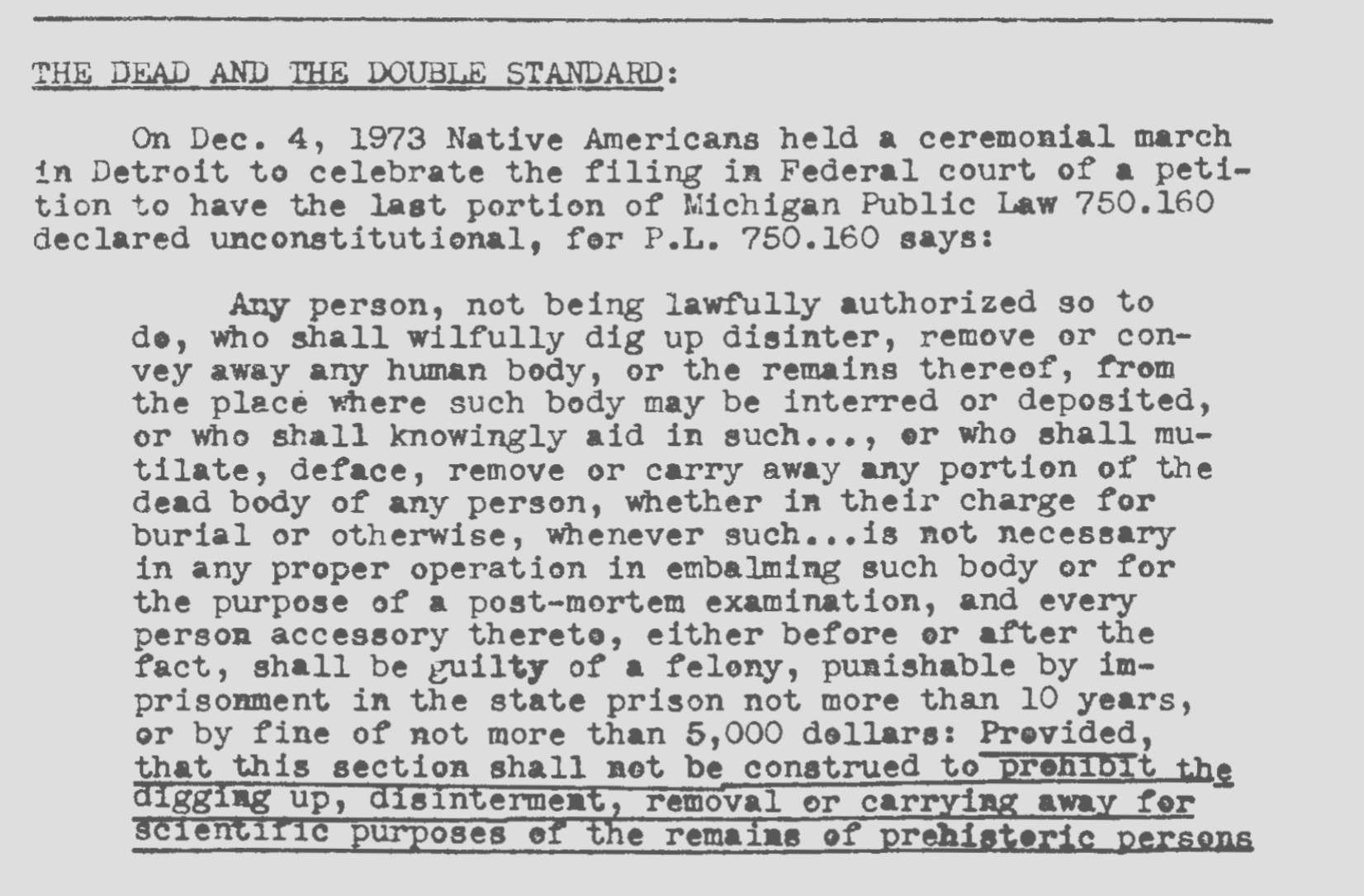
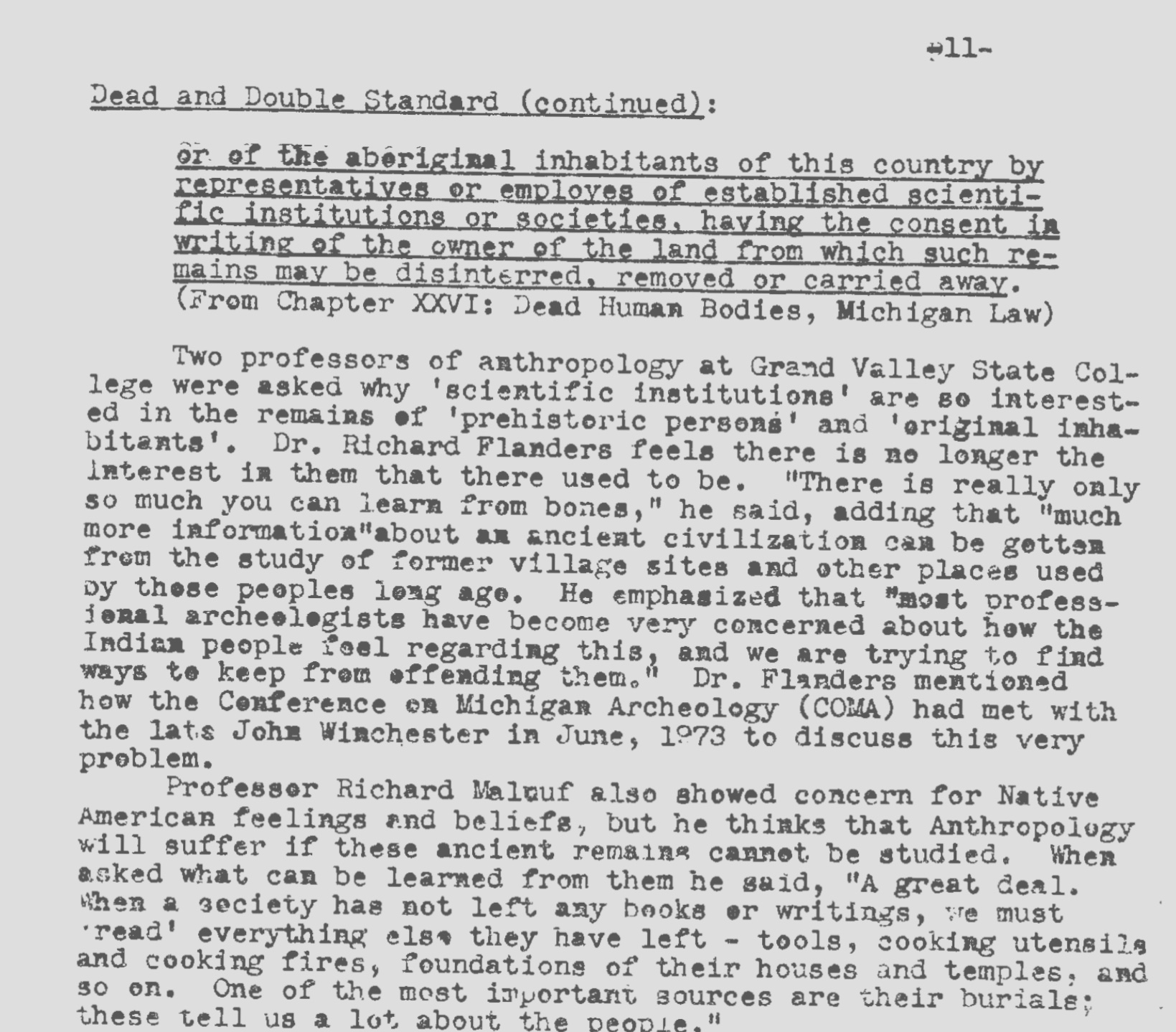
Came across this short note in Indian Talk, a 1973 newsletter by and about Michigan Indians and a precursor to the original Turtle Talk, referencing a federal lawsuit filed to have Michigan public law 750.160 declared unconstitutional. That law prohibited Dr. Frankenstein and others from digging up graves, but granted an exception to Indiana Jones in case he found some Indian bones:

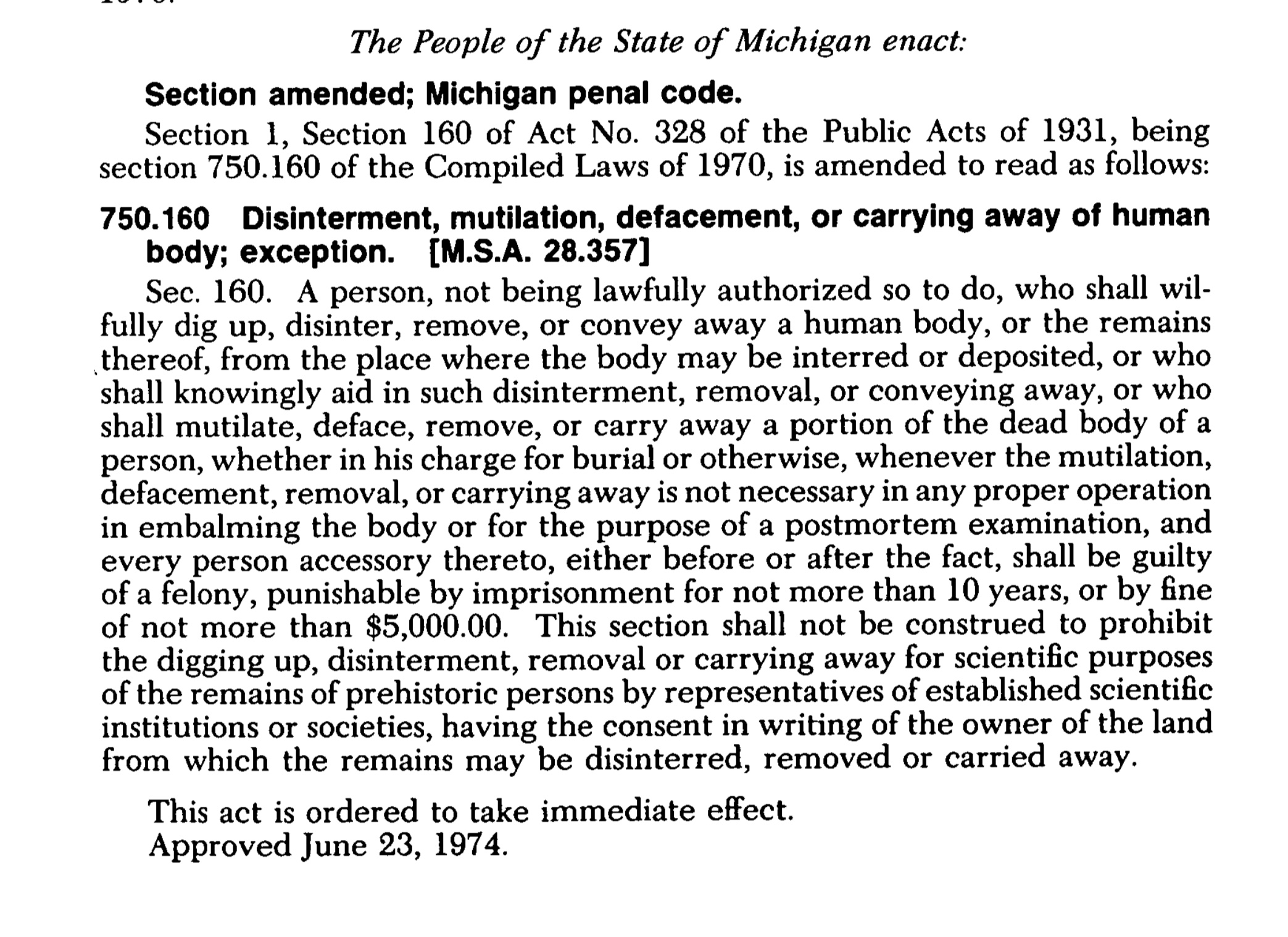
Shay Elbaum at the Michigan law library found a 1974 law repealing the part about “aboriginal inhabitants.”

Can’t find a record of the lawsuit, however. It probably went away when the state legislature repealed the exception.

Wednesday, February 16, 2022

Indian Children and Their Guardians ad Litem (GALs)


BABY Veronica :  Adoptive Couple v. Baby Girl

From the Turtle Talk blog:


North Carolina Supreme Court on Reason to Know [ICWA]

by Kate Fort

 (click headline)


Fletcher & Fort: “Indian Children and Their Guardians ad Litem”

Kate Fort and I published a short paper for a Boston University Law Review mini-symposium on Adoptive Couple v. Baby Girl: “Indian Children and Their Guardians ad Litem.”

An excerpt:

One of the primary goals of the Indian Child Welfare Act (ICWA) is to limit the influence or bias of state workers in decisions placing American Indian children out of their home and community.1 While this focus usually concerns state social workers, the officials who most often seek removal of a child, or the courts, the body that issues the orders and opinions, guardians ad litem (GALs) receive less attention.2 Despite this lack of attention, GALs exert a similar level of influence as state social workers. In Adoptive Couple v. Baby Girl,3 the role of the GAL was unusual but critical – the GAL, while officially appointed by the court, was handpicked by the adoptive parents.4 The role of the GAL remains understudied in the ICWA literature, though GALs continue to exert enormous influence in the courts. Unfortunately, many GALs throughout the nation subvert the national policy embodied by the ICWA by advocating against the implementation of the statute in case after case.5

There are three other papers in the symposium:

Perspective I by Professor Barbara Ann Atwood is available here, 

Perspective II by Professor James G. Dwyer is available here, and

Perspective III by Professors Naomi Cahn and June Carbone is available here.

Monday, October 25, 2021

Lawyering ICWA | White Mother to a Dark Race

Fletcher and Singel have posted "Lawyering the Indian Child Welfare Act," forthcoming in the Michigan Law Review's upcoming symposium on civil rights lawyering. Here is the abstract:

This Essay describes how the statutory structure of child welfare laws enables lawyers and courts to exploit deep-seated stereotypes about American Indian people rooted in systemic racism to undermine the enforcement of the rights of Indian families and tribes. Even where Indian custodians and tribes are able to protect their rights in court, their adversaries use those same advantages on appeal to attack the Constitutional validity of the law. The primary goal of this Essay is to help expose those structural issues and the ethically troublesome practices of adoption attorneys as the most important ICWA case in history, Brackeen v. Haaland, reaches the Supreme Court.

MUST READ book:

White Mother to a Dark Race

Settler Colonialism, Maternalism, 

and the Removal of Indigenous Children 

in the American West and Australia, 1880-1940

AUTHOR Margaret D. Jacobs

592 pages
24 photographs, 2 maps, index

Paperback

March 2011

978-0-8032-3516-8

buy


Thursday, October 21, 2021

Systemic Racism and the Dispossession of Indigenous Wealth in the United States

 I always say... "The system isn't broken, it was built this way." Blog Editor TLH

Fletcher on Systemic Racism and the Dispossession of Indigenous Wealth in the United States

I developed a short paper for the Federal Reserve Bank’s series on Racism and the Economy, “Systemic Racism and the Dispossession of Indigenous Wealth in the United States,” posted here.

Here is a video of today’s program. April Youpee-Roll was part of the program, too, and provided important commentary on heirship and federal Indian policy.


Friday, October 1, 2021

Indian Tribes Are Governing Well. It’s the States That Are Failing


(excerpt) 

Nowhere is the contrast between good tribal governance and failed state government more glaring than in the federal lawsuit over the constitutionality of the Indian Child Welfare Act. In Texas, the state child foster care system is a human rights calamity, where the physical, sexual, and emotional abuse of children is the norm. The state’s response was not to take responsibility, but to challenge the constitutionality of the ICWA. Texas now faces $75,000 daily in contempt of court sanctions as a result of its continued failure to reform the child welfare system.

The Texas case is not really about child welfare; the state’s own child welfare agency “fully supports” the ICWA, as it stated in its 2015 comments submitted in response to the proposed federal ICWA regulations.  

The suit is pure political theater. 

Accepting Texas’s challenge, the Fifth Circuit Court of Appeals, which covers Texas, Louisiana, and Mississippi, recently struck down several parts of the ICWA as violative of states’ rights.

A national coalition of child welfare agencies told the Supreme Court in 2013 that the ICWA is considered the “gold standard for child welfare policies and practices that should be afforded to all children.” Before the act, parents (Indian and non-Indian) whose children had been removed by the state after allegations of abuse and neglect rarely had basic due process protections. States have 48 or 72 hours after removing a child to hold an emergency removal hearing that justifies their actions, but they were not providing notice of the hearing to affected parents. If families did show up, courts would not allow them to testify, present evidence, or cross-examine witnesses. The ICWA required states to provide minimum procedural protections to Indian families.

The act also requires states to take “active efforts” to reunify Indian families. Most states rush to terminate parental rights where they can find an adoptive family. Though it only applied to Indian families, the ICWA has changed the legal culture of child welfare in this country. Nine states, including several red states, have adopted the ICWA as state law. With important exceptions, such as the right to counsel for indigent parents, states improved their child welfare systems to meet the act’s requirements for all.

After four-plus decades of the ICWA, Texas suddenly has decided that the act is unconstitutional. Texas doesn’t want to comply with the minimum due process requirements for Indian parents and doesn’t want to make active efforts to reunify families. For Texas, children are a costly burden that it very much would like to turn over to the private sector. Texas doesn’t care about good governance. Texas cares about the Tenth Amendment.

Indian tribes, on the other hand, are true laboratories of best child welfare practices. Proportionally, Indian tribes dedicate far more government services money to child welfare than any state. Tribes develop healing to wellness courts. Tribes fight the termination of parental rights whenever they can. Tribes go the extra thousand miles to try to reunify their families who struggle.

The ICWA case soon will be in front of the Supreme Court. The Court will, of course, focus on the legal questions, but the backdrop to that case will be whether sovereignty or good governance prevails.

READ HERE


Monday, September 20, 2021

TODAY: Native America Calling

Monday, September 20, 2021 – ICWA: Federal protections for children under constant legal pressure

Host: Rebecca Nagle

The Indian Child Welfare Act has been upheld in dozens of court decisions as a vital federal protection for Native adoptees and foster children. That string of wins ended when a Texas district court judge ruled the more than 40-year-old law unconstitutional. A subsequent federal appeals court agreed that at least parts of ICWA are unconstitutional.  Long considered by legal experts as the gold standard of adoption law, ICWA faces its most significant legal challenge. We’ll examine how we got here and who is behind the legal efforts to dismantle ICWA.

Guests:

Matthew Fletcher (Grand Traverse Band of Ottawa and Chippewa Indians) - law professor at Michigan State University’s college of law and author of the “Turtle Talk” blog

Sandy Whitehawk (Sicangu Lakota) – Elder in Residence at the ICWA Law Center

Shana King (citizen of the Mandan, Hidatsa and Arikara Nation) – parent advocate at the ICWA Law Center

CLICK TO LISTEN

Break 1 music: Tapwe Oma (song) Fawn Wood (artist) Iskwewak (album)

Break 2 music: Dat One (song) The Delbert Anderson Trio (artist) MANITOU (album)


Saturday, January 9, 2021

Adoptive Couple v. Baby Girl #BabyVeronica


Baby V (Cherokee)

Fletcher and Fort’s Rewritten Opinion in Adoptive Couple v. Baby Girl

Fletcher and Fort posted “Intimate Choice and Autonomy: Adoptive Couple v. Baby Girl,” forthcoming in CRITICAL RACE JUDGMENTS (Cambridge Univ. Press, eds. Bennett Capers, Devon Carbado, Robin A. Lenhart, and Angela Onwuachi-Willig) (forthcoming 2021).

As if there was any doubt, we have reached the opposite outcome as the Supreme Court did back in 2013. A few excerpts:

This case is about a little girl (Baby Girl) who is a citizen of the Cherokee Nation, like her father, grandparents, and a multitude of generations before her. American Indian tribal citizenship with a federally recognized tribe is a unique concept in American law. E.g., Santa Clara Pueblo v. Martinez, 436 U.S. 49, 55 (1978) (“[Indian tribes] have power to make their own substantive law in internal matters. . . .”). Tribal citizens are beneficiaries of the federal government’s trust relationship with Indian tribes, and the federal government has promised to tribal citizens for centuries to assist in the maintenance of tribal governments, cultures, and sovereignty. Worcester v. Georgia, 31 U.S. 515, 556 (1831) (“[The Cherokee treaty], thus explicitly recognizing the national character of the Cherokees, and their right of self government; thus guarantying their lands; assuming the duty of protection, and of course pledging the faith of the United States for that protection; has been frequently renewed, and is now in full force.”).

And:

The ethically dubious acts of the Petitioners in this case extends to this Court’s amici. Several amici invoked the racist dog whistle of referring to the Petitioners as the “only family” Baby Girl has ever known. E.g., Brief for Guardian Ad Litem, as Representative of Respondent Baby Girl, Supporting Reversal at 56 (“Indeed, it is hard to imagine what liberty interest is more important to a 27-month old child than maintaining the only family bonds she has ever known, absent a strong showing of necessity.”) (emphasis added); Brief of Amica Curiae Birth Mother in Support of Petitioners at 3 (“The decision below effectively negated Birth Mother’s decision to place Baby Girl with Adoptive Couple, and ripped Baby Girl from the only family she has ever known, in derogation of both Birth Mother’s and Baby Girl’s rights and expectations under state law.”) (emphasis added); Brief of Amici Curiae Bonnie and Shannon Hofer; Roger, Loreal, and Sierra Lauderbaugh; and Craig and Esther Adams in Support of Petitioners at 38 (“[T]he lower court took non-Indian Petitioners’ adopted Indian daughter from them – destroying the only family she has ever known.”) (emphasis added); Brief of Amici Curiae National Council for Adoption in Support of Petitioners at 13-14 (“ICWA is implemented in some cases to traumatize children by forcing them into completely unknown environments, traumatizing them by removal from the only family they’d ever felt a connection with and imposing the developmental delays that come with the traumatic removal from a secure attachment.”) (emphasis added).[1] It appears that for some of our amici, the “only family” that matters is the non-Indian Petitioners’ family. For these amici, the Indian family and other biological relatives are strangers and foreigners. The only pain and shame of removal and separation that matters is that of the non-Indian family. It is apparent the “only family” dog whistle is designed to distract our attention from the ever-present bias against Indian parents and relatives in the child welfare and adoption system. This we will not accept. As noted above, this Court long has been complicit in dehumanizing Indian people. In Professor Harris’ words, “[C]ourts established whiteness as a prerequisite to the exercise of enforceable property rights.” Harris, supra, at 1724. No longer. We additionally suspect that this form of advocacy implicates American Bar Association Rules of Professional Conduct 3.4 (Fairness to Opposing Party and Counsel), 3.5 (Impartiality & Decorum of the Tribunal), 4.4 (Respect for Rights of Third Persons), and 8.4 (Misconduct).


[1] One commentator even referred to the Cherokee family here, who descend from an Indigenous nation that has been present in this hemisphere since time immemorial, as “foreign.” Thomas Sowell, Indian Child Welfare Act does not protect kids, Denton Record-Chronicle, Feb. 1, 2018, at 6A (“This little girl is just the latest in a long line of Indian children who have been ripped out of the only family they have ever known and given to someone who is a stranger to them, often living on an Indian reservation that is foreign to them.”) (emphasis added).

**

Use the search word Baby Veronica to find our coverage and opinion on this blog...

Monday, August 3, 2020

The Promise Not Kept


Prof. Matthew L.M. Fletcher

Prof. Matthew L.M. Fletcher | The Promise Not Kept

“I grew up surrounded by adults talking about federal recognition and the promise of ‘Indian money,’ compensation for lost treaty rights.”
I come from Anishinaabe communities, the Grand Traverse Band Odawa and Pokagon and Gun Lake Bodewadmi, who signed numerous treaties from 1795 to 1855 that suffered through administrative termination from the 1860s through the 1980s and 1990s. I grew up surrounded by adults talking about federal recognition and the promise of “Indian money,” compensation for lost treaty rights.
My relatives had nothing, no reservation, no tribal government, no HUD money for housing, no IHS, no BIA, but they still ended up getting removed to boarding schools and foster care with white families, going to jail, and dealing with suicide and addiction. I went to law school and chose to work with tribes to be a part of the restoration of Anishinaabe government and culture.
A friend once asked me what standards apply in tribal courts when a prosecutor moves to charge a juvenile as an adult. I was taken aback. No Anishinaabe tribal judge I know would ever agree to that. Indian children are special, considered by some to be supernatural creatures, deserving respect and deference. The word in Anishinaabemowin for child is benodjhen, which loosely translated means spirit coming forth.
As a policy matter, the last thing a tribal judge would want to do is sentence a child to a jail where they could be brutalized and converted into a hardened criminal. Tribal communities already struggle with the reintegration of our adult prisoners. It would be so much worse for our children.
Matthew L.M. Fletcher is professor of law at Michigan State University College of Law, director of the Indigenous Law and Policy Center, and editor of the leading blog on Indian law, Turtle Talk. He is a member of the Grand Traverse Band of Ottawa and Chippewa Indians. 

Thursday, July 9, 2020

How the ‘only family’ argument is used against Indigenous families


Fletcher: “How the ‘only family’ argument is used against Indigenous families”

by Matthew L.M. Fletcher

In High Country News, here.
Excerpt:
There’s a powerful dog whistle attacking American Indian families and tribes who assert their rights to keep Native children with Native families under the Indian Child Welfare Act (ICWA). Increasingly, foster and adoptive parents are fighting those families and tribes who seek to reunite with their children by claiming to be “the only family the child has ever known.” It was the racism in the child welfare system against Indian families that initially compelled Congress to establish ICWA in 1978. Now, as America continues to grapple with its racist history and systems of white supremacy, it’s time for courts to see through racist dog whistles and prioritize families of color.

Monday, June 29, 2020

Indian Lives Matter | The "Indian Problem"


Stanford Law Review Online Publishes “Indian Lives Matter — Pandemics and Inherent Tribal Powers”

by Matthew L.M. Fletcher

Fletcher's paper, "Indian Lives Matter -- Pandemics and Inherent Tribal Powers," is now available online (PDF).


The1918 and 1919 influenza pandemicdevastated American Indian communities.In several states in the west and southwest—Arizona, Colorado, Mississippi, New Mexico, and Utah—4%to 6%of American Indian people died.35“Among Alaskan Natives, entire communities were stricken, and some towns were abandoned.”36Nearly 3,400 Diné (Navajo) people walked on during this time.37Overall,2%of American Indian people walked on because of the pandemic.3


Tuesday, February 18, 2020

Oklahoma Bar Journal Article on the Constitutionality of #ICWA

Turtle Talk Blog

by Matthew L.M. Fletcher

Whatever one believes about Native Americans as a racial archetype, however, is not relevant to an adequate under-standing of Indian status as a legal phenomenon. Judge O’Connor and others fail to grasp that concept. 
By Austin Vance, starting on page 12, here.

Thursday, January 23, 2020

Matthew L.M. Fletcher on The New Trail of Tears #TNToT

reblog

Sixth Commentary on TNToT — Chapter 5: “Taking Indian Kids Away from Their Homes and Families”


This is the sixth full commentary on “The New Trail of Tears” (TNToT), a book written by Naomi Schaefer Riley (NSR or the author). The announcement post is here.
  • The first commentary, “Framed by a Friend,” is here.
  • The second commentary, “Turning Indian History against Indians,” is here.
  • The third commentary, “Indians are Saudi Arabia, Not Israel (Oh, and Crying Toddlers)” is here.
  • The fourth commentary, “”Indians as Unmotivated, Dependent Victims” is here.
  • Monte Mills’ guest commentary is here.
  • The fifth commentary: “Tearing Down American Indian Educators and Parents” is here.
  • Commentary on NSR’s DAPL column is here.
Chapter 5 is an outrage, with NSR implicitly advocating for the complete eradication of tribal communities because Indian tribes and the federal government have made them unlivable. This chapter deals with the Indian Child Welfare Act and Indian country justice. NSR continues to condemn Indian people for the same dog whistles — they’re lazy, ignorant, and dependent.
ICWA (or, Indian Country is Hell)

TNToT tees up a series of anti-ICWA advocates here, but never really makes the argument for why ICWA is bad. NSR’s goal here is to try to show that Indian country is an unlivable hellhole. NSR believes that “for too many children the best option is be raised elsewhere” [at 146]. TNToT quotes Elizabeth Morris (a vociferous anti-ICWA voicebox for the Christian Alliance for Indian Child Welfare), who hopes that her own children won’t grow up in Minnesota Indian country [at 145]. Morris blames the federal government’s “subsidies” for her perception that Indian families are disintegrating. [at 150] For Morris, the government has “replace[d] the father in the home. . . .” [at 150] Further, “A man does need to feel needed. But the government took care of all that.” [at 150]
Morris is an evangelical Christian who firmly preaches the “drunken Indian” stereotype as fact. She also believes that Indian children should be raised by white families: “If they seriously wanted to protect children, they would have to send them off the rez and give them to white foster homes.” Morris is affiliated with the “Citizens Equal Rights Alliance,” a white nationalist group. These are NSR’s people, leading her down the primrose path to conclude: “[T]he reservation [is] no place for . . . children.” [at 167]

NSR also relies upon Mark Fiddler (the man who wants as many Indian children in foster care as possible: “If anything, there should be more Indian children put into foster care.”). Like Morris, Fiddler condemns Indian parents and reservation homes, referring to a “cycle of dysfunctional parenting.” [at 152] Fiddler also alleges: “And a disproportionately high number of Indian children are in danger every day.” [at 149-50] Foster care in off-reservation homes as a solution to the real problems in Indian child welfare is a really bad idea. I addressed these claims here:
Studies show what should be inherently understood—plucking children out of a community they know and putting them in stranger foster care is actively harmful to kids (there’s a reason Casey Family Programs is putting a billion dollars into reducing the number of kids in foster care). Eighty percent of child welfare removals are due to neglect. Our children do deserve better: better services, better wrap around care, a better understanding of the mental health issues and chemical dependency that plagues their parents. They don’t deserve to be taken from everything familiar—their neighborhood, schools, and extended family—because of system failures in our society.
Opposition to ICWA often comes from the private adoption market, as I wrote here:
Who benefits if ICWA tumbles? As usual, the answer can be found by following the money. Start with the beneficiaries of the $14 billion private adoption market. The adoption industry long has been a foe of ICWA. Conversely, Indian tribes do not profit from the termination of parents’ rights.
ICWA requires the state to seek an Indian family to adopt where possible, but private adoption agencies don’t get paid unless an adoption with a paying family goes through. In both direct placement adoptions and adoptions following failed reunifications with parents, money works against reunification with families and ICWA compliance. Some foster parents are encouraged by private agencies to become foster-to-adopt parents, altering the goal of foster care from reunification to termination for adoption. And being told they will be able to adopt their Indian foster children just as soon as the parents’ rights are terminated creates an adversarial relationship – not one that encourages the stated goal of reunification. In addition, fees charged by private and religious adoption agencies taint direct placement adoption petitions.
There is a candid statement in TNToT about the origins of ICWA: before ICWA, states removed Indian kids because the families were poor: “These standards, of course, would be enough to remove plenty of white children from their homes as well.” [at 149] I’m not sure if NSR is advocating for more foster care for all poor families regardless of race, or if’s an admission that there’s a problem in child welfare more generally.


Indian Country Criminal Justice
NSR also alleges a “serious law enforcement problem” in Indian country. [at 154] She’s pretty late to this ballgame — the Amnesty Report “Maze of Injustice” arrived in 2006, followed by the Tribal Law and Order Act of 2010 and the tribal jurisdictional provisions of VAWA in 2013, and then the Indian Law and Order Commission Report in late 2013.

NSR lays a lot of blame. TNToT blames Indian country schools for not cracking down on Indian kiddos [at 153]; white guilt (I think): “There’s so much guilt about racism, that they don’t want to shine a light on crimes taking place now.” [at 157]; fetal alcohol syndrome [at 158]; tribes for being ineffective [at 164]; the complexity of Indian country criminal jurisdiction (“The jumble of legal jurisdictions has made it all but impossible to adequately police some reservations.”) [at 167]. On that last point, NSR should have read something about tribal-state-local public safety cooperation agreements, which occupies an entire chapter of the Conference of Western Attorneys General handbook on Indian law. Cooperation is the norm.

TNToT offers no solutions whatsoever to these problems (other than, I guess, depopulating Indian country). NSR doesn’t think more power to tribal governments would be effective (“doubtful”) [at 162-63], but doesn’t say why, other than to allege that there would be “less effective policing and prosecution”. [at 164] NSR laments that due to tribal political power, states will never be authorized to be the solution [at 164]. There’s a lot of baloney in TNToT, but even the United States Supreme Court doesn’t buy that states could be a solution:
Even when capable of exercising jurisdiction, however, States have not devoted their limited criminal justice resources to crimes committed in Indian country. Jimenez & Song, Concurrent Tribal and State Jurisdiction Under Public Law 280, 47 Am. U. L. Rev. 1627, 1636–1637 (1998); Tribal Law and Policy Inst., S. Deer, C. Goldberg, H. Valdez Singleton, & M. White Eagle, Final Report: Focus Group on Public Law 280 and the Sexual Assault of Native Women 7–8 (2007)[.]
[United States v. Bryant, 136 S.Ct. 1954, 1960 (2016). If NSR talked to more people than her anti-Indian informants, TNToT would be much better and more intellectually honest.

General Notes:
Statehood for Indian Tribes!!!!
William Allen recommends statehood for Indian tribes, at least the larger ones. [at 167] Well, okay then.

Indian Self-Determination
Ha! I’m laughing at myself because I earlier stated TNToT doesn’t discuss Indian self-determination, well, it’s in Chapter 5 a little bit. Here’s NSR’s take, quoting on William Allen, a Bush I era Civil Rights Commission appointee who apparently last thought about Indian country in 1991 when the Commission published an absolute hackjob on tribal governments: “After [ISDEAA], you began to get a steady stream of people coming back into the reservation, because it came with some pretty targeted federal funding.” [at 167] This sounds like a good thing!
Not for NSR, who then claims in the very next sentence: “Today it’s the most vulnerable people who remain on the reservation. They’re the ones with little education, little sense of what life outside the reservation might offer them, and little ambition.” [at 167] Holy cow! So first there’s a steady stream of professional Indians going back home to administer self-determination contracts (according to Allen), but for NSR the only Indians left in Indian country are ignorant and unmotivated (yes, that’s dog whistle politics again). Maybe TNToT needed a better editor. Aside from this contradicting evidence (Allen is right, NSR just dislikes Indians), NSR still doesn’t get self-determination right, even when she quotes Allen on it.

Indian Country Civil Rights
Still channeling Allen’s 1991 report on civil rights, NSR claims, “No one has made them aware of their rights as American citizens.” [at 167-68] Indian people are not that stupid. NSR sounds like a staffer on the Senate Committee on Indian Affairs c. 1965 before the enactment of the Indian Civil Rights Act. Still can’t take this seriously until NSR acknowledges that Indian tribes and Indian people have property rights.

More: “So the question is who will stand up for the civil rights of individual Indians? Who will say it’s not simply the collective interests of the tribe or the personal interests of tribal leaders that matter?” [at 68] The tribes with tribal judiciaries are doing a pretty good job, better than federal courts, where apparently it’s not a problem when an African-American employee given a promotion is welcomed into his new job with the placement of a hangman’s noose in his office. [PDF] Speaking of tribal judiciaries. . . .

Tribal Courts
For NSR, just bad. “The court systems often can’t guarantee the rights of victims or of defendants.” [at 168] NSR is backed by the National Association of Criminal Defense Lawyers, which testified against the VAWA tribal jurisdictional provisions. [at 163] Finally, NSR relies on an entity not affiliated with the conservative right.
Still, it’s an overbroad statement. I serve on 8 judiciaries, all of which make their laws available and guarantee the right to counsel in cases where jail time is possible. None of the elements complained about by NACDL are present with these tribes. Broad, generalized statements like these are borderline irresponsible, and NACDL knows it.

TNToT includes an argument recited by the Independent Women’s Forum that wants victims to have access to same courts as everyone else [at 163]. So does everyone! Outside of Indian country, assaulted women can turn to their local first responders (even that’s not so great). Not so in Indian country because tribal police (who are the first responders usually) and tribal courts have either no jurisdiction (non-Indians) or limited sentencing authority (Indians). And we already know from the Supreme Court in Bryant that states and feds have failed. Tribes are the only realistic effective justice provider and they’re hamstrung, even with more jurisdiction (I argued this here).

More Biased Sources
Other than NACDL, NSR quotes the same kind of people who are advocates for less government and tend to think liberals are PC Nazis. We get a Walter Olson sighting on page 147. He’s a Cato Institute scholar; tends to get critically important facts about ICWA cases wrong, as I pointed out he did here. There’s a reference to the Independent Women’s Forum, a group heavily funded by Koch-affiliated billionaires and foundations. See also here.

NSR also tells the story of Johnston Moore to criticize ICWA [at 147-48] Moore lost an ICWA case, and began a crusade against ICWA (joining Elizabeth Morris). A blog titled “Ethical Christian Adoption” has pointed out some of the unethical actions of both:
Instead of pushing to make sure that family is involved, Moore has involved himself in FOUR  ICWA cases wanting to deny children permanency with their natural families.   In the case of Veronica Brown (Capobianco), he ignored the numerous ethics violations that were at the start of this case and even the dishonesty of the adoptive parents and biological mother in favor of using this case to overturn ICWA.   A majority of the misinformation that was sent out about this case was through a public relations firm headed by Jessica Munday.     I only bring this up because instead of distancing himself from the case when the lies came out into the open, he decided instead to found an organization with Jessica Munday and Lisa Morris (who runs the Christian Alliance for Indian Child Welfare, a group considered by many natives to be a racist hate group, indeed, a group with its own ethical questions to answer) called the Coalition for the Protection of Indian Children and Families.

More Bigotry

As would be expected, NSR spends some time on the Spirit Lake Nation ICW tragedy from a few years back. There’s not much to say about it other than the federal government stepped in when it went out of control. Where NSR goes off the rails is in her comparison of the tribe to a Muslim community in England that allegedly engaged in mass child abuse.  [at 156-57] This is yet more dog whistle politics, with the added wrinkle of pandering to the Trumpian-era bigotry against Muslim people, too.

Allegations of Tribal Corruption
We’re in the last full chapter, and NSR still keeps alleging tribal corruption without any backing evidence whatsoever, claiming things like tribal social service workers are “incompetent”, there’s no oversight from the state or BIA, court orders are slow, there are different “standards” than state courts, and the judges related to parents [at 159-60]. Still no evidence. Nothing.
Excepting Spirit Lake, which was a real tragedy to be sure (and not unique to Indian tribes as pointed out here: “child abuse scandals happen in state government more“). That horrible scandal has no analogs in Indian country (and hopefully never will).

Adoptive Couple v. Baby Girl
TNToT covers the tragedy of the Baby Girl case, excluding critically important facts that her informants don’t want her to report: 1) Birth Father was an active duty serviceman; (2) Birth Fathers’ due process rights generally prohibit the relinquishment of parental rights by text message; (3) several months delay by the adoptive couple before serving Father of adoption papers; (4) and Baby Girl with her dad for years before forced back to South Carolina.
There’s actually an important and candid admission in TNToT about the case: “If the paperwork had been done correctly, the child would have been with him the whole time. There would’ve been no question about ICWA’s relevance.” [at 146-47]

Larry Long’s Study: “understanding contextual differences in American Indian criminal justice”
NSR really lays blame on Indian men for violence in Indian country. NSR concludes that since 60 percent of the criminal docket in South Dakota federal courts involves Indian defendants, that means most of the crimes are committed by Indians [at 164]. That logic (I should say logical fallacy) was the House Republican minority’s argument against enacting the 2013 VAWA tribal jurisdictional provisions. Ryan Dreveskracht destroyed the notion years ago:
What the House Report did not note is that the SDAG study was limited to the State of South Dakota and used only police prosecution records. This police data, of course, did not include the numerous instances in which on-reservation perpetrators went free due to the very jurisdictional gap indicated above (which, by its nature, excludes non-Indians), where police had refused to investigate the crimes, or where the crimes went unreported. The House Report’s reading of this study has been contradicted by numerous independent reports, including recent studies conducted by the Department of Justice and Amnesty International. Indeed, as noted by the National Congress of American Indians:
Upon analysis, [the SDAG study] supports [the] concern that domestic violence crimes committed by non-Indians are often unprosecuted. The DOJ statistics measure reported assaults. [The SDAG study] compares that to prosecutions, and concludes that most of the defendants in South Dakota are Indians. That is [the] point–non-Indians commit many assaults on Indians, and they are not prosecuted. This is particularly true in South Dakota.
What is more important, who cares if it is eighty-eight percent or thirty-one percent of sexual predators who are allowed to violate Native women and get away scot-free? The fact that House Republicans take the position that Indian rape and violence is tolerable up to some point between those two numbers is absolutely deplorable. Were this the case in any other part of the country, affecting any other racial demographic, such atrocities would surely not be tolerated.
‘Nuff said.
[as Matthew pointed out in his critique of this new book TNToT, we have had missionaries and governments and their colonization and destruction long enough on our lands. This book only adds to the racist rhetoric out there, and undermines Indian self-determination and sovereignty... Trace]

click

Contact Trace

Name

Email *

Message *

NO MORE UPDATES

GO TO:  https://blog.americanindianadoptees.com/  for updates and news. THIS BLOG cannot be updated...