BLOGGER changed, not allowing us to UPDATE this back-up blog

(UPDATED 726/2025) issues with blogger are preventing this
Showing posts with label American Indian adoptee. Show all posts

Tuesday, October 29, 2019

I see dead people

Repost from 11/12/2010

By Trace Hentz (blog editor)

Well, actually I do not see dead people but I know people who are living like they are dead.

OK, imagine this.... You are a child and you disappear. Not only are you upset, your entire family is crazy with despair and your parents are distraught. They might go on television and beg the people who took you to please bring you back. Your mom and dad might even divorce since they cannot forget you and they can’t seem to heal since you are missing.

You (the child) on the other hand, might be too young to fight back, or even try and escape. But you want to.

That is child abduction and we all take this seriously in American and all over the world.

Now, change the word child to adoptee.

This life changing event: “adoption” does change you and your parents. America and the world do not think of adoption as abduction but I do. Why? It feels the same to the child. And to some mothers, it feels exactly like your child was abducted.

The trauma of being abducted or adopted is the same for the child. You are feeling you are not where you are supposed to be. Let’s not get into the medical terms but those words do exist in medical journals.

So, I ask you, when will people who adopt children begin to understand that adoptees have feelings they cannot describe or display? Some adopters I know have taken this very personally and have tried to make the child feel better and assure them they will meet their natural parents someday. I have friends who have adopted and some are remarkable in their sensitivity. Some of them advocate for open adoption, so their adopted child meets their parent on a regular basis, if at all possible.

So, if you are adoptive parents and reading this, I need you to do something TODAY. Forget that there are laws preventing disclosure when it’s a sealed adoption. I want you to request the adoption file – the legal proceedings. All of it! You signed the documents so you can request them.

OK, you did it. When your adopted child asks, I want you to tell them you have the name of their natural mother and that you will help her/him find their natural parent(s) when they turn 18. It depends on the child and when they ask. If they don’t ask, I want you to give them the file when they are 18 as a gift.

That is why I see dead people. If you are a mystery, it feels like you’re dead.

Tuesday, October 8, 2013

A Glimmer of Hope #ICWA #BABYVERONICA

In recent days, because of the Baby V case and all the publicity and drama that ensued and the unjust decisions to hand Ronnie over to the SC adopters, she is still a Cherokee child and a sovereign citizen of her nation.  Judges everywhere should preside and rule by the Indian Child Welfare Act, and case by case recognize that Indian children are everywhere, not only on reservations.  American Indian children need to be protected and raised by their tribal kin.  ICWA is still a valid standing federal law. Read this case (below).  Last night I was a guest on John Kane's Let's Talk Native. One of the things he asked, is there anything for Dusten to do to get Ronnie back? I answered that if there are improprieties or collusion or another court finds that Nightlight Adoption Agency and those in the law profession acted improperly or illegally, then there is still a glimmer of hope. Because of Ronnie Brown, this hope exists and discussion continues around the world!... Trace

Podcast: LISTEN


A Positive ICWA Case Out of California


We almost never see a positive case out of California. Here is one (In re C.S.), and the words of the juvenile referee Sobel from state court:
The court granted the section 388 petitions filed by mother and father, concluding, “We have an American Indian child. That’s different. We have siblings who are with relatives. That’s different. We have a new baby who has been safely in the mother’s care since the [non-detain] petition was filed. That’s different. So, when you say that the children who are placed with foster parents at birth, that is their parent, the parent that is there night and day, you are correct, in every case, that’s correct. But the point of this is what happens to parents in the part that we call reunification? Where at some point do the parents earn the right to become those people? Where is that transference into being able to be a parent? Now, with the two other children . . . , they are with relatives. Those relatives are glad to step back and be relatives. If they need to adopt, they will. But the fact is they are grandparents. They prefer to be grandparents. I have two parents in complete compliance with their original case plan and American Indian. As to [C.’s older sibling and half-sibling], there’s no question there are changed circumstances here. The issue is best interest and I find it’s in the best interest of [the older sibling and half-sibling] to grant the 388 and place the children home of parents: mom for [the half-sibling and sibling], dad and mom for [the sibling]. We’ve already taken [the baby] off the track [by dismissing the non-detain petition as to her]. . . . [C.] is American Indian. She has three siblings. Those siblings are going home. . . . I am telling you, from my heart, an American Indian child belongs in an American Indian home, especially when that home has siblings in it and parents who are appropriate. There is no question that ICWA requires that I do what is right under ICWA; that I do what’s right for this family, understanding and knowing that C. loves [her de facto parents] both as a primary attachment. . . .    I’m granting mother[’s] and father’s 388 as to C., finding there are changed circumstances and that it is in the child’s best interest to be returned to her parents.”

Monday, July 8, 2013

GUEST POST: Levi EagleFeather Sr.

         Living life for me during my early years was much like walking through a very colorfull yet very surreal collage of everyone else’s bad or leftover dreams. Nothing made any sense!
 
        Hello, my name is Levi William EagleFeather Sr. I am a Lakota by heritage. Sicangu Lakota by birth. I am an enrolled member of the Rosebud Sioux tribe of Rosebud South Dakota. I was adopted at the age of four but haven’t been since I changed my mind about it at the age of fifteen and got the hell away from the whole sordid mess. That was quite awhile ago. I’m 55 now.
 
         It wasn’t until the first summer I sundanced that those dreams faded and reality became mine. Clarity, like cool clear water to a thirsty parched throat or shade to a sun drenched overheated mind, soothed my weary war torn senses and  underfed spirit. At long last I had found sanctuary and once again re-entered the land of the human being or as we say in Lakota, Ikce Wicasa (common man). 

         Somewhere in Scott Momaday’s writing he wrote that telling a story takes words to describe words. Life is certainly that way.  Whether it’s yours or mine it’s story.  Being such it requires or demands words many words to bring forth a full sense of our reality. Words which describe the full spectrum of thought, emotion and feeling that make-up the scattered and fragmented and sometimes incomprehensible reality of our lives as American Indians. Especially in the aftermath of the wars and ongoing efforts of genocide against our people. Adoption is but one of those many efforts and the resulting ism’s are but its results. Results that force us into, well let’s just say that chameleons have nothing on us!  Nevertheless, for sanity’s sake for peace of mind these results are ours to overcome.

         The words of our overcoming, these words, my words, your words, our words describe just a portion of life's meaning, but it’s our life and it‘s important.  A living reality of experience, thought, feeling and emotion. No two experiences ever exactly alike. No two thoughts, feelings or emotions ever exactly the same, at the same time, or about the same thing. Always ongoing ever-changing, growing, metamorphisizing neither negative or positive necessarily, but always changing describing the ever shifting ever adapting overcoming that is life and living. That part of life and living that in its many forms and shapes is you and me, the American Indian.

         In looking back, when all is said and done life has been pretty full for me, as it should be. I am, for the most part most of the time, a happy man and enjoy living come what may. Although, it hasn’t always been this way. Time and distance have allowed my spirit the space needed to recover somewhat so the light of day no longer sears the consciousness of my soul. I think, an experience of surviving hell and high water and coming out on the other side does that to a person. Living through it can and often does make us creatures of a darker understanding of life and living. Sometimes morphing us into a breed of walking dead, soul dead. Adoption can be like that, hell and high water, for some. It was for me and my sibs.

         I realize throughout it all some don’t do so well. Adapt and overcome I mean. Seems that some get burned pretty bad and take on lots of water and experience lots of hurting for many years after. I think, myself, I just became hell. Unfortunately, for those associated with me or those who experienced me during my early days will attest that that was the reality of being too close or trying getting to know me. There was much scorched earth left in the wake of my struggling. Struggling to survive those early years on my own alone.

         Understanding the reality of all of this. Who, what and why I was and am has taken many years to gather and digest.
One thing good about us though is that we are just another form of nature. Being such, raw nature, we are energy. Raw energy and we seek to flow. In flowing we seek our own level much  like water running to the sea. Sometimes we rage sometimes we flood cutting our way through the rock and the barriers that obstruct our knowing and our understanding. Our journey our destiny if you will becomes cluttered with the debris of our raging and flooding. Disrupted journey’s disrupted destiny’s on the way to experience the ebb and flow of natural being.
This is the first in a series. Words, just words strung together to convey meaning and understanding to a reality that wasn’t supposed to exist, but does. It’s my story.
 
Levi lives in Germany and will be contributing to this blog.

Sunday, March 25, 2012

Utah officials on Native children foster care statistics

American Indian children too often in foster care
Utah Officials try to keep children in their homes, out of system.

More than 33 years after Congress passed the Indian Child Welfare Act, American Indian children in Utah are still being removed from their homes and placed in foster care far too often — a troubling statistic that is the focus of the state’s tribes and government officials.
True, there has been a vast improvement in out-of-home placements over those decades. In 1976, two years before passage of the act, American Indian children in Utah were 1,500 times more likely to be in foster care than other children in the state, said Utah Appeals Court Judge William Thorne, who spoke March 16 at the first Indian Child Welfare Conference to be held in Salt Lake City.
Read story here:
http://www.sltrib.com/sltrib/news/53755655-78/indian-foster-american-care.html.csp?page=1

Indian Child Welfare Act of 1978
Congress passed the Indian Child Welfare Act to prevent breakup of American Indian families after a 1976 report showed “an alarmingly high percentage” of children were in “non-Indian” foster and adoptive homes or institutions. It governs what is supposed to happen if an American Indian child is placed in state custody, giving tribal courts jurisdiction for children who are members or eligible for membership in a recognized tribe.

Thursday, March 1, 2012

BLOG WEEK: My beautiful sister Teresa

Teresa (1961-2012)
Meeting and getting to know my sister Teresa was the greatest gift in my life. I met her in 1994 when I met my dad Earl for the first time. She died yesterday at age 50.
I always wanted a sister and she was the very best for the past 18 years. I will be attending her funeral and conclude BLOG WEEK "Adoption Establishment" with this.

  1. Getting to meet siblings is life-changing.
  2. Knowing my first family and siblings helped me go full circle on my adoption journey to healing.
  3. Finding family who looked like me and loved me unconditionally was priceless.
I am glad I never gave up the search for my first family. My reunion happened 16 years after I started looking for them. I don't regret opening my adoption, despite the laws that prevented me and unwritten rules that said I should never search because it would hurt my adoptive parents.

Adoptees, please start your search if you haven't. FIND YOUR FAMILY! Write your legislators and tell them to open your adoption records. Contact Soaring Angels on Yahoo Groups and get your non-id paperwork. Don't wait, start today.

Trace/Laura Thrall-Bland

(I have a few more BLOG WEEK posts scheduled in the next few days)

Friday, November 18, 2011

Diabetes Diabetes Diabetes

This past week more than a few Native adoptee friends told me adoptees need to be reminded of the diabetes epidemic in Indian Country.  Even if you have not made contact with your natural parents or tribe, adoptees still need to watchful of their health and have regular blood tests.  My birthmother died from complications of diabetes, so I am extra careful.  I remind everyone to schedule your annual physical now and ask your doctor to monitor your blood glucose levels.
As you know, most adoptees are denied their medical history. Some of us are Indian or part-Indian...  I will be posting more on health issues for Split Feathers very soon... Trace
get your blood tested for diabetes

This press release came at the right time: Native American tribes Focus of Diabetes Education Campaign

SANTA CRUZ, CA, Nov 16, 2011

LawyersandSettlements.com, the premier publication for Online Legal Media, has announced an educational campaign aimed at the Native American Indian population. In honor of National Diabetes Month, as well as American Indian Heritage Month, LawyersandSettlements.com identified Native Americans as an underserved group when it comes to diabetes education and information on the potential hazards and current legal activity of drugs used to treat diabetes. Their Nov. 16th news release will hit media outlets and social media that particularly serve the tribes with the largest populations, including Navajo, Cherokee, Sioux, Chippewa, Choctaw, Apache, Iroquois, Pueblo, Creek and Blackfeet, among others.

According to the Indian Health Service (www.ihs.gov), American Indians and Alaska Natives have the highest rates of type 2 diabetes in the United States. It is unknown what percentage of American Indians with diabetes have been treated with drugs such as Actos and Avandia, but LawyersandSettlements.com believes it is important for all users to have a single source of current legal news and pending lawsuits.

For those who, unfortunately, have suffered such side effects as bladder or kidney cancer, heart failure or bone fractures, readers can turn to http://www.lawyersandsettlements.com/ and read the latest news and information regarding pending lawsuits and other legal actions.

"Indigenous people are genetically twice as likely to get type 2 diabetes," said Ben Stewart, an attorney who works with several tribes on issues concerning Native populations and traces his heritage to the Upper Creek Nation. "Many American Indians are on a supplemental drug plan and Actos has historically been the cheapest drug to treat diabetes. They are receiving treatment for one disease but are not being screened for side effects as a result of their Actos use. LawyersandSettlements.com is making a great effort to spread the word on this all-important issue."

"We believe it's important to keep topics alive that often fall off the radar of traditional mass media," said Stephen King, CEO. "By reaching out to specific populations, we hope to educate those readers with comprehensive legal news coverage so they can make an informed decision about their possible case."

Visit them on the web: http://www.lawyersandsettlements.com/

Follow Online Legal Media on Twitter @OnlineLegalNews
and on Facebook at  http://www.facebook.com/pages/LawyersAndSettlementscom/74380229132

Monday, October 17, 2011

How do we Mend the Hoop?

By Trace A. DeMeyer (Winyan Ohmanisa Waste La Ke)


Years ago I was embarrassed to say I was adopted. I did not feel lucky. I did not have a clue that my adoption hurt me so badly, its tentacles reached into every aspect of my life, even as an adult. My hoop, my connection to my ancestors, was broken by my adoption.
I ached to know my own mother, the woman who created me.
One expert wrote, “Loss of the most sacred bond in life, that of a mother and child, is one of the most severe traumas and this loss will require long-term, if not lifelong, therapy.”
Really? No one helped me with this. I had therapy twice. The counselling I received in my 20s or 30s concerned my dysfunctional childhood and yet all my issues stemmed from my adoption wound and loss. They missed it or didn't inquire or connect the dots. Why is that?
For close to 20 years, on my own I searched and simply wanted to find answers and the truth. I made calls before I showed up anywhere; I did not disrupt anyone’s life. If I was invited to meet relatives, I went. This year alone, two cousins have filled giant gaps in my ancestry. Prayers are answered, even the unspoken ones.
I can see how adoption loss can last a lifetime. For some friends, they're stalled with sealed adoption records, not knowing which tribe, and suffer greatly with grief and depression.
For them, I wrote my book as a journalist and adoptee and now I write this blog for other American Indian adoptees, raised by non-Indians.
For those who attempt to open their own adoption, or simply want to understand, I explain many stages, steps I had taken: some good, some hard.
Sharing our stories is how we heal, how we mend the hoop.
Even now there is persistent rampant poverty in Indian Country. Even now it isn’t easy being Indian, on and off the reserves. But it is definitely better to know who you are, which tribe, and not live in a mystery. Someone needs to build a bridge for these adoptees. Open records will accomplish this.
It's hard to admit but adoptees with Indian blood find out soon enough their reservations are closed to strangers. Without proof, without documents, you’re suspect.
We don’t always get our proof since state laws prevent it. Just one Minnesota tribe, White Earth, decided to call out to its lost children/adoptees; this made news in 2007. Just a few adoptees showed up. Why? Adoption records are still sealed in Minnesota.
America’s Indian Adoption Project was not publicized or well known, just like a few more secrets I found out. Congress heard Indian leaders complain in 1974, “In Minnesota, 90 percent of the adopted Indian children are placed in non-Indian homes.”
I was born in Minnesota.
For any adoptee going back to their tribe, this requires a special kind of courage. Adoptees know this. Rhonda, a Bay Mills Tribal member, an adoptee friend of mine, was told early on – be happy, be white. Ask yourself, how would you react?
When did Indian Country become such a bad place to be from? When did this happen? How did this happen?
My mission is to find these answers and build new bridges... it is time to mend the hoop for all adoptees.

The Hoop symbolizes the never ending circle of life which starts with birth, then goes to maturity, then to old age and death with the completion of the hoop in rebirth here or in the spiritual world. The individual who has his life in order stands in the center of the hoop to see, to understand, and to be guided by the various paths of life around him. The best compliment one can pay an individual is to say that he stands in the center of the hoop of life or that he lives on the correct path of life. http://www.grandfathersspirit.com/Hoop-of-Life-Buffalo-Skull.html

Sunday, October 2, 2011

American Indian Adoption History & Honor Song

Two NEW VIDEOS: First Nations Repatriation's Sandy White Hawk on the History of the ADOPTION ERA in America and American Indian Adoptees. Click here: http://youtu.be/3c1DvBcbrLc
Jerry Dearly, writer of the sacred Honor Song for American Indian Adoptees: Orphans Be Strong, Watch here: http://youtu.be/HwumOlfNA1s

These wakan words are for all of you adoptees who are reading this blog..... Be Strong, You are Not Alone... Trace

Wednesday, September 28, 2011

Seed Beads and Porcupine Quills

the first pair of earrings I made
No one knew what ancestry I had growing up. It mattered more to me than it did to the family who adopted me. As adoptees grow up, we realize we are a mystery; sadly our adoptive family may not know anything or share anything with us about our true identity. That is a hard way to live, not a good way to live. It hurts when people call you a bastard or orphan. It happened to me often – I was asked why I was adopted. I didn’t know the answer. How could I know? I was relying on lies and half-truths, like it was better I didn’t know the truth about me and my mother. I hated the way I was treated: like I was someone who did not deserve to know the truth, as if it should not matter to me!

I did follow my spirit when I started to make beaded jewelry, long before I knew I had any Indian blood. I still have the first pair of earrings I made when I was 20. Something drew me to seed beads and porcupine quills. Blood is embedded with our genetic code. No one can alter that. I didn’t know about my Cherokee-Shawnee ancestry until I was 40.

Here is a something else to consider: “…Before Europeans arrived, Indian education taught children how to thrive. Social education taught responsibilities to the extended family and the clan, band, or tribe. Vocational education taught about child rearing, home management, farming, hunting, gathering, fishing, and so forth. Children learned about their place in the cosmos through stories and ceremonies. Traditional Indian education emphasized learning by application and imitation, not by memorizing information…” This is from Path of Many Journeys, The Benefits of Higher Education for Native People and Communities, published in February 2007.

So Indian Country taught by example. Children watched and learned. I wanted to learn the peyote stitch, so I call this an interest by instinct and blood. When I think back, I prayed while I beaded. Each bead I strung, I would pray. No one in my adoptive family ever said to do this. No one taught me or encouraged me to bead. My first husband actually discouraged it since he said I wouldn’t make money selling them. He missed the point. I made this jewelry to give away as gifts. Edie, my adoptive mother, often wore hers to church.

I did a radio interview on Sunday Sept. 25 (See Interviews & Readings 2011 on the left sidebar) and a friend asked me to answer this on air: “If you love someone you want to know everything about them… Why don’t adoptive parents want to know everything about their child?” (Since we ran out of time, I was not able to answer this.)

Here is my answer: I think some adoptive parents did and do want to know. I know some were told personal details in meetings with social workers and lawyers. (For example, Edie saw paperwork on my brother and saw his real name in the 1950s.) Before the 1950s, the adoption system believed in openness so adoptive parents had more details about blood and the child’s birth family; this was the era of eugenics and fears of “Bad Seed” in certain children put up for adoption. Openness changed when the adoptive family started to demand total privacy in adoption, obviously to calm their anxiety and fears of losing a child they adopted. To seal the deal, adoption records were closed in most states so baby and birthmother would never meet or be able to know each other. We know some parents spent thousands of dollars to adopt a baby (or babies) and didn’t want to ever lose that child. We also know social workers created stories and myths so adoptees would appear perfect and very smart. Imagine the disappointment if a child starts to act anxious or traumatized and “acts out” over this mystery they are forced to accept for life. A few adoptees told me they heard details growing up that were later found to be lies, especially about ancestry.

Another question was: Do adoptive parents disown children if they open their adoption and find their birthfamily? Yes. It happens frequently.

State systems and religion-based adoption groups still control information and secrecy with sealed records. Secrecy prevents future reunions. Secrecy would also protect some birthmothers from future judgment or scandals concerning their immorality. We also know that information collected was purposefully vague to prevent adoptees from finding their birthparents or vice versa.

Why adoptive parents do not tell adoptees anything is simply their preference, and their belief that we are theirs legally. They don’t believe blood matters. This is a very flawed way of thinking. I am living proof that blood matters greatly.

I will be answering more questions in the next blog posts… If you have a question, click on the  "Contact" tab on this page... Trace

Wednesday, June 1, 2011

Washington state ICWA passed today

WASHINGTON INDIAN CHILD WELFARE ACT PASSED (6-1-11) NEWS!!

After a multi-year tribal effort to make this Act a reality, Governor Chris Gregoire has signed the Washington State Indian Child Welfare Act (WICWA) into law. AAIA has worked closely with Washington state tribes on Indian child welfare issues for many years and we believe this is an important step forward in the ongoing efforts to promote the safety and well-being of Indian children and families.

WICWA has two main purposes. First, it codifies in Washington law the main provisions of the federal Indian Child Welfare Act (ICWA). This helps to make sure that state courts, attorneys and others involved with the state legal system incorporate ICWA protections for Indian children, families and tribes into their everyday practice. AAIA has long been involved in Indian child welfare advocacy. Studies and efforts by the AAIA were the catalyst for the enactment of the ICWA in 1978.

Second, WICWA clarifies how the federal law should be implemented and expands upon its protections. Among the most meaningful additions are provisions which define important legal terms, such as “active efforts,” “best interests,” and “qualified expert witnesses,” modify the placement preferences and improve procedures for identifying Indian children, including recognizing tribal decisions on membership as conclusive.

AAIA provided technical legal assistance to Washington tribal leaders and attorneys drafting and advocating for WICWA. WICWA builds upon previous tribal efforts to implement ICWA in Washington State which AAIA has assisted, including negotiation of a landmark tribal-state Indian child welfare agreement with the state, incorporation of provisions in the agreement into state practices and procedures, and legislation requiring the state to recognize tribally-licensed foster homes.

WICWA will help to advance the central goals of ICWA – namely to keep Indian families together and to ensure placement with extended family or tribal members whenever possible.
http://turtletalk.wordpress.com/2011/06/01/washington-icwa-passes/

[Great news...now we need other states to do this... Trace]

Friday, March 25, 2011

Self Love (how many adoptees don't have enough)

My definition of a narcissist is someone who is totally in love with themselves. Every child, not adopted, has this love of self. Ask a five, six or seven year old about love and they will say I love who I am, how I feel, I love my parents and I am happy – they might even act giddy, unaware their focus is on themselves and not other people. An emotionally-healthy child typically is self-centered until they grow to learn compassion, interest and respect for other life forms.
When a narcissist doesn’t grow up, they show an excessive interest in their own appearance, comfort, importance, and abilities – you might say self-centered and selfish to an extreme. It is unhealthy, actually, and all too common! It's often the "Me Generation."
There is a Greek myth about Narcissus, a beautiful youth, who after Echo’s death, is made to pine away for love of his own reflection in a spring and changes into a narcissus (a lily with narcotic properties.) It’s interesting the word narcotic is anything that has a soothing, lulling or dulling effect and narcosis is a condition of deep stupor which passes into unconsciousness and paralysis, usually caused by a narcotic or certain chemicals.
Being in love with yourself is intoxicating and quite healthy if you are a child.
Sooner or later reality will knock on your door and change this perception and sensible adult behavior will take hold.
I totally believe adoptees are not as narcissistic as they should be in childhood. We are worried, sad, watchful and we blame ourselves for everything, especially our abandonment.
I hated myself. I truly did.
This was a consequence of my adoption and my abandonment.
The adoption business will again downplay: Most of the patients in psychiatric care are adoptees!  One doctor calls it “severe narcissistic injury.”  Emotions, even extreme emotions, can be expected at some point in time in an adoptees life. Some thing or some event or someone can and will trigger a reaction.  Adoptees face facts eventually.  The adoption system is hardly aware of the damage it causes – or else they would change it or stop it altogether! Adoptees are locked out of reality and given an illusion to embrace. And we must never expect to know our origins? Yes, this is true. Sealed court documents and secrecy prevent knowledge and truth in adoption.  When will the world wake up?

Thursday, February 10, 2011

Patti Hawn memoir

http://write-o-holic.blogspot.com/2011/02/this-really-pisses-me-off.html

Denise's blog speaks to the indifference of publishers and agents to sell our stories since we are not famous.
Goldie Hawn's sister Patti had no problem getting her memoir published about giving her son up for adoption.
Amazing, huh?

Wednesday, October 20, 2010

My recent book tour (October 2010)

I had a blast!
By Trace L. Hentz (formerly DeMeyer) 

 Sometimes it takes me awhile to process what just happened. In other words, I had to recover from my recent mini-book tour/road trip to Wisconsin.
    
 Driving is my therapy. I think best while driving. This time I used the 30+ hours to pray and ask “what should I read?”  Great Spirit answered loud and clear. Four times I read from One Small Sacrifice and each time was different!
  
The first time I visited the Menominee tribe in 2001, it was to attend the Wiping the Tears ceremony, led by the most sacred holy men Chief Arvol Looking Horse and Elder Chris Leith. Here I was, nine years later, back there with my own story. That ceremony for adoptees was the first one ever and the miracle I attended was not lost on me. My writing about Lost Birds feels like ceremony.
  
On Sept. 27, I met my friend Jackie in the Milwaukee suburb of Brown Deer and she shared recent updates about Ben-Ani, who is an adoptee currently incarcerated. I’ve known Jackie a few years and we talked about “abduction trauma,” while others may refer to this as “being adopted by non-Indians.”  Ben is Anishinabe-Menominee and he’s agreed to tell his story in my second book, Two Worlds: Lost Children of the Indian Adoption Projects..
  
Monday night Jackie and I drove to the Menominee rez and stayed at their casino (their new guestrooms are even fancier than casino hotel rooms out East).  Tuesday for breakfast, we met up with Colleen, a Lost Bird from the Menominee tribe, who went full circle – from a stranger adoption in Pennsylvania to a reunion with her tribal family and is back home living on her rez in Wisconsin. Colleen is my relative now and always will be. It was Colleen who graciously arranged for me to read at the tribe’s high school and then at their tribal college.
  
Tuesday: One of the saddest moments for me was when I asked the high school students how many of their parents had attended boarding school and practically all their hands shot up. Their parents had been sent as far away as Texas and California. Stranger (not traditional kinship) adoptions and traumatic boarding school experiences permeate every American Indian experience, one way or the other. I think of this as “generational trauma.”
  
Next stop: the audience at the Menominee Tribal College was perhaps keenest and most sensitive to the Lost Bird/adoptee experience. Colleen was sitting up front with me and told of her own experience to the surprised group. The hour-long talk was taped. I answered all their questions and they asked if my talk could be used later in their classrooms. Of course I said YES! (News from Indian Country will later post this video on their internet TV channel. I’ll post a link on my blog when it airs.)
  
Late Tuesday afternoon I drove north. I was going home. I’d see cousins, old friends and even friend’s parents who remembered me but lost contact when I moved away after college. This was going to be the real test, sharing my personal life. Writing at 4 a.m., I would often think about my friends and relatives and what I never told them about my childhood being raised by an alcoholic who molested me. If they read the memoir, they’ll know every single gory embarrassing detail. Even writing it, I felt nauseous.
  
My grade school classmate Julie helped me to process this by letting me talk. I stayed with her and her husband Mike in Billings Park. By the time I read at the Superior Public Library, I was truly calm. (Thanks Julie!) Former mayor of Duluth and Superior, my awesome SSHS classmate Herb Bergson, was there to introduce me. Herb promoted my Twin Ports readings with emails and an update on Howie’s blog: http://www.howiehanson.com/?p=49616.
  
Wednesday morning, I was interviewed by the local National Public Radio (NPR) affiliate at the University of Wisconsin in Superior: that interview was broadcast on National Native News later! Even my friends John and Sara heard me in Tuba City, Arizona. This was fantastic!
  
On Wednesday night at the Public Library, I read a few chapters about my younger days in Superior as a rock musician and even had 'em laughing. I also showed them the shawl my adoptee friend Kim Peterson gifted me for high school graduation. Across the street from the library was the apartment building where Kim was murdered. I’ll never forget Kim, I told them, and her photo is where I can see her every single day. Kim is who I credit for surviving my troubled teens, and why I dedicated my book to her.
  
That hour went by so fast at the library, I barely remember details. There were a few tears. I did survive emotionally, I told them. What irony I was reading on the birthdays of my favorite uncle, Chet McIntyre, and my own birthmother, Helen Thrall. Neither of them lived long enough to see this homecoming or know I wrote about them in my memoir.
  
 On Friday, the reading at Jitters in Duluth felt so good, it didn’t seem like a book reading. I caught up with new friends from Facebook and met classmates from high school. Gary, the awesome Jitters coffeehouse owner, made Julie and me his famous Mocha Malt. I have to admit, if every reading went this smooth, I’d never stay home.
  
 That week I had dinner with my first cousins Scott and Mary Margaret and had lunch with a family friend, Faye from Allouez. They gave me the greatest gift of all – their memories. They shared stories that made me so full and happy, I felt a profound peace. I do hope they realize this “troubled kid” can see her parents as people now. That gift, peace of mind, I wish I could give to every adoptee I know.
  
 I didn’t catch the bug going around during my week in Wisconsin but my sore throat was a sign it was time to head home to western Massachusetts.
  
To wrap up my talk, I shared this story with the high school students on the Menominee rez:  “The old story goes there was a farmer who found a wounded eagle and placed him in a chicken coop to recover. The eagle started to act like a chicken, he bobbed his head like a chicken, he ate like a chicken, and otherwise thought he was a chicken. Until one day an Indian came along and asked what the eagle was doing with the chickens. The farmer told him the story, and the Indian asked if he could remove the eagle. The Farmer gave his permission to do so. So the Indian took the eagle to the mountain and said, “You have to know who you are and what you stand for...” The eagle started to flex his wings. His keen eyesight started to return, and the strength in him started to come back. The eagle flew and soared and everything came back to him, who he was and that he wasn’t a chicken. He gained everything back he lost because of where he was placed.”
  
I told the students Lost Birds are that eagle and every adoptee raised away from their tribe and traditions needs to return home.

Thanks to everyone who helped make the readings of One Small Sacrifice a success: Colleen, Dale K and the Menominee Tribal Nation, Janet and Maggie at the Superior Public Library, Gary at Jitters, Mike Savage and Kalisha at UWS, the honorable Herb Bergson, Faye and her Allouez Book Club, my friends Julie, Mike, Jackie, and JRey, my cousins who I love so much, and my heartfelt thanks to everyone who showed up!


Friday, September 3, 2010

Losing your right to be Indian

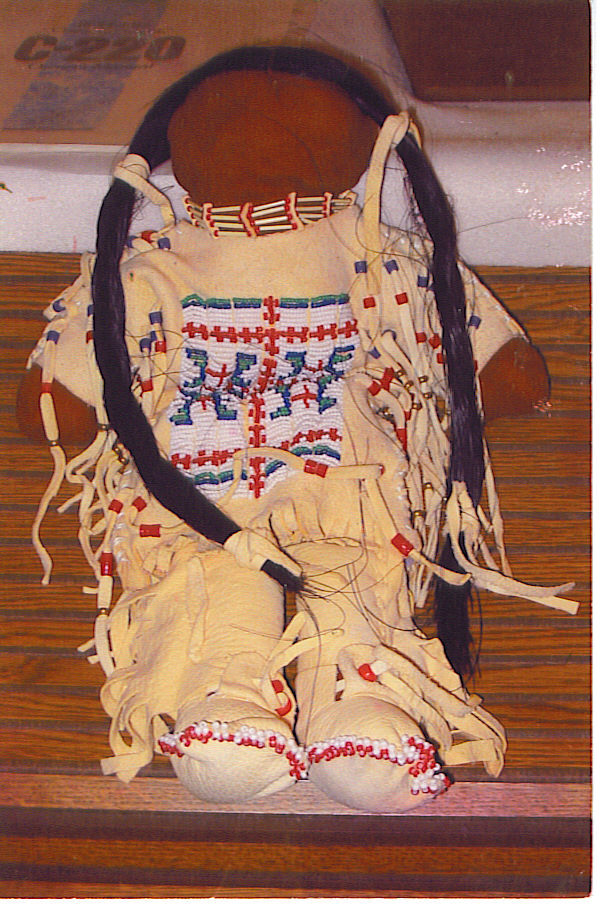
Ellowyn Locke's doll
     I’ve been thinking how some things have not changed significantly in Indian Country. The following testimony happened in 1974, when Indian leaders decided to stop the wholesale removal of Indian children to boarding schools and for adoption to non-Indian families.  Mr. Byler spoke eloquently to Senator Bartlett and Senator Abourezk about detribalization.  The result  was the Indian Child Welfare Act of 1978, which is meant to prevent non-Indians from adopting American Indian children.

            Excerpt:
            Senator BARTLETT. Do you feel that the boarding school removes some of the parental responsibility …that it creates a gap between the children and the parents, in which it makes the job of the parents more difficult and harder to achieve?

            Mr. BYLER. Yes; I think this is very much the case. In addition, I would say also we can really take the whole educational experience. Dr. Edward P. Dozier criticized Headstart programs for some Indian communities on the ground that an Indian child has such a short time in his life to learn how to behave in his own environment, to pick up the cultural and behavioral patterns of his parents. It was bad enough to start school at five or six because that bobtailed the opportunity the kids had to learn this. Now with Headstart in some communities, that age is down to 3 years, so these preschool experiences denied the children the opportunity to learn how to function properly in their own society.
            And it demoralizes the whole functioning of families when those children who grow up in a boarding school become parents themselves and have not had the opportunity to observe normal child rearing.
            In some of the early poverty programs funded under OEO, Indian tribes asked for funds to train their teenagers to be parents because they didn’t know what it was like because they had been away in boarding school.

Senator BARTLETT. What should be the structure for facing up to the emotional needs of Indian children and also in meeting the educational needs?

Mr. BYLER. I believe that in terms of the educational needs, that would be contracting the Indian schools with tribes that wish to contract for those schools. Where the tribes have taken over those schools, and there are not many yet, the educational result has been dramatic.
            For example, in Florida the Miccosukees had never had a school at all, none of their children attended school until 1961 or 1962. They took over their school about 4 years ago and, 1 year after the tribe itself had taken over the school, the comparative educational achievements of the children improved by 50 percent.
            Dropout rates have dramatically been reduced in the Busby school on Northern Cheyenne, and the Rocky Boy school, both in Montana, since Indian tribes have taken them over. So, I do think that educational needs can be met more adequately by the Indian community controlling the schools themselves.
            In terms of the emotional needs, I think perhaps one of the most central things to the emotional life of the Indian family and the Indian child, is to remove from that family the threat that their children will be taken away from them. I think this is the most dangerous aspect. It has a far greater impact on Indian emotional life than any other single factor.
            I think that in societies throughout the United States, and Indian societies, not all impoverished children or families suffer this kind of family breakdown. Among the Miccosukees, children are not taken from their parents, nor among the Coushattas of Louisiana; it’s unknown, the kind of breakdown that one sees in some Indian communities. It’s not because of Indian poverty. There are many societies in the world that are much more poverty stricken than the average American Indian community, but exhibit little or none of the family breakdown.
            I think it’s a copout when people say it’s poverty that’s causing family breakdown. I think perhaps the chief thing is the detribalization and the deculturalization, Federal and State and local efforts to make Indians white. It hasn’t worked and it will never work and one of the most vicious forms of trying to do this is to take their children. Those are the great emotional risks to Indian families.
            [More of this testimony is available at: www.liftingtheveil.org/byler]


            So what happened years ago, its effects are still being felt today. Loss of culture and language could have destroyed Indian Country but it has not. We may be wobbly but we’re still working…
            For adoptees that went through what I did, we look in a mirror and know something is wrong, yet we feel helpless to change it.  Who can discuss identity issues with you if you’re not a part of your tribal nation? I’m troubled tribes are so busy surviving they don’t reach out and search for their lost tribal members, like adoptees.
            I am so troubled by this disconnect, I try to connect adoptees to each other since we share the feeling of being lost. Our grief can’t be healed until we’re united successfully with family, relatives and tribe. Many have succeeded. Many more are trying.
            Many Native American adoptees are opening up and talking. Our identity is not mirrored back to us. We lost more than culture. We lost our right to be Indian. We have to fight to regain it. And with sealed adoption records, we may never be able to…

Wednesday, October 21, 2009

Looking for more Lost Birds

If you are an American Indian adoptee or a birthparent of a child who was given up for adoption, please contact me.
Email me anytime for more info...
Please email me at: laratrace@outlook.com
Website: www.splitfeathers.blogspot.com

Lara Trace (Lost Bird/journalist)

click

Contact Trace

Name

Email *

Message *

NO MORE UPDATES

GO TO:  https://blog.americanindianadoptees.com/  for updates and news. THIS BLOG cannot be updated...