This webinar by the National Native American Boarding School Healing Coalition (NABS) explores hidden epidemics within the U.S. Indian boarding school system. This event features guest speaker Dr. Preston McBride (Comanche by descent), and is moderated by NABS Research Assistant Joe Tahdooahnippah (Comanche).
Showing posts with label NABS. Show all posts
Showing posts with label NABS. Show all posts
Tuesday, October 15, 2024

Friday, September 13, 2024
Hidden Epidemics (webinar)

Join NABS on September 25th, 2024 from 12pm-1:30pm CT for our upcoming Research Webinar: Hidden Epidemics of Indian Boarding Schools.
This webinar will explore hidden epidemics within the U.S. Indian boarding school system. This event will feature guest speaker Dr. Preston McBride (Comanche by descent), and will be moderated by NABS Research Assistant Joe Tahdooahnippah (Comanche).
After you register, you will receive a confirmation email and link to the event.
LINK: https://boardingschoolhealing.org/nabs-research-webinar-series-hidden-epidemics/
Tuesday, August 13, 2024
"Kill the Indian, Save the Man" - Carlisle Boarding School - US History ...
MORE:
Full Text and Excerpts of Pratt's "Kill the Indian, Save the Man" Speech from Dickinson College: https://carlisleindian.dickinson.edu/....
American Indian Boarding Schools Haunt Many - NPR: https://www.npr.org/2008/05/12/165168...
Death By Civilization - The Atlantic: https://www.theatlantic.com/education...
If you can take 10 minutes, this animated film (above) is a good overview of that history. There is so much information to understand, that this animated film can reinforce some of the details.
If you haven't yet called or written your congressperson to support these two bills, here it is again. PLEASE CONTACT YOUR CONGRESSPERSON AND SENATOR TO SUPPORT THE TWO BILLS PROPOSED BY SEC.DEB HAALAND TO INVESTIGATE AND BEGIN TO BRING HEALING TO NATIVE AMERICANS ADVERSELY TRAUMATIZED BY THE BOARDING SCHOOL ERA.
HR. 7227 TRUTH AND HEALING ACT
If you would like to be part of educating the public, please consider hosting our film NATIVE WOMEN AND ALLIES SPEAK: What You Weren't Taught in School
FILM TRAILER:
CNA promo.12.12.23 from Arla Patch on Vimeo.
Tuesday, August 6, 2024
“We deserve truth, we deserve justice and ultimately, we want to heal from this long legacy of abuse” | Extension to File Claim: Important information for Native American Tribes
60 Native children from Northwest died in U.S. boarding schools, among nearly 1,000 deaths nationwide
Alexandra Yoon-Hendricks, The Seattle Times 8/1/2024
SEATTLE — More than 60 children from tribes with homelands in Washington, Oregon and Idaho are among the nearly 1,000 Native American children who died in the U.S. government’s abusive boarding school system that tore families apart and devastated Indigenous communities, according to the results of a federal investigation released Tuesday.
Between 1819 and 1969, thousands of children were taken from their homes as part of a targeted effort by federal officials and religious leaders to eradicate Indigenous culture and identity. The report estimates the federal government spent $23.3 billion in inflation-adjusted dollars over the 150 years supporting the boarding school system and similar assimilation policies.
There were at least 17 boarding schools in Washington, up and down the Interstate 5 corridor, on the coast, and dotted through the arid grasslands of the eastern parts of the state, according to the Interior Department. Many of them were on present-day tribal land.
Tribal nations did not gain the right to run their own schools until 1975, and parents could not prevent their children’s placement in off-reservation schools until the Indian Child Welfare Act passed in 1978.
The report, commissioned by Interior Secretary Deb Haaland, found marked and unmarked graves at 65 of the more than 400 U.S. boarding schools that were established to forcibly assimilate Native American children into white society.
The actual number of burial sites associated with Indian boarding schools — and the number of Indigenous children who died there — is likely far greater, the Interior Department acknowledged. The report also doesn’t include details on how each child died, but officials noted the causes of death included sickness, accidents and abuse.
The findings come after Haaland embarked on a two-year “Road to Healing” tour conducting listening sessions at tribes across the United States.
The tour included a stop at the Tulalip Tribes’ gathering hall last year, about 35 miles north of Seattle, where the secretary heard survivors share stories of their brutal experience at Native American boarding schools.
Deborah Parker, a citizen of the Tulalip Tribes and chief executive of the National Native American Boarding School Healing Coalition, welcomed the release of the report, but said the federal government and her organization ultimately need more time and access to records to understand the full picture.
“The department was able to identify, by name, 18,624 Indian children — that’s only a beginning,” Parker said. “That’s a beginning.”
There were an estimated 523 of these boarding schools in the U.S., according to research by the National Native American Boarding School Healing Coalition. The Interior Department report accounts for 417.
The report does not include burial sites affiliated with other institutions like day schools, orphanages or stand-alone dormitories, or boarding schools operated by churches and groups that didn’t receive federal funding. More than 1,000 institutions involved in the education of Indigenous children did not meet the criteria used in the department’s investigation.
A number of children from Washington who died in the schools were identified, including one child from the Confederated Tribes of the Colville Reservation, one from the Muckleshoot Tribe, one from the Puyallup Tribe, two from the Quinault Indian Nation, one from the Suquamish Tribe, one from Skagit, one from Snohomish and two from Yakama. The report also accounts for the deaths of 15 Nez Perce children, and others across the West.
The tribal affiliations of more than 200 children who died at boarding schools were not identified in the report.
Suquamish Tribe Chairman Leonard Forsman said his tribe is still reviewing the report and working to uncover more information about the Suquamish student identified to offer a “proper resolution.”
“We hope this will contribute to the healing of our people from the trauma resulting from the assimilation policies imposed on us by the U.S.,” he said in a statement.
At these boarding schools, children were forced to follow militaristic schedules, performed agricultural and manual labor, and in some cases, experienced physical and sexual abuse.
Survivors have recounted stories of having their mouths washed out with soap and their hair cut, or of school leaders whipping them with ropes and belts. They were punished for speaking their language and practicing their traditions.
By 1969 — when the federal support for Native American boarding schools ended — 25% to 35% of all Native American children had been separated from their families, according to studies conducted by the Association on American Indian Affairs.
Growing up, Parker said she witnessed how the schools disrupted healthy family relationships, traditions and how people viewed the educational system.
Children ripped away from their parents were left struggling to create stable homes for their own children years later, said Tulalip Tribes Chair Teri Gobin. Studies have found that the childhood experiences at boarding schools left adults with serious physical and mental health issues, ones that could also be seen among their children.
“This historical trauma has moved from one generation to the next,” said Gobin, whose father attended Cushman Indian Hospital, a boarding school that performed medical experiments on students. “They destroyed their lives, their children’s lives.”
The healing coalition has been central to the Interior Department’s research and is advocating for the creation of a federal commission through Congress to find and analyze the records from the government and church-run boarding schools and uncover the horrific truth publicly. Parker said the coalition hopes the bill’s passage would coincide with an apology from the sitting U.S. president, and a commitment to meaningful action.
The healing coalition and tribal nations are still looking for records of children who never returned home and of unmarked, or poorly marked, burial sites. These are stories and records that have largely been withheld from Indigenous people, Parker said.
“We deserve truth, we deserve justice and ultimately, we want to heal from this long legacy of abuse,” said Parker, whose relatives attended boarding schools.
In addition to a formal apology, the report calls for the U.S. government to invest in programs that could help tribes heal from the intergenerational trauma caused by boarding schools, such as violence prevention and language revitalization.
That funding should be “commensurate with the investments made in the Federal Indian boarding school system between 1871 and 1969,” according to the report’s recommendations.
“We’re bringing back our culture, we’re bringing back our canoes, we’re bringing back our longhouse way of life, and I’m incredibly proud of that,” Parker said. “I hope that we continue to do that, and then others learn from Native American people, because we have a lot to give.”
If you are a boarding school survivor or a descendant, resources are available from the National Native American Boarding School Healing Coalition at boardingschoolhealing.org.

Dear Relative,
The
Franciscan Friars of California, Inc. has determined that at least
seven Native American tribes in Arizona and New Mexico are eligible to
file claims against the Franciscan Province of St. Barbara for clergy
sexual abuse as part of its ongoing Chapter 11 bankruptcy case.
🗓️ Key Information:
- The Franciscan Friars of California, Inc. filed for bankruptcy on December 31, 2023, due to facing 94 new abuse claims, mostly from California.
- The Bankruptcy Court has extended the deadline for filing proofs of claim to August 30, 2024.
Your Voice Matters: The strength and courage to report abuse is vital.
If you or someone you know is a survivor, please file your claim to
receive support.
To find information about the Franciscan Friars of California's bankruptcy case, including instructions on proofs of claim click HERE.
Thursday, August 1, 2024
DOI report on boarding schools: “Acknowledge, Apologize, Repudiate” + NEW policy to prevent family separation due to poverty

For the first time, the United States is owning up to its role in the deplorable treatment of Native American, Alaska Native and Native Hawaiian children at Indian Boarding Schools over more than a century. The report from the U.S. Department of Interior documents the deaths of nearly 1,000 children at boarding schools—many in collaboration with Catholic and other Christian institutions. The report includes distressing testimony collected at public meetings around the country from boarding school survivors and their relatives, detailing the personal costs of the government’s attempts to eradicate Native cultures and languages. It recommends the federal government not only formally apologize, but also establish a path and funding to account for the wrongs and the continuing harm resulting from it.
GUESTS
Bryan Newland (Bay Mills Indian Community), Assistant Secretary for Indian Affairs in the U.S. Department of the Interior
Ben Barnes (Shawnee Tribe), chief of the Shawnee Tribe and National Native American Boarding School Healing Coalition board member
Gwen Carr (Cayuga), executive director of the Carlisle Indian School Project
Levi Rickert (Prairie Band Potawatomi Nation), publisher and editor of Native News Online
NATIVE AMERICA CALLING: August 1, 2024 – DOI report on boarding schools: “Acknowledge, Apologize, Repudiate”
Related Stories
NEW:
Biden-Harris Administration Actions to Keep Children and Families Safely Together and Supported
The White House hosts a convening on transforming child welfare and
announces new policy to prevent family separation due to poverty
Children should not be separated from their families due to financial hardship alone. Several states, like Kentucky, Indiana, South Carolina, Wisconsin, Pennsylvania, Washington, and Kansas have already clarified that poverty alone should not cause child removal.
Details:
- Allowing child welfare agencies to draw on federal funds to finance background check operations to facilitate quicker licensing for kin and others who provide foster care.
- Rolling out a new website spotlights states and Tribes that have adopted new kinship licensing rules, as well as data on their kinship placement rates.
- Publishing a resource guide on federal programs that provide supports to grandparents and kin in their caregiving roles.
- Conducting a series of listening sessions to identify federal flexibilities needed for states and Tribes to adopt kinship licensing rules and kinship first approaches.
- Respecting Tribal sovereignty. The Administration expanded the scope of Public Law 102-477 plans,
which now deliver over $300 million in flexible funding to 298 Indian
Tribes to strengthen the economic stability and mobility of families in
Indian Country – including by braiding child welfare funding with
workforce funding to help preserve families. And just over a year ago,
the President celebrated the Supreme Court’s decision in Haaland v. Brackeen,
which upheld the Indian Child Welfare Act as a necessary safeguard to
ensure that whenever possible, children should be kept with their
extended families or community.
EDITOR NOTE: It blows my mind the system that created poverty (and forced adoptions in Indian Country) is aiming to fix that - what, after 100+ years? Really? THEY CREATED POVERTY! We already had KINSHIP care for kids on the rez... it's called family and relatives!
So Biden-Harris really really need the NATIVE VOTE in 2024, apparently...
The billions of dollars spent to run all these gov't agencies and departments to remove Native kids could have ended poverty a long time ago.
That is why some call this POVERTY PORN... TRACE
Tuesday, July 9, 2024
Bill to create a Truth and Healing Commission on Indian boarding schools reached U.S. Senate
👆Native America Calling (listen) (7/9/2024)

NABS Photo: CARLISLE students
Notable progress for boarding school survivors

For the first time, a bill to create a Truth and Healing Commission on Indian boarding schools has reached the floor of the U.S. Senate. A companion bill is working through the U.S. House. The concept of an official panel to look into the abuses of boarding schools has surfaced previously but failed to take hold. The action comes as the National Native American Boarding School Healing Coalition is launching a database of documents, photographs, and other records to help survivors and others connect understand the full weight of the boarding school era. And an important event to promote healing from Canada’s residential school era is taking place in Ontario. Some voices in Canada are calling for residential school “denialism” be criminalized.
GUESTS
Fallon Carey (Cherokee Nation), interim digital archives manager for the National Native American Boarding School Healing Coalition
Edward Washines (Yakama), member of the Washington State Truth & Reconciliation Tribal Advisory Committee
Eleanore Sunchild (Thunderchild First Nation), Cree Indigenous lawyer practicing law in Calgary
 |
| CARLISLE GRAVES |
NABS: https://nibsda.elevator.umn.edu

An example from the NABS website:
Quapaw Nation and Modoc Nation - Seneca Nation, Shawnee Tribe and Wyandot Nation of Kansas
Thursday, February 8, 2024
Committed to Investigating Abuses at 523 BOARDING SCHOOLS (USA)

Thursday, February 8, 2024
This week, U.S. Reps. Sharice Davids (Ho-Chunk/D-KS) and Tom Cole (Chickasaw/R-OK) reintroduced legislation to investigate, document, and report on the histories of Indian boarding schools and their long-term impacts on tribal communities.
The bill has been endorsed by the National Native American Boarding School Healing Coalition (NABS).
NABS CEO Deborah Parker talked about the legislation at the 2023 White House Tribal Nations Summit.
“It’s much needed to help us tell the story, help us understand what happened to our Native American children in U.S. boarding schools. And we deserve, America deserves, not only Native Americans, but students, but people, any human being who is living today deserves to understand the truth about what happened in the United States.”
Parker says they’re seeking records and information from both the federal government and churches that ran the schools.
“We know parents are still looking for children to this day, their relatives who never came home. Most of the parents are no longer with us, but there are elders who have brothers and sisters, siblings, cousins who never made it home from the boarding school. So, they are missing. We’re trying to help families locate their loved ones…we still know our communities have, we have broken systems within our communities because we don’t know where our loved ones are.”
The legislation would establish a formal commission to investigate federal Indian boarding school policies, develop recommendations for federal entities to help with healing efforts, and provide a forum for victims to speak.
Reps.
Davids and Cole, co-chairs of the Congressional Native American Caucus,
say they’re committed to investigating the abuses at the institutions,
which are connected to an estimated 500 student deaths. (I have seen bigger numbers: 10,000 + who died in the schools)
The Truth and Healing Commission on Indian Boarding School Policies Act of 2024 has also been endorsed by the National Congress of American Indians.
Where are they? Where are all the adoptees? Genocide is hard to document, right? Trace
Thursday, October 5, 2023
AG Ferguson creates Indian boarding schools Truth & Reconciliation Tribal Advisory Committee

OLYMPIA, Washington — Following the National Day of Remembrance for Indian Boarding Schools on Saturday, Attorney General Bob Ferguson announced today the five members of his office’s Truth & Reconciliation Tribal Advisory Committee. The committee will study how Washington state can address the harms caused by the government’s historical role in the shameful legacy of Indian boarding schools.
The National Day of Remembrance for Indian Boarding Schools, also known as “orange shirt day,” is observed on Sept. 30 to raise awareness about residential boarding schools.
The five new members of Ferguson’s Truth & Reconciliation Tribal Advisory Committee will hold public listening sessions across the state over the next year to begin a two-year journey toward uncovering the full history of Indian boarding schools in Washington.
“These schools are not just a shameful part of our history — the trauma they caused reverberates through generations of Indigenous families,” Ferguson said. “This week, we do more than just observe the National Day of Remembrance for Indian Boarding Schools. With this new committee, we start a long but essential journey toward healing.”
“We are grateful for Washington state’s leadership in not only investigating its role during the Indian boarding school era, but also its willingness to promote healing for survivors,” said Deborah Parker (Tulalip), CEO of The National Native American Boarding School Healing Coalition. “We need other states to follow suit and work with Tribes and Native communities to bring the truth about this dark history to light.”
During the 2023 session, the Legislature directed the Attorney General’s Office to convene the Tribal Advisory Committee to study boarding schools in Washington through a truth and reconciliation model. The committee’s five members must be citizens from federally recognized tribes in diverse geographic areas across the state. They must also either have personal, policy or specific expertise with Indian boarding school history and policies, or have expertise in traditionally and culturally appropriate truth and healing endeavors.
The Truth & Reconciliation Tribal Advisory Committee members are:
- Edward Washines (Yakama).
- Tamika LaMere (Anishinaabe enrolled with the Little Shell Tribe of Chippewa Indians of Montana).
- Rebecca Black (Quinault).
- Abriel Johnny (Tlingit and Cowichan First Nations).
- Diana Bob (Lummi).
The committee had its first meeting on Sept. 26. The Tribal Advisory Committee will hold the first of its public listening sessions around the state in January 2024.
The shameful legacy of Indian boarding schools
In May of 2022, the U.S. Department of the Interior’s Federal Indian Boarding School Initiative released an investigative report detailing more than 400 boarding schools across 37 states, including Washington, between 1819 and 1969, that were part of the federal Indian boarding school system.
The schools “deployed systematic militarized and identity-alteration methodologies to attempt to assimilate American Indian, Alaska Native and Native Hawaiian children.” Tactics employed at the schools included:
- Renaming Indian children with English names
- Cutting childrens’ hair
- Discouraging or preventing the use of their languages, religions and cultural practices
- Organizing Indian children into units to perform military drills and forcing them to perform manual labor
- Corporal punishment, including solitary confinement, whipping and more
The Department of the Interior estimates that the number of Native children who died while at federal Indian boarding schools could number in the thousands or even tens of thousands. Many of those children were buried in unmarked or poorly marked burial sites far from their tribal lands.
The report identified 15 boarding schools in Washington. However, this does not account for all schools and institutions — such as asylums and orphanages, for example — that targeted American Indian, Alaska Native and Native Hawaiian children in the pursuit of a policy of cultural assimilation. In August, the National Native American Boarding School Healing Coalition released research that identified 17 Indian boarding schools in Washington state, which included two schools that did not show any evidence of federal support. The Tribal Advisory Committee will build on this knowledge to study the full extent of the impacts of boarding schools and other cultural assimilation practices in Washington state.
The committee will submit a report in 2025 that, among other goals, delivers recommendations on how the state can address the harm done by Indian boarding schools and other cultural and linguistic termination practices through a truth and reconciliation model.
Sunday, October 1, 2023
The Times is Now... A Virtual Conversation on the U.S. Truth and Healing Commission...
Webinar on the U.S. Truth & Healing Commission Bill on 9.27.23

The National Native American Boarding School Healing Coalition (NABS) hosted a virtual conversation on the Truth and Healing Commission on Indian Boarding School Policies Act (S. 1723).
NABS is joined by U.S. Congresswoman Sharice Davids (Ho-Chunk) and a guest panel featuring Sterlin Harjo (Seminole/Muscogee), Dallas Goldtooth (Lower Sioux Dakota Nation), Mato Wahuyi (Oglala Lakota), and Georgeanne Growingthunder (Fort Peck Assiniboine and Sioux Tribes).
Learn how you can advocate for the U.S. Truth and Healing Commission Bill.
Learn More: https://boardingschoolhealing.org/truthcommission/
Explore our Advocacy Toolkit: https://sites.google.com/nabshc.org/nabs-truth-and-healing-toolkit/home
Why a Truth and Healing Commission
We have a right to know the truth of what happened in Indian boarding schools in the United States.
Over the course of a century, hundreds of thousands of our children were taken or coerced away from our families and Tribes and forced to attend government-sanctioned Indian boarding schools. These schools were tools of assimilation and cultural genocide, resulting in the loss of language and culture and the permanent separation of children from their families. To date, there has never been an accounting of:
- the number of children forced to attend these schools;
- the number of children who were abused, died, or went missing while at these schools; and
- the long-term impacts on the children and the families of children forced to attend Indian boarding schools.
We have a limited amount of time to hear directly from survivors and record their stories. A Congressional Commission is needed to locate and analyze the records from the 523 known Indian boarding schools that operated in the U.S. A Commission would also bring together boarding school survivors with a broad cross-section of tribal representatives and experts in education, health, and children and families to fully express and understand the impacts of this federal policy of Indian child removal.
Wednesday, September 27, 2023
Ask your relatives: Interested in sharing your Indian boarding school experience?

“I know that this process will be long and difficult. I know that this process will be painful. It won’t undo the heartbreak and loss we feel. But only by acknowledging the past can we work toward a future that we’re all proud to embrace.” — Secretary Deb Haaland
NABS Receives Grant From DOI to Create Permanent Collection of Stories from Survivors of Federal Indian Boarding Schools
|

|

Dear Relatives,
We are honored to share that NABS received a grant from the Department
of the Interior (DOI) to conduct video interviews with Indian boarding
school survivors across the United States to create a permanent oral
history collection. This effort is part of the DOI’s Federal Indian Boarding School Initiative.
NABS sees this Oral History Project as a historic opportunity to
highlight the voices of Indian boarding school survivors and the harmful
effects of U.S. Indian Boarding School Policy. Through this project,
NABS will support the storytelling and healing of survivors which has
never been done before in U.S. history. Since NABS was established, we
have created spaces where survivors have felt safe to share their
experiences. We have sat with them, learned with them, and have been
moved by their courage. They are our family.
We look forward to working with our relatives across Indian Country in
the U.S., empowering them as they share their stories. Our commitment
includes offering our love and support throughout this process.
tix̌ix̌dubut (take care of yourself),
Tsicyaltsa,
Deborah Parker (Tulalip Tribes)
NABS Chief Executive Officer
Interested in sharing your Indian boarding school experience? LINK
|
|
|
|
|
You can
help today. The truth about the U.S. Indian boarding schools has largely
been written out of the history books. The social, emotional,
spiritual, and cultural devastation from boarding school experiences are
passed down to Native American individuals, families, communities, and
Tribal Nations today. The time for healing these intergenerational
traumas is now. Help us work towards truth, justice, and healing.
Resources:
- Secretarial Memo launching the Federal Indian Boarding School Initiative
- Secretary Haaland op-ed(link is external): My grandparents were stolen from their families as children. We must learn about this history.
- Department of the Interior and National Native American Boarding School Healing Coalition Memorandum of Understanding
- Department of the Interior Releases Investigative Report, Outlines Next Steps in Federal Indian Boarding School Initiative
Wednesday, September 6, 2023
War against the children | NABS REPORT: US operated 523 boarding schools
The US government, Native American children and boarding schools
Holly Richardson 9/1/2023There are now over 500 Native American boarding schools accounted for in the United States. Eight were in Utah

In this photo taken in 1906, provided by the Quaker and Special Collections at Haverford College, teachers and students gather for a portrait at Tunesassa School in Tunesassa, New York. The National Native American Boarding School Healing Coalition says it will digitize 20,000 archival pages related to Quaker-operated Indian boarding schools. The records will provide a better understanding of the conditions that children received at these schools. IMAGE: Quaker and Special Collections, Haverford College via AP
“They went after our language, our culture, our family ties, our land. They succeeded on almost every level,” Ben Sherman told The New York Times. “Don’t try to tell me this isn’t genocide.”
Sherman, now 83 and a retired aerospace engineer, is also a member of the Oglala Sioux Tribe who spent four years in a Native American boarding school in South Dakota. Sherman believes that after the “shooting wars” by the United States government against Native Americans had subsided, the government was “not done with war, so the next phase involved war against the children.”
Enter Native American boarding schools.
‘Vast and entrenched’
“From small shacks in remote Alaskan outposts to refurbished military barracks in the Deep South to large institutions up and down both the West and East coasts,” Native American boarding schools took in children from across the country.
Incomplete records and scant government attention let the stories of these schools largely fade into oblivion. For many students of those schools and their families, the trauma “never went away.”
Recently, however, more concerted efforts are being made to identify the schools and the children who went there, as well as those who never left. Last year, the Department of the Interior, under the leadership of Deb Haaland, released a report identifying 408 schools in 37 states, including 21 schools in Alaska and seven in Hawaii, from 1819 to 1969.
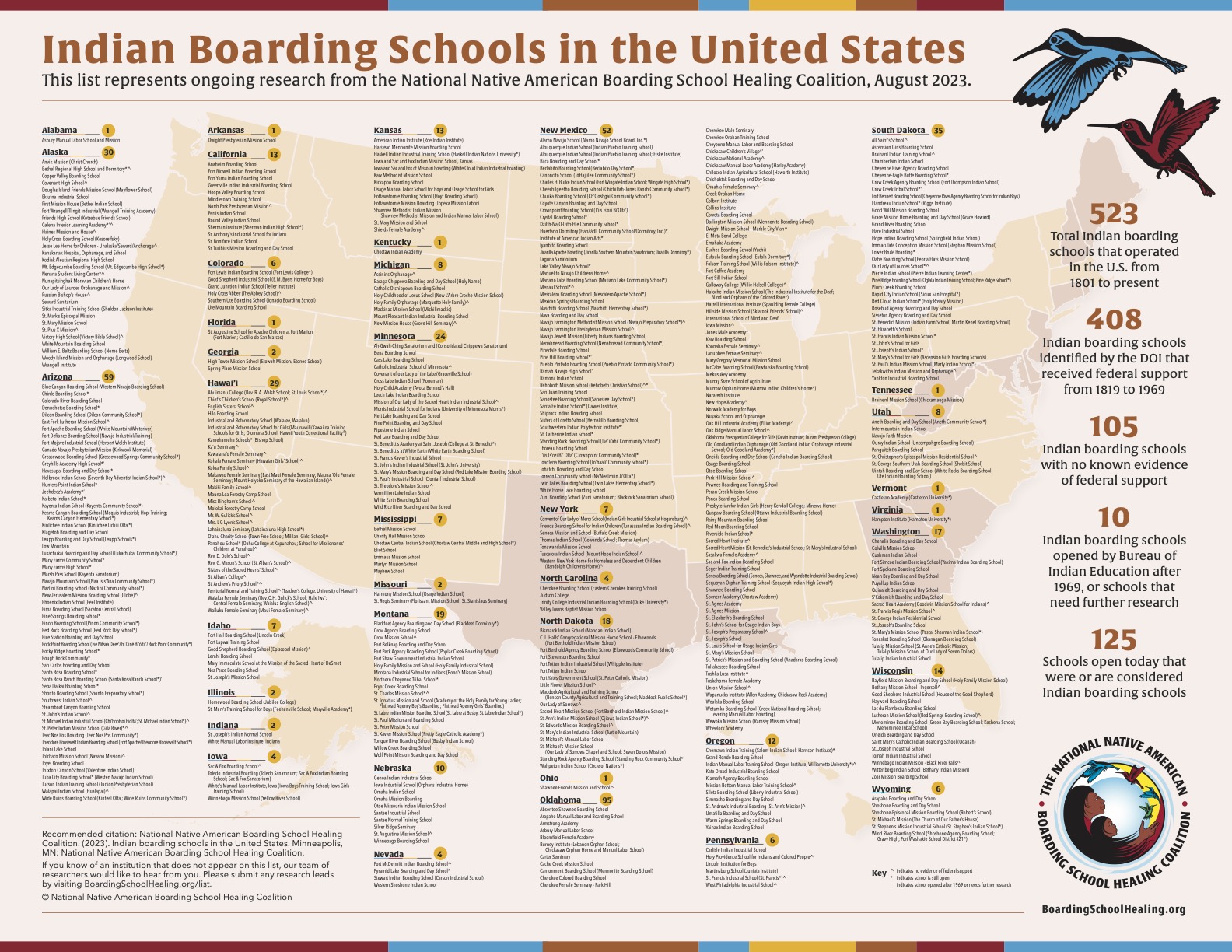
On Wednesday, the nonprofit National Native American Boarding School Healing Coalition announced that they had identified another 115 schools, bringing the total to 523 in 38 states. They identified one additional school in Utah, bringing this state’s total to 8. They found 22 more in Hawaii, bringing that state’s total to 29. They found even more in Oklahoma, the state with the most schools identified, now standing at 95.
Most of the additional schools did not receive federal funds, but were run by religious groups and churches, reports The Washington Post. Many were Catholic, Presbyterian or Episcopalian, but also included small congregations of Quakers, Congregationalists and others.
Scattering the children
Richard Henry Pratt, a military officer who fought in the 1870s to forcibly remove multiple tribes from the Southern Plains, dreamt of abolishing all Native American reservations and “scattering the entire population of Native children across the country, with some 70,000 white families each taking in one Native American child,” reports The New York Times.
While he was not successful in bringing that vision to fruition, he started down that road by creating the Carlisle Indian Industrial School in Carlisle, Pennsylvania, in 1879. The school took in Native American children from as far away as Alaska and tried to “civilize” them. In 1892, Pratt delivered a speech at a convention, where he said,
A great general has said that the only good Indian is a dead one, and that high sanction of his destruction has been an enormous factor in promoting Indian massacres. In a sense, I agree with the sentiment, but only in this: that all the Indian there is in the race should be dead. Kill the Indian in him, and save the man.
Pratt then praised the benefits of slavery for Black people and said it was now the responsibility of the United States to “civilize” Native Americans.
The “civilizing” process, or “assimilation” was, as Pratt described by wanting to “Kill the Indian in him,” a brutal one. Children’s hair was cut off, their native apparel burned. They were dressed in Western apparel, their names changed and their religion changed. They were “hired out” to do menial jobs, with the schools retaining any fees received.
Moderating a panel at the Leonardo in Salt Lake City last year, Utah State University student Taylor “Cheii” Begay said, “This assimilation process, the boarding school era, it was a war tactic.”
“They tried to kill us”
For noncompliant students, punishment could border on torture. Being whipped with a cat-o’-nine tails, being paraded naked for other students to beat with belts, being thrown into walls, doused with fire hoses, having food withheld, being publicly humiliated and more. Sexual abuse was rampant, report both The New York Times and The Washington Post.
The New York Times reports that in 1891, the Grand Junction News printed an exchange between the superintendent of the Grand Junction Indian School in Colorado and the secretary of the Interior. The superintendent informed the secretary that one of the boys at the school could not fit his foot into the government-issued shoe because he had six toes. “What shall I do?” asked the superintendent? “Off with his toe!” came the reply. So, off came the toe.
Not every student counts their time at Native American boarding schools as traumatic. For some, it was not, including Cris Polk, from the Yakama Tribe of Washington, who told KSL earlier this year that those were the best four years of her life, and where she met her lifelong best friend.
Andy Merrick, chairman of the Omaha Tribe of Nebraska, met his wife at Intermountain Indian School. They celebrated their 43rd anniversary this year.
“I love this place. I love the mountains and the memories I have here,” Merrick said to KSL. “One of the best times of my life was out here in Utah.”
Truth and healing
Those with fond memories are the exception. By 1928, the Meriam report detailed how children were “malnourished, overworked and harshly disciplined.” Forty-one years later, in 1969, a U.S. Senate report reported on the failures of the system. That report spurred support for the Indian Self-Determination and Education Assistance Act in 1975 and then the Indian Child Welfare Act in 1978.
In June, the U.S. Supreme Court upheld a challenge to ICWA in a decision praised by tribes and Utah’s elected officials, including Lt. Governor Deidre Henderson. Supreme Court Justice Neil Gorsuch summed up the importance of ICWA, stating that it “secure(s) the right of Indian parents to raise their families as they please; the right of Indian Children to grow in their culture; and the right of Indian communities to resist fading into the twilight of history.”
When Deb Haaland was appointed the first Native American to head the Department of the Interior, she brought with her boarding school legacies. Her grandparents were stolen from their families as children and she grew up hearing their stories. Her great-grandfather was taken to the infamous Carlisle Indian School. She cried with her grandmother as her grandmother shared her loneliness and sadness at being separated from her family.
“Acknowledging these painful truths and gaining a full understanding of their impacts” will help heal painful “threads of trauma and injustice,” she wrote in 2021. Over the past year, she has been around the country on a “Road to Healing Tour.”
Last year’s report was one of two. The second report will focus on the number of children who died at the boarding schools. Investigators expect that number to be in the “thousands or tens of thousands.” With sparse records of the children, or even where the cemeteries are located, the final number is likely to remain unknown. At least one excavation in the United States this summer found no remains.
Holly Richardson is the editor of Utah Policy
**

NABS launches digital map with new research of
523 U.S.
Indian
boarding
schools

|

|

|
|
NABS hopes
this new
research and
tool will
inspire
researchers,
educators, and
policymakers
to gain a
better
understanding
of the impact
and scope of
Indian
boarding
schools.
Ultimately, we
hope it will
help
survivors,
descendants,
and Tribal
Nations in
charting a
pathway
forward.
This project
was made
possible
through a
partnership
with the
National
Centre for
Truth
and Reconciliation.
Read more
about this
work in
The New York
Times and
Washington
Post.
Subscribe to:
Posts (Atom)

click
-
 Editor NOTE: This is one of our most popular posts so we are reblogging it. If you do know where Michael Schwartz is, please leave a com...
 -
Published on Sep 28, 2013 This 40-minute documentary explains the reason for and the process of creating and implementing ...
-
 By Melanie Payne ( mpayne@news-press.com ) August 15, 2010 Alexis Stevens liked to describe herself as a model citizen. She was adopted fr...
 -
 By Mary Charles I somehow don't believe the intention was for us (adoptees) to find our homes using DNA. But when I came across t...
 -
South Carolina court drops contempt charge against Dusten Brown Dusten Brown and the Cherokee Nation rea...
-
 By: Shannon Logan Feb 07, 2014 Leland Morrill was estranged from h...
 -
By Trace L Hentz, blog editor I have often wondered about how we adoptees were affected by our adoptions, as far as our mental health. (I ...
-
 CALLED HOME: Book Contributors : We are honored that these adoptees (or relatives of adoptees) contributed to CALLED HOME: Suzie ...
 -
 By Trace A. DeMeyer Have you watched the TV program WHO DO YOU THINK YOU ARE, a not-so-subtle sales pitch for the Mormon’s...


