BLOGGER changed, not allowing us to UPDATE this back-up blog

(UPDATED 726/2025) issues with blogger are preventing this
Showing posts with label Supreme Court. Show all posts

Monday, March 25, 2024

The Great Divider: How the Baby Veronica case was the sign

 REBLOG from February 24, 2014

By Trace Hentz

OK, as promised, I have more thoughts after I went to the hallowed halls of Yale Law School last Friday to hear a review of the Baby Veronica Case - and to hear what NCAI, NARF and the Tribal Supreme Court Law Project at Yale were doing while this major case was going on... and I reported to you yesterday what they said essentially…

There weren't any surprises for me unless you count how these panelists didn't use the time to discuss the genocide that actually occurred prior the passing of the Indian Child Welfare Act of 1978 and the child abductions by social workers and missionaries - nor did they mention human trafficking and the Nightlight Adoption Agency dealings with Maldonado, the birthmother.  They did mention boarding schools.

So, I was truly upset. From what I heard, it appears American Indians are eons behind in civil rights and we can't seem to win a case in the Supreme Court.  I’d heard that warning years prior but this time at Yale was a bit more in my face. This case was about adoption by non-Indians, something I lived myself.

We had Justice Alito writing an opinion that Veronica is 1.2% Indian.  NARF attorney Joel West Williams asked the Yale audience, "Who in America is 1/16 or 3/256th anything?"  Yet we have a judge issuing his opinion by measuring an Indian for their Indian-ness which equates to measuring a child’s blood? This is still happening?

·        JUSTICE ALITO delivered the opinion of the Court:
This case is about a little girl (Baby Girl) who is classified as an Indian because she is 1.2% (3/256) Cherokee. Because Baby Girl is classified in this way, the South Carolina Supreme Court held that certain provisions of the federal Indian Child Welfare Act of 1978 required her to be taken, at the age of 27 months, from the only parents she had ever known and handed over to her biological father, who had attempted to relinquish his [**736]parental rights and who had no prior contact with the child. The provisions of the federal statute [*2557] at issue here do not demand this result.


·        Jun 25 2013: Judgment REVERSED and case REMANDED. Alito, J., delivered the opinion of the Court, in which Roberts, C. J., and Kennedy, Thomas, and Breyer, JJ., joined. Thomas, J., and Breyer, J., filed concurring opinions. Scalia, J., filed a dissenting opinion. Sotomayor, J., filed a dissenting opinion, in which Ginsburg and Kagan, JJ., joined, and in which Scalia, J., joined in part. Read more here
·         

I couldn’t sleep ... Dusten Brown never had a chance. He went to Iraq knowing the Capobiancos had his daughter but he had to serve a year and a JAG lawyer took his case.  The puzzle remains why Maldonado mysteriously breaks up with him and severs all communication. Was she punishing her high school sweetheart Dusten by selling his baby or was she manipulated by the adoption agency to take their money?

Then it hit me - keeping America ignorant of Indians, culture, actual history - this all works to take Indian children.  Judgment is easy.  Third World poverty (which we didn’t create) somehow equates to abuse of children.  Add their general ignorance of sovereignty and culture, what it means to be Cherokee or Lakota or Navajo or any tribe - and it means you can't win public opinion polls or cases before the Supreme Court? 

Ignorance about Indians? Exactly!

It's been going on since colonial contact.  Please, let's not call them settlers anymore but invaders.  America has always been the Great Divider, building its fences, writing its laws, counting on classism and racism to divide us. 

America wins every time when it perpetuates this ignorance of Indians.  Do Indians do a good job of educating others about culture, or what's important to us?  Not really.  We're way behind in any civil rights movement.  We've had movies romanticizing us over 100 years and it's hard to kill those "savage" “redskin” stereotypes drilled into all our heads!  

What do Americans know about Indians? Nothing.  Practically zilch.

America's "taking care" of Indians only works to create HATE among Americans who view us as privileged in some way that they are not.  Like why do we even have a law that keeps nice white people from adopting Indian babies?  Trust me, ICWA is under attack.

I do know that Indians are way ahead in surviving every broken treaty and then fighting each other over small scraps of power.  Some tribes even subscribe to "blood quantum" as if they need to purge their citizen rolls of those who may be too white or too black.

We have Supreme Court Justices using the blood quantum argument and you see that is not entirely their fault (they all went to law school but didn’t even have a course on Indian Law at those Ivy League schools) but it tells me - do not go anywhere near them.  They are not even aware of their ignorance.  Dusten Brown didn't have a chance, not in that court.

We Indians shouldn't go anywhere near that court or any court with that level of stupidity.  No, you can't tell Americans they are stupid.

What the panel did say was each and every tribe needs to create and have their own child protection network. I agree since it's pretty evident that you can't trust any non-Indian social worker to go to the reservation and use their mother- father “family unit” example.  Only Indians can decide who the right people are to care for its children.  That person might be an auntie, grandmother or another relative, depending on who in the tribal family is willing and able.

And the panel said we need more American Indian lawyers who become judges - because the way it is now - Indians can’t win.

For many years Vine Deloria and others did try very hard to educate others (with their brilliant books) on the white man’s level, even earning degrees in white man’s colleges like Yale and Harvard, but it all comes down to this:  whites don’t really care.

And if we really think about it, this is a very dangerous situation to be in.


Footnote:  I attended white schools like most everyone else - Really nothing I learned was true or real about Indian culture or history. I learned more sitting at the kitchen table of my friend Ellowyn who is Oglala Lakota, who gave me an education about Indians not written about anywhere.  Then there was my one adoptive aunt (a first-born American) who calls me a liar when I told her there were Indian Boarding Schools, and this was right after I visited Haskell in Kansas.  No, Americans are not learning about Indians or the truth of our history. 
The Baby Veronica case is the sign, whether we wish to see it that way or not - but we can no longer ignore the ignorance or the danger surrounding this case. 
 
THIS BLOG HAS MANY POSTS ABOUT THE BABY V CASE... Yes, she was adopted out...
 
BLOODISM? READ THIS

Thursday, June 15, 2023

Supreme Court affirms ICWA

UPDATED: ‘The bottom line is that we reject all of petitioners’ challenges to the statute, some on the merits and others for lack of standing’


Justice Neal Gorsuch, the justice with extensive federal Indian law knowledge and experience of all the justices, wrote in support:

"Often, Native American Tribes have come to this Court seeking justice only to leave with bowed heads and empty hands. But that is not because this Court has no justice to offer them. Our Constitution reserves for the Tribes a place—an enduring place—in the structure of American life. It promises them sovereignty for as long as they wish to keep it. And it secures that promise by divesting States of authority over Indian affairs and by giving the federal government certain significant (but limited and enumerated) powers aimed at building a lasting peace"


READ THIS

Wednesday, April 19, 2023

Part Five: What if We Lost ICWA | Our Sovereignty


The plaintiffs, Brackeens, assert ICWA is an unconstitutional law

PART 5: 
Haaland v. Brackeen

By Trace L Hentz, blog editor and adoptee

Am I worried about the ICWA case? Yes. Very.

I am worried that the "Supreme" Court has shown no respect for our inherent sovereign rights.  Just look at history.  This case could rescind the Indian Child Welfare Act of 1978.  I worry the impact on adoptees now and future Native adoptees.  (ICWA allows adoptees to open their adoption records.)  We are called The Stolen Generation and Sixties Scoop for good reason.

We lost our sovereignty when we were adopted out to white families.  We lost everything - language, culture, land, family, ceremonies and our tribal stories.  (Some of us lost our sanity too!)  Swimming pools, college degrees, and white families in fancy houses, cannot replace this.

Sadly, I do not think these Justices actually know what our loss means!

Many years ago in Wisconsin, two tribal chiefs gave talks to new congresspeople on Sovereignty 101- I interviewed them about it and then wrote an article in News from Indian Country.  They explained it used to be feds (the federal government) that dealt with tribes and the feds were keenly aware of sovereign tribal rights and history.  Both chiefs said state lawmakers were not as understanding.  There was also high turn-over in states and many new congressmen don't know state or federal history, even how tribes signed numerous treaties.

The Department of WAR (who authorized killing Indians) morphed eventually into the Department of the Interior.


I looked back at my blog posts: Sovereignty and how it applies to Haaland vs. Brackeen.

As Rebecca Nagle explained: "A host of federal statutes—including on land rights, water rights, health care, gaming, criminal and civil jurisdiction, and tribal self-governance—treat Native Americans differently based on this political classification.  In this light, I fear that the Brackeen lawsuit is the first in a row of dominoes—if the Court strikes down ICWA, everything else could soon go with it."

"Under federal law, tribes and tribal citizens are not a racial group, but a political one.  Accordingly, ICWA applies only to Native children who either are enrolled in a federally recognized tribe or are eligible based on a given tribe’s citizenship requirements," Nagle said. 

And this:

This cultural difference — that a family’s fitness is determined by its wealth, and that those concerns should outweigh a child’s connection to their family and heritage — is essentially why the Indian Child Welfare Act was created in 1978.  The law recognizes the history of federal policy aimed at breaking up Native families and mandates that, whenever possible, Native families should remain together.

Sarah Kastelic, the executive director of the National Indian Child Welfare Association, said that ICWA acknowledges important familial and tribal bonds that have long been disregarded, and that Native ways — such as extended families living under the same roof — have often been used to show unfitness in child welfare proceedings. “No matter the picket fences and swimming pools and things, most of the time, kids want to be with their families,” she said.

READ: The Native adoption case that could dismantle the Indian Child Welfare Act, explained - Vox


THE INTERIOR AND INDIAN AFFAIRS:


👇This is a bit technical but it is the argument the Justices are deliberating:

"What's Missing in the Brackeen Argument: An Indian Affairs Clause"

|

I was chatting with Prof. Lorianne Updike Toler (Northern Illinois), and she mentioned some thoughts of hers on this subject, based on her recent University of Chicago Law Review article, The Missing Indian Affairs Clause. I encouraged her to write up a blog post, and she kindly passed along the following:

In the November 9th oral argument for Haaland v. Brackeen, which challenges the constitutionality of the Indian Child Welfare Act, Justice Amy Coney Barret's question about the impact of overruling Congress' plenary power over tribes underscores a centuries-old confusion about federal Indian Affairs.

It's not just the Court that is confused.  Former Volokh Conspiracy posts on point reveal the deep academic fissures over the historical context of the Indian Commerce Clause.  Unknown to the Court and most of academe is the root cause of all the confusion: that the Constitutional Convention initially forgot (and then later intentionally excluded) the Articles of Confederation's Indian Affairs Clause in the Constitution.

As I detail in this University of Chicago Law Review article, Pennsylvanian comparative constitutionalist James Wilson, tasked by the five-member Committee of Detail to draft the Constitution, initially checked off "Indian Affairs" to include as a Congressional power, but then failed to get the power into his final draft.  He was not the only one to forget.  Although the Convention had commissioned the Committee to include all the Congressional powers in the Articles of Confederation (where Indian Affairs featured), Edmund Randolph also forgot to include the power in his initial sketch of the Constitution.  Odd, considering a Cherokee chief had met with him that summer in Philadelphia and he was then directly concerned with settler-tribe disputes on Virginia's frontier as the state's governor.  It was John Rutledge, the South Carolinian chair of the committee, who remembered, scrawling the power in the margin of Randolph's sketch. Yet he later forgot this power in combing through Wilson's final draft, and it was reported out of the Committee sans (without mentioning) Indian Affairs.

But James Madison remembered.  It was he who suggested Indian Affairs be inserted back into the Constitution.  This time, the Committee of Detail intentionally excluded the Clause, instead inserting "Tribes" into the Commerce Clause.  No one objected.  This despite that at least three Convention members had just spent their ten-day break (for the Committee of Detail to meet) fulfilling their congressional duties in New York.  There, impending tribal wars in Virginia and Georgia's Creek disputes were discussed.  Presumably, the Convention thought Congress' previous powers under the Article's Indian Affairs were addressed by the Indian Commerce Clause and other provisions of the Constitution—such as the power to declare war and peace and the president's shared Treaty Power.

What does this mean for the Constitution? Put simply, Congress has no Indian Affairs power, and therefore no plenary power. Early assertion of this power was justified under the tripartite powers of Indian Commerce, War and Treaty Powers. But Congress halted tribal treaty-making long ago.  If it wants to re-assert power over tribes beyond the Commerce Clause, the President needs to begin treating with tribes again.

And what of any residual power? As I propose in my article linked above, the residue reverts to the sovereign tribes. Tribal sovereignty is to tribes what federalism is to the states. Powers not reserved by the Constitution to Congress and the President revert to the tribes.

This would mean that Congress lacked constitutional power to pass ICWA, however well-intentioned.  ICWA was adopted in an attempt to prevent Native American erasure by allowing the community to intervene in adoption and foster cases to ensure tribal children are raised in Native American families.  ICWA grants the child's tribe exclusive jurisdiction over custody proceedings and other intervention privileges.  Further, it establishes placement preferences first in favor of any family members, then the tribe, and then any Native American families regardless of tribal membership.

Unless related to its Indian Commerce power (and heaven forbid if we have arrived at treating adoption of babies and children as commerce), Congress has no power over Native American adoptions. On this basis, ICWA might be unconstitutional wholesale.  However, to the extent ICWA respects tribal sovereignty and refers cases to the child's tribe, it may be constitutional under a structural reading of the Constitution:  The combined intratextual references to tribes as the constitutional unit of recognition— "tribes" under the Commerce Clause and the presumption that Indians are not taxed under Art I. sec. 2 of the Constitution—together with the parallel analog of federalism vis-à-vis states may permit Congress to proactively proscribe federal and state deference to tribal power.  But as Congress has no plenary power over tribes and Native Americans as a people, it cannot specify adoption placement or other preferences.  The Court should so rule in Brackeen.

👇👇👇This gives me hope:


read:

Native American Law and Sovereignty Institute, “Expert Q&A: Professor EagleWoman Explains Important ICWA Case Heading to Supreme Court,” March 10, 2022, Mitchell Hamline School of Law, n.d., https://mitchellhamline.edu/native-american-law-and-sovereignty/2022/03/10/expert-qa-professor-eaglewoman-explains-important-icwa-case-heading-to-supreme-court/. 

(to be continued)


Wednesday, March 8, 2023

Part Two: What if We Lost ICWA? CULTURAL GENOCIDE


By Trace L. Hentz, Blog Editor and Adoptee (video editor from 2014)

I have been rereading TWO WORLDS: Lost Children of the Indian Adoption Projects. It's first person accounts of adoptions by non-Native parents and our history.

What was life like pre-ICWA?

Can we please look at the impact of closed adoptions through the eyes of the adoptee-adult?  We are called the Stolen Generation, remember that.

The word often used about being adopted is “cultural genocide and culture loss.”

If we lose ICWA, we go back to that earlier form of genocide: Less Indians on the rolls, less people on the rez, and the adoptee will lose years of ancestral knowledge and history and language we would have received from our relatives. (There are very few adoptees back on their rez.)

This cultural knowledge is not found in books. It’s learned at a kitchen table, in the kitchen cooking, hunting or gathering with your parents, at a beading circle, at a memorial/funeral, or at a social gathering like a powwow, on in ceremony.  It’s learned walking the land. It’s learned hearing your grandparents tell stories. It’s learned over years of contact, contact with your people, your clan, your cousins, your tribal nations.

That knowledge is your inherent sovereign right as a sovereign citizen of your TRIBAL NATION, that lies within the boundaries of America or Canada.

Babies and children adopted by non-Natives, this ancient ancestral knowledge and language is gone, erased. Your tribal history is gone.

YOU ARE GONE.

Do you think the Supreme Court knows anything about this cultural genocide?  Do you think they know about 1,000 Indian Wars? No treaty went unbroken. Do you think it matters to them what happened 100 years ago, or since ICWA was passed in 1978 to stop the adoption industry and the united states funding child trafficking?

Do adoptive parents know about cultural loss? What do they plan to do when the child asks about their tribe, or their parents, or their history, or their language?

“What is my language,” a child might ask. “Where are my people?”

If We Lost ICWA?

Think about Arnold Lyslo who ran the Indian Adoption Projects in America. He was busy selling his story ideas to magazines so white readers would feel sympathy and want to help. He counted his successes in how many Indian children were placed with white families. (Success? Erased: off the rez, off the rolls.)

It was the perfect storm. The adopters were not told there was a massive inter-country genocidal project going on. They just thought: “Hey, were doing a good thing (adopting a Native kid.)”

How many of these adoptions failed? (I wanted to know that. I asked adoptees to write their stories in the anthologies Two Worlds, Called Home and Stolen Generations.) I sent a bunch of questions to each adoptee.

How many adoptees committed suicide? We don’t know.

How many adoptees acted out and were sent to prison?  Too many actually, quite a few I heard about.

Nobody wants Indians to have anything – especially good-sized populations – that would not work for the people who make sure “Indians stay poor.”

What happens if ICWA fails, and adoption goes widespread again and there is some new method of closed adoptions, like the earlier INDIAN ADOPTION PROJECT(s), or ARENA?  What if they open new boarding schools and force Indian children to attend?   The governments of Canada and America funded them, gave the churches money to take Indian kids, some literally abducted off the rez at gunpoint?

To be continued 

If you cannot afford to buy the book Two Worlds, please email Trace (tracelara@pm.me)

Thursday, December 8, 2022

One Choinumni man's adoption horror story

Emerson Gorman (R), who is a Navajo elder, poses at his property with his (L-R) daughter Naiyahnikai, wife Beverly and grandchild Nizhoni near the Navajo Nation town of Steamboat in Arizona on May 23, 2020. - Emerson Gorman knows what it's like to face the destruction of his culture: when he was five-years-old he was among thousands of Navajo children taken from their families and sent to Christian schools that tried to erase their belief systems.
Emerson Gorman (right) was one of the thousands of Navajo children taken from their families and sent to Christian schools to erase their beliefs. His daughter Naiyahnikai, wife Beverly, and grandchild Nizhoni are pictured (left to right) on his Arizona property May 23, 2020.

“But honoring tribal sovereignty isn’t about discrimination or race. That’s a fundamental misunderstanding of Indigenous rights,” Ciesemier said in an episode meant to draw attention to what’s at stake for Native children.

Jaimie Nelson, a Choinumni Yokuts man from Fresno, California, was once one of those children. He detailed on the podcast abuse he encountered at the hands of a white family who adopted him. For Nelson, legal experts, and activists, the Supreme Court challenge is an outgrowth of an intentional and systematic effort to whitewash Native Americans.

"I am not a victim of some odd set of circumstances where I lost my sister and my brother," Nelson said. "It was an intentional act built around ‘Kill the Indian, Save the Man.’"

Nelson referenced words uttered in 1892 by racist American Army Capt. Richard Henry Pratt. He tried, along with the federal government, to strip Native Americans of their beliefs, cultural histories, and traditions. And though Pratt made the speech 130 years ago, the sentiment he championed is far from extinguished.

Nelson said eliminating the very constitutional right that attempts to protect Native children from such cultural atrocities is “a genocidal act.” And he would know exactly what that feels like, because it was attempted on him. 

Nelson told the ACLU of his adoption:

There’s a lot of muddy water in there. I know that it happened at a very young age in the late seventies. My biological parents, they were, my mom was either addicted to drugs, my dad was a pretty bad dude. But it didn’t mean that they had to take us away from our native family. Our native family wanted to keep us, but the courts indicated, essentially that there’s nothing you can do about it. They specifically told my grandmother that there’s nothing that you can do about it. And from what I understand, from what I was told, it destroyed her that she was not able to keep us in the home. I don’t have very many memories of my of my time in the foster care system or any of the sort of lead up to the adoption. What I do have, I have physical reminders of my introduction into the system. I have a tracheotomy scar on my neck and on my sides from apparently when I was abused, like immediately after being taken from my Native family.

Nelson said when he learned of the case that will be before the Supreme Court, he knew he had to do something "because there cannot be another Jamie."

"There cannot be another child that is taken away because of some archaic, just genocidal, bigoted ideas," he said. "It’s unbelievable. It’s unconscionable to me that we still have to go through these hurdles, but we do."

Dr. Twyla Baker, president of the Nueta Hidatsa Sahnish College, tweeted about the case five days before Native American Heritage Month began today. "The thing I can’t get off my mind—it’s about to be Native American Heritage Month, as SCOTUS is about to hear a case that has the potential to knock down the Indian Child Welfare Act," Baker said in the tweet. "This kind of existential dichotomy pops up way too often for Native people here."

She later added:

My bad, actually this didn’t ‘pop up’—it was a situation crafted, intentionally, over years with much larger implications and intentions to follow. Superficial acknowledgments of our humanity as other structures work to dismantle our Native Nationhood is really pretty standard.”

Stephanie Amiotte, a member of the Oglala Lakota Tribe and legal director for the ACLU of South Dakota, North Dakota, and Wyoming, said when the Indian Child Welfare Act was proposed, 25 to 35% of American Indian children were being raised in adoptive or foster homes or other institutions.  About 90% of Indigenous children were being raised by people who were not Indigenous, Amiotte said.

She explained that, historically, the federal government’s position and policy has been “to remove Indian children from their families in an attempt to assimilate” them “to white dominant culture.”

“It is something that actually threatens the very existence of future tribes and Indigenous peoples as a population,” Amiotte said.

Wednesday, November 30, 2022

“For Indian country, it is maybe one of the most important cases that has ever gone before the Supreme Court” | The case that seeks to strike down the Indian Child Welfare Act is about colonialism

 NOVEMBER 5, 2022  THE HILL

Supreme Court’s ‘sleeper’ case is major clash over Native American adoptions

The Supreme Court heard a dispute over a longstanding federal law that gives preference to Native American families and tribes over non-Native couples when deciding where to place Native children in custody proceedings.

Although overshadowed by the court’s more politically charged cases, legal experts say the dispute could prove hugely consequential for Native American rights and tribal sovereignty.

“It is a sleeper case,” said Mary Kathryn Nagle, a Native rights attorney who filed an amicus brief in the case. “For Indian country, it is maybe one of the most important cases that has ever gone before the Supreme Court.”

The dispute tees up questions about whether the Indian Child Welfare Act (ICWA) unlawfully imposes race-based preferences when placing Native children, and if the law amounts to excessive federal overreach into state adoption policy.

The case plays out against the uniquely troubling history of mistreatment suffered by the country’s Indigenous population, including the once-common practice of separating Native American children from their families and tribes, which the ICWA was designed to combat.

The Supreme Court looked very different when it last confronted a major ICWA question in 2013 and counted the late Justices Antonin Scalia and Ruth Bader Ginsburg among its members. Although the court now has a solid 6-3 conservative majority, some court watchers believe the current ICWA case could produce a split among the court’s conservatives.

The complex dispute to be heard Wednesday began when three white couples who sought to adopt Indian children sued the federal government over ICWA. Later, additional plaintiffs including the state of Texas joined the case, and several Indian tribes intervened to support ICWA.

Texas and the other challengers claim, among other things, that the law’s provision giving preference to Native American adoptive parents over non-Native parents violates the Equal Protection Clause of the 14th Amendment.

“A classic example of so-called ‘benign’ discrimination, ICWA creates a government-imposed and government-funded discriminatory regime sorting children, their biological parents, and potential non-Indian adoptive parents based on race and ancestry,” Texas wrote in court papers.

“Because this Court has recognized that ‘the way to stop discrimination on the basis of race is to stop discriminating on the basis of race,’ such methods violate equal protection.”

ICWA’s passage arose in response to the frequent separation of Native children from their families and communities by state child welfare and private adoption agencies.

According to research conducted around the time of ICWA’s passage in 1978, around 25 to 35 percent of all Native children were removed from their families and placed either into foster homes or with adoptive families or other institutions. Among Indian children in foster care, roughly 85 percent were in non-Native homes, according to a 1969 survey of 16 states.

“This law was passed against a very disturbing and tragic history of the wholesale removal of Indian children from families to assimilate them into white culture based on prejudice about Indian culture,” said frequent Supreme Court litigator Lisa Blatt at a recent legal forum. Blatt argued the 2013 ICWA case on behalf of a non-Native adoptive couple. 

“It started with the Bureau of Indian Affairs putting all these kids in horrendous boarding schools, and then it then transitioned to the ‘60s and ‘70s to state custody removal proceedings,” said Blatt, a partner at the law firm Williams & Connolly.

In practice, ICWA requires that Indian children be placed with members of their extended family or tribe, or other Native American families before outside candidates may be considered.

Ben Kappelman, a partner at the law firm Dorsey & Whitney who has provided pro bono services to a Minnesota Indian tribe in child welfare proceedings, touted the law as a success.

“ICWA, considered the gold standard in child welfare policy, establishes priority for caregivers of Native American children whose parents cannot care for them,” he said.

Supporters of the law say the ugly history that led up to its enactment underscores the enduring need for protections for Indian children and families’ culture.

“ICWA is based on a simple idea: When Indian children can stay with their families and communities, Tribes and children alike are better off,” the tribes wrote in court papers. “By implementing that simple idea, ICWA ‘promotes the stability and security of Indian tribes and families’ and ‘protects the best interests of Indian children.’”

The Justice Department, on behalf of the Biden administration, is arguing in support of ICWA.

The case has the potential to create a split among the court’s conservatives, some experts say. Blatt, of the firm Williams & Connolly, noted that Justice Neil Gorsuch, a Trump appointee, has “consistently ruled” in favor of tribal rights and law.

“I think the assumption is that the United States that’s defending the law with the support of the tribes, has at least four votes, assuming they have Gorsuch’s vote,” she said. “And that leaves the challengers needing to pick up both Justice [Brett] Kavanaugh and Justice [Amy Coney] Barrett.”

A decision in the cases, Haaland v. Brackeen, is expected by summer 2023.

👇👇👇


When You Take Away the Kids, You Take Away the Future

The case that seeks to strike down the Indian Child Welfare Act is about colonialism, not civil rights.

 LISTEN:


Tuesday, October 25, 2022

American Indian Child Welfare Gets High-Court Hearing (Podcast)


The US Supreme Court is gearing up for its next argument sitting that will feature closely watched disputes about race and identity.

Sunday, October 2, 2022

U.S. Supreme Court to hear oral arguments Nov. 9, 2022 on an Indian Child Welfare Act case, Brackeen v. Haaland

 #WHYICWAMATTERS

Tribes wait for Supreme Court decision in ICWA case

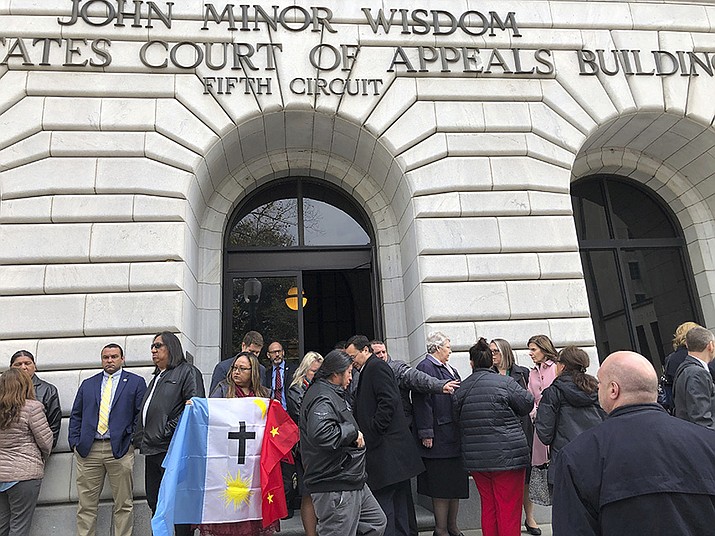
Rosa Soto Alvarez, of Tucson,, holds a flag of the Pascua Yaqui Tribe as she and other Native Americans stand outside the federal appeals court in New Orleans Jan. 22, 2020. Parts of a federal law giving Native American families preference in the adoption of Native American children were effectively struck down April 6, 2021 by a sharply divided federal appeals court, a defeat for Tribal leaders who said the 1978 law was important to protecting their families and culture. (AP Photo/Kevin McGill)

Rosa Soto Alvarez, of Tucson,, holds a flag of the Pascua Yaqui Tribe as she and other Native Americans stand outside the federal appeals court in New Orleans Jan. 22, 2020. Parts of a federal law giving Native American families preference in the adoption of Native American children were effectively struck down April 6, 2021 by a sharply divided federal appeals court, a defeat for Tribal leaders who said the 1978 law was important to protecting their families and culture. (AP Photo/Kevin McGill)

FLAGSTAFF, Ariz. — When the U.S. Supreme Court hears oral arguments Nov. 9, 2022 on an Indian Child Welfare Act case, Brackeen versus Haaland, its decision will decide the constitutionality of the act, which has been in place since 1978.

In February 2022, the U.S. Supreme Court announced it would hear a challenge to ICWA.

Texas, Indiana, Louisiana and other plaintiffs argued that ICWA is unconstitutional saying the act violates provisions of the Fifth Amendment that deal with equal protection and the Tenth Amendment’s prohibitions on issuing direct orders to states. The act says that Tribes are given the authority to decide adoption placement of Native children and states must comply.

While the appeals court ruled in April 2021 that Congress had authority to enact the law and that ICWA did not violate equal protections because it is not a race-based calculation, the Court of Appeals for the Fifth Circuit ruled that provisions of the act violate the 10th amendment because it “imposes” duties on the states, according to Scotusblog, a blog devoted to covering the U.S. Supreme Court comprehensively.

The U.S. government originally enacted ICWA in 1978 because of the large number of Native American children public and private agencies removed from their homes.

The act was designed to preserve Native American culture and heritage by giving Native American children and tribes a say in what happens to those children by establishing minimum standards for the removal of Native American children from their families. The act established a preference that Native children who are removed from their homes be placed with extended family members or in Native foster homes.

“Some who fiercely assert the evils of ICWA contend that all children should be treated equally and, therefore, ICWA should be dismantled,” said Terry Cross, former executive director of the National Indian Child Welfare Association (NICWA), in 2013. “This argument sounds reasonable to those unfamiliar with the long history that led to ICWA’s passage. At that time 20-30 percent of all American Indian children were removed from their homes…80 percent were placed, often permanently, in white homes.”

On Aug. 19, the National Council of Urban Indian Health, and five urban Indian organizations signed on to the National Indigenous Women’s Resource Center’s amicus brief to the Supreme Court in support of the constitutionality of the act, according to Indian Country Today.

An amicus brief, commonly known as ‘friend of the court’ is filed on behalf of an entity who is not one of the main parties in a case.

In the lower court, 486 Tribal Nations, 59 Native organizations, 31 child welfare organizations, 26 states and Washington D.C. and 77 members of Congress offered support for ICWA.

“These supporters recognize that ICWA is firmly in the best interests of Native children,” said a NICWA press release. “In keeping them connected to their extended family and cultural identity, the positive outcomes are far-reaching and include higher self-esteem and academic achievement. Further, they recognize that collaboration between sovereign Tribal nations and state child welfare systems is effective and just governance.”

University of Kansas professor Sarah Deer, filed an amicus brief with the court, with attorneys Mary Kathryn Nagle and Shoney Blake on behalf of two women who were adopted by white families, pre-ICWA, and struggled throughout their lives to reconnect with their tribal nations.

Deer works at the University of Kansas in the Department of Women, Gender and Sexuality Studies and the Public Affairs and Administration. She is also a MacArthur fellow and an inductee into the National Women’s Hall of Fame and is credited for her role in the 2013 reauthorization of the Violence Against Women Act.

Deer said Brackeen is the first Supreme Court case to address ICWA since Adoptive Couple v. Baby Girl in 2013.

In that case, a Cherokee father was ultimately ordered by the Supreme Court to turn over his biological daughter to a couple who sought to adopt her after the court decided that ICWA played no role in the case.

“There is more at stake in this case, however, because one of the questions to be resolved is whether ICWA is constitutional at all,” Deer said. “In other words, the Supreme Court could overturn ICWA.”

While people assume the purpose of ICWA is to take Native children away from white foster or adoptive parents, Deer said that typically happens only if ICWA is not followed from the beginning and/or is deliberately ignored.

“Native children in state court deserve to have their Nation involved in any long-term decisions about custody arrangements,” she said. “And ICWA is considered ‘gold-standard’ by numerous child advocacy groups, who appreciate the value of connecting Native children with their heritage and citizenship.”

Deer said the current numbers and make-up of the court make her worry what the outcome of the ruling may be.

“I’m trying to stay optimistic, but this particular court seems somewhat hostile to tribal nations,” Deer said. “In addition, Justice Roberts and Justice Coney Barrett are adoptive parents [of non-Native children]. As such, they may bristle at any argument that questions the value of adopting children outside the tribal nation. [Justice] Clarence Thomas also has a history of suggesting — in dissents — that all Indian law is potentially unconstitutional.”

Oral arguments are to take place Nov. 9. The Supreme Court will issue a decision by June 30, 2023.

Indian Country Today contributed to this report

SOURCE

Thursday, September 22, 2022

How tribal placements benefit Native foster children’s health #PROTECTICWA


Allowing children from these communities to be placed through state foster care when there are family or tribal members to take them in dissociates children from their culture and perpetuates the harmful effects of decades of state and federal policies that enabled removal of Native children from their families and tribes.

Because evidence shows that children’s mental and physical health are best served when placed with a family or tribal member, the Litigation Center of the American Medical Association and State Medical Societies and the American Academy of Pediatrics (AAP) are urging the U.S. Supreme Court to uphold the Indian Child Welfare Act (ICWA) of 1978.

The law—passed in response to decades of laws that took children away from their families and tribes and promoted forced assimilation—says that a child’s extended family is the first preference for adoption, followed by members of the child’s tribe. In the case before the U.S. Supreme Court, Haaland et al. v. Brackeen et al., seven people, along with Texas, Louisiana and Indiana are challenging the ICWA’s provisions as race-based discrimination infringing on state sovereignty.

“Invalidating ICWA risks returning far too many children to the assimilationist realities of the past. The historical trauma that so many already suffer would be compounded and magnified with fresh loss. Preserving ICWA, however, protects the critical familial and tribal support networks” that American Indian and Alaska Native “children need to thrive,” says the amicus brief filed with the Supreme Court (PDF) by the AAP and AMA Litigation Center.

Find out more about the cases in which the AMA Litigation Center is providing assistance and learn about the Litigation Center’s case-selection criteria.


Tuesday, September 13, 2022

Supreme Court anti-Native decision sets stage for Tribal-State conflict

September 8, 2022 | By Albert Bender People's World peoplesworld.org

“States have no criminal jurisdiction in Indian Country over crimes by Indians against anyone or crimes by non-Indians against Indians. Crimes by Indians are punishable either by the tribe or the federal government, and crimes by non-Indians against Indians are punishable exclusively by the federal government.” Williams v. United States (1946)

The above passage is from the much-esteemed book, American Indian Law, by William C. Canby Jr., Senior Judge of the U.S. Court of Appeals for the Ninth Circuit. Canby was a former Director of the Office of Indian Law of the Arizona State College of Law and a foremost authority on Federal Indian law. The ruling cited by Judge Canby is quite clear— and on point—in reference to states and criminal jurisdiction regarding crimes committed by non-Indians against Indians in Indian Country.

On June 29 of this year, the Supreme Court issued a decision striking an unprecedented body blow against the Tribal sovereignty of Indigenous nations. The retrograde Court ruled in the case of Oklahoma v. Castro-Huerta, that states have concurrent jurisdiction with the federal government in crimes of non-Indians against Indians on Tribal lands.

The Court stated in its inflammatory decision that Indian Country is part of state territory. This is incredibly shocking and betrays an apparent complete ignorance of Federal Indian law.
As an attorney whose specialty is federal Indian law, and having practiced on a number of reservations, I shall review the recent Supreme Court decision from the standpoint of its most basic egregious errors, while also scrutinizing the ruling from the perspective of the scathing dissent issued by Supreme Court Justice—and Indian law authority—Neil Gorsuch.

The general foundational rule is that state jurisdiction is limited to those crimes that do not concern Indians or Indian interests. Hence, state jurisdiction is limited to crimes committed by non-Indians against non-Indians in Indian Country. Otherwise, the state has no authority on Tribal lands absent Congressional authorization. This is clear and unambiguous.

But it must also be kept in mind that Federal Indian law is filled with ambiguities, uncertainties, inconsistencies, and nuances, more so than any other body of law in the entire United States. However, this discourse addresses the more salient errors and lack of knowledge, history, and law embodied in the Court’s latest excursion into Indigenous jurisprudence.

As Long as the Waters Flow by Allan C. Houser
As Long as the Waters Flow by Allan C. Houser (Apache) stands outside the Oklahoma State Capitol Building in Oklahoma City. Photo: Ann W

Supreme Court decision foreshadows Tribal-State conflict

The decision written by Justice Kavanaugh, who has no Indian law background, is an engagement into the most labyrinthine twists and turns of Byzantine sophistry in a sordid, awkward attempt to pull the proverbial “rabbit out of the hat.” It is a clear violation of long established Federal Indian law.

The granting of states the right to intrude on Native lands in this respect has no basis in case law, or in the enshrined tenets of statutes and case law, beginning with the Indian Trade and Intercourse Act of 1790, to the much heralded decision of Worcester v. Georgia issued by the John Marshall Court in 1832. This set the standard of a nation-to-nation relationship between the Tribal nations and the United States. The Marshall Court stated that the “treaties and laws of the United States contemplate the Indian territory as completely separated from that of the states.”

The ruling rendered in Oklahoma v. Castro-Huerta purports to give the states a foothold in Indian Country. The legal reasoning asserted in this decision is stunningly faulty; indeed, one has to strain to try to make sense of it, and still to no avail.

I shall begin with an issue that is a supporting core of Kavanaugh’s ruling that is curiously not directly addressed by Justice Gorsuch. Justice Kavanaugh asserts as one of the foundations of his errant opinion, that Indian Country is part of and not separate from state territory. That would be equivalent to saying that New York is part of Pennsylvania, or Ohio is part of Indiana. Both are, of course, separate political entities. A state is defined as a territory with its own government and borders within a larger country.

Justice Kavanaugh’s assertion that a reservation is part of state territory lowers Tribal land to a subordinate status and takes away the nation-to-nation status vis-à-vis the federal government proclaimed in Worcester. Federal Indian law has held for over 200 years that reservations are separate from the states. This is founded on treaties, statutes, and case law that the Tribes are sovereign nations with only Congressional limitations.
In reference to the Worcester decision, that states have no jurisdiction in Indian Country, Kavanaugh’s retort is that at the time of the ruling territorial separation was the reason that state authority did not extend to Tribal lands. He advances that in the early 1800s Indian Country was separate from the states, therefore state law did not apply. Kavanaugh has no idea of what he is talking about, as he has no knowledge or grasp of history.

Georgia was already a state in the Worcester case of 1832 and had been for decades. There was no territorial separation between it and the Cherokee Nation. The Cherokee Nation was geographically within the boundaries of the states of Georgia, Tennessee, North Carolina, and Alabama. Since there was no territory separating those states from the Cherokee Nation, such an argument is absurd. There was a national boundary between those states and the Cherokee Nation based upon treaties with the federal government of the United States.

Keep in mind that Kavanaugh, throughout his bumbling opinion, never explains what he means by “territorial separation.” We are left to draw our own reasonable, logical conclusion.

Moreover, the case of Organized Village of Kake v. Egan (1962)—which Kavanaugh professes as supporting his argument that reservations are part of states—is inapplicable because the language in regard to state authority is dicta and, therefore, non-binding. Further, it is irrelevant because the land involved in that case was neither a reservation nor under a treaty.

Kavanaugh further states that the Worcester ruling of Indian Country as separate from the state was abandoned in the 1800s. He says “that after that change, Indian Country in each state became part of the state’s territory.” What change is he referring to? Again, Kavanaugh provides no answer and makes no sense.

He continues to prattle on, throughout his opinion, that a reservation is part of a state while citing Kake, which again is pure dicta no matter how many times it is repeated, and cannot rise to the level of binding precedent.

In reference to legitimate state authority, a state has general criminal jurisdiction over all persons including Indians, outside Indian Country. Inside Indian Country, the state’s jurisdiction is generally limited to those crimes that do not affect Indians or Indian interests. That has been the long-standing rule. However, it can be clearly seen that non-Indian crimes against Indians affect and concern Indians and Indian interests. Hence, the long-standing prohibition against state involvement, in accordance with Federal Indian law, has to be maintained. It is also good to keep in mind another general rule: The state has exclusive jurisdiction over crimes committed by non-Indians against non-Indians in Indian Country, as these are the only crimes that normally do not concern Indians or Indian interests. This is as simple as it should get and as simple as it should stay.

Gorsuch points out in his dissent that the Castro-Huerta decision is Oklahoma’s effort to exercise jurisdiction over crimes involving Tribal members on Tribal lands in violation of the decision of its own Court of Criminal Appeals. The Justice asserts that this has been an attempt to portray reservations as “lawless dystopias.” He also expounds that “the decision is unattached to any colorable legal authority.”

His dissent maintains that the Court has committed “astonishing errors”’ that are violations of clear principles of precedent, and argues that only Congress can make a change of the type and magnitude conferred on Oklahoma by the errant ruling. The majority opinion, propounds Gorsuch, is a ”string of carefully curated snippets—a clause here, a sentence there—from six decisions from a galaxy of the Court’s Indian law cases.” Gorsuch is unrelenting in his scorching criticism of this outlier ruling. The Court’s reasoning is “mistaken root and branch” he continued.

The Justice also delves into Oklahoma Indian history. He cites the famous groundbreaking volume by famed Oklahoma historian, Angie Debo, entitled And Still the Waters Run: The Betrayal of the Five Civilized Tribes, to illustrate that state officials and state courts defrauded the exiled Tribes of land and resources guaranteed by federal treaties. Gorsuch also cites the “deadliest of enemies” description from United States v. Kagama (1886) to further indicate traditional state enmity toward Tribal nations.
The dissent notes that “in the decades following statehood, many settlers engaged in schemes to seize Indian lands and mineral rights by subterfuge.” Gorsuch explains that these schemes resulted in the bulk of the landed wealth of the Indians ending up in the hands of the new settlers, and that state officials and courts “were sometimes complicit in the process.” I would add that this happened more than “sometimes” considering that the vast amount of Oklahoma Indian land was taken in stolen allotments.

For Kavanaugh to continue claiming that Indian Country is part of the state is inflammatory and provocative language that will foster further conflict and confrontation in Tribal-State relations. Some tribal communities are already pondering whether the decision means that state police will enter reservations patrolling and policing for non-Indian law violators. Will the ruling foster state jurisdictional intrusions into Indian land and interests?

Will the Court’s decision “that Indian Country is part of a state and not separate from it” be tested by an overzealous state to further this intrusion into Indigenous sovereignty?

Supreme Court decision is part of a conservative political agenda
The Supreme Court ruling has less to do with law, than with the conservative majority’s pursuit of an energized right-wing political agenda. Its anti-Indian sovereignty ruling will join a conservative cavalcade of other regressive decisions seen previously with abortion rights, the Environment Protection Agency’s (EPA) authority to control carbon emissions, the separation between church and state, and restricting Miranda rights.

The potential ramifications are huge and far-reaching. It shall remain, for the time being, a decision issued in infamy and best described by Gorsuch as “an embarrassing new entry into the anticanon of Indian law.” Tribal nations must be prepared to combat this judicial onslaught—and any more to come—from this Court’s conservative anti-Native agenda.

As with all op-eds published by People’s World, this article reflects the opinions of its author.

U.S. Supreme Court Decision in Oklahoma v. Castro-Huerta
Syllabus | Opinion [Kavanaugh] | Dissent [Gorsuch] | Complete Document

U.S. Supreme Court Documents in Oklahoma v. Castro-Huerta
Questions Presented | Docket Sheet: No. 21-429 | Oral Argument Transcript | Day Call


Albert Bender is a Cherokee activist, historian, political columnist, and freelance reporter for Native and Non-Native publications. He is currently writing a legal treatise on Native American sovereignty and working on a book on the war crimes committed by the U.S. against the Maya people in the Guatemalan civil war He is a consulting attorney on Indigenous sovereignty, land restoration, and Indian Child Welfare Act (ICWA) issues and a former staff attorney with Legal Services of Eastern Oklahoma (LSEO) in Muskogee, Oklahoma.

This article originally appeared on People's World. It is published under a Creative Commons license.

click

Contact Trace

Name

Email *

Message *

NO MORE UPDATES

GO TO:  https://blog.americanindianadoptees.com/  for updates and news. THIS BLOG cannot be updated...