BLOGGER changed, not allowing us to UPDATE this back-up blog

(UPDATED 726/2025) issues with blogger are preventing this
Showing posts with label Sovereignty 101. Show all posts

Friday, September 27, 2024

Tocabe ships frozen meals ‘anywhere in the lower 48’

Tocabe is an Osage-owned Indigenous restaurant and online store founded by Ben Jacobs, and this year they’ve released a line of ready-to-eat, elevated frozen meals. The ready-made meals are made with Indigenous-sourced ingredients

Tocabe launched its Indigenous marketplace this year, selling Native foods to the mainstream.  Microwaveable meals for adults and children are among the shippable products sourced from Native producers.  Tocabe also expects a spike in orders beginning with Indigenous People’s Day on Oct. 14 and continuing through Native American Heritage Month in November. 

Founder Ben Jacobs describes Tocabe’s Indigenous sourcing as “Native-first, local second,” meaning if a Native farmer or producer has a Native ingredient, Tocabe will source from them before relying on a local organic option.

“We source from Native producers growing and raising traditional foods, but also utilizing ingredients which have been introduced post-contact, as long as they are Native-produced,” added Katrina Salon, a representative for Tocabe.  For example, she said, “Wheat berries from Ramona Farms and olive oil from Seka Hills.” 

Tocabe created their Indigenous marketplace because they want Native food to be accessible.  Native food is not well understood, encountered or available, but Tocabe hopes to bring Native foods to everyone, Jacobs said. 

In addition to creating mainstream access to Indigenous foods, Jacobs also aims to support Indigenous economic development.  Tocabe does this by supporting the development of Native farmers, ranchers, and food producers who are building “an equitable, sustainable and innovative food system … benefitting American Indian communities.”

Tocabe’s Indigenous marketplace has products for sale from such ethical Native producers for customers to use in their own cooking – or, they can order ready-made meals in bulk bundles or individually. In a children’s line called Little Harvest, Tocabe has options like blue corn pancakes, spaghetti and bison meatballs and French toast.  In the adult line of meals, there are “elevated” options like iko’s green chili stew.

One Harvest Meal option is the “bison Sonora bowl,” which has a wheatberry and white tepary bean blended with roasted squash purée, nopales, zucchini and Navajo-grown pinto beans, with braised bison and a chili sauce.  Meal bundles include the “Best of Bison” bundle, with the bison Sonoran bowl alongside bison chili, bison posu, sausage posu, wild rice jambalaya and a “sausage sunset” – similar to the Sonoran, but with roasted yams, bison sausage and other variations in sauce and the type of beans.  

The meals do have some preservatives, Salon said, due to some of the ingredients they include in their ready-made meals.  But Tocabe does not add any additional artificial or synthetic preservatives, according to Salon.

The company has scaled-up their distribution and they’re ready to fill all the orders they’re expecting through the fall, said Salon.  From home cooks who want to source Indigenous ingredients for their Thanksgiving menus to busy professionals who want fast, nutritious options for dinner, Tocabe is hoping to be one of the options that comes to mind.

Their frozen Indigenous meals can be prepared with a microwave, in the oven, or by heating in a sauté pan after defrosting.  To give one of the ready-made meals a try – or to order Indigenous-sourced ingredients – visit https://shoptocabe.com/.    

STORY: https://osagenews.org/tocabe-ships-frozen-meals-anywhere-in-the-lower-48/?utm_source_platform=mailpoet

Wednesday, April 19, 2023

Part Five: What if We Lost ICWA | Our Sovereignty


The plaintiffs, Brackeens, assert ICWA is an unconstitutional law

PART 5: 
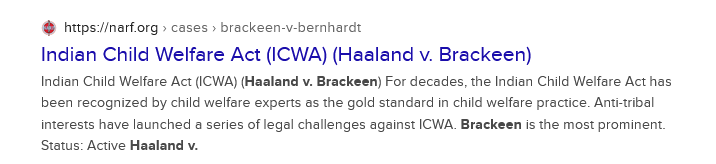
Haaland v. Brackeen

By Trace L Hentz, blog editor and adoptee

Am I worried about the ICWA case? Yes. Very.

I am worried that the "Supreme" Court has shown no respect for our inherent sovereign rights.  Just look at history.  This case could rescind the Indian Child Welfare Act of 1978.  I worry the impact on adoptees now and future Native adoptees.  (ICWA allows adoptees to open their adoption records.)  We are called The Stolen Generation and Sixties Scoop for good reason.

We lost our sovereignty when we were adopted out to white families.  We lost everything - language, culture, land, family, ceremonies and our tribal stories.  (Some of us lost our sanity too!)  Swimming pools, college degrees, and white families in fancy houses, cannot replace this.

Sadly, I do not think these Justices actually know what our loss means!

Many years ago in Wisconsin, two tribal chiefs gave talks to new congresspeople on Sovereignty 101- I interviewed them about it and then wrote an article in News from Indian Country.  They explained it used to be feds (the federal government) that dealt with tribes and the feds were keenly aware of sovereign tribal rights and history.  Both chiefs said state lawmakers were not as understanding.  There was also high turn-over in states and many new congressmen don't know state or federal history, even how tribes signed numerous treaties.

The Department of WAR (who authorized killing Indians) morphed eventually into the Department of the Interior.


I looked back at my blog posts: Sovereignty and how it applies to Haaland vs. Brackeen.

As Rebecca Nagle explained: "A host of federal statutes—including on land rights, water rights, health care, gaming, criminal and civil jurisdiction, and tribal self-governance—treat Native Americans differently based on this political classification.  In this light, I fear that the Brackeen lawsuit is the first in a row of dominoes—if the Court strikes down ICWA, everything else could soon go with it."

"Under federal law, tribes and tribal citizens are not a racial group, but a political one.  Accordingly, ICWA applies only to Native children who either are enrolled in a federally recognized tribe or are eligible based on a given tribe’s citizenship requirements," Nagle said. 

And this:

This cultural difference — that a family’s fitness is determined by its wealth, and that those concerns should outweigh a child’s connection to their family and heritage — is essentially why the Indian Child Welfare Act was created in 1978.  The law recognizes the history of federal policy aimed at breaking up Native families and mandates that, whenever possible, Native families should remain together.

Sarah Kastelic, the executive director of the National Indian Child Welfare Association, said that ICWA acknowledges important familial and tribal bonds that have long been disregarded, and that Native ways — such as extended families living under the same roof — have often been used to show unfitness in child welfare proceedings. “No matter the picket fences and swimming pools and things, most of the time, kids want to be with their families,” she said.

READ: The Native adoption case that could dismantle the Indian Child Welfare Act, explained - Vox


THE INTERIOR AND INDIAN AFFAIRS:


👇This is a bit technical but it is the argument the Justices are deliberating:

"What's Missing in the Brackeen Argument: An Indian Affairs Clause"

|

I was chatting with Prof. Lorianne Updike Toler (Northern Illinois), and she mentioned some thoughts of hers on this subject, based on her recent University of Chicago Law Review article, The Missing Indian Affairs Clause. I encouraged her to write up a blog post, and she kindly passed along the following:

In the November 9th oral argument for Haaland v. Brackeen, which challenges the constitutionality of the Indian Child Welfare Act, Justice Amy Coney Barret's question about the impact of overruling Congress' plenary power over tribes underscores a centuries-old confusion about federal Indian Affairs.

It's not just the Court that is confused.  Former Volokh Conspiracy posts on point reveal the deep academic fissures over the historical context of the Indian Commerce Clause.  Unknown to the Court and most of academe is the root cause of all the confusion: that the Constitutional Convention initially forgot (and then later intentionally excluded) the Articles of Confederation's Indian Affairs Clause in the Constitution.

As I detail in this University of Chicago Law Review article, Pennsylvanian comparative constitutionalist James Wilson, tasked by the five-member Committee of Detail to draft the Constitution, initially checked off "Indian Affairs" to include as a Congressional power, but then failed to get the power into his final draft.  He was not the only one to forget.  Although the Convention had commissioned the Committee to include all the Congressional powers in the Articles of Confederation (where Indian Affairs featured), Edmund Randolph also forgot to include the power in his initial sketch of the Constitution.  Odd, considering a Cherokee chief had met with him that summer in Philadelphia and he was then directly concerned with settler-tribe disputes on Virginia's frontier as the state's governor.  It was John Rutledge, the South Carolinian chair of the committee, who remembered, scrawling the power in the margin of Randolph's sketch. Yet he later forgot this power in combing through Wilson's final draft, and it was reported out of the Committee sans (without mentioning) Indian Affairs.

But James Madison remembered.  It was he who suggested Indian Affairs be inserted back into the Constitution.  This time, the Committee of Detail intentionally excluded the Clause, instead inserting "Tribes" into the Commerce Clause.  No one objected.  This despite that at least three Convention members had just spent their ten-day break (for the Committee of Detail to meet) fulfilling their congressional duties in New York.  There, impending tribal wars in Virginia and Georgia's Creek disputes were discussed.  Presumably, the Convention thought Congress' previous powers under the Article's Indian Affairs were addressed by the Indian Commerce Clause and other provisions of the Constitution—such as the power to declare war and peace and the president's shared Treaty Power.

What does this mean for the Constitution? Put simply, Congress has no Indian Affairs power, and therefore no plenary power. Early assertion of this power was justified under the tripartite powers of Indian Commerce, War and Treaty Powers. But Congress halted tribal treaty-making long ago.  If it wants to re-assert power over tribes beyond the Commerce Clause, the President needs to begin treating with tribes again.

And what of any residual power? As I propose in my article linked above, the residue reverts to the sovereign tribes. Tribal sovereignty is to tribes what federalism is to the states. Powers not reserved by the Constitution to Congress and the President revert to the tribes.

This would mean that Congress lacked constitutional power to pass ICWA, however well-intentioned.  ICWA was adopted in an attempt to prevent Native American erasure by allowing the community to intervene in adoption and foster cases to ensure tribal children are raised in Native American families.  ICWA grants the child's tribe exclusive jurisdiction over custody proceedings and other intervention privileges.  Further, it establishes placement preferences first in favor of any family members, then the tribe, and then any Native American families regardless of tribal membership.

Unless related to its Indian Commerce power (and heaven forbid if we have arrived at treating adoption of babies and children as commerce), Congress has no power over Native American adoptions. On this basis, ICWA might be unconstitutional wholesale.  However, to the extent ICWA respects tribal sovereignty and refers cases to the child's tribe, it may be constitutional under a structural reading of the Constitution:  The combined intratextual references to tribes as the constitutional unit of recognition— "tribes" under the Commerce Clause and the presumption that Indians are not taxed under Art I. sec. 2 of the Constitution—together with the parallel analog of federalism vis-à-vis states may permit Congress to proactively proscribe federal and state deference to tribal power.  But as Congress has no plenary power over tribes and Native Americans as a people, it cannot specify adoption placement or other preferences.  The Court should so rule in Brackeen.

👇👇👇This gives me hope:


read:

Native American Law and Sovereignty Institute, “Expert Q&A: Professor EagleWoman Explains Important ICWA Case Heading to Supreme Court,” March 10, 2022, Mitchell Hamline School of Law, n.d., https://mitchellhamline.edu/native-american-law-and-sovereignty/2022/03/10/expert-qa-professor-eaglewoman-explains-important-icwa-case-heading-to-supreme-court/. 

(to be continued)


click

Contact Trace

Name

Email *

Message *

NO MORE UPDATES

GO TO:  https://blog.americanindianadoptees.com/  for updates and news. THIS BLOG cannot be updated...