The Sámi (/ˈsɑːmi/SAH-mee; also spelled Sami or Saami) are the traditionally Sámi-speaking indigenous peoples inhabiting the region of Sápmi, which today encompasses large northern parts of Norway, Sweden, Finland, and of the Kola Peninsula in Russia. The region of Sápmi was formerly known as Lapland, and the Sámi have historically been known in English as Lapps or Laplanders, but these terms are regarded as offensive by the Sámi, who prefer their own endonym, e.g. Northern Sámi Sápmi.[8][9] Their traditional languages are the Sámi languages, which are classified as a branch of the Uralic language family.
Skolt Sámi Heini Wesslin did not learn about her culture – now she hopes that truth and reconciliation process changes education
The recently founded Truth and Reconciliation Commission aims at
acknowledging and assessing the wrongs done against the Sámi in
Finland. Two Sámi tell now about their experiences and what they expect
of the Commission.
Yle Sapmi | November 30, 2021| By Inger-Elle Souninen
For Skolt Sámi Heini Wesslin, loss of language has been the
tough issue in her life, while Inari Sámi Rauni Mannermaa still feels
the burden of her days in a dormitory.
The stories and experiences of Wesslin and Mannermaa are
familiar to the Sámi. The old events that still cause pain for the next
generations would presently be considered serious violations. The
purpose of the Truth and Reconciliation Commission is to look at these
issues now.
After years of preparation, the historical Sámi Truth and
Reconciliation Commission has started its work. The objective is to
acknowledge and assess the wrongdoings that have been, and are still
being, done against the Sámi. In addition, the Commission also aims at
admitting and assessing the State’s assimilation policy and violations
of rights.
The report of the Commission is to be submitted by the end
of November 2023. Before that, the Commission has an enormous amount of
work to do. The variety of experiences and expectations equals the
number of people, but there is a common history behind them all.
Returned home when she got children
Heini Wesslin lives in the village of Sevettijärvi in the
northeastern part of Inari Municipality. There is a strong sense of
Skolt Sámi community in the village, and the local language and culture
play a central role in Wesslin’s everyday life. But this has not always
been the case.
When Wesslin was six, her family moved from her parent’s
home village Sevettijärvi to Utsjoki. Wesslin got her primary and
secondary education there. Although Utsjoki is in the Finnish Sámi Area,
it is not the home region of the Skolt Sámi. Thus Wesslin did not get
to learn about the Skolt Sámi and their culture at school.
Later, life and studies took Heini Wesslin to Helsinki,
Inari and Rovaniemi. Finally, twelve years ago, she returned to
Sevettijärvi. She moved there above all because she wanted to give her
children a sense of belonging from the very day they were born.
“Despite the fact that I’ve lived in Sápmi, I have not
lived in my own community. Therefore, it felt natural and important to
move here.”
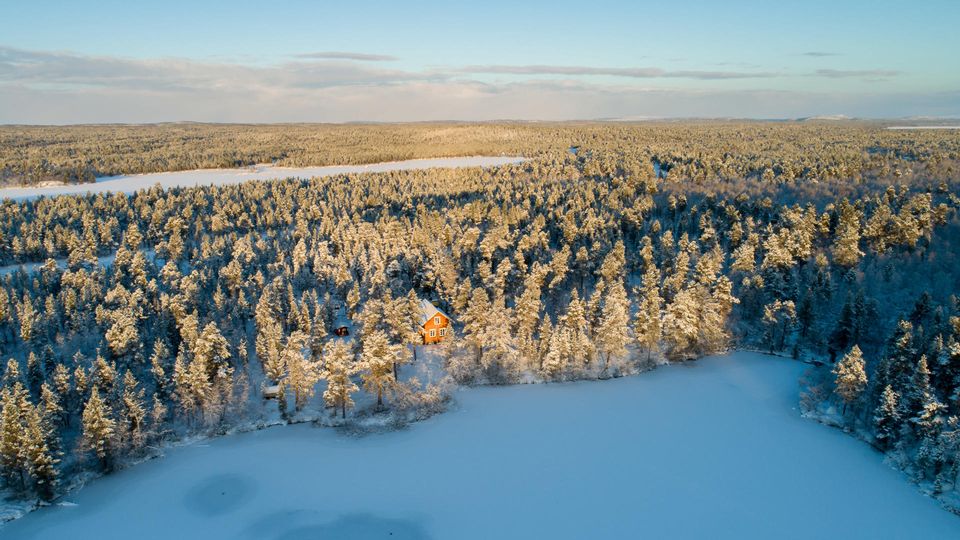
Heini Wesslin’s home is situated right on Lake Sevettijärvi. Photo: Vesa Toppari / Yle
The Skolt Sámi language has had a great impact on Heini
Wesslin’s choices in life. She did not learn her native language from
her mother, who believed that not knowing the language would make
Heini’s life easier. But Heini began to study the language as soon as it
was possible.
At first, speaking the language was difficult for Heini
Wesslin: she felt that she should already know the language. Today, she
accepts that she does not always speak correctly, but at least she uses
the language.
She speaks Sámi with her children. The children speak Skolt
Sámi also with their grandmother, but for Wesslin herself it does not
yet feel natural to speak the language with her mother.
“It’s extremely difficult to switch languages with certain people.”
Used handicraft to connection with culture
At present, Heini Wesslin knows the language and lives in a
community with a strong Skolt Sámi culture. However, she has sometimes
bad feelings about not having learned the language as a child.
“I’ve thought a few times that I could also be doing
something else in the evenings instead of conjugating Skolt Sámi verbs
via Teams.”
At first, Wesslin used doing Sámi handicraft, or duodji, to build up a connection to her culture.
“There’s also another language I speak: duodji.”
Many people know Heini Wesslin as a skilled craftmaker.
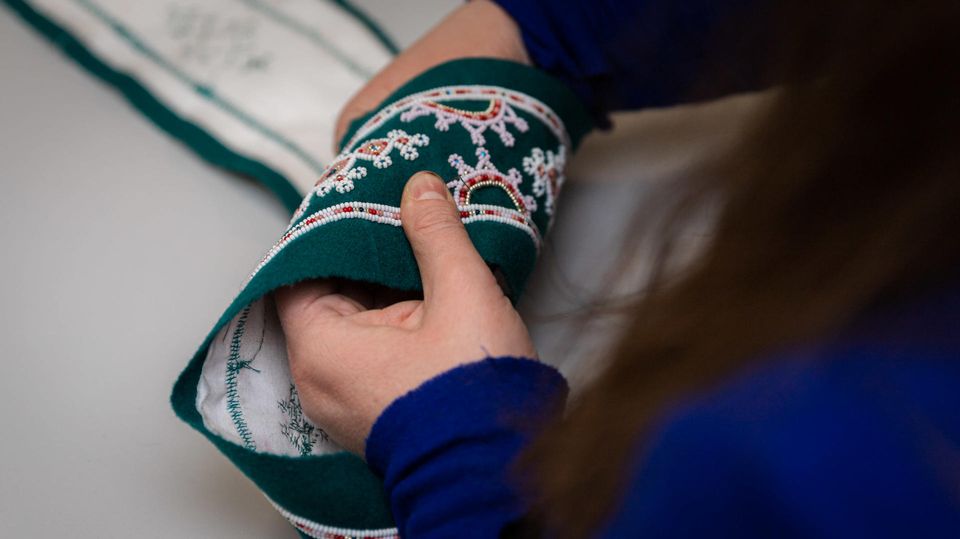
Beadwork is an important part of Skolt Sámi culture. Photo: Vesa Toppari
/ Yle
Wesslin began to wear the traditional Sámi clothing after
her secondary education. She had crafted the Skolt Sámi dress together
with her grandmother. Wearing Skolt Sámi clothing, finally, evoked many
feelings in her.
“It was an important thing. I didn’t have a very strong sense of belonging then. It took a while to feel part of the community.”
At present, she makes the clothes for both her children and
parents, helping them wear them. Wesslin’s parents belong to the
generation who had to stay in dormitories, so they never learned to wear
the traditional clothing. When Wesslin dressed her children in Skolt
Sámi clothing, her parents also dared to start wearing it.
Today, she is a carrier of culture – as a result of many
conscious choices. She did not get to learn about her culture at school,
but hopes that everyone will have the opportunity in future.
“The biggest problem is that we’re not allowed to learn
about ourselves. We learn the history and way of thinking of the
dominant culture.”
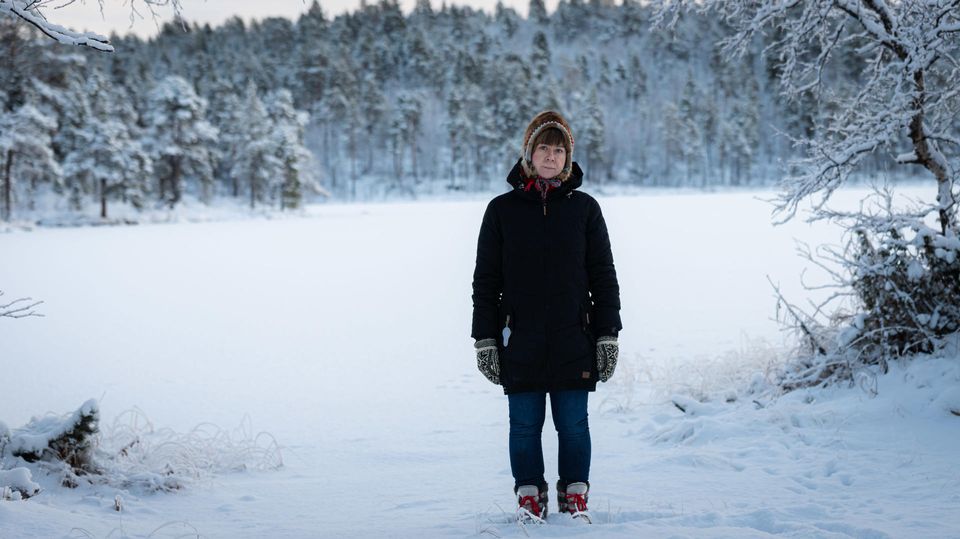
Wesslin believes that if the truth and reconciliation
process is carried out properly, it will benefit everyone. Photo: Vesa
Toppari / Yle
Wesslin hopes that the work of the Truth and Reconciliation
Commission will change the situation and that the process will be
careful and carried out on the terms of the Sámi. She hopes that the
process will lead to changes both in health and social care and in the
School.
Wesslin feels that this process of looking at history will
also help the main population to understand its own history. The past
may reveal answers that can help maintain the culture in future, too.
“If the process is carried out properly, we’ll all win.”
Both good and bad memories from school
Rauni Mannermaa was born into an Inari Sámi family on the
Katsomasaari Island on Lake Inari in 1940. When she was four years old,
her family was evacuated further south in the autumn. They were allowed
to return home the next spring. Despite the war, everything was intact
on the island.
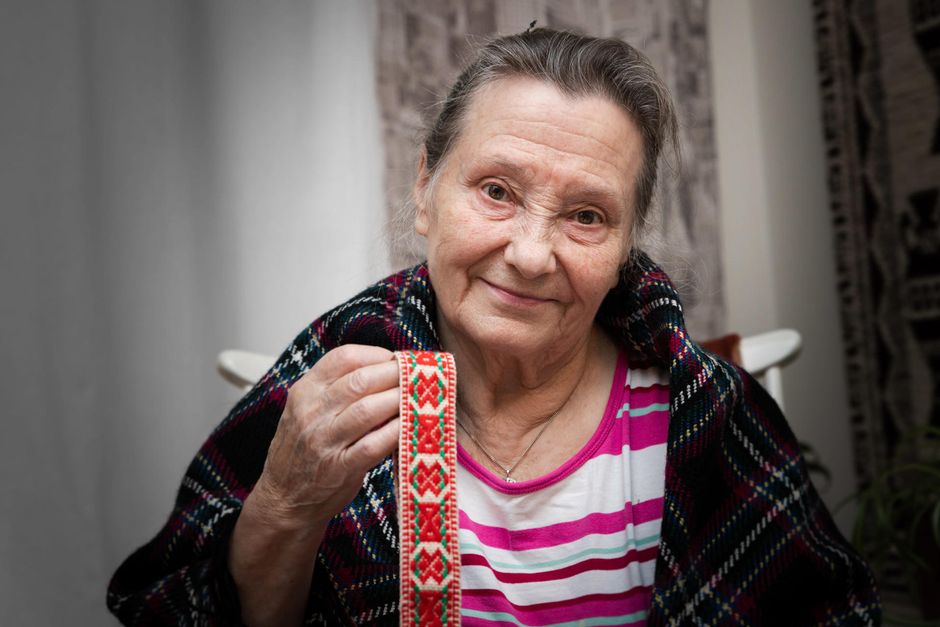
Rauni Mannermaa, who was evacuated at an early age, did
not get to use or learn her native language at school, but sees things
nevertheless positively. She would rather let bygones be bygones. She
still has the first woven handicraft that she made with her mother.
Photograph: Vesa Toppari / Yle
As soon as the next winter, Mannermaa’s life changed again
dramatically. She fell ill and had to be taken to the village of Nellim
25 km away from home. From there, she was supposed to continue to the
hospital. However, she got well, but there was no one to take her home,
as it was not easy to travel in those days. The only possible means was
being pulled by a reindeer. She thus stayed in Nellim and started school
at the age of five, sitting in on classes at first.
Because of long distances, schoolchildren had to stay in
dormitories. They got to go home only for Christmas and summer.
Mannermaa has both bad and good memories of the period.
Mannermaa recalls how pupils could be punished physically
both in the school and the dormitory. She remembers how they once pulled
her by her hair so that her fringe came loose and there was a hairless
spot on her skull. The reason was that the teacher thought she had
talked in the evening after the pupils were supposed to be silent.
The schoolchildren of Nellim School. Rauni Mannermaa is
on the right in the first row, in a white blouse. Photo: Vesa Toppari /
Yle
Mannermaa feels that being punished filled a child with shame even if they had done nothing wrong.
There are also worse memories, but Mannermaa chooses not to talk about them. The worst matters have also been tried in court.
“It was a long time ago, and the wrongdoers have been convicted. I don’t want to go into the worst things.”
The children never talked about their experiences at home.
They had already forgotten them by the time they got home. There, they
just wanted to enjoy being at home again.
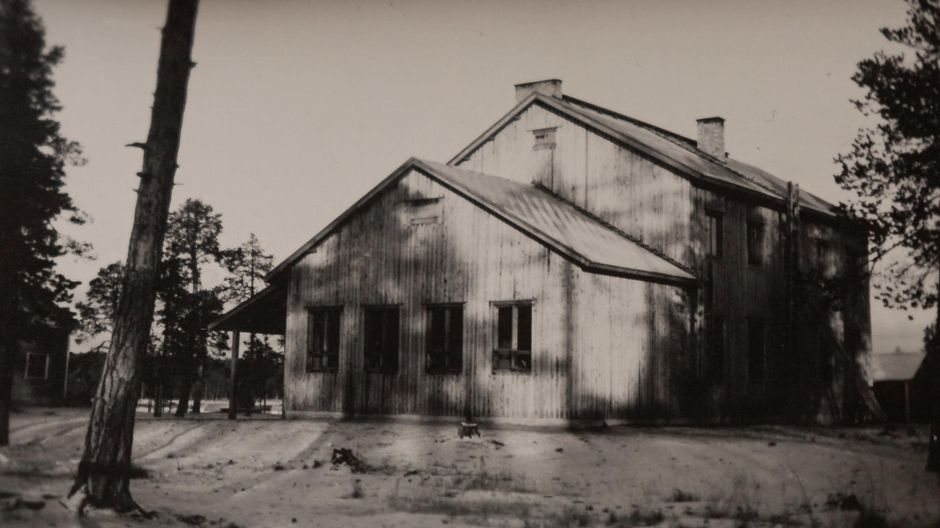
The dormitory in Nellim, which was initially also used as a school. Photo: Vesa Toppari / Yle
No speaking in Sámi unless everyone understood
There were strict rules both in the school and the
dormitory, and no Sámi was spoken there. The personnel made it clear
that no Sámi could be spoken unless everyone understood it. The children
naturally obeyed the adults. Thus, they only spoke Sámi at home.
Not being able to speak the language lefts its mark.
Mannermaa has never learned to write in Sámi. As an adult,
Mannermaa began to study Sámi in Inari, but quit the course as the
distance from home to Inari was so long.
Mannermaa hopes that the Truth and Reconciliation
Commission will take into consideration the people who wish to learn the
language. Her view is that the State should have provided, and still
should provide, support for studies in Sámi to those who did not get to
learn their native language at school.
“I feel that the State should’ve given us resources.”
In addition to support for language studies and the
acknowledgement of school-time experiences, Mannermaa hopes that the
Commission’s work will lead to equality between all the Sámi – no matter
which group of Sámi they belong to and whether they have studied or
not.
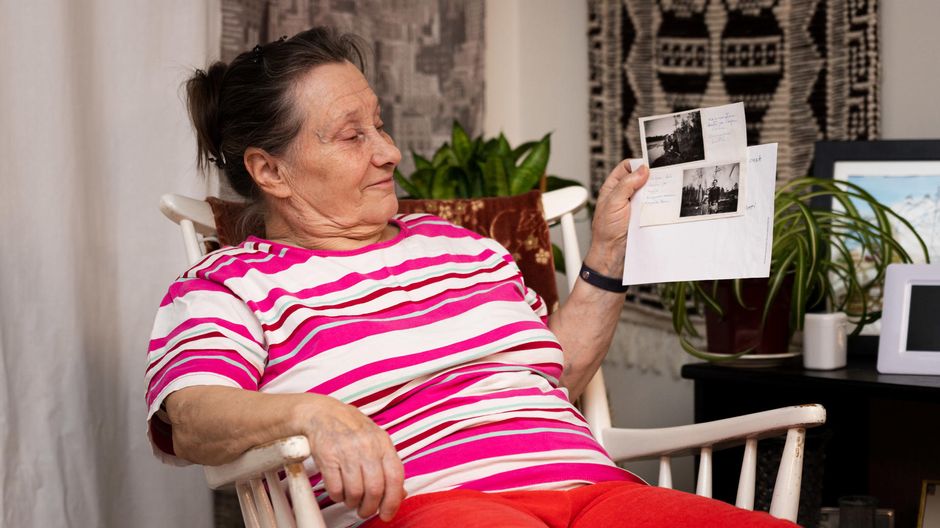
Rauni Mannermaa recently received a letter with old
photos of her parents, and herself and her sisters as children. Photo:
Vesa Toppari / Yle
Mannermaa says that people earlier felt ashamed of being
Sámi and avoided using their language. According to Mannermaa, this is
the reason why so many “turned into Finns”. However, she feels that
people have a right to their ancestry and culture even if their
grandparents have tried to hide them.
“It was not their fault. It was the period when they attempted to turn us into Finns,” Mannermaa says.
Commission has begun its work
The Sámi Truth and Reconciliation Commission of Finland met
for the first time in mid-November. The commissaries are Kari Mäkinen,
Hannele Pokka, Heikki Hyvärinen, Miina Seurujärvi and Irja Jefremoff.
Two of the commissaries were nominated by the Government of Finland, two
by the Sámi Parliament and one by the Skolt Sámi Village Meeting.
Senior Specialist Nina Brander tells that the Commission
will also choose a secretariat and chair for itself. In addition, the
Commission will have a monitoring group that consists of members who
represent parliamentary parties, the Sámi Parliament, the Skolt Sámi
Village Meeting, the Evangelical Lutheran Church of Finland and the
Orthodox Church.
When the Sámi Truth and Reconciliation Commission was
founded, the significance of its work was emphasised by Finnish Prime
Minister Sanna Marin at the briefing.
“This work is important because we need to transparently
look at what has happened in Finnish history and how the Sámi have been
treated, and still are treated, in Finland,” the Prime Minister said.
Translated from North Sámi by Kaija Anttonen
This article first appeared in Yle Sapmi and is translated and republished as part of a news sharing partnership with the Barents Observer