BLOGGER changed, not allowing us to UPDATE this back-up blog

(UPDATED 726/2025) issues with blogger are preventing this
Showing posts with label Bad History. Show all posts

Friday, April 4, 2025

New Science to Fight the Old Science

Ancient DNA Revolution September/October 2024

The Blackfoot Confederacy is today made up of four bands. The traditional lands of three of them, the Blood (Kainai), Piikani, and Siksika First Nations, are on the plains of southern Alberta, Canada, while the Blackfeet Tribe’s homeland is in northern Montana.  Many scholars have concluded that the confederacy is a relative newcomer to the High Plains.  Linguists classify the Blackfoot language as part of the Algonquin family, which includes many languages spoken by peoples living around the Great Lakes and on the Eastern Seaboard.  Since the nineteenth century, Euro-American anthropologists have argued that the ancestors of the people of the Blackfoot Confederacy must have originally lived near the Great Lakes.  At some point in the last millennium, they are thought to have migrated to the High Plains.  But the Blackfoot have no collective memory of a migration from the east.  Some of their stories do tell of a migration from the north that took place long ago, when giant beavers and camels still existed, but nothing in Blackfoot oral history matches the history anthropologists have written for them.  (I call that BAD HISTORY...)

A genetic study has now provided support for the Blackfoot people’s belief that they have lived on their traditional lands from time immemorial.  Working in partnership with the Blood (Kainai) First Nation and the Blackfeet Tribe, a team led by archaeologist Maria Zedeño of the University of Arizona and archaeogeneticist Ripan Malhi of the University of Illinois Urbana-Champaign analyzed DNA samples taken from six living members of the Blackfoot Confederacy and from the remains of seven ancestral Blackfoot. 

To their surprise, the researchers discovered that the Blackfoot did not share any genetic affinity with Algonquin groups, or, indeed, with any other Native American peoples.  Statistical analysis showed that the Blackfoot lineage probably broke off from other Native groups around 18,000 years ago.  The Blackfoot likely lived in relative isolation for millennia before interacting with Algonquin speakers.  These new insights into Blackfoot genetic heritage support recent linguistic research suggesting that the Blackfoot language has features that belong to an ancient language spoken by a people who lived in the Blackfoot Confederacy’s homeland.  These features are thought to have long predated the advent of Algonquin languages.

“This really confirms what we already knew,” says Gheri Hall, an archaeologist with the Blackfeet Tribal Historic Preservation Office, who notes that the genetic evidence could help the tribe in future legal cases involving land disputes. “Now we can use the new science to fight the old science.

Saturday, November 16, 2024

WRONG Side of History


OPINION: 

Halito! Chim Achukma? (Hello, how are you?)

It’s Native American Heritage Month again. I would like to discuss something that’s been endeared to me for some time.  I seek transparency, and I do not desire to be offensive in any way, but I’m on deck, and it’s my turn to bat.

This concerns school curriculums and at least offering ‘Native American’ studies as an elective.

We seldom hear anything about Native American history, and after all, we are Oklahoma and home to 69 tribes who were displaced here in the 1800s. The Oklahoma History course in school only skims the surface of Native studies, and, after all, with its indigenous history, no other state compares to Oklahoma.

There’s been a sudden urgency to actualize how Native American history should be taught in our schools.  For a start, why not tell the truth instead of withholding, editing, and sanitizing it? In layman‘s terms, “tell it like it is.”.

We’re talking transparency here.  It’s necessary to open ‘Pandora’s box’ and discuss land theft (I call it ‘land grab’), government corruption, hundreds of broken treaties, rape, human trafficking, taking children from parents and sending them far away, and even scalping men, women, and children and collecting ‘bounties’ for scalps.

The prestigious yet dishonest Texas Rangers even murdered Mexican people scalped them, and sold scalps as being Indians.  Rangers called it glory, and they answered to nobody.

For many years, our history books have failed miserably regarding Indigenous history.  Three years ago, Kim and I were in West Point, New York, and I finally found an 8’ x 8’ section in the museum basement devoted to ‘Indian Wars,’ which referenced it as ‘Indian Uprising.’ I might also add that Native people should never be referred to as ‘renegades’ when referencing people who were fighting for their land, families, and the honor of being the true and quintessential Americans. Unfortunately, they have been... on the wrong side of history.

Such was the case when Indigenous people fought on what I call the ‘wrong side of history.’

Indigenous people have, to a large extent, wandered anonymously in the education of America’s youth. Take Native Chiefs, for example.

Where are they now?  The same place they’ve always been—lost in the annals of American history.  Their names are without content.  Their voices are silent.  A rightful place in American history has not been reserved for them. A desecration of sorts, to me anyway. Or, just…‘On the wrong side of history.’

American history has been ‘all in’ when focused on such leaders as George Washington and Thomas Jefferson (both slave owners), Douglass ‘Doug-Out’ MacArthur, Dwight D. Eisenhower, U.S. Grant, and Andrew Jackson. Grant and Jackson committed their share of genocide. Jackson championed the Indian Removal Act of 1830.

The U.S. Supreme Court said he couldn’t do that, but he said, “Just watch.” And, thus, the Choctaws, Chickasaws, Cherokees, Creeks, and Seminoles had all their lands dispossessed and were driven like animals to Oklahoma, and nobody spoke up for them. I ask, Where was the ‘Rule of Law’ in our Constitution, which says, ”No one is above the law?“ They were more or less an afterthought as the U.S. government continued the seizure of more and more ‘Indian land’ while being…‘On the wrong side of history.’

Meanwhile, little credit has been given to Chief Seattle, Chief Joseph, Sitting Bull, Crazy Horse, Red Cloud, Quanah Parker, Black Kettle, Geronimo, Osceola, Tishomingo and Pushmataha, to name a few. These Indigenous leaders have been ‘all out’, not ‘all in.’

How brilliant and courageous these leaders were to have withstood genocide and kept their people together against insurmountable odds while being, in the truest sense, Americans. They were incredible military leaders who often made a mockery out of the U.S. Army (always under-reported). Truth: when the U.S. Cavalry won a battle, it was called a victory, but when the Indians won, it was called a massacre. Once again...‘On the wrong side of history’.

They didn’t hold PhDs, graduate from Harvard, nor were they in America’s Who’s Who, or come from affluent families back east. They shared a relationship with the land and were willing to die for it. This was something that Euro-Americans could never understand. Nobody could place a price on the land, nor could you fence it. The land was a part of the Native, and the Native was a part of the land, inseparable. One and the same, and settlers and the U.S. government both wanted it.

We’re talking blatant, unadulterated land theft, and treaties were like New Year’s diets, not worth the paper they were written on. This was a one-sided, non-negotiable act and was never a ‘Robin Hood’ type. In every instance, he was doomed for defeat, and nobody in our illustrious history has anyone been the consummate underdog such as He. He was outmanned, outgunned, but never outfought. For almost three centuries, he held that distinction while also being…‘On the wrong side of history.’

Most often, the cry of settlers was, “What do they want with all that land? They don’t need all that land.”

Even John Wayne was quoted, “I don’t feel wrong about taking this great country from them. There were great numbers of settlers who needed that land, and Indians were selfishly keeping it for themselves.” Okay, let’s say that John Wayne was eating at the Cattlemen’s Steakhouse in OKC. He’s served a huge 16-ounce ribeye, and I casually walk over, cut over half of it, put it on my plate, and say, ‘Sorry Duke, but you don’t need all that steak.’”

I have very few fears. One of those is that the history of Native America and its many incomparable leaders will be a thing of the past if we don’t salvage and recover the remnants of what’s already been lost. You get beyond two hundred years, and the authenticity of history can be a matter of conjecture and a ‘crap shoot’. This can be especially so if you happen to be...‘On the wrong side of history.’

I could elaborate more, but I feel we have a moral and ethical obligation to tell the other side of a people who were and are the ‘First Americans’. It’s an evolving door now, and many native people prefer to be called by their tribal name, and the word ‘Indian’ has definitely fallen out of favor because the name is inaccurate since it was given by Europeans who thought they had landed in ‘India’. Just consider what we would have been called had Europeans been searching for China.

‘Chi pisa la chike,’ — Alan Simpson

ADA NEWS: https://www.theadanews.com/opinion/wrong-side-of-history/article_9e2c6546-9df0-11ef-8507-438a9819f94c.html

Friday, September 27, 2024

Sugarcane: “I could feel the presence of that devastating and violent history — a history that is largely invisibilized in Alaska.”

A new film highlights the traumas inflicted on Indigenous children by residential schools

Alaskans say that history needs more attention. “Sugarcane” is set in British Columbia. But after recent screenings in Sitka and Anchorage, advocates say the documentary’s themes are as relevant and urgent just across the Canadian border in Alaska.

By: - September 25, 2024 5:00 am
St. Joseph's Mission Indian Residential School, a site featured in a scene from the new documentary Sugarcane. (Sugarcane Film LLC)

St. Joseph’s Mission Indian Residential School, a site featured in a scene from the new documentary Sugarcane. (Sugarcane Film LLC)

This story contains difficult subject matter relating to Canada’s and America’s history of operating residential schools for Indigenous people. The National Native American Boarding School Healing Coalition has gathered resources for self-care at this site.

A new documentary, “Sugarcane,” recounts the searing, traumatic history of colonization and forced assimilation of British Columbia’s Indigenous people through a network of what are known as Indian residential schools. 

The film features former students and their descendants seeking truth, reconciliation and healing from the nation’s legacy of those schools — institutions that the Canadian federal government now says carried out a “cultural genocide” through physical and sexual abuse.

After recent screenings in Sitka and Anchorage — and with the approach of the annual Sept. 30 commemoration for survivors — advocates say the film’s themes are as relevant and urgent just across the Canadian border in Alaska. 

Churches and the federal government once operated a similar network of roughly two dozen such schools in Alaska starting in the 1870s, according to federal records.

Those institutions, advocates say, inflicted their own traumas that still cast a shadow over Alaskan survivors and their relatives — many of whom have not had the same chance to process the painful history in the way that’s shown onscreen in the new film.

“I could feel the tension in my body. I was shaking all night; I still feel it now, two days later,” Ayyu Qassataq, a 44-year-old Yup’ik and Iñupiaq advocate, said after watching Sugarcane at its packed screening last month at the Anchorage Museum. “I could feel the presence of that devastating and violent history — a history that is largely invisibilized in Alaska.”

The Canadian federal government established a Truth and Reconciliation Commission in 2008 in response to class action lawsuits filed by survivors of the country’s residential schools. 

The commission ultimately concluded that the Canadian schools were a “systematic, government-sponsored attempt to destroy Aboriginal cultures and languages and to assimilate Aboriginal peoples so that they no longer existed as distinct peoples.”

Sugarcane’s two directors, who spoke onstage with Qassataq immediately after the Anchorage screening, said they want the movie to lead to deeper understanding among both Indigenous and non-Indigenous people of the systems that operated on both sides of the border. 

That’s especially the case in the U.S., they said, where the federal government hasn’t as thoroughly accounted for the schools’ history as in Canada. 

In that country, the government has provided some $7.5 billion in restitution for Indigenous people, according to the New York Times

The Canadian federal government also is currently spending more than $150 million to support tribes as they document, locate and commemorate missing children and unmarked burial sites at former residential schools. In 2008, the prime minister formally apologized for the school system.

Julian Brave NoiseCat, co-director of Sugarcane, speaks after a screening in August at the Anchorage Museum. Co-director Emily Kassie is at left, and Ayyu Qassataq, a Yup’ik and Iñupiaq advocate, is at right. (Photo by Nathaniel Herz/Northern Journal)

“There is not a parallel process of truth and reconciliation happening in this country in as robust a way as there is in Canada,” co-director Julian Brave NoiseCat, who explores his family’s own traumatic history in Sugarcane, said in an interview just before the screening. He added: “It takes a lot of courage to have the conversation. And our hope is that this film inspires people across the country who are living in the legacy of this genocide to have those conversations.”

Sugarcane, described by the New York Times as “stunning” and a “must-see” film, tells the story of a single Canadian First Nation in British Columbia, and its efforts to excavate and account for the deep harms inflicted by a Catholic-run boarding school. 

NoiseCat’s grandmother was a student at the school, where she gave birth to NoiseCat’s father. Harrowing scenes feature survivors and former workers recounting how unwanted babies born to Indigenous students at the school were sometimes thrown into an incinerator.

KEEP READING:  https://alaskabeacon.com/2024/09/25/a-new-film-highlights-the-traumas-inflicted-on-indigenous-children-by-residential-schools/

Thursday, September 5, 2024

23 & ME DNA Quacks Bad Science

23&Me is collapsing: turns out, all that precious DNA data is worthless.


Quick Note By Trace L Hentz (p.s. I'm an elder, too)

Native Elders warned long ago about the collection of your sacred and sovereign DNA (blood and spit) - and the elders also warned about colonial QUACKS (bad medicine) and science's inaccuracy!  Bad data?  That, too.  

Blood for Money? READ MY REVIEW OF LEECH AND EARTHWORM:  www.ipcb.org/publications/video/files/revp2.html

I wrote:

Ever wondered if genetic research is being done on Indigenous people? Absolutely and often without their knowledge. The film “The Leech and the Earthworm” chronicles the new Columbus – a genetic scientist who wants to map your genetic identity, and will even steal to get it.”

One interview that stands out is with Larry Baird, leader of the Nuu-chah-nulth Tribe of Vancouver Island, Canada, who was outraged to find out that DNA samples taken from over 800 tribal members almost 20 years ago for arthritis research were taken to Oxford (in England) and used for other purposes without their consent. (Cloning and worse...)

👉THIS BLOG: https://blog.americanindianadoptees.com/2019/02/twins-get-mystifying-dna-ancestry-test.html

Mainstream History was written so wrong, so fake, for so long, you cannot trust it, any of it... Think back to school... what did you learn? No history worth your time remembering, I'd bet.  (We're educated to be ignorant?)

Years ago, my birthfather's family (cousins) insisted they do DNA to prove what tribe - well, dah... that failed... YOU CANNOT PROVE YOUR TRIBE with a DNA swab. The "science" is total bullcrap.  (But all those expensive TV Commercials told you and sold you, right?) 

They are making MONEY on our stupidity!

You and I and DNA cannot begin to correct the bad history, a million years of migrations, conquest, intermarriages, invasions and murders -and bad theories abound about our FIRST NATIONS (aka anthropology)...

To today...

In what feels like a desperate attempt to stay afloat, 23andMe plans to… start prescribing weight loss drugs.  How did we get here, with the once-mighty DNA testing company becoming just the latest to join the GLP-1 trend, like so many others have already done?  But 23andMe has few cards left to play.  Once valued at $6 billion, it’s now a penny stock on the verge of being delisted from the Nasdaq.  It’s struggled to stoke demand for its DNA spit tests, and its attempts to use its trove of genetic data for drug discovery and development have been predictably expensive, with potential profits a long way off.

On Friday, August 9, the company said it’s shutting down its internal drug discovery efforts but will continue to fund development of two cancer drugs.

23andMe's attempt in recent years to connect consumer DNA tests to health — showing the diseases people are at risk for, and visits with doctors who can help determine next steps — seems like an offering that should catch on, especially given how popular the longevity and wellness fads have become.

But that was all a fraud and didn't work!

The experts are baffled - why, given the mountain of precious DNA information, the “code of life” and “software for everything” the company can’t make it work?  Some brave souls have suggested there’s not much doctors can do with the information gleaned from consumer DNA tests

Oh, great!

By the way, it’s not much anyone can do with DNA data, other than make Ponzi schemes investing into stupid things like 23andMe, then pumping and dumping the stock.   Admittedly, a Ponzi scheme can last a while and be profitable for some, who dump the stock ahead of others.


BAD SCIENCE?  Isolation of DNA from nucleus of cells is just as hocus-pocus as isolation of viruses from samples.  Despite several decades after the hyped-up “human genome sequencing” project completion, which promised to cure cancer (yeah… again…) and all diseases, none of that happened. Nothing really useful came out of those billions invested into the pipe dream of cracking the genetic “code of life”.  At the completion of the human genome project, Svante Paabo could not coherently explain the difference between a chimpanzee and a human, while any 5 year old will have no difficulty explaining it.  (A huge waste of MONEY, too.)

👉 Did you know the new weight loss shots have killed people...America is buying these (weight loss) drugs and having them prescribed to Americans more than any other country on earth.”  This is where he shocked me the most.

“…the company Novo Nordisk ... was just handed 10,000 lawsuits by people who have used Ozempic and Wegovy and have now either died, had brain cancers, had thyroid cancers, breast cancers, paralyzed stomachs.


...and there is a rise in strange cancers, sudden deaths and autoimmune diseases NEVER seen before…

READ MORE:  https://sashalatypova.substack.com/p/23-and-me-is-collapsing-turns-out?publication_id=870364&post_id=147670281&action=share&triggerShare=true&isFreemail=true&token=eyJ1c2VyX2lkIjoyMDcwNTY0OSwicG9zdF9pZCI6MTQ3NjcwMjgxLCJpYXQiOjE3MjQ5NDI1OTQsImV4cCI6MTcyNzUzNDU5NCwiaXNzIjoicHViLTg3MDM2NCIsInN1YiI6InBvc3QtcmVhY3Rpb24ifQ.M8jRQP8Q8S7Hp_bWG3XOPQHad-7w32uwk0eyf2WlFH0&r=cbskx&triedRedirect=true 

Both companies 23AndMe and Ancestry.com will collect your DNA sample, charge you money to tell you who you are related to — BUT they are under no obligation to keep this private.  As far as I can tell they use this data to sell your information, and of course profit from it. (Always follow that money, right?)

The Leech and The Earthworm preview:


Monday, August 5, 2024

Vermont’s Uncomfortable Eugenics History

darkness-under-water-book-cover darkness-under-water-book-info-jpeg


Dormancy Concept Trailer from Luke Becker-Lowe on Vimeo.

Dormancy: A 1930's Vermont Film


Eugenics- noun

noun plural but singular in construction

-  eu·gen·ics    yu̇-ˈjen-iks

A science that deals with the improvement (as by control of human mating) of hereditary qualities of a race or breed


DormancyTrailerProRes from Luke Becker-Lowe on Vimeo.

A former U-32 student is back in Vermont to make a movie about the state’s infamous eugenics era.

Luke Becker-Lowe, fellow film students from Emerson College in Boston and a cast of 20 were at the Center for Arts and Learning on Barre Street Saturday and Sunday, filming scenes that staged the sterilization of subjects.

The film is based on the Vermont Eugenics Program that followed a 1931 law legalizing the sterilization of “idiots, imbeciles, feeble-minded or insane persons residing in state institutions.” Vermont’s eugenics program, headed by University of Vermont Prof. Harry F. Perkins, led to the sterilization of 253 people, mostly women, between 1931 and 1957, according to UVM’s website.

Becker-Lowe said growing up on dirt roads in central Vermont gave him an appreciation of backwoods life, unique characters and the challenges they face. He is also a fan of 20th century period films that reflect social and cultural shifts over time. Their project, “Dormancy,” was a response to and a reflection of a new era of political and social intolerance in America that serves as a sobering lesson, he said. 

via Filmmakers Explore Vermont’s Uncomfortable Eugenics History


 Eugenics target Pirate Families and Indians?

Lucy Cannon Neel, Chairperson of the Vermont Commission on Native American Affairs presented at the Benson Village School on December 21, 2016. Lucy shared about the history and continued presence (of Indians in Vermont)…

READ: Teach the Children Well

Vermont Eugenics: When our branding wasn’t so sweet | Rutland Reader

Excerpt: …Founded in 1925 by University of Vermont zoology professor Henry F. Perkins, the Eugenics Survey of Vermont was built on the “belief in the existence of racial stereotypes,” and “accepted the myth that certain people (particularly those of northern Europe) possess a monopoly of desired characteristics, and thought that human differences were invariably caused by heredity.”

Armed with these beliefs, Perkins and his supporters went out into the hills and valleys of Vermont searching for, studying and analyzing the so-called data on the “pirate families,” those who lived on houseboats and had French-Canadian ancestry; “gypsy families,” those with the dark-skin of African-American, Abenaki or French-Canadian descent; “chorea families,” those with the illness Huntington’s Chorea; and other “defectives.” [Hunting them down? OMG]

The categorization of these “inadequates” included: illiterate, illegitimate, insane, thief, queer, pauper, immoral, dishonest, rapist, sex offender, syphilitic, untruthful, epileptic, twin, stillborn, dependent, alcoholic, speech defect, “just not right,” harelip, “a little odd,” sloppy, light-fingered, “smoked and chewed at age 12,” wild, wanderer, cruel, deserted husband or wife, one-eyed, tuberculosis, poor memory, breach of peace, shiftless, degenerate.     [OK OK… I am several of these, including illegitimate/adopted. How about you?]

The Eugenics Survey of Vermont

seems pretty recent to me

Source: Vermont Eugenics

Footnote:  Well well well… A Zoology Professor was in charge of eugenics in Vermont – this explains so much… His worldview of Indians was obviously “wild savages.”  Again, I bet you never heard this news/history in your textbooks and I know how this kind of BAD His-Story shocks people in a bad way.

PS: My ancestry includes Anishiaabe and French Canadian from Quebec/Ottawa which makes me so very happy to be alive…  I'm a Pirate who is still “here…”

***

EUGENICS: ‘Reprograming the Human Genome’, The Hidden History of Bar Harbor, MAINE…William E. Castle was an organizing member of the Second International Congress of Eugenics (New York, 1921) which in 1922 dissolved into the American Eugenics Society (AES) which was funded by America’s powerful industrial elite.

Thursday, December 8, 2022

One Choinumni man's adoption horror story

Emerson Gorman (R), who is a Navajo elder, poses at his property with his (L-R) daughter Naiyahnikai, wife Beverly and grandchild Nizhoni near the Navajo Nation town of Steamboat in Arizona on May 23, 2020. - Emerson Gorman knows what it's like to face the destruction of his culture: when he was five-years-old he was among thousands of Navajo children taken from their families and sent to Christian schools that tried to erase their belief systems.
Emerson Gorman (right) was one of the thousands of Navajo children taken from their families and sent to Christian schools to erase their beliefs. His daughter Naiyahnikai, wife Beverly, and grandchild Nizhoni are pictured (left to right) on his Arizona property May 23, 2020.

“But honoring tribal sovereignty isn’t about discrimination or race. That’s a fundamental misunderstanding of Indigenous rights,” Ciesemier said in an episode meant to draw attention to what’s at stake for Native children.

Jaimie Nelson, a Choinumni Yokuts man from Fresno, California, was once one of those children. He detailed on the podcast abuse he encountered at the hands of a white family who adopted him. For Nelson, legal experts, and activists, the Supreme Court challenge is an outgrowth of an intentional and systematic effort to whitewash Native Americans.

"I am not a victim of some odd set of circumstances where I lost my sister and my brother," Nelson said. "It was an intentional act built around ‘Kill the Indian, Save the Man.’"

Nelson referenced words uttered in 1892 by racist American Army Capt. Richard Henry Pratt. He tried, along with the federal government, to strip Native Americans of their beliefs, cultural histories, and traditions. And though Pratt made the speech 130 years ago, the sentiment he championed is far from extinguished.

Nelson said eliminating the very constitutional right that attempts to protect Native children from such cultural atrocities is “a genocidal act.” And he would know exactly what that feels like, because it was attempted on him. 

Nelson told the ACLU of his adoption:

There’s a lot of muddy water in there. I know that it happened at a very young age in the late seventies. My biological parents, they were, my mom was either addicted to drugs, my dad was a pretty bad dude. But it didn’t mean that they had to take us away from our native family. Our native family wanted to keep us, but the courts indicated, essentially that there’s nothing you can do about it. They specifically told my grandmother that there’s nothing that you can do about it. And from what I understand, from what I was told, it destroyed her that she was not able to keep us in the home. I don’t have very many memories of my of my time in the foster care system or any of the sort of lead up to the adoption. What I do have, I have physical reminders of my introduction into the system. I have a tracheotomy scar on my neck and on my sides from apparently when I was abused, like immediately after being taken from my Native family.

Nelson said when he learned of the case that will be before the Supreme Court, he knew he had to do something "because there cannot be another Jamie."

"There cannot be another child that is taken away because of some archaic, just genocidal, bigoted ideas," he said. "It’s unbelievable. It’s unconscionable to me that we still have to go through these hurdles, but we do."

Dr. Twyla Baker, president of the Nueta Hidatsa Sahnish College, tweeted about the case five days before Native American Heritage Month began today. "The thing I can’t get off my mind—it’s about to be Native American Heritage Month, as SCOTUS is about to hear a case that has the potential to knock down the Indian Child Welfare Act," Baker said in the tweet. "This kind of existential dichotomy pops up way too often for Native people here."

She later added:

My bad, actually this didn’t ‘pop up’—it was a situation crafted, intentionally, over years with much larger implications and intentions to follow. Superficial acknowledgments of our humanity as other structures work to dismantle our Native Nationhood is really pretty standard.”

Stephanie Amiotte, a member of the Oglala Lakota Tribe and legal director for the ACLU of South Dakota, North Dakota, and Wyoming, said when the Indian Child Welfare Act was proposed, 25 to 35% of American Indian children were being raised in adoptive or foster homes or other institutions.  About 90% of Indigenous children were being raised by people who were not Indigenous, Amiotte said.

She explained that, historically, the federal government’s position and policy has been “to remove Indian children from their families in an attempt to assimilate” them “to white dominant culture.”

“It is something that actually threatens the very existence of future tribes and Indigenous peoples as a population,” Amiotte said.

Tuesday, December 6, 2022

HISTORY: How the "free" state of California enslaved Native children

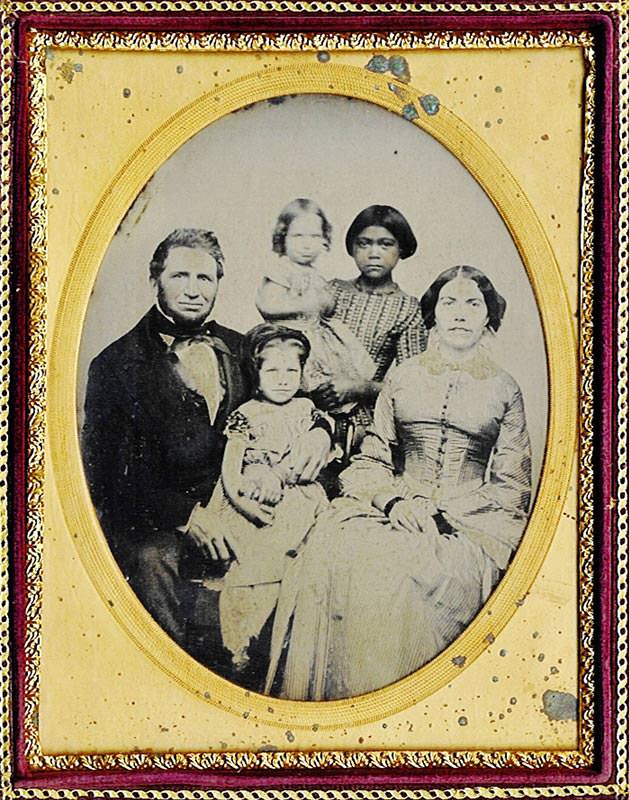
Photo of Kate Camden, a Native girl who at age 10 was forced into servitude for a white family living in Shasta County. Photo is one of few records that exist showing Native children entrapped by California's apprentice and guardianship laws // Credit: Camden Family Portrait, circa 1857-1859 courtesy of Whiskeytown National Recreation Area, WHIS 9066

 Kate Camden family portrait

New Episode of ACLU Gold Chains Podcast Examines Indigenous Child Slavery in 19th century California, Connects to Upcoming U.S. Supreme Court Case Brackeen v. Haaland

How the "free" state of California enslaved Native children

Media Contact: press@aclunc.org, (415) 621-2493

SAN FRANCISCO, CA – California came into the Union as a free state in 1850 with a constitution that banned slavery. So how did white settlers in the mid-19th century get away with enslaving Indigenous children, some of them as young as 2 years old? And why does this little known, terrible chapter of California history matter today?

Today, the ACLU of Northern California released the third episode of Gold Chains, our podcast about California’s hidden history of slavery. Indigenous Injustice” examines a 19th century state law called the Act for the Government and Protection of Indians that effectively legalized Indigenous child slavery and encouraged kidnappers to snatch Native children from their tribal communities.

“The horror of what happened in California, the genocidal violence against Native people, and especially the enactment of that violence against children, is unfathomable,” said historian Stacey Smith, who appears as a guest on the show.

“Indigenous Injustice” isn’t just ancient history. Over time, the practice of forcibly separating Native children from their tribal communities has taken on many forms. There were the so- called Indian Boarding Schools. A variety of other government-sanctioned adoption schemes have funneled Indigenous children into Non-Native, mostly white households.

Currently, there’s a landmark case scheduled to be heard by the U.S. Supreme Court on Nov. 9 – Brackeen v. Haaland – that deals with the very same issue of the forced removal of Native children from their families, tribes and tribal culture. It threatens to dismantle the Indian Child Welfare Act (ICWA), which was passed to prevent Native children from being removed from their communities.

The American Civil Liberties Union, along with 12 ACLU affiliates ( including the ACLU of Northern California) have filed an amicus brief with the U.S. Supreme Court, urging the court to uphold the constitutionality of the Indian Child Welfare Act.

“Indigenous Injustice” is a timely story that connects the dots between Indigenous child slavery in California to the present.

Link to Episode Website


November 1, 2022

Episode 3:
Indigenous Injustice

California joined the Union as a so-called free state in 1850. So how did white settlers get away with enslaving Native children until they were young adults?

We explore a little-known California state law called the Act for the Government and Protection of Indians that unleashed genocidal violence against Indigenous children. And we connect the dots between that terrible past and a landmark upcoming U.S. Supreme Court case.


Episode Credits:

Produced by the ACLU of Northern California

Host and writer Tammerlin Drummond

Senior Producer and Editor Joanne Jennings

Mix and Original Score Renzo Gorrio

Executive Producer Candice Francis

We’d like to thank our wonderful guides Stacey L Smith, William Bauer and Tedde Simon.

Our associate producers are Lisa P. White and Carmen King.

A special thanks also to our voice actors Pauline Schindler, William Freeman, and Avi Frey.

Elize Manoukian provided fact-checking and production assistance.

Field recording was done by Julie Conquest, Ron George and Eric Gleske.

We’d also like to thank the following members of our Gold Chains team: Brady Hirsch, Gigi Harney and Eliza Wee. Thank you also to Abdi Soltani, executive director of the ACLU of Northern California.

A special thanks to World Affairs, Oregon State University and the University of Nevada, Las Vegas for providing us with recording studios.

Archival sound was provided courtesy of Periscope Films and Prelinger Archives.


Episode Guests:

William Bauer is a professor of history at the University of Nevada, Las Vegas and a citizen of the Round Valley Reservation. He is the author of California Through Native Eyes: Reclaiming History and We Were All Like Migrant Workers Here: Work, Community and Memory on California’s Round Valley Reservation.

Stacey Smith is an associate history professor at Oregon State University. She is the author of Freedom's Frontier: California and the Struggle over Unfree Labor, Emancipation and Reconstruction.

Tedde Simon is the Indigenous justice advocate at the ACLU of Northern California and a citizen of the Navajo Nation.


Additional Resources:

Gold Chains: The Hidden History of Slavery in California, ACLU of Northern California

Among the Diggers of 30 Years Ago, Helen M. Carpenter

Early California Laws and Polices Related to California Indians Kimberly Johnston-Dodds, California State Library

Federal Indian Boarding School Investigative Report U.S. Department of Indian Affairs

This Land, host Rebecca Nagle

At Liberty, host Kendall Ciesemier


Friday, December 2, 2022

Churches starting to face facts on boarding schools

Government, churches begin to address assimilationist education policies

By: - January 13, 2022 5:30 am

June 1900, Phoenix. (U.S. National Archives and Records Administration)

Red Cloud Indian School is taking the lead among Christian-run schools in coming to terms with its assimilationist past.

The Jesuits have given Red Cloud a $20,000 grant to help in the work, including conducting searches with ground-penetrating radar for unmarked graves, and have allocated $50,000 to hire an archivist for one year to examine the order’s boarding school history at its archives in St. Louis.

School leaders are also working with tribal representatives about searching the school grounds on the Pine Ridge Reservation in South Dakota for remains of students who died there.

“The Catholic Church needs to recognize that honesty, being forthright and vulnerable are far more powerful and more healing than being reticent, restrictive and closed,” said Maka Black Elk, Oglala Lakota, executive director for Truth and Healing at Red Cloud Indian School.

Churches are joining the U.S. federal government in facing the often-brutal history of Native boarding schools, which forced children from their families into schools where they were often abused, underfed and used as virtual slave labor. Some died there without ever going home.

U.S. Interior Secretary Deb Haaland (Laguna) launched the Federal Boarding School Initiative in June directing the agency to prepare a report detailing historical records of schools operated by the U.S. government.

Secretary of the Interior Deb Haaland (Laguna). (Photo by Leigh Vogel / Getty Images)

The Initiative, however, has no authority over Christian denominations, which operated about one-third of the approximately 400 Indian boarding schools in the U.S.

With more than 100 schools, various Catholic orders operated most of the Christian Indian boarding schools, some long before President Ulyssis Grant’s 1869 Peace Policy formally created the federal school system.

Christians began operating boarding schools as early as the 1600s when Jesuits and Puritans separated Native children from their families in order to receive “civilizing” Christian instruction.

Christian missionaries were paid by the federal government to operate Indian schools beginning in 1819 with the Indian Civilization Fund Act. But the heyday of federal Indian boarding schools came under Grant’s policy.

Indian Country Today reached out to leadership in the Catholic, Methodist, Presbyterian, Episcopal and Quaker churches, denominations that operated most of the schools, asking what they are doing now to address the history.

Churches starting to face facts on boarding schools


click

Contact Trace

Name

Email *

Message *

NO MORE UPDATES

GO TO:  https://blog.americanindianadoptees.com/  for updates and news. THIS BLOG cannot be updated...