BLOGGER changed, not allowing us to UPDATE this back-up blog

(UPDATED 726/2025) issues with blogger are preventing this
Showing posts with label Federal Indian Boarding School Initiative. Show all posts

Friday, August 9, 2024

“The only thing they didn’t do was put us in (an oven) and gas us”

TEEN VOGUE


Nearly 1000 Native American Children Died in Abusive US Boarding Schools, Report Finds

Angie Jaime 8/1/2024

An investigation commissioned by U.S. Interior Secretary Deb Haaland found graves at 65 of the more than 400 U.S. boarding schools where Native American children were forced to assimilate into white, American society.  While the report found that at least 973 Indigenous children died while attending schools in the system, it also acknowledges that the actual number of deaths is likely higher.

“The federal government – facilitated by the Department I lead – took deliberate and strategic actions through federal Indian boarding school policies to isolate children from their families, deny them their identities, and steal from them the languages, cultures and connections that are foundational to Native people.  These policies caused enduring trauma for Indigenous communities that the Biden-Harris administration is working tirelessly to repair,” Haaland said in a statement.

In the 150 years between 1819 and 1969, thousands of Native children and youths were forcibly taken from their homes, as part of systemic efforts from the federal government and Christian religious leaders to eradicate Indigenous culture and identity.  The report estimates the U.S. federal government spent $23.3 billion in inflation-adjusted dollars over the 150 years that the government supported the boarding school system and similar assimilation policies.

It wasn’t until 1975 that tribal nations received the right to manage tribal schools, many of which were on tribal land, and parents could not prevent their children’s placement in off-reservation schools until the Indian Child Welfare Act passed in 1978.

“For the first time in the history of the United States, the federal government is accounting for its role in operating historical Indian boarding schools that forcibly confined and attempted to assimilate Indigenous children,” Assistant Secretary and citizen of the Bay Mills Indian Community (Ojibwe) Bryan Newland said in the same statement.

“This report further proves what Indigenous peoples across the country have known for generations – that federal policies were set out to break us, obtain our territories, and destroy our cultures and our lifeways. It is undeniable that those policies failed, and now, we must bring every resource to bear to strengthen what they could not destroy. It is critical that this work endures, and that federal, state and Tribal governments build on the important work accomplished as part of the Initiative.”

The findings follow listening sessions held by Haaland throughout the U.S. over the past two years, in which dozens of boarding school survivors described what they endured while separated from their families.

“I thought there was no God, just torture and hatred,” Whirlwind Soldier testified during a 2022 event on the Rosebud Sioux Reservation led by Interior Secretary Deb Haaland. “The only thing they didn’t do was put us in (an oven) and gas us,” she said, invoking Holocaust atrocities.

Within the report, Assistant Secretary Newland includes a number of steps that aim to support a path to healing the nation, including among its recommendations: issuing a formal apology from the U.S. government and “investing in remedies to the present-day impacts of the federal Indian boarding school system.”

The report, Haaland said, just the beginning of a long road to healing.

Tuesday, June 6, 2023

Our Stories Heal – Ginoojimomin Apii Dibaajimoyang [Recording]


Our Stories Heal – Ginoojimomin Apii Dibaajimoyang [Recording]

The full recording can be found here.


In 2021, Secretary of the Interior Deb Haaland announced the Federal Indian Boarding School Initiative. This initiative, which includes gathering records from the boarding school era, and compiling an official list of boarding school sites, makes visible on a national scale the intergenerational impact federal Indian board schools have had on tribal communities. Currently, there are five schools in the state of Michigan that were identified from the federal investigation process (Holy Childhood Boarding School, Baraga Chippewa Boarding and Day School (Holy Name), Mount Pleasant Indian Industrial Boarding School, Mackinac Mission School, and Catholic Otchippewa Boarding School). This is not an extensive list of all the other entities, schools, and programs that operated in Michigan through the Indian Civilization Act of 1819.

The Native Justice Coalition’s Truth and Reconciliation Commission (TRC) was launched in July 2022. It seeks to expand its reach to strengthen relationships between Indigenous and non-Indigenous people in an effort to seek the truth behind the Indian boarding school policies and corresponding actions taken by the government and church. Through this work, the NJC provides safe, supportive, and culturally competent spaces that offer opportunities for healing and uniting our Native communities on this journey. Our goals are to create an Indigenous-led process that is grounded in mutual respect, culturally sensitive, and focused on meeting clearly defined, jointly agreed upon metrics. Our key four priorities are truth and reconciliation, healing our people and our communities, strengthening ICWA and ensuring a cultural identity for our children, and building a strong ecosystem through investment in the Native Justice Coalition.

Without support from community partners such as the Indigenous Law & Policy Center, Native American Institute, and American Indian and Indigenous Studies at Michigan State University, this work would not be possible. This one-day symposium honors that work on a local scale, providing Michigan State University, and the greater Lansing community an opportunity to learn about the intergenerational trauma caused by federal Indian boarding school policies. Attendees will hear first-hand accounts from boarding school survivors and others who can provide the legal, social, and historical context of the Indian boarding schools. By joining together in community to share stories and voices, the symposium provides a space for knowledge and healing.

Wednesday, July 20, 2022

SOS Villages: Keeping Kids Together | Historic Healing Tour

We have posted about SOS Villages... you can search for it on this blog. - TLH, Blog Editor

GOOD NEWS๐Ÿ‘‡๐Ÿ‘‡๐Ÿ‘‡

New Homes in Southern California Will Keep Siblings in Foster Care Together

New Homes in Southern California Will Keep Siblings in Foster Care Together
The city of Palmdale, California is moving forward on a housing project that keeps siblings in foster care housed together. Photo by Annie Spratt via unsplash.com.

If children must enter foster care while their parents sort out mental health crises, violent relationships or addiction, the trauma of abuse and neglect, and the pain of separation can be long-lasting. But there’s one clear way to minimize the impact: keeping siblings together.

Public officials in a high-desert bedroom community north of downtown Los Angeles have committed to building housing that facilitates those critical family ties. Within a year, according to local and county officials, the city of Palmdale will be the first site in California to begin construction of a development built specifically for sibling groups in foster care. 

The aim of these temporary homes and the staff who will oversee them, said Mike Miller, director of neighborhood services for the city of Palmdale, is to get the children safely back to their families once problems at home have been sorted out. 

“They’re helping the children, but they’re also working with the parents because ultimately I think our wish for all foster kids and parents is that this family stays together,” he said. “These aren’t kids just getting thrown into a home somewhere,” he added. “This is also about valuing the family, and keeping the kids together. That’s transformational.”

The $19 million project will include a dozen three-bedroom townhomes.  Up to six siblings will live in each home, together with a specially trained professional caregiver. The housing project will also include two units for young adults transitioning out of foster care, and offices for case managers and support staff.

Last week, in accordance with its goal of creating “quality affordable housing” for “low, very low and extremely low-income” residents, the Palmdale City Council and Housing Authority authorized a $1.2 million “acquisition and pre-development” loan for the project. The Los Angeles County Development Authority has also committed to a $500,000 loan, with the remaining costs covered by private financing, according to a city staff report.

The project, which will be constructed on the north side of McAdam Park on 30th St. East in Palmdale, is being developed by SOS Children’s Villages. The more than 70-year-old agency describes its aim as building families for orphaned, abandoned and other vulnerable children in 135 countries, including the United States.

SOS Children’s Villages is now a global organization, but it began humbly, its first “village” built in 1949 in Imst, Austria to house children left behind during World War II. The group now operates more than 550 “villages” serving approximately 13 million children, youth and families. 

New Homes in Southern California Will Keep Siblings in Foster Care Together
Los Angeles County Supervisor Kathryn Barger

Palmdale will be the first location of its type to open in California, but the developer of the site runs three similar housing projects in Illinois, and one in Florida.

“I’m a proud supporter and funder of the SOS Children’s Villages project in Palmdale,” L.A. County Supervisor Kathryn Barger said in an email to The Imprint, adding that she met with the project’s leadership at length. “I’m impressed by their long-standing commitment to family reunification efforts, and to providing compassionate care to foster youth and those at risk of entering the system.” 

Keeping siblings together

The hazards of failing to keep siblings in foster care are widely acknowledged, and “placing siblings in the same home should always be the priority,” states a 2019 federal Children’s Bureau bulletin.

Although the relationships can be expansive in definition — biological siblings, step siblings, foster siblings, or other close relatives or nonrelatives with whom they have lived, even siblings they’ve never met — maintaining an attachment is essential to the children’s well-being.

“For some siblings in care,” the bulletin says, “their separation or infrequent visiting can cause those relationships to wither, sometimes to the point of permanent estrangement.”

When foster children stay close to their siblings, they are more likely to remain in stable homes, and more likely to “achieve permanency” through family reunification, adoption or legal guardianship. The pairing of siblings helps them adapt to new living situations, whatever they may be, in part because they are less worried about where their other family members are and how they are doing.

Researchers have also found that contact with brothers and sisters soothes the trauma of childhood abuse and neglect, as well as the traumatic experience of being separated from parents and the only home a child has ever known. Children who have positive relationships with siblings are less likely to suffer behavioral problems, such as anxiety and depression.

For siblings who can’t be housed together, child welfare experts encourage close placement, frequent visits and ongoing contact through letters, email, social media, cards and phone calls.

Numerous federal laws aim to promote sibling connections.

The Fostering Connections to Success and Increasing Adoptions Act of 2008 was the first federal law stressing the importance of sibling relationships in the foster care system. It requires that any child welfare agency relying on federal funding to seek placements that keep siblings in the same home or, if that’s not possible, provide ongoing contact and visits.

In 2014, the Preventing Sex Trafficking and Strengthening Families Act required that the parents of siblings be included as people to be notified when a child needs placement, as a means to keep children within extended kin networks. 

Four years later, the Family First Prevention Services Act passed, allowing states to waive the number of children who can be placed in a single foster home, as a way to better accommodate sibling groups.

Changing the profile of Antelope Valley

The region known as the Antelope Valley — which includes the cities of Palmdale and Lancaster — has some of the highest poverty and child maltreatment rates in Los Angeles County. Three horrific and highly publicized child deaths in the area over a six-year period put the child welfare agency’s delayed response to household warning signs under a harsh spotlight. The area has also experienced a relatively high level of turnover among social workers and CPS line staff.

Referring to the torture and killing of 8-year-old Gabriel Fernandez in 2013 — crimes committed by his mother and her boyfriend — Miller said the tragedy also spurred action.

“It really heightened our community to tell us that we need to do more,” he said. “And the community’s really stuck to that promise of trying to do more for the kids. So this SOS project is just right on that path of commitment that came as a result of that tragedy.”

Miller said the sibling housing project will take some time to complete, given the complexity of the project’s funders, agencies involved and unique requirements. But he expects construction will begin within a year.

“These projects really do take time but this one just strikes to the heart and it has such momentum and support,” Miller said. “What we’re hoping is that this is a model that other government entities here in California will use to do the exact same thing up and down the state.”

Tim McCormick, CEO of the SOS Children’s Villages Illinois, got esoteric in describing the project. He said it’s meaningful that the site will be located in the high desert, and the architecture will be environmentally friendly and reflect the region’s natural colors and hues.

“There’s really an intrinsic beauty of life out there,” McCormick said. “It’s kind of a hidden gem.”

McCormick also noted that the sibling groups who will live at the site more than likely will have come from impoverished households. But once built, their temporary home will serve as a resource center for these low-income children and families. It will also nourish cultural life, with an outdoor theater for the arts, music and spoken word — “almost like a Greek auditorium,” McCormick described. “So that’s what we hope to do there, is to bring in resources that are outside Palmdale and inside Palmdale, to blend them together and create and strengthen a narrative of a child’s life and a family’s history.”

SOURCE: https://imprintnews.org/child-welfare-2/homes-in-california-will-keep-siblings-in-foster-care-together/66575


ALSO READ:


Opened in 1871 by Quaker missionaries, Riverside is the nation’s oldest boarding school operated by the federal government.  It is one of the 408 across the U.S. identified in Haaland’s recently launched Federal Boarding School Initiative — described by the Department of the Interior as the government’s first comprehensive attempt “to shed light on the troubled history of Federal Indian boarding school policies and their legacy for Indigenous Peoples.” 

Haaland has pledged to document the schools’ troubled pasts, address their intergenerational impact and fully account for the trauma they inflicted throughout Indian Country. 

READ :  https://imprintnews.org/child-welfare-2/historic-healing-tour-honors-survivors-indian-boarding-schools/66367

Monday, January 17, 2022

Renewed Debate over U.S. Indian boarding schools


Oney M. Roubedeaux

As tribes wait for investigation to conclude, debate over Indian schools continues

Tribes across the Southwest dread the possibility that thousands of unmarked graves might be uncovered by a federal investigation into abandoned Native American boarding schools expected to wrap up early this year.

The investigation, ordered by U.S. Interior Secretary Deb Haaland, came in the wake of the discovery this year of more than 1,200 unmarked graves at two long-shuttered boarding schools in Canada’s British Columbia and Saskatchewan provinces.

The probe also has renewed debate over Indian boarding schools, which were established in the 19th and 20th centuries with the primary objective of assimilating Indigenous youth into white culture by denying the use of their languages, dress and other cultural aspects.

Most boarding schools were closed in the 1980s and early 1990s, but dozens of schools remain open, with 15 still boarding students as of 2020, according to the National Native American Boarding School Healing Coalition. Some are controlled by local tribes, while others are operated by the Bureau of Indian Education, a division of the Department of the Interior.

Boarding school alumni are widespread among Indigenous communities, and their thoughts about their experiences vary widely.

“She’s brought awareness for our Native people, for our children,” retired elementary school teacher Oney M. Roubedeaux said of Haaland. “I feel like that is opening up a box of worms. I mean, just a whole big old span of our people that nobody paid attention to.”

Roubedeaux, who is Ponca and Otoe-Missouria, was 6 in 1971, when she rode a Greyhound bus from Stillwater, Oklahoma, to Concho Indian Boarding School in El Reno with her brother, who was 8. She is the youngest of 17 siblings, many of whom attended boarding schools.

After her mother’s death in 1973, Roubedeaux was separated from her brother when she transferred from Concho to the Seneca Boarding School.

She said one of her other brothers was beaten to death in his room in Chilocco Indian School, 20 miles north of Ponca City, in 1980, the year it closed down. By the time she left Concho, there had been three student deaths, one being her best friend’s brother.

After her mother’s death, Roubedeaux was placed in foster care.

She went through 10 foster homes before one foster mother realized Roubedeaux – who was 16 – could not read or write. The teachers at the public and boarding schools she attended had never taken the time to teach her, Roubedeaux said.

She caught up, she said, with help from her foster mother, and eventually obtained a degree in special education from the University of Central Oklahoma. Roubedeaux, who lives in Pawnee, concluded her 20-year teaching career in March 2020.

Although “not everything was good,” she said, boarding schools gave her self-reliance, which was her biggest reclamation of agency.

“Boarding schools were a learning experience for me as a young child … it took me through life, to be able to rely on myself,” Roubedeaux said. “To this day, at the age of 57, I can still do that.”

According to the Boarding School Healing Coalition, 367 Indian boarding schools operated in 29 states, from Alabama to Alaska. Seventy-three were operating in 2020, and 15 of them still boarded students. Oklahoma had the most, with 83 schools, some of which still are operating. Arizona was second with 51 schools, 25 of which are open and three of which board students; New Mexico was fourth with 26 boarding schools.

Riverside Indian School in Anadarko, Oklahoma, organized in 1871, is the oldest of four federally operated boarding schools in the nation.

Today’s boarding schools are a good thing, said Constance Fox, who is Cheyenne and Arapaho and graduated high school from Riverside in 1984.

“I think they’re a good thing because of the uniqueness Native students have,” said Fox, who’s a self-determination adviser for the Bureau of Indian Affairs in Oklahoma. “For many, it was all they had, good and bad. I hope they continue. I know there’s been a lot of positive strides made … I go back to Riverside and it’s a whole different place.”

Fox said Riverside has upgraded its buildings and athletics department over the years. When she attended Riverside, Fox said, no advanced courses were offered, but teachers now are recruited for such courses.

“I have friends that have kids and grandkids that go to boarding schools and it’s because they want to … because there is still discrimination in public schools,” Fox said. “Being around their Native people makes them want to do better and want to succeed. So, I think that’s a dynamic that has changed over the years.”

Fox attended Concho from grades 3 through 8 and graduated from Riverside as valedictorian. She holds a bachelor’s degree in tourism management from Northeastern State in Tahlequah, Oklahoma, and a master’s degree in education from the University of Oklahoma.

Fox, who lives in Yukon, has worked for the BIA for nearly three decades, mostly in the area of self-determination.

Fox said boarding schools – specifically the adults who worked at them, who she says practically raised her – helped shape her passion for self-determination and her career working to better tribes.

“What at the time was negative to me ended up really being positive,” Fox said. “I learned so much about self-responsibility, and that came from the dorm parents, teachers, and other people who worked at both Concho and Riverside.”

Fox said she fully supports Haaland’s efforts and thinks her investigation shows goodwill to create an understanding of the traumas her ancestors suffered and the impact it has in 2022. Although closure can’t begin without acknowledging the history, she said it is hopeful to begin the healing process for the families and tribes impacted.

Hopi journalist Patty Talahongva got her start in journalism at Phoenix Indian High School in the 1978-79 school year. She is the executive producer of newscasts by Indian Country Today, a national nonprofit digital news publication focusing on Indigenous issues.

Although Talahongva, who lives in Phoenix, knows about the brutal history of her grandparents’ boarding school experiences, her year at Phoenix Indian School was different.

“People want to cling to this idea that it was always, always bad,” Talahongva said. “I would say there’s always good in whatever story, no matter how bad it got.”

By the time she was in school, Talahongva said, children were allowed to speak their languages freely, and cultural customs were celebrated, not suppressed. The overall experience, she said, made her more independent. The school, which opened in 1891, shut down in 1990.

Even the launch of Indian Country Today’s newscast in April 2020 has roots in boarding schools.

Talahongva said the newscast began a month after the pandemic was declared, so studio options were few. The solution? The former grammar building of Phoenix Indian School, built in 1935 and now used as a visitors center. Indian Country Today used it for seven months before moving into a studio at Arizona PBS.

“Those kids who went to school in that building were never encouraged to go to college, get a degree, or do whatever they wanted to do,” Talahongva said. “They were certainly never encouraged to become (television) anchors and producers. I can hear our relatives laughing. It’s like, ‘Take that, government. We’re using the building you put up to hold us down, and we’re broadcasting to the world.’”

This story was originally published by Gaylord News, a reporting project of the University of Oklahoma Gaylord College of Journalism and Mass Communication. Nancy Marie Spears, a Gaylord News reporter based in Washington, D.C., is an enrolled member of the Cherokee Nation of Oklahoma. Cronkite News contributed to this story.

Wednesday, July 7, 2021

Indian Boarding School Survivors Take Action at Cathedral of Saint Paul


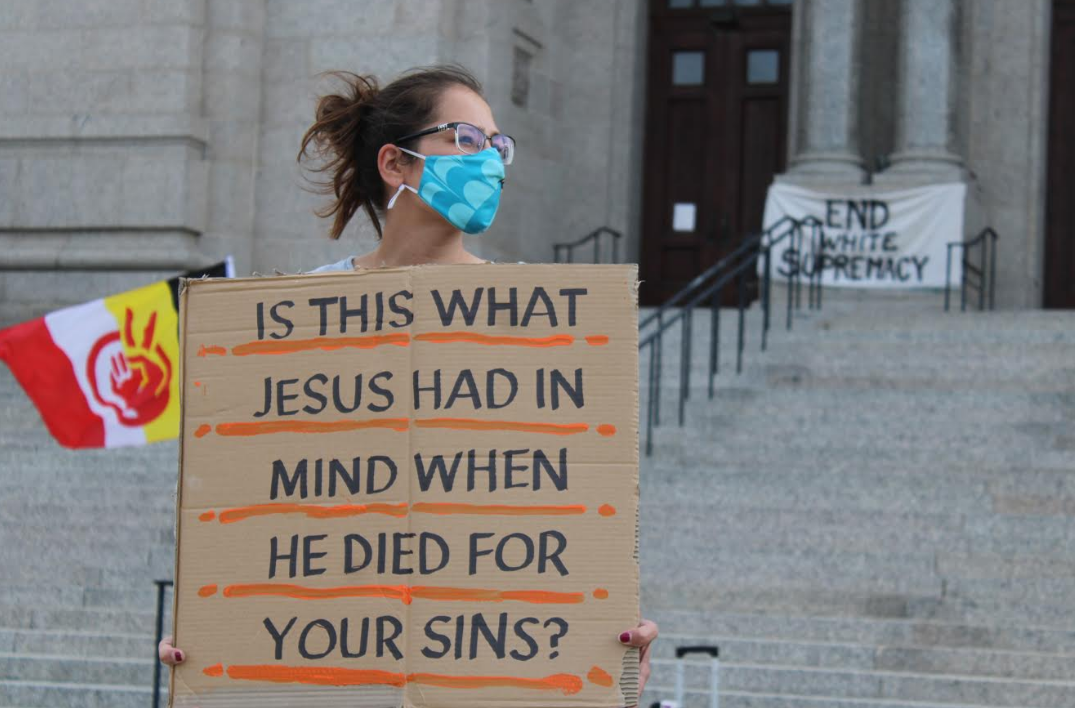
A demonstrator holds a sign at the steps of the Cathedral of Saint Paul on July 1, 2021. (Photo/Darren Thompson)


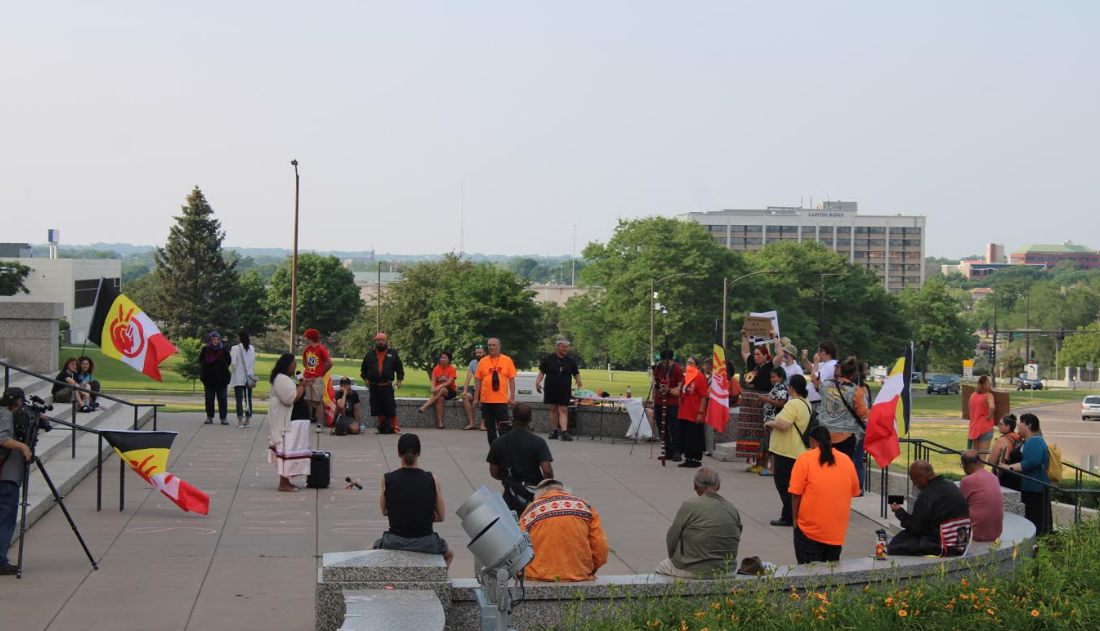
SAINT PAUL, Minn. — The American Indian Movement (AIM) Twin Cities chapter held a press conference and protest on Thursday outside the Cathedral of Saint Paul in the Saint Paul, Minn,

The event brought several dozen people from around the Twin Cities to protest the recent discoveries of more than 1,000 children found in an unmarked graves at various residential schools in Canada. 

“My name is Michael Anthony, after the Saint Michael and Saint Anthony,” AIM Twin Cities Chairman Mike Forcia said at the press conference. “The church must acknowledge its participation in the genocide of our people.”

Last year, Native News Online reported that Forcia was charged and convicted last year for the toppling of the Christopher Columbus at the Minnesota State Capitol grounds. 

Organizers posted American Indian Movement flags, sang on the drum, and addressed the history of boarding schools and its complicated relationship with the Catholic church. Demonstrators held signs in traffic that read "Search Every School!” and “From Canada to the USA, Honor Native Treaties.” 

Demonstrators host a press conference at the steps of the Cathedral of Saint Paul in St. Paul, Minnesota on July 1, 2021. (Photo/Darren Thompson)

A confrontation between tourists of the Cathedral and a demonstrator erupted into an argument over the land the church is built on. Shortly after, a fight broke out between a man who claimed he attended church at the Cathedral and a participant in the demonstration. 

The demonstration was held in conjunction with Cancel Canada Day, where tens of thousands of people demonstrated and marched throughout towns and cities in Canada. On day normally celebrated by Canadians for their country’s confederation on July 1, statues of Queen Victoria and Queen Elizabeth II were toppled. Thousands protested from coast to coast over the mass graves of Indigenous children being discovered at residential boarding schools that were operated for decades by the Canadian federal government and Catholic churches. 

“As more stories break of the bodies of over one thousand children being recovered from mass graves at boarding school sites in Canada, I find myself holding my eight-year-old daughter close each night,” Minnesota Lieutenant Governor Peggy Flanagan said to Native News Online. “These children never got to go home to their parents and their communities who loved them. They endured physical and sexual abuse, and their childhoods were stolen under the guise of ‘Kill the Indian, and save the man.’”

“Kill the Indian, and save the man” was the ethos instilled by General Richard H. Pratt—founder of the Carlisle Indian Industrial School in Pennsylvania, which established a model for other Indian boarding schools. It's goal was to strip American Indian children of their culture in order to "Americanize" them. At the Carlisle Indian School and at other Indian boarding schools, American Indian children were strictly forbidden to speak their tribal languages or practice their spirituality. Their clothing was burned and replaced with military drab, and long hair was cut and styled in Euro-American fashion. 

For American Indians, the boarding school left a lasting distrust of the entire U.S. education system. According to the National School Boards Association, Native American students performed two to three grade levels below their white peers in reading and math. They were two times more likely to drop out of school than their white peers, according to a study conducted by National Caucus of Native American State Legislators.

“This is not ancient history or a Canadian issue; our parents and grandparents in Minnesota and across the United States attended these institutions, but too many people do not know about this painful chapter in our history,” Flanagan added. 

Recently, at the National Congress of American Indians’ Mid Year Conference, Secretary of Interior Debra Haaland announced that she established the Federal Indian Boarding School Initiative, which is tasked with identifying past boarding schools throughout the country and investigating possible burial sites, then identifying those buried and returning the remains to their rightful tribes. A report from the initiative is due to Secretary Haaland on April 1, 2022.

“It is time to tell the whole truth about our history, and it is time to take action to ensure that Native children and people are safe, valued, and protected in their communities now and in the future,” Flanagan said.  SOURCE


click

Contact Trace

Name

Email *

Message *

NO MORE UPDATES

GO TO:  https://blog.americanindianadoptees.com/  for updates and news. THIS BLOG cannot be updated...