BLOGGER changed, not allowing us to UPDATE this back-up blog

(UPDATED 726/2025) issues with blogger are preventing this
Showing posts with label ARENA. Show all posts

Thursday, May 2, 2024

'I'm not alone': Sixties Scoop survivors gather in Winnipeg to reconnect, heal

 READ

APRIL 29, 2024

Hundreds of Sixties Scoop survivors who attended a Winnipeg conference on Sunday to share their stories, reconnect with their communities and access support. The event, hosted by the Southern Chiefs' Organization and the Anish Corporation — which promotes health, wellness and emotional support for Indigenous peoples — is welcoming survivors from across Canada and from the U.S. 


 👇FROM 2019:


Thursday, February 15, 2024

FILM: A Place Between - The Story of an Adoption

By Trace Hentz (blog editor) REBLOG from 2019

I run across comments by adoptive parents and PAPS (potential adoptive parents) asking why is it wrong for non-Natives to adopt Native kids?  Volumes have been written about this, on this blog, and in medical studies and published reports but we STILL have people who don't understand.

Curtis and Ashok Kaltenbaugh were born in Manitoba and are of First Nations ancestry. After the 1980 death of their younger brother, at ages of 7 and 4 respectively, they were removed from the custody of their birth mother and placed for adoption with a middle-class white family living in Pennsylvania.

 Here is an example on Adoption.com:

I'm watching this documentary right now on demand. Its about these two Native American boys (now adults) who were adopted from foster (care) in Canada to an American (CC) family in Redding, PA.  They were adopted as young boys so they remembered being with the bmom and now one of the boys is making a film about being between both families.  I thing that bothers me is the younger brother has basically at 18 yrs old left his adoptive family and went back to Canada to bio family and he hasn't talked to his AP's in 8 years.  His issues are growing up without his NA identity and racism he dealt with being NA in a all CC environment.  Actually both boys are living in Canada now.  The older brother still has a relationship with his AP's. As an AP I would take it as a slap in the face if my kid just left and wouldn't talking to me for 8 yrs.  Its like these boys bio mom was an alcoholic who had her kids taken away because she was neglecting them.  She said herself she would be drunk for 6 weeks straight and have no idea what day or month it is.  Also leaving these babies at home by themselves while she's out partying and they have to change each diapers etc...  So you have this family come in and give you a stable home and love and yet because they are CC you just leave??  Im wondering if this something that happens more often with older kids adoption from foster care?  Like I said earlier it really annoys me but a great watch anyways. LINK


 WATCH 

A Place Between - The Story of an Adoption, Curtis Kaltenbaugh, provided by the National Film Board of Canada

A Place Between – The Story of an Adoption is a 2007 documentary film dealing with cross-cultural adoption and aboriginal life in Canada. It was directed by First Nations adoptee Curtis Kaltenbaugh and produced by the National Film Board of Canada.
The film chronicles their search for identity and the meeting of their adoptive and birth families.
The film won Best Public Service Award at the Annual American Indian Film Festival, held in San Francisco during November 2007.[wiki]


Thursday, January 11, 2024

Sister's Emotional Reunion #60sScoop

 READ: https://globalnews.ca/news/10211379/sisters-reunite-sixties-scoop-vancouver/

WARNING: This story deals with disturbing subject matter that may upset and trigger some readers. Discretion is advised.

It was a reunion decades in the making and a kickoff to the new year the Quill family will never forget.

Sisters Nita and Brandy Quill met for the first time at a SkyTrain station in Vancouver last week, more than 30 years after they were separated during a period of colonial violence against Indigenous families known as the ’60s Scoop.  The pair found each other on Facebook in the years after their mother’s death.

“It’s surreal. Nothing like this has ever happened in our lives before,” Brandy said, embracing her long-lost sister at Burrard Station downtown.

“This is to me a miracle. I’m just trying to take it in. It will probably take a long time to process it. It’s a dream come true.”

’60s Scoop advocate Katherine Legrange on the need for a national inquiry
Click to play video: '’60s Scoop advocate Katherine Legrange on the need for a national inquiry' 

The ’60s Scoop refers to a period between the 1950s and 1980s after amendments to the Indian Act let provincial governments take over Indigenous child welfare. Thousands of First Nations, Inuit and Métis children were taken from their birth families, usually without consent, and placed in non-Indigenous homes.

Many were stripped of their language and culture, and left with complex questions about their identities. Many also experienced physical, sexual, mental and spiritual abuse.

“So much of our lives has been taken from us, so to ever be in a moment where we don’t have to be afraid of who we are, that we’ve been given our meeting, it just feels like it’s the beginning of something new — not just for us but for the country,” Brandy said. “I only wish our mom was still here to see it with us.”

’60s Scoop advocate Colleen Cardinal on challenges reconnecting to birth communities
Click to play video: '’60s Scoop advocate Colleen Cardinal on challenges reconnecting to birth communities' 

Nita and Brandy are the daughters of Linda Quill, a Sapotoweyak Cree woman from Manitoba and a residential school survivor.  Linda was abused and malnourished at residential school, eventually contracted tuberculosis and was placed in a sanitorium without her family’s knowledge, Brandy told Global News.

Brandy was born in Edmonton, placed in foster care at the age of five and eventually shipped off to an Ontario group home where she aged out of care and has lived independently since then. Nita was born in Winnipeg, taken from Linda at 18 months of age and adopted by a family in Scotland.

“I’ve always known there’s more to me, there’s more to who I am, there’s more to my story,” said Nita, who also met her niece — Brandy’s daughter Taylor — at the station last week.

“Blood memory goes very deep so I’ve been nervous for the last 24 hours. Meeting my sister definitely calms me. It’s a relief. It’s the end of an era but it’s also the beginning.”

Linda Quill is seen with her youngest daughter Brandy Quill in an undated photo. Courtesy: Brandy Quill

Brandy said she and her mother “cried for years” wondering what happened to Nita, the eldest sister.

Nita eventually left her adoptive family in Scotland with no knowledge of her Sapotaweyak and Wuskwi Sipihk family in northern Manitoba, but through a Facebook post, connected with Brandy.

Both she and Brandy said they were told false stories of their mother having tried to leave them after their births.

“My story — it’s always been a journey of identity, of belonging, understanding. My story is one that’s repeated so much within a lot of families. It’s a story of being lost,” Nita said.

“The bigger picture is we are together and there’s a lot of hope … for a lot of the pain to go away and a lot of the happiness to come in. This is a promising day.”

Click to play video: 'Appeal could have wide-ranging impacts on B.C. Indigenous child protection system'

The Manitoba government apologized for its role in the ’60s Scoop in 2015.  The Alberta government followed suit in 2018 and Saskatchewan Premier Scott Moe did the same in 2019.

In 2022, the Sixties Scoop Indigenous Society of Alberta pressed the B.C. government to follow suit. No such apology has been delivered at the B.C. legislature.

“In B.C., we are committed to a respectful and genuine dialogue with the survivors, families and communities impacted by these historical wrongs on how best to move towards an apology that will be part of the healing process,” wrote B.C.’s Ministry of Children and Family Development in a Tuesday statement.

“We recognize an apology must also address the continued impact of colonization on Indigenous families, especially in terms of the child welfare system. This process must be sensitive and trauma-informed in order to reach a meaningful apology.”

Click to play video: '‘Our children have an inherent right to know who they are’: Sts’ailes former chief on new legislation in MCFD'
‘Our children have an inherent right to know who they are’: Sts’ailes former chief on new legislation in MCFD

Nita, Brandy and Taylor shared many tight hugs in Vancouver before going out for a meal and getting to know each other better. They credited their mother for their reunion and said they know she was watching, smiling from the Spirit World, as her daughters and granddaughter reunited.

“We’re just so blessed to be able to continue the next bit of our path together so we’ll see where that takes us,” Brandy said.

The family said they hope their story inspires others who have been through similar experiences and fosters empathy among those who haven’t.

— with files from Cliff Shim and Aaron McArthur 

The Hope for Wellness Help Line offers culturally competent counselling and crisis intervention to all Indigenous peoples experiencing trauma, distress, strong emotions and painful memories. The line can be reached any time toll-free at 1-855-242-3310.

Wednesday, January 6, 2021

Where is my buffalo robe? #60sScoop

 As I see theft of Indigenous identity, I'm left to forge myself from scraps

When I see the cultural appropriation and identity theft of Indigenous people — the Latimer situation and others like it — it stirs something ancient in me, that resonates deep like the heartbeat of Mother Earth herself.

I was part of the Sixties Scoop. For those of you unfamiliar with that term, it refers to the tens of thousands of Indigenous children apprehended by the government to be assimilated and raised in non-Indigenous homes. In my case, the AIM (Adopt Indian and Métis) program of Saskatchewan from the 1960s and 1970s placed me permanently in a white family in small-town Saskatchewan.

I am part of the national Sixties Scoop settlement which seeks to compensate those wronged by the erasure of our cultural identity and birthright.

Now, five decades later, that loss echoes in all that I am and do. I make my home in Témiscaming, Quebec on the beautiful Ottawa River. I remain an activist on Indigenous issues, but the recent spotlight on Indigenous identity, race shifting and cultural appropriation tears at the core of me. I find myself sitting wondering, where is my buffalo robe?

The buffalo robe I speak of is my Indigenous identity (Plains Cree) and I am one of hundreds of thousands of Indigenous people displaced by centuries of Canadian government policy, left to forge my Indigenous self from scraps left by politicians, capitalism and exploitation. That's why these issues strike so deeply for Indigenous people.

My buffalo robe is my identity. It is my jingle dress on the pow wow trail. When I dance, the spirits move me and I dance without tiring, without shame and with great pride. Pow wow is a ceremony: flying ribbons, eagle feathers, all the colours of the rainbow moved by the resilience and humility of my people — a glimpse of that sacred buffalo robe on my shoulders.

I've never worn a buffalo robe. I imagine it must be warm, robust, loving, beautiful. I picture being able to wear it like I've been wearing it forever, like those hearty Cree who weathered the harshest winters of our Canada — long before mechanical things heaved their way across the landscape — traversing rivers, landscapes, herds of the wild ones, carving what we see today.

'If you're going to pose in that buffalo robe, well then. Pick up that glass of murky brown water deemed undrinkable that so many Indigenous people live with every day, too.' (Submitted by Crystal Semaganis)

I see you posing in a buffalo robe. Trailblazers, heroes and heroines, forging the Indigenous path for us to follow. Now, that sacred path is tainted.

Were they who they said they were? I see them in their finery, at film festivals, book signings, news articles, magazines, all while proclaiming an Indigenous identity not theirs.

This is trauma. Forging an identity is no light thing. It is resilience flowing in our veins, the whispers of thousands before us and those yet to come. This is what it means to be Indigenous. How can such a precious, sacred thing be taken from us now? Stolen buffalo robes!

I search for my buffalo robe. I feel exploited. We are living artifacts of the Indigenous nations across this country from shore to shore, and we fight to reclaim our language, culture and all things sacred. We search for connection! To have a settler reap such vast rewards wearing a buffalo robe that was meant for others, that's a hurt felt by so many.

Residential school survivors, Sixties Scoop survivors, fledgling talents in the entertainment industry and Indigenous people passed over by the deception of those in stolen buffalo robes, that's a hurt that won't go away anytime soon.

Please, look beyond the romantic ideals of dreamcatchers, inukshuks, mukluks and war bonnets and see everything. Not just the accolades and commodification of all things Indigenous (let's face it, there was much money to be gained by proclaiming to be Indigenous) – but really see.

If you're going to pose in that buffalo robe, well then. Pick up that glass of murky brown water deemed undrinkable that so many Indigenous people live with every day, too. Join us in the search for the missing, lament the loss of land, language, wild things, the trauma, the displacement, the crumbling abandoned schools. Take it all in — and not just the pretty stuff.

**Crystal Semaganis is an Indigenous activist living in Témiscaming, Que., with a focus on advocacy for the Sixties Scoop, residential school survivors and environmental issues. She is a mother of four, grandmother of one, an artist and a jingle dress dancer. She is on Twitter @Lil_Cree777, Instagram @seven_wolves and TikTok @sevenwolves1971.

That buffalo robe is a sacred thing. I say now, we are coming for our buffalo robes.

Reconciliation is not taking our buffalo robes – it's giving them back.

I wear a size, immortal.

Dedicated to my sister,

Cleo Semaganis-Nicotine

May 7, 1965 - Dec. 22, 1978


FINDING CLEO podcast

Thursday, February 20, 2020

The Journey Home: Wayne William Snellgrove

(reblog from 2013)
Wayne (center) with his brother and a-mom Ann Snellgrove
Torn Apart 32 Years Ago By Canadian Policy Toward Aboriginals, A Mother And Son Meet For The First Time.


September 21, 2003| BY MARGO HARAKAS


He called himself Lost Cub, and for years he tried futilely to find his way home.


Then in 2002, feeling that at last he was closing in, Wayne Snellgrove hired a private investigator to follow up on the final four names on his list. He needed a shield, a buffer from the searing pain of renewed rejection. When the Canadian investigator finally telephoned her news, Snellgrove took the phone to the bedroom, closed the door, and, lying down on the bed, braced himself.


http://articles.sun-sentinel.com/images/pixel.gif
"I found your mother," she said. Then it all tumbled out.


Nora Smoke, a Saulteaux Indian living on a reserve in Saskatchewan, told the investigator, she loved Wayne, always had, that it was the happiest day in her life that he had found her. She had never forgotten the child she'd never seen.


"Please tell my son," Smoke pleaded with the investigator, "I've always thought of him."


And the 6-foot-3-inch, 225-pound athlete sobbed, sobbed like a baby, sobbed with 32 years of repressed emotion, sobbed like a kidnapped child returned to his bereft mother.


The search had ended; however, the story of a newborn's disappearance three decades ago was yet to be told.


Snellgrove, like many Canadians, calls it kidnapping. Others call it cultural annihilation or cultural genocide. Officially, it's been dubbed the Sixties Scoop.


Throughout the 60s, 70s and into the mid 80s, thousands of native children were separated from their mothers and adopted out to middle-class, non-native families in the United States, Europe and elsewhere.


"Some communities lost an entire generation," says Darrell Racine, professor of native studies at Brandon University, in Manitoba, Canada.


At best, say the critics, the action of the Children's Aid Societies, authorized at the time to administer Canada's child welfare services, was misguided. At worst, it was racism.


"It goes back to the usual manifest destiny complex white people have over red people and the idea they are more civilized than aboriginal people. They thought they were doing the aboriginals a favor," says Emma LaRocque, professor of native studies at the University of Manitoba.


The problem was those removing the children were usually white and, because of bias or ignorance of aboriginal culture, they were, say critics, unqualified to determine what was in the best interest of the native child.


That the Sixties Scoop followed on the heels of the horrific residential school program was not coincidence. The thinking there, says Racine, "was the only way to civilize the Indians was to get the child away from the parents." So the children were forced into church-run boarding schools to be purged of their language, customs and culture. (Similar boarding schools were operational throughout most of the 20th century in the United States, as well.)


In the 1960s, with the closing of Canada's residential schools, aboriginal children continued to be removed, this time on the grounds of parental ambivalence, poverty, illness, or drug or alcohol addiction.
http://articles.sun-sentinel.com/images/pixel.gif


"Entire reserves would be assessed as dysfunctional and every child in the community would be removed," says Kenn Richard, director of Native Child and Family Services of Toronto.


And then "because of racism," says Richard, who is half native, "few white Canadians were willing to adopt aboriginal children, so placements were made through agencies in the U.S."


'I really don't belong'


Wayne Snellgrove came through an agency in Northampton, Mass. Six months before getting the 2 1/2-year-old Wayne, Richard and Ann Snellgrove, his adoptive parents, had taken home another boy, a white boy. They wanted to find for him a companion.


Despite loving and caring parents, Wayne says, "I've always had this feeling of being lost and misplaced, feeling I don't really belong here. Every time I looked in the mirror, I knew it. I had only to look at my brother to know I was different."


He describes his adoptive family as "wonderful." But his situation was far different from those that have made headlines in Canada and suggest there was little screening of prospective parents. Several stunning cases are recounted by the Native Child and Family Services of Toronto in its report titled "Research Project: Repatriation of Aboriginal Families -- Issues, Models and A Workplan." One Native child, placed with a bachelor in Kansas, was sentenced to 20 years in prison for killing his adoptive father with a baseball bat. The trial revealed that for years the youth had been sexually abused by his adoptive father.


Likewise, a native girl placed with a family who subsequently moved to Holland wound up a drug addict and prostitute after being impregnated twice by her adoptive father. After years of living abroad, she returned to Canada where, with the help of birth siblings, she established a new life.


 Please leave a comment! Wayne, an amazing artist and Olympic swimmer, is on Facebook.  He lives in Florida. This is his painting of a red hand.

Wednesday, June 5, 2019

A Place Between – The Story of an Adoption #60sScoop

By Trace Hentz (blog editor)

I run across comments by adoptive parents and PAPS (potential adoptive parents) all the time on why is it wrong for non-Natives to adopt Native kids? Volumes have been written about this, on this blog, and in medical studies and published reports but we STILL have people who don't understand.

Here is an example on Adoption.com:


I'm watching this documentary right now on demand. Its about these two Native American boys (now adults) who were adopted from foster (care) in Canada to an American (CC) family in Redding, PA. They were adopted as young boys so they remembered being with the bmom and now one of the boys is making a film about being between both families. I thing that bothers me is the younger brother has basically at 18 yrs old left his adoptive family and went back to Canada to bio family and he hasn't talked to his AP's in 8 years. His issues are growing up without his NA identity and racism he dealt with being NA in a all CC environment. Actually both boys are living in Canada now. The older brother still has a relationship with his AP's. As an AP I would take it as a slap in the face if my kid just left and wouldn't talking to me for 8 yrs. Its like these boys bio mom was an alcoholic who had her kids taken away because she was neglecting them. She said herself she would be drunk for 6 weeks straight and have no idea what day or month it is. Also leaving these babies at home by themselves while she's out partying and they have to change each diapers etc... So you have this family come in and give you a stable home and love and yet because they are CC you just leave?? Im wondering if this something that happens more often with older kids adoption from foster care? Like I said earlier it really annoys me but a great watch anyways. LINK


 WATCH   


A Place Between – The Story of an Adoption is a 2007 documentary film dealing with cross-cultural adoption and aboriginal life in Canada. It was directed by First Nations adoptee Curtis Kaltenbaugh and produced by the National Film Board of Canada.

Curtis and Ashok Kaltenbaugh were born in Manitoba and are of First Nations ancestry. After the 1980 death of their younger brother, at ages of 7 and 4 respectively, they were removed from the custody of their birth mother and placed for adoption with a middle-class white family living in Pennsylvania.

The film chronicles their search for identity and the meeting of their adoptive and birth families.
The film won Best Public Service Award at the Annual American Indian Film Festival, held in San Francisco during November 2007.[wiki]


Thursday, March 22, 2018

Adopt Indian Metis Program


We also have the Canada and American governments conducting the ARENA programs- transporting First Nations and American Indian children for adoptions cross borders.
Were you adopted into the US from Canada? Do you know?

1966 The National Adoption Resource Exchange, later renamed the Adoption Resource Exchange of North America (ARENA), was established as an outgrowth of the Indian Adoption Project.

READ THIS

Tuesday, November 28, 2017

What came after the Indian Adoption Projects? Adoption Resource Exchange of North America

Source: U.S. Children's Bureau, Child-Welfare Exhibits:  Types and Preparation, Miscellaneous Series, No. 4, Bureau Publication No. 14 (Washington DC: Government Printing Office, 1915).
Beginning in 1916, the U.S. Children's Bureau brought its baby-week campaign to thousands of cities, towns, and rural communities across the United States. The photograph above was taken during a baby-week celebration on an Indian reservation.
1958
Child Welfare League of America published Standards of Adoption Service (revised in 1968, 1973, 1978, 1988, 2000); Indian Adoption Project began.
The Adoption Resource Exchange of North America (ARENA), founded in 1966, was the immediate successor to the Indian Adoption Project. ARENA was the first national adoption resource exchange devoted to finding homes for hard-to-place children. It continued the practice of placing Native American children with white adoptive parents for a number of years in the early 1970s. (It's estimated some 20,000 children were removed from their First Nations families and sent to non-Native parents in the US.)
1966 The National Adoption Resource Exchange, later renamed the Adoption Resource Exchange of North America (ARENA), was established as an outgrowth of the Indian Adoption Project.
Quote: ARNOLD LYSLO, DIRECTOR, INDIAN ADOPTION PROJECT 12/1962
Indian children have certain rights which are theirs by birthright. That is, they have rights of tribal enrollment if they meet the requirements for enrollment set up by the tribe. As tribal members they have the right to share in all the assets of the tribe which are distributed on a per capita basis. The actual as well as anticipated benefits of an Indian child adopted through our Project are furnished by the Secretary of Interior. The Secretary of Interior, through the superintendent of the Indian agency where the child is enrolled, has the right to approve or disapprove of any plan made for the distribution of funds belonging to an Indian child.
Editor Note:  Even though Lyslo said we have rights, we are still taken from our tribes and placed in non-Indian families - which is part and parcel of a genocide program. And maybe those non-Indian parents adopted us for the money we could earn as tribal members...Poverty was often cited as the reason for removal - so who caused the poverty?? - we know the answer...

This post is about the government sanctioned Indian Adoption Project when adoptive parents were questioned over a period of years. It was a study. Who did they ask? Not the adoptee. But there were many projects and many churches who ran adoption programs... More than just this Indian Adoption Project... Trace

Thursday, April 20, 2017

My birth certificate is literally ‘fake news’

Connecticut is the home to many Native adoptees who were transferred and adopted there from Washington state - yes, all the way across the country! That is the Indian Adoption Projects and ARENA in action.


Older birth parents and relatives are dying off, so are some of the adoptees leaving their children and grandchildren with big holes in their personal family health histories.  Adds Caffery, “We feel strongly that time is of the essence. It’s time to end this failed social experiment of secrecy and shame. It’s time to threat us as full citizens of our country and our state.”

Saturday, December 6, 2014

Colonization is Always War: A War for LAND and Territory


By Zig-Zag, WarriorPublications.wordpress.com
(Originally pub. 1999 as Colonization is Always War, Revised 2012)


“If anyone is trying to destroy you, STOP HIM!” Karoniaktajeh – Louis Hall, Warrior’s Handbook p. 1

War & Colonization
Just slightly over 500 years ago, in 1492, three European ships under the command of Christopher Columbus arrived on the shores of what has come to be known as the Americas. With this began a genocidal war aimed at destroying Indigenous nations, occupying our ancestral territories, and plundering the natural wealth of the earth. How many tens of millions of Indigenous people were killed in this war will never be known, although the methods of massacres, biological warfare, executions, torture, and the enslavement of entire nations, has been well documented by historians.
Similar invasions were being carried out in Africa and parts of Asia during this same period. This systematic campaign of genocide and colonization was a total war waged against Indigenous nations by European colonialist nations. No one can deny this historical fact.
Colonization can be defined as the practise of invading other lands for the purpose(s) of settlement and/or resource exploitation. When the land is already occupied by another people, the result is usually war. In fact, colonialism occurs in a similar manner to many military conflicts between nations: there is a reconnaissance, an invasion, occupation, and then assimilation (the same methods can be seen in Iraq and Afghanistan).
War can be defined as, “a state of hostilities that exists between or among nations, characterized by the use of military force… a violent clash between two hostile, independent, and irreconcilable wills, each trying to impose itself on the other. “The means to that end is the organized application or threat of violence by military force.” Warfighting, p. 3
Here in North America, military violence can be said to have characterized the imposition of colonialism & the establishment of settler-nations up to 1890. That year, 300 Indigenous men, women and children were massacred by US military forces at Wounded Knee, South Dakota. By the late 1880s, the use of gun-boats to destroy villages had ended along the Northwest Coast. In the southwest, Apache guerrillas had also been defeated. At this time, the military domination of Indigenous peoples was virtually complete. This was only slightly over 100 years ago.
Mass grave at Wounded Knee, 1890; the massacre was carried out by the reformed 7th Cavalry

Is There A War Against Indigenous Peoples Today?
Today, there are some who believe that military force and violence does not characterize our present-day reality here in N. America. But this is not entirely correct: The selective use of military/police violence can be clearly seen in recent examples from the last 30 year period.
Thousands of soldiers and police, using military equipment, weapons and tactics, have been deployed against Indigenous movements and communities.

The most notable examples being:
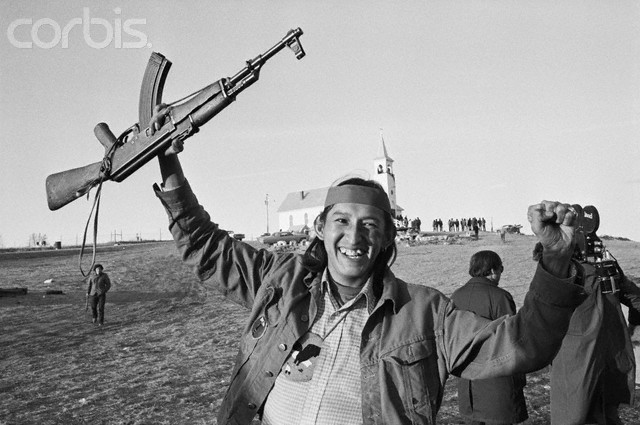
• the 71-day siege at Wounded Knee, S. Dakota, in 1973. Hundreds of police, FBI and paramilitaries, with military assistance including armoured personnel carriers, weapons, ammunition, etc., engaged in fire-fights with warriors in bunkers and trenches. 2 warriors were shot & killed.
• the re-occupation of Ganienkah by Mohawks in New York state in 1974. Hundreds of state police laid siege, and gunfire was exchanged with white vigilantes. NY state eventually retreated & negotiated a parcel of land still occupied today.
• the blockade at Cache Creek, BC, in 1974.
• the re-occupation of Anicinabe Park near Kenora, Ontario, in 1974.
• the 1975 shoot-out at Oglala, S. Dakota (two FBI agents and one warrior killed). Hundreds of FBI agents were deployed to Pine Ridge in a massive search for AIM members.
• Restigouche, 1981: over 500 Quebec police raid the Mi’kmaq community of Restigouche, carrying out assaults & searches for ‘illegal’ fishing.
• the 77-day standoff at Kanehsatake (Oka) and Kahnawake, near Montreal, Quebec, in 1990. Over 4,500 Canadian soldiers were deployed. One SQ police officer was killed in an initial raid by a heavily-armed police tactical unit on Mohawk road-block, July 11.
Kanehsatake/Oka 1990: a 77-day armed standoff between warriors and military.

• the month-long siege at Gustafsen Lake, BC (Ts’Peten), in 1995. Over 450 RCMP ERT members were used, with 9 Bison armoured personnel carriers from the Canadian military. During the siege, RCMP used an explosive charge to disable a vehicle, then rammed it twice with an APC. In a fire-fight which occurred, as many as 20,000 rounds were fired by police, yet only one defender was wounded (1 dog killed).
• the re-occupation at Ipperwash (Aazhoodeena), Ontario, 1995. A police tactical unit opened fire on unarmed protesters, killing Dudley George and shooting a 15-year old youth in back (1 dog killed).
• Burnt Church 2000-01. Hundreds of heavily armed DFO & RCMP officers (inc. ERT units) in boats, helicopters, & planes were used against Mi’kmaq lobster fishermen & security escorts (inc. Westcoast Warrior Society).
• July, 2001: over sixty RCMP were used to dismantle a road block at the Sutikalh re-occupation camp near Mt. Currie, BC. Along with a helicopter & dog teams, heavily-armed ERT members were used to arrest 7 (unarmed) people. The blockade had shut down all commercial traffic on Highway 99, a vital link between Vancouver & the southern interior.
Wounded Knee, 1973

• Sun Peaks (Skwekwekwelt), where RCMP arrested approx. 80 elders & NYM’ers from 2000-08. These arrests resulted from occupations, road-blocks, & protests against expansion of the Sun Peaks ski resort (near Kamloops, ‘BC’).
• September 21, 2002: RCMP from the Integrated Security Enforcement Team (INSET)—an anti-terrorist unit created after 9-11— along with ERT, raided homes of Westcoast Warrior Society members on Vancouver Island (BC).
• April 8, 2003: RCMP with ERT & helicopter raided NYM member homes in Bella Coola & Neskonlith (BC). They seized computers, discs, address books, & printed materials.
• October, 2003: a convoy of approx. 100 RCMP in over 30 large vehicles & vans, with ERT units, riot cops, and dog teams, rolled through Cheam as a show of force (Cheam had blockaded a CN railway cutting through their reserve in protest against logging in Elk Creek).
• June 27, 2005: over 30 Vancouver Police & RCMP (including ERT & INSET members) arrest 2 members of the Westcoast Warrior Society in Vancouver. They confiscate 10 rifles that had been legally purchased at Lever Arms. No charges are laid and the weapons kept as part of an ongoing investigation (shortly after, the WWS announces its disbandment).
• Spring, 2006: hundreds of Ontario Provincial Police are deployed against the Six Nations reserve near Caledonia, Ontario, after a housing development & highway are blockaded as part of a land reclamation. On April 20, police attempt to remove people from the reclamation site using batons & pepper spray but are forced back. This begins months of blockades and sabotage.
During these incidents & the time periods in which they occurred, hundreds of people were assaulted, arrested, and jailed. At least six Indigenous people died during these incidents; in S. Dakota, between 1973-1976, nearly 70 members/associates of the American Indian Movement (AIM) were killed by paramilitary groups & BIA police, acting under the direction of a corrupt tribal president, with the complicity of local, state, and US federal law enforcement agencies. FBI agents supplied training and equipment to these paramilitary & tribal police forces.

At roadblocks or re-occupation camps, heavily armed police ERT’s are also frequently used for surveillance and over-watch for regular police making arrests. When the Lil’wat road block at Mt. Currie was dismantled in the Fall of 1990, the large RCMP force which arrested over 60 people was covered by ERT snipers.
During a Spring 1995 road block near Merritt, BC, (Douglas Lake Ranch), an RCMP ERT unit was discovered conducting surveillance.
RCMP Emergency Response Team pose in front of Bison armored personnel carrier.

In May 2001, near La Loche, Saskatchewan, an RCMP ERT unit was discovered conducting surveillance on a blockade camp. The camp was alerted to the presence of camouflaged police by a dog. After being confronted, they ran back to an old cabin, where other ERT members were brewing coffee. In their retreat, they left behind several items, including a tear gas canister and a 9 mm pistol.
Following September 11, 2001, and new anti-terrorist measures, the RCMP have become even more aggressive in their repression of Indigenous resistance. As noted, in September 2002, RCMP INSET & ERT units raided the homes of Westcoast Warriors. In April 2003, RCMP & ERT raided the homes of NYM members in Bella Coola & Neskonlith, BC. Then, in June 2005, the arrests of WWS members in Vancouver (after legally purchasing weapons) by INSET officers & ERT.
In 2006, a draft copy of the Canadian Forces new counter-insurgency manual included a description of the Mohawk Warrior societies as an example of domestic insurgents:
“The rise of radical Native American organizations, such as the Mohawk Warrior Society, can be viewed as insurgencies with specific and limited aims. Although they do not seek complete control of the federal government, they do seek particular political concessions in their relationship with national governments and control (either overt or covert) of political affairs at a local/reserve (‘First Nations’) level, through the threat of, or use of, violence.”
Because of Native protests, the CF removed the reference to warrior groups. Despite this, it is clear that the military continue to train and prepare for future domestic operations against Indigenous defenders.
Considering all this, it must be acknowledged that the use of military/police force, or the threat of violence by military/police force, has in fact continued, directed against and mostly limited to, those Indigenous people who become involved in protest or resistance activities.
Tyendinaga Mohawks at blockade, Arpil 2008

Psychological Warfare
Because of the focused use of state violence against Indigenous resistance, some people believe these confrontations are the result of “extremists”, and that this use of military\police force is used only to resolve “criminal” matters.
This view reveals the success with which the state has isolated resistance, in the minds of some, as being the work of Indigenous “criminals” & “terrorists”, etc. In fact, after the 1990 Oka Crisis, an analysis of the siege concluded that the use of the military gave the Mohawk warriors a ‘moral victory’ in the eyes of the public. This was seen to contribute to widespread sympathy for the warriors across the country. One report recommended the use of heavily-armed police to reinforce the view of Indigenous rebels as “criminals.” This tactic was successfully used at Gustafsen Lake & Ipperwash in 1995 (along with strict control of the media).
Leonard Peltier, an Anicinabe-Lakota involved with AIM in the 1970s and imprisoned for over 30 years, has observed that,
“If white society’s attempts to colonize people meets with resistance, it is called war. However, if the colonized Indians of N. America unite to rise up and resist, then we are called criminals.”
Portraying resistance as “criminal” is a primary method by which our enemy seeks to undermine our movement. Other common smears include “terrorist,” “thugs,” etc. These terms carry negative & anti-social meanings. When attached to a group, terms such as these influence public perception & loyalties. Corporate media play a big role in disinformation campaigns & counter-insurgency operations.

War by other Means
Some may agree that the selective use of military force is used, but argue that this is the result of the imperfect society we live in. They might add that in other parts of the world, Indigenous people live with deadly violence on a daily basis. In N. America, we may be oppressed, but it is not a war, because military force is not used against our people as a whole.
This perspective, however, is based on a narrow definition of war, characterizing it as purely military. A broader definition of war states:
“War involves the use of all the elements of national power, including diplomacy, military force, economics, ideology, technology, and culture.”
Warfighting, p. 25
Wars can be of either high- or low-intensity, depending on the overall objectives & the means available to wage that war. By its very nature, because it is a struggle between two opposing wills, war is both uncertain and constantly changing. Because of these factors, different means of waging war will tend to dominate in certain conditions.
Native children in Residential School.

Here in N. America, as our military ability to resist was overcome, other means besides a military one came to dominate colonialist strategies and methods. The suspension of military campaigns did not, however, mean the end of colonization.
Colonization is an ongoing and continual process that does not end so long as the territory and people are occupied by the colonialist nation. Just as war cannot be said to be purely a question of military force, neither can colonization. The imposition of special laws contained in the Indian Act, including the reserve and band council system; the residential school system and religious indoctrination; distorted and incomplete depiction’s of our people & history in the public education system, etc.; these are some examples of colonialism using legal, political, ideological, and cultural means.

Colonization is War
Colonization, the occupation of a territory and the domination of the Indigenous people, can be characterized as a clash between two forces, opposed to each other by their very nature, with one attempting to impose its will onto the other. It is a life & death struggle. This characterization fits our definition of war as previously stated.
It is therefore correct to say that colonization is a condition of war, and is it itself a form of war to gain territory for resources &/or settlement.
Because colonialism continues to this day, it follows then that a war is being waged against our people at this time. This war of colonization is conducted by the state of Canada using all the elements of national power at its disposal, including diplomacy, military/police force, economics, ideology, technology, and culture.
1995, siege at Ts'Peten (Gustafsen Lake) in south central interior of 'BC'.

Identifying The Effects Of This War And Combating Them
“There is another type of warfare waged on the native… It is waged against the mind of the natives. This type of warfare is every bit as dirty and deadly as the ones with guns. The casualties are the drunks, dope addicts & suicides. The casualty rate is high. There are Indians walking around dazed and confused suffering from identity conflict. This is one of the wars the modern… warriors have to fight. To fight any kind of war, one needs courage, gumption knowledge of the enemy and strategic planning. The biggest single requirement is FIGHTING SPIRIT.”
Louis Karoniaktajeh Hall, Warrior’s Hand Book, p. 10.
The more that a war of colonization comes to rely on political, economic or ideological means, and the less it uses military force, the more difficult it is for the Indigenous people to comprehend and understand that a war is in fact being waged against them.
In this way, the inferior condition of the Indigenous person in all aspects of life, and little progress towards remedying this oppressed condition, cannot be accounted for, except as an “unfortunate” result of history. Yet, despite continual inquiries and special commissions & constitutional debates & new government programs — all aimed at uplifting the Indigenous people, we are told — the fundamental conditions which keep Indigenous people oppressed do not change.
This lack of change is not due to history, it is because our enemy actively prevents any movement towards fundamental changes to its system. It in fact seeks to prevent even the thought that fundamental changes are necessary.
Ideology and psychological warfare, transmitted through the public education system, corporate media and entertainment industries, and political institutions, serves to obscure and make incomprehensible the full nature and extent of a war of colonization.

Know Your Enemy
Unable to comprehend this war, the Indigenous person is then incapable of defining an enemy and the means by which they are oppressed. This understanding can only come through education & consciousness. The identification of the colonial system as an enemy of Indigenous people must therefore be clearly communicated. Another important part of de-colonization is the history of Indigenous resistance to colonialism. As well, people need to be exposed to the realities of the global capitalist system, its use of military force to impose imperialism, the role of white supremacy & patriarchy in this process, etc.
St. Michael's Residential School in Alert Bay, 2011

Casualties of War
The effects colonization has had on our people must be acknowledged. Indigenous peoples have the highest rates of suicide in the country; the highest infant mortality rates; the lowest life expectancies; disproportionately high rates of AIDs, cancers, and imprisonment; the lowest income level; the highest unemployment rates, etc.
Many have suffered physical, mental and sexual abuse in the residential school system; the effects of this have resulted in inter-generational patterns of abuse in our communities. How many tens of thousands of Indigenous children have been taken from their families, and their people, and fostered out in non-Indigenous family units may never be known, and still continues.
The overall physical and psychological effects of these oppressed conditions can never be fully known, for the casualties and deaths of such a war do not appear as bodies on a battlefield, but instead as suicide statistics, alcoholics, drug addicts, prostitutes, and slaves. Many become apathetic to these conditions, while some attempt to assimilate themselves even further into this system and its way of life, a form of self-destruction in itself. Unable to see colonization as the fundamental condition which oppresses them, many not only lack a will to resist, they can even lack a will to live (i.e., disproportionately high rates of suicide among Native peoples).

Fighting Spirit
A primary aim of Indigenous resistance must be to strengthen the fighting spirit of our people and their will to resist. Fighting spirit can be strengthened and affirmed in many ways, i.e. through the use of certain language and concepts, graphics, clothing, crest animals, songs, etc. A fuller understanding and practice of our own Indigenous cultures would also contribute to raising fighting spirit, and in & of itself is a form of de-colonization. Our people’s history of resistance, and especially the last thirty year period, should be maintained and communicated.
Masked warriors at Kanehsatake, 2004, after shutting down the police station.

Conclusion
The purpose of this article has been to expose the reader to a view of colonization as a war for territory. It is believed that this view is critical to understanding the true nature of our struggle and the intentions, strategies, & tactics of our enemy.
That state security forces will be used to enforce colonial rule & corporate access to resources is an already established fact. As economic & environmental conditions decline, as resources become more depleted, the potential for ever-greater social conflict increases. For these reasons, fighting spirit must also be augmented by preparations for militant defense of land, resources, & communities, in the years to come.

 [The chapter of the Indian Adoption Projects and ARENA are also part of this pattern of colonialism. We are living proof of what these governments did...Trace]

click

Contact Trace

Name

Email *

Message *

NO MORE UPDATES

GO TO:  https://blog.americanindianadoptees.com/  for updates and news. THIS BLOG cannot be updated...