BLOGGER changed, not allowing us to UPDATE this back-up blog

(UPDATED 726/2025) issues with blogger are preventing this
Showing posts with label Kamloops Indian Residential School. Show all posts

Tuesday, June 14, 2022

One Year after Kamloops Discovery of Unmarked Graves

Q&A: One year after Kamloops, push for answers continues

Al Jazeera speaks to Stephanie Scott about search for ‘full truth’ of unmarked graves at Canada’s residential schools.

Flowers and tributes are laid out in front of Kamloops Indian Residential School
Flowers and tributes are left at the Kamloops Indian Residential School, where the remains of 215 Indigenous children were discovered in May of last year [File: Nicholas Rausch/AFP]

Warning: The story below contains details of residential schools that may be upsetting. Canada’s Indian Residential School Survivors and Family Crisis Line is available 24 hours a day at 1-866-925-4419.

Canada – A year ago this week, Tk’emlups te Secwepemc First Nation announced that “an unthinkable loss that was spoken about but never documented” had been confirmed.


Tuesday, November 23, 2021

Kamloops Indian Residential School: So why is it so hard to determine how many children died there?

With any genocide, the oppressor seeks to minimize their damage and atrocity... TLH

Lost children


The threat of death was part of life at the Kamloops Indian Residential School. So why is it so hard to determine how many children died there?

June 13, 2021

WARNING: This story contains details some readers may find distressing.

During a 1937 outbreak of measles at the Kamloops residential school, a nurse gave student Mary Francois some Aspirin, mustard plasters and brandy after the girl fell ill on May 3.

On May 10, Mary was taken by car to the nearby Royal Inland Hospital. She had been sick with pneumonia, two bacterial ear infections and inflamed kidneys. That day, the school principal sent a letter to her parents — but they never received it.

The local Indian agent phoned them on the morning of May 13. But when the parents arrived at the hospital that evening, it was too late.

Mary was dead from a blood clot in her brain.

Afterward, Mary's father, the chief of the Adams Lake Band, which sits about 60 kilometres to the east, wrote a letter to the Indian agent.

"In connection with the death of my daughter Mary, while attending Kamloops Indian Residential School," read the letter from Chief Francois, "I would request, as Chief of the Adams Lake Band, that in future, when a child of the school is taken sick and requires hospital attention, that the parents or guardian be notified at once."

The typewritten letter is signed with an "X."

The information about Mary Francois's case is found in a death memorandum from the Indian Affairs department (which does not, in fact, note her age). Mary's record now lies in the holdings of the National Centre for Truth and Reconciliation alongside 10 other death memorandums from 1935 to 1945, in a folder titled "Kamloops Residential School, Pupil Deaths." The folder is twice stamped with the word "dormant."

An image of Mary Francois's death record, kept by the Indian Affairs department. (National Centre for Truth and Reconciliation)
 

These memorandums are a reminder that the threat of death was part of life at the Kamloops Indian Residential School.

The institution has become a household word since Tk'emlúps te Secwépemc First Nation announced the discovery of what are believed to be the unmarked burial sites of children's remains adjacent to the former school's grounds.

The death of students at Kamloops residential school was no secret among the First Nations whose children were forced to go there. Finding out how they died is a challenge, but the evidence that does exist reveals a record characterized by the indifference of authorities, who saw the children as a means to an end that had little to do with their well-being.

CBC News obtained historical records as well as an out-of-print book that, along with the oral history of survivors, sheds light on the lives and suffering of the students who attended the school.

 
An undated photo of the Kamloops residential school. (National Centre for Truth and Reconciliation)

Many causes of death

Survivor testimony and historical records reveal how children died at the institution throughout the years. Many fell to diseases like tuberculosis and measles. Others drowned in the Thompson River, which flowed nearby. Some, fleeing school, tried to hop trains and died. Others died of suicide.

The National Centre for Truth and Reconciliation, the repository of residential school records gathered by the Truth and Reconciliation Commission, found evidence for 51 fatalities at the institution. There are likely more.

The federal government purged three volumes of funeral records from Kamloops residential school, according to listings of destroyed files held by the National Archives of Canada. The Indian Affairs department also destroyed three volumes of Indian agent reports, along with quarterly "returns" for 1956 to 1961 — student lists that would include deaths.

The memories of survivors fill in some of the gaps left by the reports.

Barbara McNab-Larson, who attended the school from 1948 to 1950, often goes down to a creek near her house in Skeetchestn First Nation. It's a place teeming with life and scents that bring her back to the place before her childhood was shattered.

"That was probably the safest time in my life," said McNab-Larson. 

When she was five, a cattle truck came to take her to Kamloops residential school. "The first thing they did was take us down to the cleansing room, where they cut off our hair," she said. "Then, they deloused us. Then, they scrubbed us down with disinfectant like we were diseased animals."

McNab-Larson returned home for the summer, but the next year, she said the school came to get her in an army truck.

WATCH | Barbara McNab-Larson talks about her time at the Kamloops residential school:

Remembering life in the Kamloops residential school

Not all were so lucky — to live and remember.

Seven years before McNab entered the doors of Kamloops residential school, a student named Florence Morgan became sick there. Her death memo notes that it was at 6:30 a.m. on June 26, 1941; by 6:50 a.m., she was taken to the Royal Inland Hospital. Florence died on June 28 from the viral infection encephalitis, the memo says.

The Indian agent reported that her body was returned by truck to her parents on the Bonaparte First Nation, which sits 90 kilometres to the east of the school.

The viral infection that killed Florence was a common after-effect of contracting measles. Outbreaks of measles coursed through the school during this era.

One of these outbreaks sickened nine-year-old Leslie Lewis. On Sept. 22, 1935, while Leslie was recovering, he suffered an epileptic attack. The nurse at the school gave him three grams of luminal, an anti-seizure medication. Leslie was put in a car and sent to the hospital at 9 a.m. the next day.

The doctor reported that Leslie seemed fine that morning, but the next day he was dead, his memo says. The doctor reported that the measles infection likely triggered the seizure.

An image of  Leslie Lewis's death memo. (National Centre for Truth and Reconciliation)
 

The Indian agent concluded the memo by commenting on the overcrowded conditions at Kamloops residential school, where five dormitories accommodated 285 students.

"During an epidemic it is impossible to properly isolate the patients and contacts," typed the Indian agent. "The need for separate quarters to house sick children is evident."

'They still get nightmares about it'

It wasn't just disease. Some students were also driven to suicide.

"This … young boy hung himself in the bathroom. You know, my brother's age group," said Gerry Oleman, who attended Kamloops residential school from about 1960 to 1968, in a recent interview with CBC. Oleman, who is from St'át'imc First Nation in B.C.'s Interior but now lives in Brandon, Man., said the students who witnessed it still can't shake the moment.

"Still today they remember that. They still get nightmares about it," he said. Oleman also mentioned other distraught students: "the runaways and people jumping trains, getting killed jumping a train, you know, freezing to death."

Suicide also haunts the stories of survivors gathered in the book Behind Closed Doors: Stories from the Kamloops Indian Residential School, which was published by the Secwepemc Cultural Society in 2001.

James Charles, who attended from 1964 to 1978 and is featured in the book, knew of three boys who died of suicide. "One suicide was over on the swings beside the brown building," Charles says in Behind Closed Doors. "No one could figure out how that really took place, because it happened in broad daylight, blue sky out, sun was shining."

Charles said there was another child who died on the bell rope and a third found in the orchard. "I think remembering these suicides played a big role in a lot of my anger that I had bottled up inside," Charles says.

According to the book, some of the children who died attempting to escape on a nearby train came from the Lillooet district, about 170 km west of the school.

One anecdote in the book, told by a survivor who signed their story "Anonymous," said their older sister Nellie died at the school. She was sick for months with hepatitis and yellow jaundice. No doctor came to treat her and no one told her parents of her illness until after her death.

"When my father came to the school after hearing of the sad news, he beat the principal and punched him down the stairs," says the survivor in the book. "As much as I want the memories of my education years to be positive, it just can't be."

 
A photo from April 4, 1937, of students, administration and teaching staff at Kamloops residential school. The photo is from the Quebec archives of the Oblates of Mary Immaculate. (National Centre for Truth and Reconciliation)

Another survivor in the book, Eddy Jules, spoke of abortions and a furnace.

"All of us that were going to school would hear the clang, and we would say, 'Oh, that's so and so's friend, and they gave her an abortion,'" said Jules, noting the strangeness of "fire in September or October or November when it's not cold."

Retired senator Murray Sinclair, who chaired the Truth and Reconciliation Commission, said in a recent video statement that he also heard testimony from survivors about this use for a furnace in residential schools.

"Some survivors talked about infants who were born to young girls at the residential schools, infants who had been fathered by priests, were taken away from them and deliberately killed — sometimes thrown into furnaces, we were told," said Sinclair.

'We mourned these children'

Despite all this evidence of death at the school, no record has yet surfaced of a graveyard at the institution — no shred of paper, cross or stone marks conveying who might lie beneath the earth.

Sister Marie Zarowny, chair of the board for the Order of St. Anne's, which provided teachers and nurses to the school, told CBC News a fire destroyed the first 30 years of records from the institution. She said that to her knowledge, no students were ever buried on the school grounds.

She said that if a child died at the Royal Inland Hospital, the body would not be returned to the school. If a student did die at the school, the body would be sent back to their home community for burial.

"We mourned these children at the school. We had a ceremony for them, but they were ... returned to their parents," said Zarowny.

She said that students from Tk'emlúps te Secwépemc who died at the school were buried in the community's cemetery. There are hints of another, now-forgotten graveyard in the records, she said, but couldn't confirm any aspect of this.

"I actually don't know if that reference comes from that school or from another school," she said.

As a result of destroyed records, the true number of students who died at residential school may never be known. The Truth and Reconciliation Commission, which was created to delve into the long history of the schools, concluded that at least 4,100 children died in these institutions.

The same uncertainty shadows the location of graveyards. Many children were buried in unmarked graves, some of which are now lost to time.

One institution that holds large pieces of this history in its archives is the Catholic Church. Catholic entities ran roughly 75 per cent of residential schools.

The church has faced widespread calls, from Prime Minister Justin Trudeau on down, to release all records related to residential schools, to augment the incomplete government record.

Zarowny said her order is sharing any relevant records with Tk'emlúps te Secwépemc that could help aid in the quest to identify the suspected remains on the Kamloops residential school grounds.

She said the Sisters of St. Anne's turned over what they viewed as records related to residential schools to the Truth and Reconciliation Commission (TRC).

 
A photo from 1931, taken at the Kamloops residential school. (National Centre for Truth and Reconciliation)

But the order has yet to sign off on the transfer of its records to the National Centre for Truth and Reconciliation, said Stephanie Scott, executive director of the institute.

"The [Sisters of St. Anne's] remain unwilling to authorize disclosure of [its] records currently in the possession of the government of Canada," said Scott, in a statement to CBC News.

Several Catholic entities never turned over any records to the TRC. According to an internal TRC document obtained by CBC News, 17 Catholic entities failed to hand over any archival material to the commission.

"There are a lot of records in church archives that we never got to go through," Tom McMahon, the former general counsel for the TRC, told CBC.

The Oblates of Mary Immaculata, which ran Kamloops residential school, turned over what it deemed to be relevant records to the TRC, according to the internal TRC document.

McMahon said the Catholic entities that did provide files made their own determinations about what was deemed to be a "relevant" document. He said the Catholic entities held onto records connected to church functions and personnel files.

"When you start talking about personnel records, they did not see that as relevant to the children and education of the children," said McMahon.

"When we talk about deaths of children, you want to think about the church records, the baptism records, death records held by the church. The church told us those records pertain to church activities and were not relevant."

McMahon said one of the potentially richest sources of survivor testimony is held by the federal Justice Department in documents relating to roughly 4,000 civil actions filed by survivors against Canada and the various churches that ran residential schools. He said most of those files were never turned over to the TRC.

Survivors and descendants have long spoken about unmarked graves and children who never came home. Their calls made it to the House of Commons in 2007 and then-Indian Affairs minister Jim Prentice, who asked the interim executive director of the Truth and Reconciliation Commission to begin working on the issue.

According to a 2008 memo obtained by CBC News, the TRC asked the research branch of Indian Residential Schools Resolutions Canada, a federal agency created to deal with a multitude of civil claims filed by survivors, to conduct an internal records search for cemeteries.

Numerous schools came back with no records of cemeteries, including Kamloops residential school, according to a preliminary report.

John Milloy, one of the country's leading historians and author of A National Crime, perhaps the seminal book on residential schools, said that may be because Indian Affairs never prioritized residential school files.

When government edicts forced the department to destroy records through recycling — for example, as a result of a paper shortage during the Second World War — such files were seen as expendable.

"An awful lot of information which one could have had, to describe the nature of the system, the treatment of the children… a lot of that information was simply lost," said Milloy, who was involved with the Royal Commission on Aboriginal Peoples and the Truth and Reconciliation Commission.

Milloy said the Indian Affairs department, which is now known as Indigenous and Northern Affairs, is really a large real estate company, holding in trust reserve lands across the country. It also determines who has the right to live on this property, holding registries with status records and band membership lists.

"So those are the records which are most critical to the department," said Milloy.

He also said that the Canadian public has not properly understood the rationale for the evolution of a residential school system under the country's first prime minister, John A. Macdonald. The schools were a means of nation-building and achieving state-security ends, he said.

"It becomes pretty obvious that, as far as Macdonald and other senior members of the Indian Affairs department [were concerned]… one of the purposes of the schools was to hold the children hostage against the good behaviour of their parents," said Milloy.

He said the officials used children as bargaining chips to counter any attempts by Indigenous nations from raising arms against the still-fledgling state.

John Milloy, one of the country's leading historians and author of A National Crime, considered one of the seminal books on residential schools. (CBC News)

Milloy provided CBC News with a pre-print academic paper he wrote that details the strategy. The draft title is "Sir John A.'s Hostages." It states that government and North-West Mounted Police officials were increasingly concerned about a breakout in hostilities between the state and armed Indigenous nations such as the Blackfoot in the Prairies, just as Canada was building a railway to deliver goods and people — as well as establish control over territory.

The use of the schools to neutralize Indigenous resistance was put bluntly by school inspector J. A. Mcrea in a 1886 letter to the Indian commissioner: "It is unlikely that any Tribe or tribes would give trouble of a serious nature to the Government whose members had children completely under Government control."

At the time, Canada wanted to avoid a repeat of the wars in the U.S. and feared any new conflicts would eclipse the violence from the rebellion led by Louis Riel in 1885, Milloy's research showed.

A 1879 report by Nicolas Flood Davin, which recommended the creation of residential schools, followed a fact-finding mission to explore how the Americans used similar institutions, the paper said.

"Davin would have discovered this covert purpose for residential schools in his conversations with Carl Schurtz, the U.S. Secretary of the Interior, and Ezra Hayt, the Commissioner of Indian Affairs," said the paper. "Certainly, for the Department, the resolution of the 'Indian problem,' characterized so often as carrying the white man's burden of Christian duty was, in fact, countering the perceived threat to state security and social purity."

Milloy said that "this is one of the reasons why the Kamloops school is developed in the 1890s, because the situation in the area is tenuous for the government … The schools are also very much part of the colonial process … for the sake of the development of Canada."

The schools used fear and violence — and fear of violence — to bend generations of children under the cross and flag. Much remains hidden from the record about the fate of thousands of children who attended these institutions, but this history is carried by those who came home.

"'You better behave. Don't get out of line, because there's a graveyard and there's also the river.' Those were warnings that were given to us as little, tiny children — five, six years old," said Barbara McNab-Larson of her time at the Kamloops school.

"I don't think you really grasp it at the time, but when your friends disappear and they don't come back, even as a child, you know something's wrong."

Support is available for anyone affected by their experience at residential schools and those who are triggered by the latest reports.

A national Indian Residential School Crisis Line has been set up to provide support for former students and those affected. People can access emotional and crisis referral services by calling the 24-hour national crisis line: 1-866-925-4419.


Monday, August 9, 2021

Canadian priest banned after downplaying residential school abuse

Father Rheal Forest also blamed the media for spreading ‘fake news’ about the physical abuse of Indigenous children.

People from the Mosakahiken Cree Nation hug in front of a makeshift memorial at the former Kamloops Indian Residential School in Kamloops, British Columbia, Canada [File: Cole Burston/AFP]

Father Rheal Forest made the comments on July 10 during a sermon in St Emile Roman Catholic Church in Winnipeg where he was reportedly filling in for the church’s regular pastor.

“If they wanted extra money, from the money that was given to them, they had to lie sometimes – lie that they were abused sexually and, oop, another $50,000,” Forest said, according to the Canadian Broadcasting Corp (CBC).

“It’s kind of hard if you’re poor not to lie,” he reportedly said.

The CBC reported that after Forest’s remarks drew widespread outrage, the Archdiocese of St Boniface removed the videos from St Emile’s Facebook page and revoked his rights to preach publicly.

“His words have deeply, deeply hurt people,” Archbishop of St Boniface Albert LeGatt said in a video published on Facebook on Thursday.

“I completely disavow his words and the attitudes and thinking and approaches and culture behind those words,” he said.

Starting in 1831 and as recently as 1996, Canada’s residential school system forcibly separated Indigenous children from their families, subjecting them to malnourishment and physical and sexual abuse in what the country’s Truth and Reconciliation Commission in 2015 called “cultural genocide”.

Since May, hundreds of unmarked graves of children have been discovered.

Survivors who spoke with Canadian and international media recalled perpetual hunger and haunting loneliness, with schools run under the threat and frequent use of force.

 
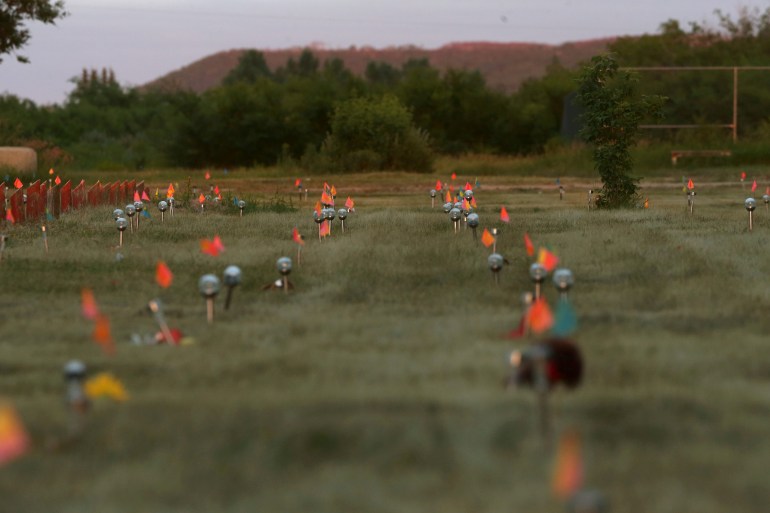
Recently installed solar lights marking burial sites on Cowessess First Nation, where a search had found 751 unmarked graves from the former Marieval Residential School near Grayson, Saskatchewan, Canada [File: Shannon VanRaes/Reuters]

Kyle Mason, an Indigenous activist in Winnipeg and the son of a residential school survivor told CBC in an interview published on Friday that he was “saddened and disgusted” by the priest’s comments.

“I was really sad to hear that somebody in his type of position could still hold these kind of views after everything that’s been said and done,” he said.

“Survivors had to endure unspeakable horrors, tragedies, and that attempted genocide on cultures and language,” he said. “So it is absolutely disgusting that you would just label them as lying to get more money.”

In a video published by CBC, Forest blamed the media for spreading “fake news” about residential schools.

“This is the evil, the evil of media. Media makes people believe so many things. Fake news,” Forest said.

The discovery of the graves has rocked Canada, prompting searches elsewhere and forcing Canadians to confront their country’s genocidal treatment of Indigenous peoples.

While the Canadian government and some Canadian bishops have apologised, no pope has, despite the significant role the Catholic Church played in the largely church-run schools.


Saturday, July 17, 2021

Indigenous chief to Trudeau: Turn over residential school records

Experts say the graves at Kamloops Indian Residential School are only the beginning.

Tk'emlups te Secwepemc Chief Rosanne Casimir speaks ahead of the release of findings on 215 unmarked graves discovered at Kamloops Indian Residential School in Kamloops, British Columbia, Canada, July 15, 2021 [Jennifer Gauthier/Reuters]

Tk’emlúps te Secwépemc First Nation Chief Rosanne Casimir on Thursday called on Prime Minister Justin Trudeau and the Mission Oblates of Mary Immaculate to open their student attendance records “immediately and fully” so her community can identify the hundreds of children buried on the grounds of the Kamloops Indian Residential School.

Casimir said her community’s search has only just begun, and she asked the provincial and federal governments to contribute funding and resources to help her community continue the investigation, and protect children’s remains.

“To the Prime Minister of Canada Justin Trudeau, we’re still waiting for you to reach out to us to acknowledge the latest truths from the Kamloops Indian Residential School. I look forward to a fulsome conversation where we can finalise the details of the federal government providing the needed support as well as access to our student records,” said Casimir at a news conference in Kamloops, British Columbia.

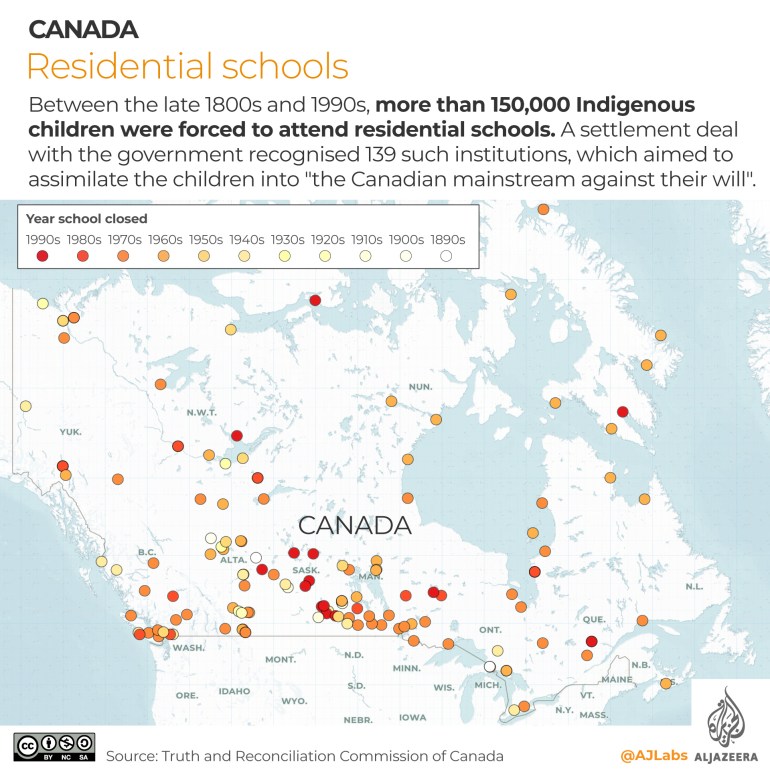
From the late 1800s until 1996, Canada forced 150,000 Indigenous children to attend assimilation institutions called “residential schools”, where they were forbidden from practising their culture or speaking their language. Many were physically and sexually abused, and thousands are believed to have died.

In May, Tk’emlúps te Secwépemc was the first in the country to release a preliminary discovery of 215 Indigenous children buried in unmarked graves at the Kamloops Indian Residential School that were found using ground-penetrating radar.

In recent months, other First Nations have used the same technology to search residential school sites, bringing the total number of Indigenous graves to more than 1,000 — many of which were not included in historical records, or had headstones removed.

Searching for graves

On Thursday, experts said only two acres (0.8 hectares) of the 160-acre (65-hectare) residential school site have been searched with ground-penetrating radar. Sarah Beaulieu, the radar specialist who participated in the search, said she further analysed the probable grave sites and concluded that there are approximately 200 likely graves — not 215 as first reported.

“With ground-penetrating radar, we can never say definitively that they are human remains until you excavate,” she said. “They have multiple signatures that present like burials, but because of that we need to say that they are probable until one excavates.”

Beaulieu said survivors led the search because they knew there were graves at the site, adding that archaeologists found a juvenile tooth near the site in the late 1990s or early 2000s, and a tourist found a child’s rib bone in the same area in the 2000s.

She said it was likely the graves contained children’s remains. “The majority of the anomalies were between 0.7 and 0.8 metres (27.5 and 31.5 inches) below the surface, which is fairly shallow, and it fits with the knowledge keepers’ descriptions of children having to dig graves, for one. It also fits with when you have a juvenile burial, because they are smaller in length, they typically are not dug as deeply.”

Beaulieu said no graves have been excavated yet. It is not clear when or if an excavation will happen.

“We are here today because of Indian Residential School survivors and intergenerational survivors who were unrelenting in carrying those painful truths about missing children forward,” Casimir said. She said survivors witnessed abuse and were required to dig graves, and it is because they spoke their truth that her community can verify where children are buried.

The Truth and Reconciliation Commission (TRC), a years-long process documenting survivors’ stories, confirmed 4,100 children who died in the institutions – from abuse, neglect, disease, fire, and from exposure after running away.

But the full scope of how many children died, and the causes of their deaths, is still unknown. According to the TRC, it was not until 1935 that the government adopted a formal policy on how to report and investigate deaths at the institutions. The commission found that, for half of the recorded deaths, the government did not include the cause of death.

More than 7,000 survivors of the institutions testified before the TRC. In its final report (PDF), the commission concluded the practice was cultural genocide, and that Canada had “set out to destroy the political and social institutions” of Indigenous people with a goal of seizing land.

According to the UN, the policy of forced assimilation institutions was popular all over the world — in Canada, the United States, Latin America, Australia, New Zealand, Asia, Russia, Scandinavia and East Africa — because it was cheaper than waging war against Indigenous people.

Survivors’ stories

During the news conference, survivors of the Kamloops institution shared their stories.

Mona Jules said her 13-year-old sister became sick and passed away at the Kamloops institution, but her parents were not notified until after her death. “They wanted to know, why wasn’t she taken to a doctor, to the hospital? It was right across the bridge,” she said. “There were no answers.”

Residential school survivor Mona Jules takes part in a presentation of the findings on 215 unmarked graves discovered at Kamloops Indian Residential School in Kamloops, British Columbia, Canada, July 15, 2021 [Jennifer Gauthier/Reuters]

Jules said she and other children were beaten for speaking their Indigenous language. She is still fluent and has spent her life teaching it to anyone who wants to learn.

“I’ve spent years trying to revive what that school has snuffed out. And it’s working — we have many of our young people who speak it and they’re running language departments, having meetings in the language, speaking it to one another. I still work with them, when I can, and I’ll continue to do that for as long as I can.”

Source: Al Jazeera
 

What will a US probe into Indigenous boarding schools uncover?

Government to study troubled legacy of forced assimilation policies. 13 Jul 2021


Monday, July 12, 2021

Chief Louis of Kamloops


EN:UNDEF:public_image_official_caption Chief Louis Clexlixqen

Source: Link

CLEXLIXQEN, LOUIS (Xlexxle’xken, Klicktickkun, Tlihtlihen, Hatakun, Little Louis, Petit Louis), HBC employee, farmer, and Shuswap chief; b. 1828 at Tk’emlul’pe7 (Kamloops, B.C.); m. first Eugenie, and they had two daughters; m. secondly Marie, widow of Abraham Larue, who had six children; d. 12 April 1915 in Kamloops.

As a young man, Little Louis occasionally worked for the Hudson’s Bay Company. He is mentioned in the journals of Thompson’s River Post (Kamloops) as an express rider, guide, and trader. A horse owner as early as 1855, he had begun farming by 1863, when he first traded potatoes to the HBC; in 1874 he threshed 16 tons of grain. In 1877, when the Indian reserve commission [see Gilbert Malcolm Sproat] took an inventory of farm stock and equipment, he appears as one of the wealthiest members of the Kamloops band of the Shuswap (an Interior Salish tribe). He owned 30 horses, 25 cattle, 30 pigs, and 50 hens.

Louis had become chief of the Kamloops band about 1852 and would serve as hereditary chief (a classification made by the Department of Indian Affairs) until his death. He converted to Roman Catholicism in the early 1860s and about 1866 he became a church chief (an appointment within the village council system instituted by Oblate missionaries). That year Oblate priest Pierre Richard commended him for cooperating in the enforcement of church precepts. 

In 1872 Father Florimond Gendre reported that Louis had raised the money to build a church on the Kamloops Reserve. Louis consistently supported education: he had encouraged Shuswap children to attend the residential school at the Okanagan mission in the late 1860s, assisted the Oblates in establishing a day-school on the Kamloops Reserve in 1880, and initiated the residential school built there in 1890. It was likely his influence that allowed the Oblates to assume control of it in 1893. 

Louis learned to write the Chinook Jargon in shorthand from Father Jean-Marie-Raphaël Le Jeune* and was taken to Rome to display his abilities to the pope. As church chief, he presided over the village council under the assumptive authority of the church. The relationship, however, was not always smooth. In a series of letters between 1873 and 1877 to Oblate superior Bishop Louis-Joseph d’Herbomez*, Father Charles Grandidier had noted the poor example Louis set by his fondness for drinking, gambling, and horse-racing, and by his irresponsibility in performing church duties. Fearful of violence, Grandidier was also alarmed at Louis’s persistent role in the native agitation surrounding land claims.

Shuswap and other interior Indians had accepted reserves in 1861 but in 1866 saw them cut in size by Joseph William Trutch*, chief commissioner of lands and works for British Columbia. This reduction, combined with gold-mining, immigration to the Kamloops district, and diminished access to grazing lands, caused significant dissatisfaction. Although Louis was responsive to the opportunities which these changes offered, he was also constantly vigilant, one of a handful of interior chiefs, among them Johnnie Chilleheetsa of Douglas Lake and Basil Dick of Bonaparte, who would persistently attempt to protect the interests of their bands. 

The first recorded meeting of protest by the Shuswap was held on 16 Nov. 1873 at the Bonaparte Reserve. For the next four years Louis was unflagging in his efforts to forge a confederacy or, if necessary, a military alliance of the Shuswap, Thompson River, and Okanagan tribes to obtain justice on the land issue. In 1876 Grandidier, who warned of “a plot between the Similkameen, Okanagan, and Shuswap to put all to blood and fire” if the question was not resolved, identified Louis as a leading provocateur. Louis had the opportunity to lay his case before Governor General Lord Dufferin [Blackwood*] in September 1876 when he visited Kamloops. The next summer the Indian reserve commission met with him and other band members and agreed to enlarge their reserve to meet the band’s requirements for stock raising and farming. Thereafter, to support their claim of title, Louis represented the interior Indians in Ottawa on numerous occasions and was part of a delegation sent to present the case to Queen Victoria. He was active in the establishment in 1909 of the Interior Tribes of British Columbia, which petitioned Prime Minister Sir Wilfrid Laurier on the matter at Kamloops the following year, and he signed the organization’s petition of 10 May 1911 to Minister of the Interior Frank Oliver*. Because the royal commission on Indian affairs for the province of British Columbia refused to discuss the issue of title in its hearings in 1913 [see James Andrew Joseph McKenna], Louis focused his testimony on the inviolability of the reserve boundaries established in 1877.

Louis was a highly public figure in both the Indian and the white communities of Kamloops. He enjoyed racing and parading his well-bred horses, participating in sporting events, and meeting, in full equestrian display, visiting dignitaries. Louis died in 1915 and was buried on his reserve in the cemetery of St Joseph’s Church. In a display of respect not often accorded native leaders, the Kamloops Standard described him as “a man of keen intelligence, [who was] very diplomatic in all business connected with the interests of his people.”

Written by Duane Thomson

[Details concerning the Kamloops band were provided by Dr Marianne Boelscher Ignace, a linguist fluent in the Shuswap language and married to a Shuswap native.  d.t.]

Arch. Deschâtelets, Oblats de Marie-Immaculée (Ottawa), records of the Oblate missions in British Columbia (mfm. at Univ. of B.C. Library, Vancouver). BCARS, A/B/20/K12; A/C/20/K12. Kamloops Museum and Arch. (Kamloops, B.C.), Mary Balf, “Chief Louis of Kamloops” (1971). NA, RG 31, C1, 1881, 1891, Kamloops (mfm. in Okanagan Univ. College Library, Kelowna, B.C.). Union of British Columbia Indian Chiefs (Vancouver), “Evidence submitted to the royal commission on Indian affairs for the province of British Columbia” (typescript, [1913–16]; photocopy in Okanagan Univ. College Library), Kamloops, 28 Oct. 1913. Kamloops Standard, 12 April 1915. Kenneth Favrholdt, Kamloops, meeting of the waters: an illustrated history (Burlington, Ont., 1989).

BIOGRAPHY 

Monday, June 28, 2021

Wretched Legacy | Angelican Church and Residential Schools


Sorrow, Shame and Rage: the Wretched Legacy of Canada’s Residential Schools


Residential school group photograph, Regina, Saskatchewan, 1908. Photograph Source: John Woodruff – Public Domain.

+++

 "Many groups have issued apologies for the wrongs they have committed towards indigenous peoples. Without changing our ways, however, these apologies fall flat"

Over the years, Anglicans have learned more of the truth about the residential schools we ran. According to Anglican Church records, the church operated around three dozen schools between 1820 and 1967. Before Confederation in 1867, Anglican missionaries ran these schools with the purpose of converting indigenous peoples to Christianity. After Confederation, the Anglican Church operated these schools on behalf of the Canadian government. These schools were used by the church not only to convert students to Christianity, but to assimilate them into a British culture. Due to underfunding, many residential schools were ill-equipped to provide a quality education for children. 

Canada’s Truth and Reconciliation Commission (TRC) identified 3,200 children (566 in Saskatchewan) who died while attending the schools as a result of poor care. Since the TRC published its report more missing children have been identified and more pain and hurt is being felt. 

Injustices towards Indigenous peoples continue today. 

BACKGROUND: Ministerial message: Truth and reconciliation at heart of religious tradition | Humboldt Journal

Sunday, June 27, 2021

Brace Yourself for More Graves | Every Child Matters | #60sScoop


Splatsin Chief Wayne Christian and Tina William lead the Every Child Matters March in Enderby Monday, June 21. (Lyndsey Leon photo)

Splatsin Chief Wayne Christian and Tina William lead the Every Child Matters March in Enderby on June 21. (Lyndsey Leon photo)

Kukpi7 Wayne Christian says more grisly discoveries to come; seek support

Brace yourself, says Splatsin and Secwépemc Tribal Chief Wayne Christian.

In the wake of the grisly discoveries of 215-plus unmarked graves in Kamloops and another 751 in Saskatchewan, the ’60s Scoop survivor said it’s important for the public — both Indigenous and non-Indigenous — to be prepared for more discoveries.

“It’s such a shock and I feel so horrific for all of us,” Christian said.

“For those of you who attended the residential schools or were connected to it in some way, I want to ask you to think about the support you may need,” he said. “If you didn’t attend a residential school yourself, I want you to reach out to people in your community who did attend or might be impacted by it, and check-in with them.”

Christian said people can support each other by learning Canada’s history and listening to survivors’ stories.

“A lot of people still won’t talk about the horrors that took place in these so-called schools,” he said. “A lot of people will not believe that there are unmarked burials at these sites. There are many, many stories that our people heard and knew – these recent discoveries confirm what our oral histories taught us.”

He also said this a non-partisan issue. 

Splatsin has released a presentation on the Splatsin.ca website for members of the public interested in learning more about Secwépemc history and the residential school system.

KEEP READING

Indigenous Land Back movement charts better way forward #LandBack

Crown lands are viewed as storehouses of resources to be exploited and Indigenous Peoples have no say over what happens on most of it


The Indigenous Land Back movement isn’t new, but it’s gaining increasing public attention and support. 

In this time of facing uncomfortable truths about past and ongoing harms inflicted on Indigenous Peoples and others, it’s important to understand the history of colonial oppression, and the roots and goals of Land Back and what it means.  

It’s not just about land. In the first of three short Land Back videos (about 12 minutes each) – Past, Present and Future – Ojibwe journalist Jesse Wente says, “It’s about self-determination for our Peoples here that should include some access to the territories and resources in a more equitable fashion, and for us to have control over how that actually looks.” 

Throughout Canada’s history, Indigenous Peoples have been forced from the lands that sustained them for millennia to ever-diminishing “reservations” so colonizers could exploit “resources.” Even national parks, including Jasper and Banff, and municipal parks like Vancouver’s Stanley Park, were created after the original people living there were expelled. 

As Jasper’s website says of the park’s creation in 1907, “Indigenous peoples were considered incompatible with nature and so couldn’t live in, hunt or harvest within park boundaries. First Nation and Métis peoples were physically removed from the landscape, blocked from accessing it and banned from harvesting plants and animals, holding gatherings and accessing cultural sites.” 

Most federal and provincial Crown lands are viewed as storehouses of timber, oil, gas and minerals to be exploited and mostly exported. Indigenous Peoples have no say over what happens on most of it, so land defenders have to step in. 

Wente argues that Canada was established more as an “extractionist corporation” than a country. 

Anishinaabe storyteller and artist Bomgiizhik agrees: “When Canada formed and became its own country, they created something called the Indian Act, which was to force people off their traditional lands, have them contained onto reservations and then filtered into colonization so that they would never, ever become a threat to resource extraction.” 

As with the recent finding of 215 children buried on the grounds of the former Kamloops Residential School (and evidence of many more throughout the country), growing awareness of missing and murdered Indigenous women and girls, the appalling foster care and “’60s scoop” systems and more, these issues are not history; they’re ongoing, with impacts that continue through generations. 

Ultimately, Land Back is about confronting these colonial abuses and charting a new path. But it holds different meanings for different people.  

Anishinaabe-Ininew 4Rs Youth Movement co-ordinator Ronald Gamblin writes in a blog, “When I hear Indigenous youth and land protectors chant ‘Land Back!’ at a rally, I know it can mean the literal restoration of land ownership. When grandmothers and knowledge keepers say it, I tend to think it means more the stewardship and protection of mother earth. When Indigenous political leaders say it, it often means comprehensive land claims and self-governing agreements. No matter what meaning is attached, we as Indigenous nations have an urge to reconnect with our land in meaningful ways.”  

It’s about responsibilities as well as rights. Beverly Jacobs, acting dean at the University of Windsor’s law faculty and a member of the Haudenosaunee Confederation, says Indigenous laws are about responsibility, relationships and reciprocity. “It isn’t until we bring in the colonial law that all of a sudden we’re talking about rights,” she says, noting that rights are based on the individual whereas Indigenous law is based on responsibility to “all our relations,” including land. 

That’s important, as western ways are unsustainable. “It’s not that the earth can’t sustain all of humanity. It’s that the earth can’t sustain what humans are doing,” Wente says. 

The goal is to move forward together, not return to some idealized past. “Every relationship evolves, and our relationship with land has to be one that accepts our modern circumstances as Indigenous People,” Anishinaabe-Métis associate professor Aimée Craft says. 

Bomgiizhik says Canada must listen to Indigenous Peoples not just when they’re protesting or blockading. “How we’re going to win is by people working together and actually getting on the land and building sustainable economies with their bare hands.” 

Land Back is rooted in Indigenous Peoples’ rights and responsibilities, but it’s also about finding a better way forward for everyone who lives here. 

Written with contributions from David Suzuki Foundation Senior Writer and Editor Ian Hanington.           Learn more at davidsuzuki.org.


click

Contact Trace

Name

Email *

Message *

NO MORE UPDATES

GO TO:  https://blog.americanindianadoptees.com/  for updates and news. THIS BLOG cannot be updated...