BLOGGER changed, not allowing us to UPDATE this back-up blog

(UPDATED 726/2025) issues with blogger are preventing this
Showing posts with label Canada genocide. Show all posts

Friday, March 21, 2025

The journey home: Sixties Scoop survivor discovers his Indigenous roots in the Yukon

Jay Mitchell traced his biological family to the Yukon, then moved to Whitehorse to reconnect

A man stands beside a river in the snow.
Jay Mitchell by the Yukon River in Whitehorse. Mitchell has spent most of his life in Alberta and Ontario and believed he was Métis — until a DNA test helped him find his true biological family in the Yukon, and prompted him to pick up and move to the North. (Cali McTavish/CBC)

Having spent his whole life in bigger cities, Jay Mitchell says he's still getting used to the pace of life in the relatively small town of Whitehorse. 

"It's a shock. I'm so used to city life," said Mitchell. 

He's also getting used to meeting new members of his extended biological family. He says people often come up to him on the street in Whitehorse and tell him, "you're my cousin," "you're my second cousin," or "you're my nephew."

Mitchell moved to the Yukon last May after discovering errors in his Sixties Scoop adoption papers and then learning the truth about his ancestry. He spent most of his life believing he was Métis, only to have a DNA test reveal that both of his biological parents were from Yukon First Nations.

Mitchell says he misses his wife and son back home in Oshawa, Ont., but he says they'll join him soon.  He's grateful to the Kwanlin Dün First Nation in Whitehorse for embracing him and giving him a job, and a place to live, while he waits for his family. He is now a citizen of Kwanlin Dün, and works as a records keeper for the First Nation. 

Mitchell's family's move to the North is about building connections with his biological family, and finding support for Mitchell's 17-year-old son Nicholas who has autism. 

A man and woman stand on a sidewalk with a small child riding a toy bike.
A photo of a younger Mitchell with his wife Lisa Hughes and their son, Nicholas Hughes Mitchell who is now 17 years old. (Submitted by Jay Mitchell)

"We're doing this for my son," says Mitchell, "to make sure that, you know, there's family to take care of him, if anything happens to us."

A case of mistaken identity

Mitchell, 57, was born in Edmonton and raised there by his adoptive family before they moved to Oshawa. He was 10 years old when his mother told him he had been adopted. He says it was a shock. 

"I had no idea," said Mitchell.

His mother also then showed him his birth certificate which said Mitchell was Métis. That set him on a path to discover his cultural roots. 

"I went to Métis celebrations, and I met the Ontario Métis chief in Oshawa," he recalled.

When he was in his 50s, a health issue prompted a doctor to encourage Mitchell to try to learn about his biological family's medical history. That led to another surprise for Mitchell, when a DNA test and an ancestry research service revealed that he was not in fact Métis.

He learned that his biological family were Yukon First Nations members. He soon connected with his biological half-brother Jeffrey Kalles in Whitehorse, and eventually his two half-sisters as well.

Grandmother, father and son sit on a couch.
Jay Mitchell, centre, with his adoptive mother Barb Mitchell, and his son Nicholas Hughes Mitchell. (Submitted by Jay Mitchell)

Kalles describes the first time he talked on the phone with Mitchell.

"Hearing that voice, and just really realizing that's [my] big brother — it's surreal," Kalles recalled.

It was also surreal for Mitchell to learn about his biological family.

"The funny thing is that with my adopted family, I'm the baby of all the siblings — and in my biological family, I'm the oldest. It's kind of weird how that works," said Mitchell. 

A group of people pose for a photo in a picnic shelter.
Kwanlin Dün First Nation members welcome Mitchell to Whitehorse last year. Mitchell is standing at the back with a ball cap and red vest on. (Submitted by Jay Mitchell)

Putting the pieces together

Through a Freedom of Information request, Mitchell was able to get his adoption records from the Alberta government and confirm the identities of his biological parents as Yukon First Nations. 

"I don't understand why they didn't put me as First Nations. It's kind of puzzling, but a lot of people say that things were different back then, in the '60s," said Mitchell. 

The Sixties Scoop refers to the practice from the 1950s to the 1980s of removing First Nations and Inuit children from their families and communities and placing them in foster care or adopting them out to non-Indigenous families. According to Sixties Scoop class action lawsuit settlement website, many claimants described being cut off from their culture and language. 

Mitchell says when he learned about the class action lawsuit he was told he didn't qualify because of his Métis status. By the time he found out the truth about his Indigenous ancestry, the deadline to join the claim had passed.

'A lot of people were shocked ... that I existed'

After moving to Whitehorse and reuniting with biological family, Mitchell learned there were two people he would not be able to meet: his biological parents. Dennis Ladue and Joyce Jonathan had both died a few years earlier. 

"A lot of people were shocked about who I was, and that I existed," says Mitchell. 

Duran Henry is one of Mitchell's cousins. He thinks Ladue would have loved to meet Mitchell. 

A close up of two men staring into the camera.
Mitchell, left, with his cousin Duran Henry. (Submitted by Jay Mitchell)

"I think he would have been surprised, and then just overwhelmed by joy and love," says Henry.

He says sometimes Mitchell reminds him of Ladue.

"The way he laughs and, you know, the way we joke around — he's just a happy guy, and [Ladue] was like that."

Kalles was also adopted and also never met Joyce Jonathan, his biological mother. But he says their parents live on through the siblings. 

On the left, a man sits holding a cup of tea. On the right, a woman smiles laughing at a camera.
Jay Mitchell's biological parents Dennis Ladue and Joyce Jonathan who both died before Mitchell had a chance to meet them. (Submitted by Jay Mitchell)

"There are these idiosyncrasies — we didn't grow up together, but the way we talk and the way he looks around and stuff like that. I guess, when I talk to him and look at him, I just know, that's my brother," said Kalles. 

Mitchell says he can't wait for his family to join him in Whitehorse this summer. 

"Every day I miss my wife and son. My son and I do everything together," he said. 

Kalles says he's also excited to meet more of his extended family.  

"I'm going to retire here shortly, so I'll have a lot of time to hopefully show them around the Yukon," said Kalles.

Tuesday, February 11, 2025

‘Denying our truth’: The fight against residential school denialism in Canada


Friday, May 17, 2024

Lisa Meeches hopes MMIWG documentary series returns to the airwaves


Over the past four decades, Lisa Meeches has produced countless acclaimed films and television programs. She tells Face to Face (APTN) there are hopes to renew the series Taken, which told the stories of missing and murdered Indigenous women and girls.

Thursday, October 27, 2022

Smudging helped David Fineday deal with trauma from #60sScoop

 'Smudge On': Saskatoon man working to fill Indigenous cultural, spiritual gap in city

David Fineday, middle, in a small circle of people who stopped by Friday for Smudge On, a program that allows people to engage in the Indigenous cultural and spiritual practice of smudging. (Dayne Patterson/CBC)

A Saskatoon man is trying to bring the Indigenous spiritual and cultural practice of smudging to those in the city, where he says it is lacking.

David Fineday, 66, said he was taken from his home at about five years old, then didn't see his mother until he returned home more than a decade later at 16. 

He said his mother and elders then taught him how to smudge. Smudging is a spiritual practice meant to purify oneself by washing the smoke from burning certain herbs, like sweetgrass and sage, over your face and body.

Fineday said he doesn't see smudging often in the city — so he treks from his home in Saskatoon to a small, treed area near the corner of 20th Street West and Avenue K South, and does it there.

Fineday leads "Smudge On," a program backed by the Pleasant Hill Community Association that invites people to smudge every Saturday. Last week he also held a smudge on Friday for those who wanted to participate on the National Day for Truth and Reconciliation.

"Smudge On is a spiritual thing that I am trying to bring back to our people," he said. 

"When you say your prayers that smoke takes your prayers up and that's how you're heard."

Two men stand in a park with a banner between them reading '60s Scoop' in large, colourful lettering, with many names written on it.
David Fineday, left, and Dennis Kissling, right, carried a banner on July 1 with names of people they said were taken from their homes during the Sixties Scoop. On the back it said 'Smudge-On,' a reference to the practice of smudging, which Fineday said has been a way to heal from the traumatic past. (Dayne Patterson/CBC)

Smudge On started in June 2020, but has become more consistent through 2021 and 2022, operating almost every Saturday through the late winter months into the late fall, Fineday said.

"People can come here if they're having problems, they can have a smudge and have a prayer and if they want to talk, they can talk," he said, calling it a no-judgment zone.

"Everybody deserves a prayer, especially these people on the street with their mental illnesses and addictions. They're chased out of every other place."

Fineday said smudging helped him to know he wasn't alone and to heal from the trauma associated with being taken during the Sixties Scoop, a period from the 1960s to 1980s when Canadian child welfare authorities took thousands of Indigenous children from their homes and placed them with non-Indigenous foster parents.

David Fineday, right, hosts the Smudge On program almost every Saturday to provide those in search of the traditional Indigenous practice an opportunity to do it. (Dayne Patterson/CBC)

While Fineday didn't attend residential schools, he said he moved from foster home to foster home from November 1961 until June 1973.

Saskatoon Ward 2 Coun. Hilary Gough stopped by Smudge On's Friday ceremony with a case of coffee and Timbits for the attendees, who sat on blue tarps that circled a metal firepit in the grassed area. 

She said she stops by occasionally.

"This is something that is happening today, for [National Day for Truth and Reconciliation], but it's also something that happens every week," Gough said. 

"It is intended to meet people where they're at."

Gough said she thinks much of the work done on the national day needs to be done year-round, not just on a designated date.

Monday, September 26, 2022

stolen children: gimoodinaan binojiinhyan (+tweets) #LandBack


Wednesday, April 13, 2022

Pimicikamak Cree Nations will search for graves

 National Native News

Another First Nation in Canada is preparing to search for unmarked graves at a former residential school.

As Dan Karpenchuk reports, this time it will be in northern Manitoba.

The Pimicikamak Cree Nations has announced plans to search the site of the former St. Joseph’s Residential School. It was operated near Cross Lake by the Roman Catholic Church in northern Manitoba, between 1912 and 1969. The chief of the Pimicikamak Nations is David Monia. He says the reserve has identified the names of 85 children who died at the school.  However, he adds that surviving records are incomplete.

“Many of them are listed as boy, as girl, 40% of them have first names only. Where did these kids come from?”

Investigators say they will use ground penetrating radar to search the site, which is now a neighborhood with homes.

“You know they don’t describe it as a school. More like assimilation camps, torture camps, or death camps and really that’s an international crime.”

No start date for the search has yet been determined. It was just over a week ago that the Pope apologized at the Vatican to a Canadian Indigenous delegation, for the role of the Catholic Church in the abuses at Canada’s residential schools. Thousands of Native children were abused at the schools, many died.

Tuesday, December 14, 2021

Compensation in Canada


OTTAWA, Dec 13 (Reuters) - Canada is setting aside C$40 billion ($31.2 billion) to compensate Indigenous children and families in foster care for suffering discrimination, and will start paying out once a protracted lawsuit is settled, officials said on Monday.

The compensation decision affects some 55,000 children.

READ


Tuesday, November 30, 2021

Punishment and Abuse | Facing History and Ourselves

 November comes to an end but not us, we will continue telling our stories... TLH

Read recollections from former students about the frequent use of corporal punishment in Indian Residential Schools.

READ: Punishment and Abuse | Facing History and Ourselves

Tuesday, November 23, 2021

Kamloops Indian Residential School: So why is it so hard to determine how many children died there?

With any genocide, the oppressor seeks to minimize their damage and atrocity... TLH

Lost children


The threat of death was part of life at the Kamloops Indian Residential School. So why is it so hard to determine how many children died there?

June 13, 2021

WARNING: This story contains details some readers may find distressing.

During a 1937 outbreak of measles at the Kamloops residential school, a nurse gave student Mary Francois some Aspirin, mustard plasters and brandy after the girl fell ill on May 3.

On May 10, Mary was taken by car to the nearby Royal Inland Hospital. She had been sick with pneumonia, two bacterial ear infections and inflamed kidneys. That day, the school principal sent a letter to her parents — but they never received it.

The local Indian agent phoned them on the morning of May 13. But when the parents arrived at the hospital that evening, it was too late.

Mary was dead from a blood clot in her brain.

Afterward, Mary's father, the chief of the Adams Lake Band, which sits about 60 kilometres to the east, wrote a letter to the Indian agent.

"In connection with the death of my daughter Mary, while attending Kamloops Indian Residential School," read the letter from Chief Francois, "I would request, as Chief of the Adams Lake Band, that in future, when a child of the school is taken sick and requires hospital attention, that the parents or guardian be notified at once."

The typewritten letter is signed with an "X."

The information about Mary Francois's case is found in a death memorandum from the Indian Affairs department (which does not, in fact, note her age). Mary's record now lies in the holdings of the National Centre for Truth and Reconciliation alongside 10 other death memorandums from 1935 to 1945, in a folder titled "Kamloops Residential School, Pupil Deaths." The folder is twice stamped with the word "dormant."

An image of Mary Francois's death record, kept by the Indian Affairs department. (National Centre for Truth and Reconciliation)
 

These memorandums are a reminder that the threat of death was part of life at the Kamloops Indian Residential School.

The institution has become a household word since Tk'emlúps te Secwépemc First Nation announced the discovery of what are believed to be the unmarked burial sites of children's remains adjacent to the former school's grounds.

The death of students at Kamloops residential school was no secret among the First Nations whose children were forced to go there. Finding out how they died is a challenge, but the evidence that does exist reveals a record characterized by the indifference of authorities, who saw the children as a means to an end that had little to do with their well-being.

CBC News obtained historical records as well as an out-of-print book that, along with the oral history of survivors, sheds light on the lives and suffering of the students who attended the school.

 
An undated photo of the Kamloops residential school. (National Centre for Truth and Reconciliation)

Many causes of death

Survivor testimony and historical records reveal how children died at the institution throughout the years. Many fell to diseases like tuberculosis and measles. Others drowned in the Thompson River, which flowed nearby. Some, fleeing school, tried to hop trains and died. Others died of suicide.

The National Centre for Truth and Reconciliation, the repository of residential school records gathered by the Truth and Reconciliation Commission, found evidence for 51 fatalities at the institution. There are likely more.

The federal government purged three volumes of funeral records from Kamloops residential school, according to listings of destroyed files held by the National Archives of Canada. The Indian Affairs department also destroyed three volumes of Indian agent reports, along with quarterly "returns" for 1956 to 1961 — student lists that would include deaths.

The memories of survivors fill in some of the gaps left by the reports.

Barbara McNab-Larson, who attended the school from 1948 to 1950, often goes down to a creek near her house in Skeetchestn First Nation. It's a place teeming with life and scents that bring her back to the place before her childhood was shattered.

"That was probably the safest time in my life," said McNab-Larson. 

When she was five, a cattle truck came to take her to Kamloops residential school. "The first thing they did was take us down to the cleansing room, where they cut off our hair," she said. "Then, they deloused us. Then, they scrubbed us down with disinfectant like we were diseased animals."

McNab-Larson returned home for the summer, but the next year, she said the school came to get her in an army truck.

WATCH | Barbara McNab-Larson talks about her time at the Kamloops residential school:

Remembering life in the Kamloops residential school

Not all were so lucky — to live and remember.

Seven years before McNab entered the doors of Kamloops residential school, a student named Florence Morgan became sick there. Her death memo notes that it was at 6:30 a.m. on June 26, 1941; by 6:50 a.m., she was taken to the Royal Inland Hospital. Florence died on June 28 from the viral infection encephalitis, the memo says.

The Indian agent reported that her body was returned by truck to her parents on the Bonaparte First Nation, which sits 90 kilometres to the east of the school.

The viral infection that killed Florence was a common after-effect of contracting measles. Outbreaks of measles coursed through the school during this era.

One of these outbreaks sickened nine-year-old Leslie Lewis. On Sept. 22, 1935, while Leslie was recovering, he suffered an epileptic attack. The nurse at the school gave him three grams of luminal, an anti-seizure medication. Leslie was put in a car and sent to the hospital at 9 a.m. the next day.

The doctor reported that Leslie seemed fine that morning, but the next day he was dead, his memo says. The doctor reported that the measles infection likely triggered the seizure.

An image of  Leslie Lewis's death memo. (National Centre for Truth and Reconciliation)
 

The Indian agent concluded the memo by commenting on the overcrowded conditions at Kamloops residential school, where five dormitories accommodated 285 students.

"During an epidemic it is impossible to properly isolate the patients and contacts," typed the Indian agent. "The need for separate quarters to house sick children is evident."

'They still get nightmares about it'

It wasn't just disease. Some students were also driven to suicide.

"This … young boy hung himself in the bathroom. You know, my brother's age group," said Gerry Oleman, who attended Kamloops residential school from about 1960 to 1968, in a recent interview with CBC. Oleman, who is from St'át'imc First Nation in B.C.'s Interior but now lives in Brandon, Man., said the students who witnessed it still can't shake the moment.

"Still today they remember that. They still get nightmares about it," he said. Oleman also mentioned other distraught students: "the runaways and people jumping trains, getting killed jumping a train, you know, freezing to death."

Suicide also haunts the stories of survivors gathered in the book Behind Closed Doors: Stories from the Kamloops Indian Residential School, which was published by the Secwepemc Cultural Society in 2001.

James Charles, who attended from 1964 to 1978 and is featured in the book, knew of three boys who died of suicide. "One suicide was over on the swings beside the brown building," Charles says in Behind Closed Doors. "No one could figure out how that really took place, because it happened in broad daylight, blue sky out, sun was shining."

Charles said there was another child who died on the bell rope and a third found in the orchard. "I think remembering these suicides played a big role in a lot of my anger that I had bottled up inside," Charles says.

According to the book, some of the children who died attempting to escape on a nearby train came from the Lillooet district, about 170 km west of the school.

One anecdote in the book, told by a survivor who signed their story "Anonymous," said their older sister Nellie died at the school. She was sick for months with hepatitis and yellow jaundice. No doctor came to treat her and no one told her parents of her illness until after her death.

"When my father came to the school after hearing of the sad news, he beat the principal and punched him down the stairs," says the survivor in the book. "As much as I want the memories of my education years to be positive, it just can't be."

 
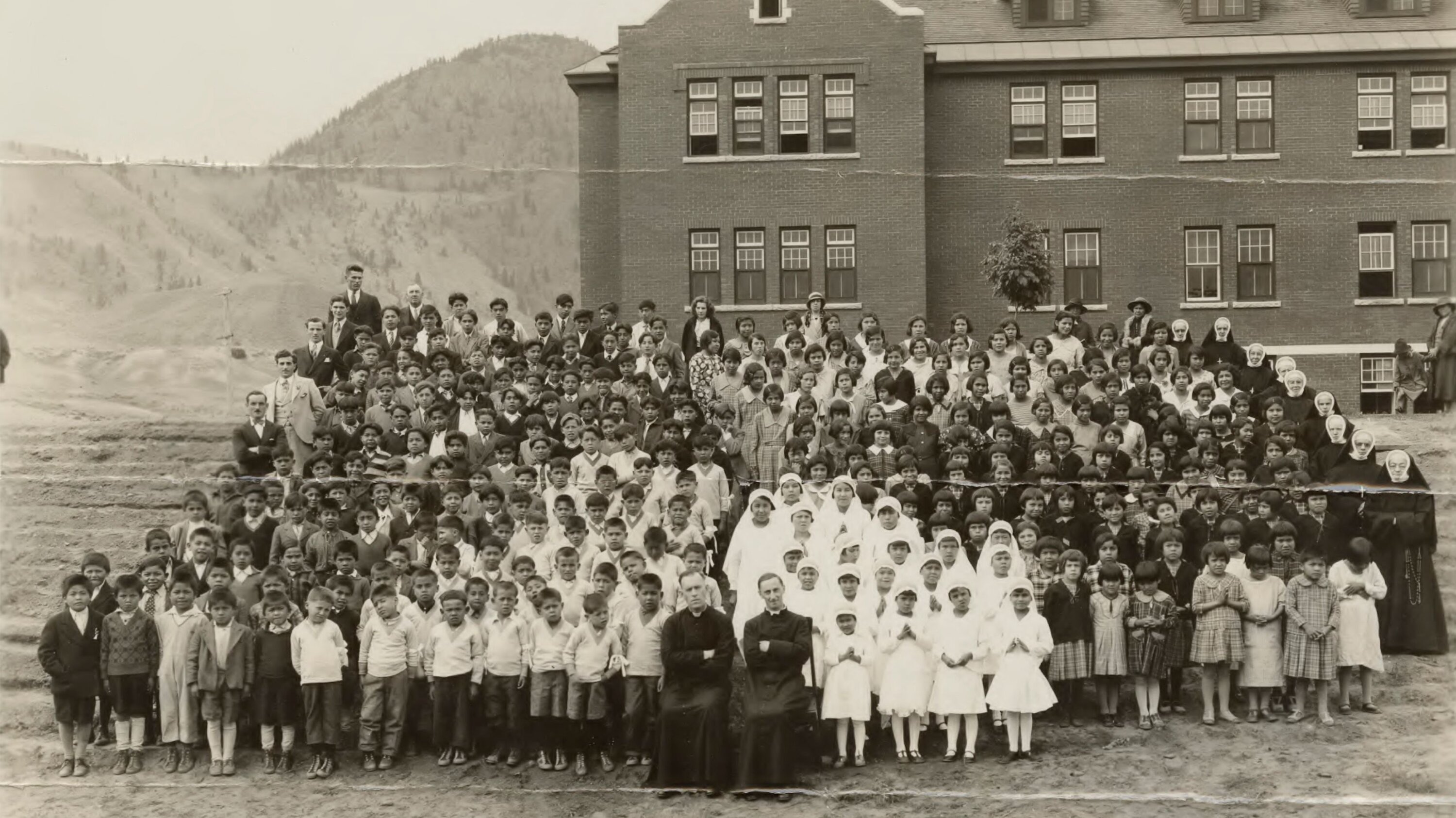
A photo from April 4, 1937, of students, administration and teaching staff at Kamloops residential school. The photo is from the Quebec archives of the Oblates of Mary Immaculate. (National Centre for Truth and Reconciliation)

Another survivor in the book, Eddy Jules, spoke of abortions and a furnace.

"All of us that were going to school would hear the clang, and we would say, 'Oh, that's so and so's friend, and they gave her an abortion,'" said Jules, noting the strangeness of "fire in September or October or November when it's not cold."

Retired senator Murray Sinclair, who chaired the Truth and Reconciliation Commission, said in a recent video statement that he also heard testimony from survivors about this use for a furnace in residential schools.

"Some survivors talked about infants who were born to young girls at the residential schools, infants who had been fathered by priests, were taken away from them and deliberately killed — sometimes thrown into furnaces, we were told," said Sinclair.

'We mourned these children'

Despite all this evidence of death at the school, no record has yet surfaced of a graveyard at the institution — no shred of paper, cross or stone marks conveying who might lie beneath the earth.

Sister Marie Zarowny, chair of the board for the Order of St. Anne's, which provided teachers and nurses to the school, told CBC News a fire destroyed the first 30 years of records from the institution. She said that to her knowledge, no students were ever buried on the school grounds.

She said that if a child died at the Royal Inland Hospital, the body would not be returned to the school. If a student did die at the school, the body would be sent back to their home community for burial.

"We mourned these children at the school. We had a ceremony for them, but they were ... returned to their parents," said Zarowny.

She said that students from Tk'emlúps te Secwépemc who died at the school were buried in the community's cemetery. There are hints of another, now-forgotten graveyard in the records, she said, but couldn't confirm any aspect of this.

"I actually don't know if that reference comes from that school or from another school," she said.

As a result of destroyed records, the true number of students who died at residential school may never be known. The Truth and Reconciliation Commission, which was created to delve into the long history of the schools, concluded that at least 4,100 children died in these institutions.

The same uncertainty shadows the location of graveyards. Many children were buried in unmarked graves, some of which are now lost to time.

One institution that holds large pieces of this history in its archives is the Catholic Church. Catholic entities ran roughly 75 per cent of residential schools.

The church has faced widespread calls, from Prime Minister Justin Trudeau on down, to release all records related to residential schools, to augment the incomplete government record.

Zarowny said her order is sharing any relevant records with Tk'emlúps te Secwépemc that could help aid in the quest to identify the suspected remains on the Kamloops residential school grounds.

She said the Sisters of St. Anne's turned over what they viewed as records related to residential schools to the Truth and Reconciliation Commission (TRC).

 
A photo from 1931, taken at the Kamloops residential school. (National Centre for Truth and Reconciliation)

But the order has yet to sign off on the transfer of its records to the National Centre for Truth and Reconciliation, said Stephanie Scott, executive director of the institute.

"The [Sisters of St. Anne's] remain unwilling to authorize disclosure of [its] records currently in the possession of the government of Canada," said Scott, in a statement to CBC News.

Several Catholic entities never turned over any records to the TRC. According to an internal TRC document obtained by CBC News, 17 Catholic entities failed to hand over any archival material to the commission.

"There are a lot of records in church archives that we never got to go through," Tom McMahon, the former general counsel for the TRC, told CBC.

The Oblates of Mary Immaculata, which ran Kamloops residential school, turned over what it deemed to be relevant records to the TRC, according to the internal TRC document.

McMahon said the Catholic entities that did provide files made their own determinations about what was deemed to be a "relevant" document. He said the Catholic entities held onto records connected to church functions and personnel files.

"When you start talking about personnel records, they did not see that as relevant to the children and education of the children," said McMahon.

"When we talk about deaths of children, you want to think about the church records, the baptism records, death records held by the church. The church told us those records pertain to church activities and were not relevant."

McMahon said one of the potentially richest sources of survivor testimony is held by the federal Justice Department in documents relating to roughly 4,000 civil actions filed by survivors against Canada and the various churches that ran residential schools. He said most of those files were never turned over to the TRC.

Survivors and descendants have long spoken about unmarked graves and children who never came home. Their calls made it to the House of Commons in 2007 and then-Indian Affairs minister Jim Prentice, who asked the interim executive director of the Truth and Reconciliation Commission to begin working on the issue.

According to a 2008 memo obtained by CBC News, the TRC asked the research branch of Indian Residential Schools Resolutions Canada, a federal agency created to deal with a multitude of civil claims filed by survivors, to conduct an internal records search for cemeteries.

Numerous schools came back with no records of cemeteries, including Kamloops residential school, according to a preliminary report.

John Milloy, one of the country's leading historians and author of A National Crime, perhaps the seminal book on residential schools, said that may be because Indian Affairs never prioritized residential school files.

When government edicts forced the department to destroy records through recycling — for example, as a result of a paper shortage during the Second World War — such files were seen as expendable.

"An awful lot of information which one could have had, to describe the nature of the system, the treatment of the children… a lot of that information was simply lost," said Milloy, who was involved with the Royal Commission on Aboriginal Peoples and the Truth and Reconciliation Commission.

Milloy said the Indian Affairs department, which is now known as Indigenous and Northern Affairs, is really a large real estate company, holding in trust reserve lands across the country. It also determines who has the right to live on this property, holding registries with status records and band membership lists.

"So those are the records which are most critical to the department," said Milloy.

He also said that the Canadian public has not properly understood the rationale for the evolution of a residential school system under the country's first prime minister, John A. Macdonald. The schools were a means of nation-building and achieving state-security ends, he said.

"It becomes pretty obvious that, as far as Macdonald and other senior members of the Indian Affairs department [were concerned]… one of the purposes of the schools was to hold the children hostage against the good behaviour of their parents," said Milloy.

He said the officials used children as bargaining chips to counter any attempts by Indigenous nations from raising arms against the still-fledgling state.

John Milloy, one of the country's leading historians and author of A National Crime, considered one of the seminal books on residential schools. (CBC News)

Milloy provided CBC News with a pre-print academic paper he wrote that details the strategy. The draft title is "Sir John A.'s Hostages." It states that government and North-West Mounted Police officials were increasingly concerned about a breakout in hostilities between the state and armed Indigenous nations such as the Blackfoot in the Prairies, just as Canada was building a railway to deliver goods and people — as well as establish control over territory.

The use of the schools to neutralize Indigenous resistance was put bluntly by school inspector J. A. Mcrea in a 1886 letter to the Indian commissioner: "It is unlikely that any Tribe or tribes would give trouble of a serious nature to the Government whose members had children completely under Government control."

At the time, Canada wanted to avoid a repeat of the wars in the U.S. and feared any new conflicts would eclipse the violence from the rebellion led by Louis Riel in 1885, Milloy's research showed.

A 1879 report by Nicolas Flood Davin, which recommended the creation of residential schools, followed a fact-finding mission to explore how the Americans used similar institutions, the paper said.

"Davin would have discovered this covert purpose for residential schools in his conversations with Carl Schurtz, the U.S. Secretary of the Interior, and Ezra Hayt, the Commissioner of Indian Affairs," said the paper. "Certainly, for the Department, the resolution of the 'Indian problem,' characterized so often as carrying the white man's burden of Christian duty was, in fact, countering the perceived threat to state security and social purity."

Milloy said that "this is one of the reasons why the Kamloops school is developed in the 1890s, because the situation in the area is tenuous for the government … The schools are also very much part of the colonial process … for the sake of the development of Canada."

The schools used fear and violence — and fear of violence — to bend generations of children under the cross and flag. Much remains hidden from the record about the fate of thousands of children who attended these institutions, but this history is carried by those who came home.

"'You better behave. Don't get out of line, because there's a graveyard and there's also the river.' Those were warnings that were given to us as little, tiny children — five, six years old," said Barbara McNab-Larson of her time at the Kamloops school.

"I don't think you really grasp it at the time, but when your friends disappear and they don't come back, even as a child, you know something's wrong."

Support is available for anyone affected by their experience at residential schools and those who are triggered by the latest reports.

A national Indian Residential School Crisis Line has been set up to provide support for former students and those affected. People can access emotional and crisis referral services by calling the 24-hour national crisis line: 1-866-925-4419.


Sunday, November 21, 2021

Headlines (November 2021)


Indigenous delegates to have private meeting with Pope Francis during Vatican visit

The Canadian Conference of Catholic Bishops says 25 to 30 Indigenous people are to meet with Pope Francis at the Vatican in December.

The delegates are to include elders, knowledge keepers, residential school survivors and youth. A small group of Canadian bishops is also to attend from Dec. 17 to Dec. 20.

“The journey towards healing and reconciliation is a long one, but we believe this will be a significant milestone in the Catholic Church's commitment to renewing, strengthening and reconciling relationships with Indigenous Peoples across the land,” Raymond Poisson, president of the Canadian bishops, said in a news release Wednesday.

First Nations, Inuit and Metis delegates are to have private meetings with the Pope, during which they will tell personal stories about the legacy of residential schools.

KEEP READING

Murray Sinclair to chair negotiations on federal compensation for First Nations kids


Ontario to release death registrations of 1,800 Indigenous children

Releasing death records was one of the recommendations in the 2015 report from the Truth and Reconciliation Commission

Ste. Anne's Residential School
St. Anne's residential school. (Supplied)

Ontario is in the process of releasing death records of approximately 1,800 Indigenous children to the National Centre for Truth and Reconciliation.

Releasing death records was one of the recommendations in the 2015 report from the Truth and Reconciliation Commission that documented abuse suffered by Indigenous children at residential schools.

A spokeswoman for the Office of Ontario’s Registrar General says the province began gathering and archiving the records after the report was released.

The province says Service Ontario has records of deaths that occurred over the past 70 years that were registered with the provincial government. 

It says the search to find death registrations of student-aged Indigenous children began at the end of 2016 and it was determined that the approximately 1,800 records should be released.

The province says digital copies of the records will be transferred to the centre once an agreement authorizing their release is finalized.

Earlier this year, the provincial government committed $10 million to search for burial sites at residential schools following news that the remains of hundreds of people had been found buried near other residential school facilities around Canada. 

The National Truth and Reconciliation Commission has identified 12 locations of unmarked burial sites in Ontario and the province has said there are likely more.

It reported the known deaths of 426 children who attended schools in Ontario and an unknown number of children still missing.

This report by The Canadian Press was first published Nov. 2, 2021.

Wednesday, October 27, 2021

At this Indigenous Elders’ literacy circle, survivors find healing


'We’re not going to be walking around in the dark anymore,' says founder, Cowichan Tribes Elder and survivor Linda Jack.

The first day in The Literacy Circle, a new Indigenous Elders’ literacy program at Vancouver Island University, meant a new experience for Elder student ‘U’nihi-ya (Catherine) Jim: For the first time, she felt encouraged to pursue her education.

“[Years ago] I went back to school and did some upgrading, and when I was doing that, the instructor told me that he didn’t think I was ever going to amount to anything except being a housekeeper. And that discouraged me, so I quit,” she says.

“I’ve always been discouraged by the words that people have said to me when I did try to go back [to school]. And right here, it’s like, ‘We’re here to support you.’ Wow. I’ve never heard that,” says Jim, who is a day school survivor from Cowichan Tribes and is currently undergoing chemotherapy for cancer.

GOOD READ: At this Indigenous Elders' literacy circle, survivors find healing

This story shares information about residential “schools.” The Indian Residential School Survivor Society’s Crisis Line can be reached any time at 1-866-925-4419.

Wednesday, September 22, 2021

Canada knowingly underfunding services for 165,000 First Nations kids and their families for decades


Where They Stand: The Parties on Indigenous Child Welfare

It’s been five years since a tribunal ruled that Canada discriminates against First Nations kids. Advocates still await change.


Katie Hyslop 16 Sep 2021 | TheTyee.ca

Cindy Blackstock doesn’t know why Liberal Leader Justin Trudeau lied about taking First Nations kids to court during the leaders’ debate last week. But Blackstock, the executive director of the First Nations Child and Family Caring Society, is “really sad” he did.

Especially when there is over 14 years of evidence — including court transcripts, news articles and 20 non-compliance orders from the Canadian Human Rights Tribunal — to the contrary.

“They have every legal right to litigate against our kids. I think it’s morally wrong — and it’s bad for the country — but they’ve chosen to do it,” said Blackstock of the government’s Federal Court case arguing against a tribunal ruling that First Nations children and families impacted by the child welfare system should be compensated.

“What they don’t have a right to do is then lie about it to protect themselves from accountability for their own behaviour.”

Blackstock would know: along with the Assembly of First Nations, her organization took the federal government to the Canadian Human Rights Tribunal in 2008 over its systemic underfunding of child welfre on reserves.

In 2016, the tribunal issued its ruling: the federal government had been knowingly underfunding services for 165,000 First Nations kids and their families for decades. The tribunal ordered the government to stop its discriminatory practices.

More than 50 per cent of children in government care in this country are Indigenous, despite representing fewer than 10 per cent of all children. The majority are First Nations children taken into care for “neglect,” which child welfare researchers say is another word for poverty.

In 2019, the tribunal declared the government must pay $40,000 — the maximum the tribunal can award — to every First Nations child removed from their family since 2006. Their guardians before the children were taken into care are entitled to $20,000.

The tribunal also awarded $40,000 to every First Nations child denied federal medical coverage between 2007 and 2017, citing Jordan’s Principle, a 2007 policy that governments should pay the medical bills of any First Nations child, on or off-reserve.

But two weeks before the 2019 election, government lawyers requested a judicial review of the compensation orders.

Hearings were held in Federal Court in June, less than a month after the Tk’emlúps te Secwe̓pemc Nation announced the rediscovery of 215 bodies on the grounds of the former Kamloops Indian Residential School.

The Federal Court’s ruling is expected at any time.

The government also took issue with the tribunal’s 2020 declaration that all children with Indian Act status; eligibility for status; or parents or guardians who have status, live on-reserve and whose First Nation acknowledges their membership — are covered by Jordan’s Principle.

The federal government argued before the court that only children with status under the Indian Act — a racist Canadian law that determines First Nations’ band membership — should be covered.

The Liberals have tried to respond to Canada’s child welfare crisis. In 2018 they released a six-point plan to reform child welfare, including implementing the tribunal’s ruling and working with Indigenous leaders to re-establish jurisdiction over child welfare.

In January 2020, the federal Act Respecting First Nations, Inuit and Métis Children, Youth and Families became law, starting the process to return jurisdiction to Indigenous communities. But it did not come with funding, and a year and a half later the federal government has yet to release a funding plan.

In B.C., a working group on child welfare and family services was established by the provincial and federal governments, the BC Assembly of First Nations, the Union of BC Indian Chiefs and the First Nations Summit.

Assembly Regional Chief Terry Teegee said that three of the 198 First Nations in the province are close to reclaiming their inherent jurisdiction over child welfare, though a federal funding commitment is needed.

“It’s always a work in progress, and I certainly know that a lot of these changes weren’t going to happen overnight,” Teegee said, adding the assembly is also waiting on provincial child-welfare jurisdiction legislation.

“We can’t let up. We need to continue on to allow our First Nations to take their rightful place in asserting their jurisdiction and their ability to express their sovereignty and self-determination in terms of children.”

The Splatsin of the Secwe̓pemc Nation is one of the three nations. It was close to signing a child welfare co-ordination agreement with the federal government before it was scrapped due to the election.

But despite how close they were, Splatsin Kukpi7 (Chief) Wayne Christian said the process has been frustrating, in part because the federal government has approached transferring child welfare jurisdiction like it is creating a new federal program.

“It’s beyond belief that you have a whole number of bureaucrats staffing up to offer this program,” he said.

No matter which party forms government, Christian said, the main stumbling block to re-establishing jurisdiction are the bureaucrats who have worked in the departments dedicated to Indigenous affairs for decades.

“They have a certain culture of how to operate with ‘the Indian problem’ and they’re still acting like Indian agents, except there’s a multitude of them now,” he said.

“It’s the bureaucracy that makes things happen, and they’re very slow to react to what we actually need to happen. They deny, delay and distract, that’s what they do.”

READ MORE


click

Contact Trace

Name

Email *

Message *

NO MORE UPDATES

GO TO:  https://blog.americanindianadoptees.com/  for updates and news. THIS BLOG cannot be updated...