BLOGGER changed, not allowing us to UPDATE this back-up blog

(UPDATED 726/2025) issues with blogger are preventing this
Showing posts with label adoptee memoir. Show all posts

Thursday, October 24, 2024

Interview: Andrea Currie (60s Scoop)

Andrea Currie writes as a survivor of the Sixties Scoop

A book cover shows beaded stitching over a red canvas. An Indigenous woman with short black hair looks at the camera.
Finding Otipemisiwak is a memoir by Andrea Currie, pictured. (Arsenal Pulp Press, Ken Woroner)
 
 
The Saulteaux Métis writer, healer and activist shares stories of family, resilience and her life as a Sixties Scoop survivor in her latest book.

Finding Otipemisiwak is the story of Sixties Scoop survivor Andrea Currie and her journey to finding her Métis roots and reuniting with her birth family. It's a tale of survival, identity, family and culture in the face of colonial practices and Indigenous erasure.

Currie is a writer, healer and activist. She lives in Cape Breton where she works as a psychotherapist in Indigenous mental health.

She spoke with The Next Chapter's Antonio Michael Downing about finding a way back to her heritage.

You start off the book by saying, since nobody has written what I need to read, I'll have to write it myself. Why do you think the Sixties Scoop has remained in the shadows?

Given what we're talking about in terms of the history of all these colonial interventions, I really feel like we could flip that question and ask settler folks why so much of the history of what has happened to Indigenous peoples on our homelands remains in the shadows.

We are still, in so many places and communities and regions, some of us just surviving.  Others are prioritizing healing and finding ways to strengthen our Indigenous cultures and to live as well as we can in our communities, or wherever we choose to be.

So I'd kind of like to ask our settler listeners, why is it that it's taking so long for this history to become just a part of our understanding, our collective understanding as a country? I do think there's a lot of difficult feelings that this history brings up for people, right? There's a human response to want to deny, avoid, not get into that, but we have to move forward to repair and create the relationships that we could have had and could still have if we don't acknowledge this history.

You reunite with your younger brother Rob, who the book is dedicated to. Can you tell us more about him and your life together?

I would love to. Rob and I were the youngest two of three adopted children. We were both Métis Sixties Scoop kids, although we had no idea of that at the time, but what we did know is that we did not feel acceptable or that we belonged in that family. It seemed like our adoptive mother was always disappointed in us and there was some way that we were supposed to be that we just couldn't measure up to. 

 That created an incredible bond between us.

- Andrea Currie

But we also knew that there was something not right about this, you know? And I think because we both shared that experience, we were able to guard each other's perceptions about that ... and that created an incredible bond between us. I honestly think it helped us survive our childhoods.

He was sent back to Children's Aid when he was 15, which changed the trajectory of his life forever and was a devastating loss to me. So I included parts of Rob's story in my book to resist that erasure of him and his truth and to honour him.

In the book you reflect on the concept of blood memory. What is blood memory and your relationship to it?

Blood memory is the knowledge that is present in us both spiritually and genetically. It's our ability to know things without ever having consciously learned them. So I had a number of moments in my childhood that I recall vividly when I knew how to do something without ever having been taught or shown, like weave a mat out of reeds, for example.

Or when I clearly had beliefs that were unlike the rest of the family members that I was growing up with, that I now see were aligned with Métis core values and ways of thinking. In fact, later on, after I'd met my birth family, I remember sharing some of these stories of disconnection with my oldest sister and her simply saying to me, "You were thinking like a Métis."

When you spoke to your birth mother for the very first time, she mentioned the parallels between your life and the life of your family. Can you tell me more about that?

I come from a family of writers. For instance, my grandmother is a celebrated Métis writer, Marie Therese Goulet Courchaine. I have always loved to write and I've been a musician. When I met my family and we were just sharing information and stories about what we'd been up to for, you know, 38 years, I sent my mother some CDs that I'd been part of recording. She sent back CDs recorded by my brother and his band and my uncle and his band.

I can't even tell you how profound and just joyful it was to realize that in many ways, in much of my life, I had been living a parallel life that was still in some ways connected to the lives of my birth family members. 

 I had been living a parallel life that was still in some ways connected to the lives of my birth family members.

- Andrea Currie

You were 38 when this journey of reconnecting with your birth family began. What place do you see this book in that journey?

I have had the opportunity to do a lot of healing in the 26 years since I found my family and to really do some of the work of integrating all of this. It's a lot, as you can imagine. And so this book really isn't for me.

This book was written to contribute to the conversation that I think needs to happen in our country, and in particular, it's written for other Sixties Scoop survivors so that we don't feel alone. I want other Sixties Scoop people to be able to find things to read or stories to hear and to connect with that help them feel less alone.

Saturday, January 27, 2024

Who am I? Podcast with Michelle Gauvreau (Mohawk adoptee)


LISTEN: 


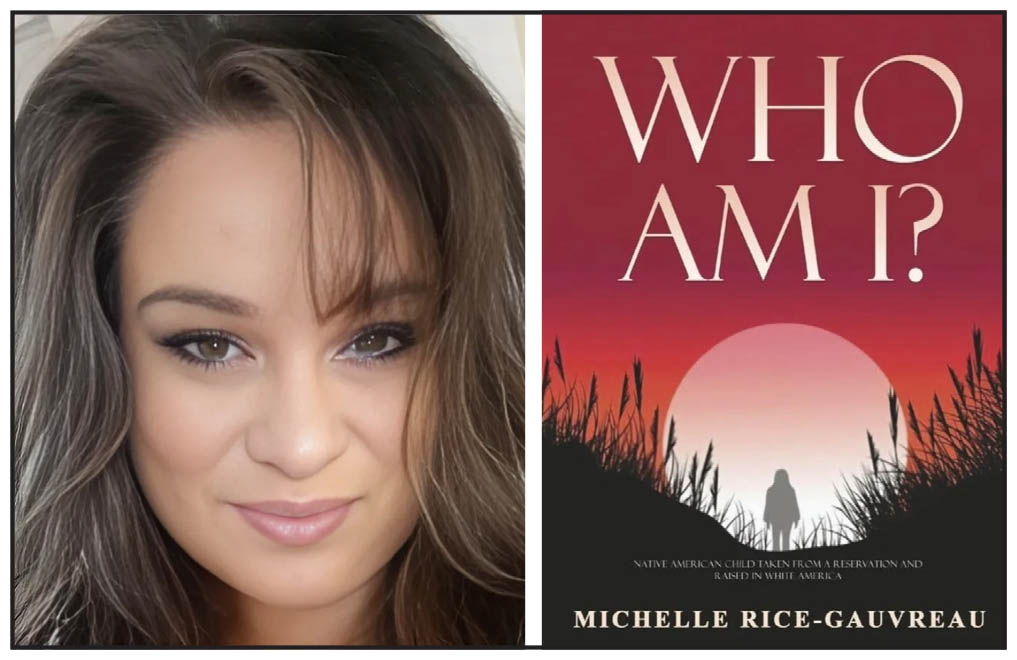
Who Am I? Michelle Gauvreau

How do you keep going when your world has been turned upside down? When you find out that you've been lied to over and again? When the shocking truth comes out. Listen in as Michelle shares her inspirational story of resilience and dogged determination as she found out who she really is.

Michelle Rice-Gauvreau is a native Mohawk woman born in Canada and raised in Connecticut via an illegal adoption, which was commonplace for many Indian babies throughout many years across North America.   She is a compassionate advocate for all adoptees looking for their own truth, peace and hope.  She hopes to instill her strength to any adoptee struggling to find their way.

Michelle now works as a legal professional for a prestigious law firm. She resides in Connecticut with her husband of many years, and her two senior cats.  She enjoys traveling and learning more about native cultures far and wide. 

Find out more at:

https://www.michellegauvreau.com/

https://www.facebook.com/adopteesmatter

https://twitter.com/ladystarre

https://www.instagram.com/ladystarre/

https://www.linkedin.com/in/michelle-gauvreau-45755919/

 
HARTFORD COURANT:

Friday, January 5, 2024

MEMOIR: WHO AM I?

Memoir examines path from illegal adoption to finding herself as a “proud Mohawk woman”

Tuesday, December 19th, 2023 windspeaker
Michelle Rice-Gauvreau with her book Who Am I?

Summary

“I was like, ‘Oh, I have a family. Maybe they'll rescue me.’ Right. Every adoptee might have that fantasy. Little did I know the culture shock I was going to get because I was not raised on the reservation.” —author Michelle Rice-Gauvreau
 
By Shari Narine
Windspeaker.com

Like many adopted children, Michelle Rice-Gauvreau believed that meeting her birthmother and extended family would save her.

Instead, the first time she travelled by bus from Connecticut to Montreal and then by borrowed car to the Kahnawake reserve resulted in culture shock.

“It was tough at 15 (years of age). And I was so headstrong. I was like, ‘Oh, I have a family. Maybe they'll rescue me.’ Right. Every adoptee might have that fantasy. Little did I know the culture shock I was going to get because I was not raised on the reservation. I'm being raised in white society,” said Rice-Gauvreau, 54.

In Who Am I?, a self-published accounting of her life from birth, Rice-Gauvreau traces her time from the hospital room of her delivery and her illegal adoption by Tom Rice, also of the Kahnawake reserve, to growing up in Connecticut where Tom lived.

When Tom dies before Rice-Gauvreau turns three years old, she is raised by Lea, Tom’s widow. Lea suffers from mental illness, which in part presents through hoarding and controlling her adopted daughter. Rice-Gauvreau lives in a filthy, moulding, cluttered house until Lea sends her away, first to live with an aunt and finally into the foster care system.

Rice-Gauvreau dedicates her memoir to Tom.

“I don’t think I would have wanted for anything (had he lived). I was told I was a Daddy’s girl,” she said. “I think everything, all of my needs, would have been met. I don't think he would have let my adoptive mother hurt me the way she did.”

Then again, she admits, that could be another adopted child’s fantasy.

“I'm sure I romanticize it a lot, but I also go by the stories that I was told, too, about him,” said Rice-Gauvreau.

Her memoir is a hard-hitting journey through pain, numbness, anger, and depression to forgiveness and understanding.

Like many Indigenous children in the 1960s, Rice-Gauvreau was given up because of poverty. It’s not an aspect she examines in any depth in her memoir because, she says, “it was a common-sense type of thing” to understand.

And because of that, Rice-Gauvreau says, she never had to forgive birth mother Sharon Armstrong, who she understood had no choice.

Sharon was living with her mother Mary, who was already raising Sharon’s first child, and she could not afford to raise and feed a second child. Rice-Gauvreau’s birth father had taken off.  While in hospital, Sharon’s roommate became aware of the situation and contacted Tom.

Rice-Gauvreau would not learn that she was adopted until Lea’s sister told her at the age of 15. Her birth and baptismal certificates had been forged which presented another issue when Rice-Gauvreau needed to get a U.S. passport in order to travel into Canada.

Rice-Gauvreau did a few successive trips to Kahnawake in her late teens, including spending time with Mary before her grandmother passed away. However, it wasn’t until she met up with foster parents Elaine and Geoff that she started to more fully embrace her First Nation heritage.

The British couple fostered only First Nations children. They co-founded the Connecticut River Powwow Society. It was at these events, Rice-Gauvreau writes, that her mind was “opened…to the spiritual world and the spiritual animals that are always guiding us.”

Rice-Gauvreau is continuing to learn about her Mohawk culture.

While today she is semi-estranged from Sharon and older brother Mike, she is in constant contact with one of her aunts. As for her birth father Eddie, he met her only once when she was a young adult and then cut off contact.

Rice-Gauvreau has no contact with Lea’s family. After Lea passed away, Rice-Gauvreau, with the support of her husband and son, spent five years sorting through Lea’s decrepit house. She sold many of Lea’s collectibles on eBay. The money from that she considers as her inheritance.

It was a hard job, she says, for her physical and emotional health to be in a house that held no good memories.

Rice-Gauvreau is continuing to learn that her feelings and experiences as an adopted child and adult aren’t unique for children or adults in her position.

For about one year now she has belonged to a group for adoptees, from which she gets support and gives support.

“I needed to feel what others were feeling. I needed to know that I was relatable to them,” said Rice-Gauvreau.

After writing her memoir, she says, she needed to connect with other people.

While putting her feelings and thoughts down on paper was cathartic, she says it was difficult.

“I still think about it. I still think about certain circumstances, absolutely. I think that happens with everybody. And I think it will always happen but I don't feel sorry for myself,” she said.

Writing her memoir came about in 2019 when she ended up in the hospital with sepsis and thought she might not make it out. She realized her only son Raymond, now 30, didn’t know her story. She started writing and even after learning she would recover, she kept on writing with the help of a book coach.

“I wanted to get my voice out there,” she said. “It took a long time. I also relived quite a bit. So I'm still kind of healing… but I think I'm doing a good job. That scab is pretty solid.”

And while that scab may be “pretty solid” now, in her memoir Rice-Gauvreau recounts the poignant goal of trying to make Sharon and Lea proud of her. Proud that after such a difficult beginning and upbringing, she survived and worked hard to get a college education. She now works as a legal professional in Connecticut.

Pride for her accomplishments is something Rice-Gauvreau feels only now for herself.

“If you asked me that five years ago, I wouldn't have said yes… because I don't think I knew where I was headed...I still didn't have a direction in my life, and that wasn't until I became sick. And then I realized, ‘Oh, I got direction. And I also have a voice and I need to use it.’.. I started writing and I started feeling my voice coming out. And that's where the pride started coming from,” she said.

It was frightening to put her life out there in a “very raw” way, she says, but her memoir, which came out in August, has received positive attention both in Connecticut and Canada.

At the end of her memoir, Who Am I?, Rice-Gauvreau answers the question, “So many events in my life shaped me into who I am today and that will never change. Growing up between two countries and two cultures, I now tell myself: ‘I am strong, I am thankful, I stand as a proud Mohawk woman. I am Michelle.’”

Who Am I? can be purchased at michellegauvreau.com

Monday, September 18, 2023

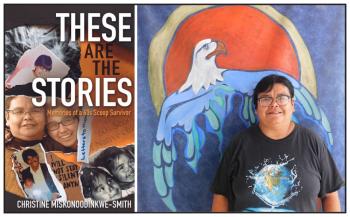
BOOK: These are the Stories

These are the Stories: Memories of a 60s Scoop Survivor was published by Kegedonce Press in December 2021. It is available through the publisher, Amazon, Indigo and local bookstores.

Free literary festival draws Indigenous writers of all genres

In a one-on-one session, Adler will be leading Christine Miskonoodinkwe Smith, who will be video conferenced in from Toronto, in conversation about the writing life and how “she’s really getting important stories out there.” Smith is a journalist and memoir and fiction writer. She is the author of These are the Stories: Memories of a 60s Scoop Survivor and editor of Silence to Strength: Writings and Reflections of a Sixties Scoop Survivor.

Indigenous writers will be featured prominently on Saturday at Word Vancouver’s Reading & Writing Festival.

And guest Indigenous curator Nathan Adler is hoping that writers and audiences form a new bond at western Canada’s largest free literary festival which runs until Sept. 23.  See website here: WV/23 (wordvancouver.ca)

READ MORE: https://windspeaker.com/news/windspeaker-news/free-literary-festival-draws-indigenous-writers-all-genres

Miskonoodinkwe Smith’s life has also been a journey, one that saw her decide to undertake higher education in her 30s, graduating from the University of Toronto with a specialization in Aboriginal Studies in 2011. She earned her Master’s in Education in Social Justice in 2017.

Today she lives in Toronto and works as a data coordinator for the Miziwe Biik, an Aboriginal employment and training centre.

“I’m a lot stronger than I was. I’m more confident than I was. I’m successful. I have a hard time talking about myself in a positive way that way, but that’s just residual negative thinking that I had in the past,” said Miskonoodinkwe Smith.

She has triumphed over those who thought she would never live past her 25th birthday.

“I think that’s the fighter in me,” she said.

Writing her story is not only about letting other Sixties Scoop survivors know they’re not alone.

“In order for the government and mainstream public to understand the impact of how the Sixties Scoop affected Indigenous children, and still has an impact to this day, I find it important to tell our stories, because then it will be hopefully understood that there are many children who were impacted in one way or another,” she said.

ABOUT THE BOOK:
https://windspeaker.com/news/windspeaker-news/sharing-sixties-scoop-story-important-other-survivors-government-canadians 

Thursday, August 3, 2023

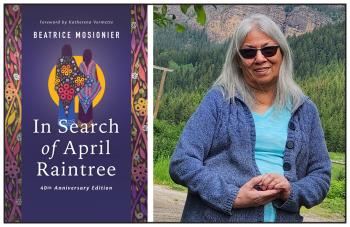
Author’s seminal novel remains relevant even after 40 years


“We knew people don't like us, but we don't know why it could be. You know, because we're brownish and because we're foster kids.” — Beatrice Mosionier, author of In Search of April Raintree
 
By Shari Narine
Local Journalism Initiative Reporter
Windspeaker.com


Little did Beatrice Mosionier expect that her first novel, In Search of April Raintree, would have such a profound impact on Indigenous readership.

But perhaps she should have.

When she was seven or eight years old, she was working in the basement of her second foster home in St. Norbert, a suburb of Winnipeg.

“I got this really powerful knowledge, and it was that I would have these three animals that would guide me: The wolf, the bear and the cougar,” said Mosionier, a Plains Métis woman.

“Later when I finally started talking about it with other people, I was told about guide animals, spirit animals, that give you strength… And it was like I was going to do something special in my life.”

She forgot about the spirit animals until she hit her thirties. In 1980, when Mosionier was 31, her oldest sister Katherine committed suicide. Sixteen years before, her other sister Vivian had taken her own life.

“It was just like things were shifting inside of me. I think that's probably how I came to decide I was going to write a book, and I think that was what led up to this,” said Mosionier.

But when she wrote In Search of April Raintree in 1983, Mosionier never believed it would be published.

Forty years later, Highwater Press is releasing a special 40th anniversary edition of the novel.

Mosionier and her siblings were apprehended in the earliest years of the Sixties Scoop, which saw an estimated 20,000 or more Indigenous children removed from their homes between 1951 and 1984.

Mosionier was taken at the age of three by the Children’s Aid Society of Winnipeg. The loss that resulted from that action was the story she told in the lives of April Raintree and the fictional younger sister Cheryl.

It was a story that resonated mightily with Métis and First Nations readers, as noted in words of praise that accompany the anniversary edition.

“In Search of April Raintree was the first book I read that spoke to the Indigenous experience, and it changed me for the better,” wrote Governor General Award winner David A. Robertson.

“I could feel it in my blood memory. Because it was tender and brutal, authentic and unapologetic, heartbreaking and hopeful,” wrote Rosanna Deerchild, host of CBC Radio One’s Unreserved.

“Reading Beatrice Mosionier’s seminal novel was lifechanging. As a young Indigenous woman, it was the first time I felt seen,” wrote Manitoba NDP MLA Nahanni Fontaine.

Those words make Mosionier feel “really humbled.”

She wrote the book “to find answers,” spurred on by the deaths of her sisters.

“I think that’s really hard on a parent…When you lose a child to suicide and then you lose a second child to suicide, there's something majorly wrong,” said Mosionier.

In writing the novel, Mosionier gained personal insight into her own family and into the larger picture of being Métis.

“I was raised in white foster homes since I was three years old. I wasn't connected to—back then we used to call it the Native—Native people,” she said.

“I did get more understandings about the why and everything. Because when I grew up, we didn't know words like ‘oppression’ and ‘racism’ and all the things like that when we're in school…We knew people don't like us, but we don't know why it could be. You know, because we're brownish and because we're foster kids.”

Along with telling the personal stories of April and Cheryl, heartbreaking and uplifting, in turn, Mosionier used Cheryl’s essay writing talent in the book to tell the wider proud Métis history.

Mosionier had to research for Cheryl’s essays. She started watching a Winnipeg television series that had interviews with Indigenous people. Her next-door neighbour, who wasn’t Indigenous, gave her a book by Heather Robertson titled Reservations are for Indians.

“I read that book and then I had a fairly good sense, because back then we didn't have computers and Google and all of that,” she said.

After her book was published, she discovered that St. Norbert had a rich Métis history. She also learned that her father used to play the fiddle.

“I didn't know anything about that. I didn't know. I just didn't know anything positive,” said Mosionier.

While there are brutal scenes in the novel, perhaps the most haunting scene comes in April’s realization near the end, which echoes the words of her broken father: “Baby Anna. Such a small part of our lives. Yet she had changed our lives the most.”

It is when Baby Anna is sick and goes to the hospital that April and Cheryl are wrongfully apprehended, and that single action sets in motion everything that follows.

Forty years later, Indigenous children are still being apprehended at a disproportionate rate.

“In Search of April Raintree is one of the all-time great works of Indigenous literature, and it is still as vital and relevant today as it was forty years ago,” wrote Dr. Warren Cariou, a professor at the University of Manitoba.

Mosionier agrees with Cariou’s observation about the relevance of her novel.

But, “I kind of feel sometimes that (the novel) didn't do its job because a lot has changed but a lot has not changed, and sometimes you think it's getting worse,” she said.

If her novel opened the gates for other Indigenous authors, Mosionier says, “I feel good about that.”

And she encourages Indigenous authors to keep doing their strong work, many of whom are now being recognized with awards.

As for her spirit animals who told her she would do something special in her life, Mosionier firmly believes writing In Search of April Raintree was that act.

The special 40th anniversary edition of the novel will be released by Highwater Press in September.

Local Journalism Initiative Reporters are supported by a financial contribution made by the Government of Canada. SOURCE


Tuesday, August 1, 2023

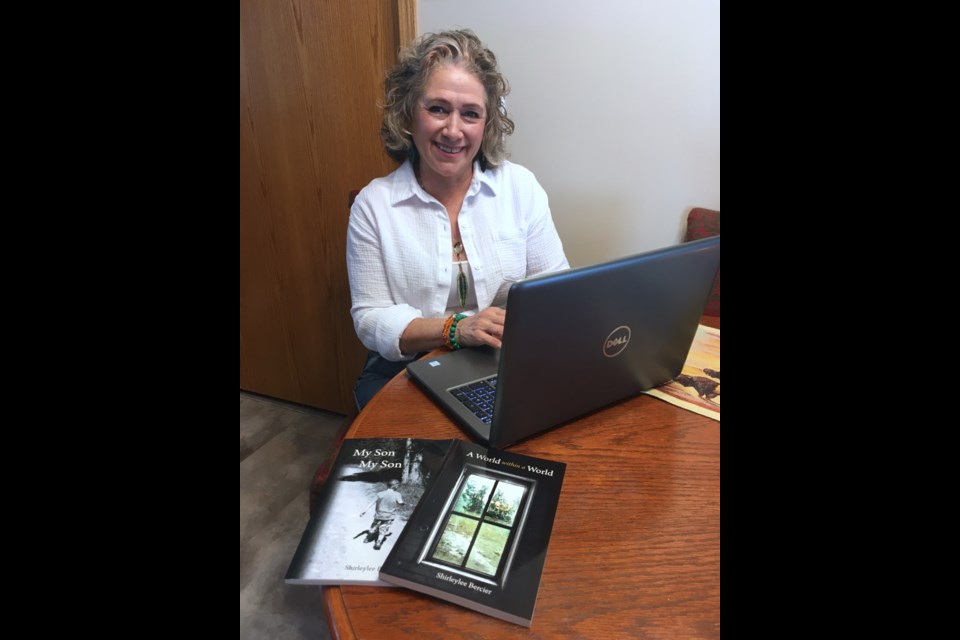
Sundre author’s book recounts her experience as Sixties Scoop survivor


A Sixties Scoop survivor who wrote an autobiography about her experience hopes that sharing her story will not only raise awareness but perhaps also embolden others with similar life experiences to embark on their own personal path of healing.

Shirleylee Shields, who moved to Sundre about a year ago, was taken away from her biological parents at the age of three and subsequently placed into the care of a foster family in a strict religious sect.

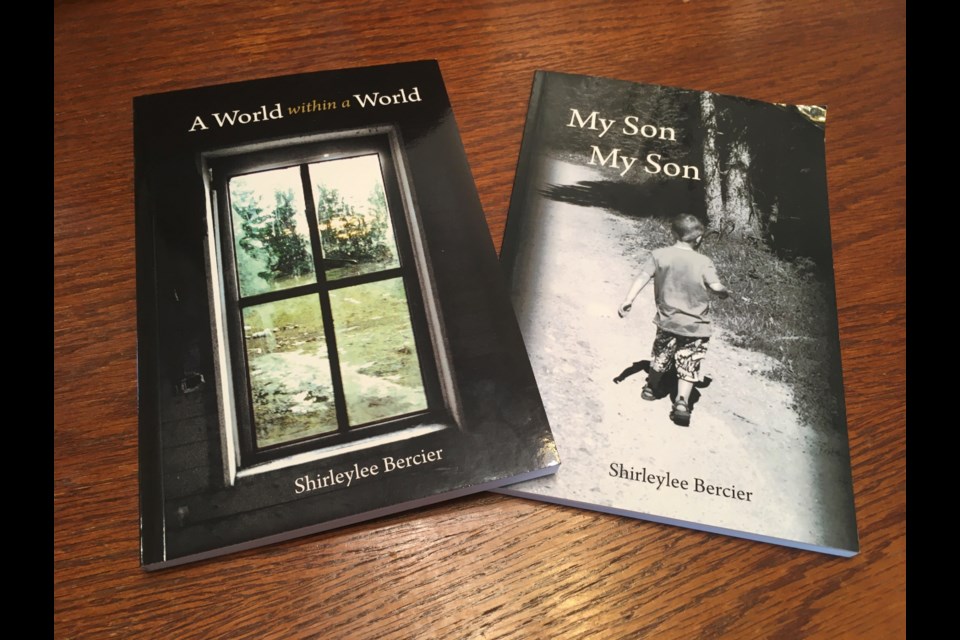
She recently offered a presentation at the Sundre Municipal Library to provide insight into her 2009 book, A World Within A World. She also penned a sequel called My Son My Son.

During a June 13 interview with the Albertan, the 58-year-old candidly recounted the long, difficult journey of self-discovery that ultimately led her to walk away from a fundamentalist life that was forced upon her and to reconnect with her family and heritage.

Sharing experience a liberating step

“There’s no more skeletons in the closet,” she said with a laugh in response to being asked how seeing her published story felt. “You have nothing to hide. It was the most freeing, cleansing thing to do, was to reveal and to bring all of this out and throw it on the table.”

At first, she confessed being “petrified” that nobody would even want to read her story. But A World Within A World is now on its fourth print run, while copies of My Son My Son are out of stock for now.

Born on May 1, 1965 in Benito – a small, rural Manitoba community just east of the border with Saskatchewan – Shields lived only briefly for three years with her six other biological siblings and parents, an English mom named Myrtle Harrington and a Métis dad called Herman Moses Bercier, at a home in the Roblin area south of where she was born.

“Me and my younger brother had been removed from the home and put into foster care and dad didn’t even know anything about it,” she said. “He came home (from working in the bush) and we were gone.”

Shields was fostered into a family that already had 10 children – making her a distant 11th – not far away from Roblin in a relatively remote rural community called Shortdale, Man., where her adoptive parents owned and worked a farm.

“They were part of the Mennonite society, but they were the Holdeman sector, which is the strictest of the Mennonite society,” she said. “There was no radio, no television, no higher education, no makeup, no jewelry; the list is endless. That’s where they dropped me off when I was three.

“It was all I knew, from three years old. You grow up with that environment, it’s just like a cult,” she said. “That’s why my book is called A World Within A World.”

Raised by her foster parents Benjamin and Tina Isaac, the couple eventually adopted her at age 10; a decision she would not find out until years later was actually Benjamin’s idea.


Strict religious upbringing

Amid a strict religious upbringing that demanded unquestioning conformity to rigid rules, Benjamin was among the few silver linings to be found.

“Even though he was a staunch believer and a member of the Holdeman Mennonite society – he loved me,” she said. “He is the only human that I knew growing up that loved me unconditionally; I did everything with my dad. He never hit me; he was the kindest soul that you could imagine.”

He even seemed to understand the internal struggle she faced on a daily basis.

“He knew,” she said. “Even when I was young – six or seven – I would look at him and I’d say, ‘I don’t belong here.’ And he’d say, ‘Well, for now, you do.’”

Expressing a deep respect born of affection for her adoptive father, she said, “I loved him and he loved me.”

Sometimes, she said he was even reprimanded.

“He’d be (temporarily) expelled from the church for associating with what they considered ‘worldly’ people; so, people of the town,” she said. “It blows your mind at the mentality that they are allowed to sit in judgment of every human being on this planet, but yet they will preach god’s love or whatever they want to believe Sunday morning. I mean, it’s just ludicrous.”

Yet she never developed a connection or relationship with Tina, who died in a vehicle collision in which only Benjamin and Shields survived; she was 15 at the time and subsequently sent away to live in Steinbach, Man. for 11 years.

But she does remember Tina as a “phenomenal gardener” who knew how to prepare a hearty meal.

“We were never hungry; we ate very well,” she said.

Pursuing her own path

Shields remained a part of that family until she decided to walk away from the strict sect in 1994 at about age 28. Although she had previously attempted to leave during a rebellious adolescent phase in her late teens, Shields said she “went back to the church because I didn’t know where any of my biological family was.”

Not having an identity to anchor to made forging out on her own path forward that much harder.

“When you grow up in that environment, they so masterfully indoctrinate you that you are worth nothing unless you are part of them,” said Shields, adding she was eventually forced into an arranged marriage with a member of the Holdeman Mennonites with whom she had four children.

“I had maybe spoken three words to him before we were engaged; if that,” she said. “And then we were married two weeks later; didn’t know him from Adam – didn’t know anything about him.”

She and her arranged husband eventually moved with their four kids to Rimbey from Kleefeld, Man. where they’d worked a dairy operation until 1993, and the writing on the wall became increasingly clear.

“There was a new little congregation starting there of the Holdeman Mennonites,” she said, referring to Rimbey. “And I knew that I needed to leave; I did not want to bring my children up in that environment.”

By the following spring, Shields had mustered up the courage to pursue her own path.

But the next leg in her journey was no walk in the park and involved a drawn-out legal battle to gain not only her freedom but also custody of her children.

“The church took my children because in their eyes I was going to hell, and if I had my children they would be going to hell with me,” she said. “So, I was probably fighting for two years to get my children back.”

Reconnecting with roots

In 1997, the fruits of her labour blossomed.

“I am the first woman in Canada and the United States to have taken this society to the Court of Queen’s Bench in Edmonton and I won my freedom,” she said, adding she was also granted sole custody of her children, who are now all adults and remain in close contact.

Now removed from the sect for more than 30 years, Shields said she decided to cut all ties after Benjamin died and has since been living her best life, eventually going on to remarry and have another daughter with Dave Shields, who had established a respectable reputation as a Calgary Stampede chute boss.

“My book is (about) my fight for freedom,” she said, adding it’s also about her journey of personal and spiritual liberation as well as rebuilding a relationship with her biological family and reconnecting with the Métis heritage that had been all but taken away from her.

“My biological family lived half an hour to an hour away from me my whole life, and I did not know that,” she said.

“My world was so hidden,” she said, adding that in 1979, the church pulled all of the Holdeman children out of the public school system and started their own private school system.

“So, we had nothing to do with the outside world,” she said.

“It was very healing for me to be able to let go of all these memories and this way of life and this programming; to put it all out there,” she said. “Because it took me 10 years to de-program. It’s like the MKUltra; it’s so brainwashing. Your value is based on what they say, not who you are.”

It wasn’t until the age of 24 while attending an uncle’s funeral that Shields finally met her biological father.

“It was so surreal for me because he stood there and he had these tears running down his cheeks and he just said, ‘You were only three when they took you; I never saw you again.’”

She recalls embracing him and offering him words of comfort and told him, “Well, I’m here now.”

Despite all of the time they were denied, Shields was nevertheless grateful to have the opportunity to get to know her father, who lived to be 90. Along the way, she was able to re-establish relationships with the rest of her biological family.

Sixties Scoop a stain on Canada’s history

Although she’s worked through her past trauma and since moved on, Shields remains committed to sharing her story of putting back together a life that was wrongfully torn asunder.  

“That is one of the biggest injustices done in humanity, is removing children improperly,” she said.

Calling the Sixties Scoop a “horrific” stain on Canada’s history, Shields said there to this day remains plenty of room for improvement on the path to meaningful reconciliation.  

“Everybody wants to talk about reconciliation with dollar signs,” she said.

But all of the money in the world won’t make much difference if survivors’ stories are downplayed – or worse, ignored – and their lives are not valued enough to reach out and listen to their experiences, she said.

Asked for her response to people who downplay what happened or who say it’s in the distant past and that it’s time to move on, she said, “Well they definitely – Number 1 – haven’t lived it. You don’t forget it.

“I’ve had a lot of people say, ‘Well, at least you had a good life.’ You mean, at least I was given air and water and a house and food? Sure. I was given the necessities of life, absolutely,” she said, adding bluntly, “but we cannot move forward as a society – as a nation – until we are ready to listen and to heal.”

Recognizing history part of reconciliation

Dismissing history without acknowledging it and addressing the harm it caused serves only to perpetuate the cycle, she said.

“There’s many things that are in the past. But they are not cleaned up, so they are constantly coming forward,” she said.

“My journey has been bringing in awareness that this still is happening,” she said, adding the fundamentalist community she was raised in hasn’t changed and that Indigenous children are still being taken away from their families by social services.

“My book is still relevant because what is in my book is still happening today,” she said. “So if people say, ‘I don’t understand, that happened in the past, why won’t you let it go?’ – I have let it go, but I’m still bringing awareness that this is still going on today.”

For those who might struggle to relate or understand, Shields encourages them to consider how drastically their own identity would be impacted faced with the sudden loss of a loved one; a formative life experience that causes a tremendous sense of loss and grief as those left behind try to put their life’s shattered pieces back together.

Money alone can't remedy past injustice

Healing is arguably the most important part of the path to reconciliation, she says, but it can also be among the most difficult for all too many survivors.

Shields, who enjoys every opportunity to speak publicly about her experience, says she’s been in rooms with dozens of survivors who were either too terrified or ashamed to share their own stories because they don’t feel valued as that’s how they’ve been treated. Fear, she added, can be an incredibly powerful emotion that prevents people from opening up.

But Shields enjoys a heart-to-heart conversation and helping others start or continue along their own paths of healing, which goes further toward mending past wounds than money alone ever could.

“We have stepped so far away from giving a damn because it’s easier to throw dollars at people,” she said.

“(But) the possibilities are endless when it comes to learning and understanding who you are, and I think it just comes back to empowering yourself and seeking your personal freedom and truth because nobody can give that to you except yourself.”


Simon Ducatel

About the Author: Simon Ducatel

Simon Ducatel joined Mountain View Publishing in 2015 after working for the Vulcan Advocate since 2007, and graduated among the top of his class from the Southern Alberta Institute of Technology's journalism program in 2006.

Friday, June 30, 2023

(Almost) Dead Indian: Writing in 2008


By Trace L Hentz, blog editor
 
In 2008, this is what I wrote as an introduction to the memoir I was working on... (a draft)

… a memoir of brainwashing and life as a dead Indian…


I did have to pretend to be someone – and live a lie - because I’m adopted. Ask any adoptee who has Native American ancestry.  If you are not told any truth, you’re just another dead Indian, at least on paper or on tribal rolls.  Our papers are usually fake and we live with amended original birth certificates (OBC).  Our adoptive parents are listed as our biological parents, which is another lie we live with....        

            America is like that.  Adoptees seem invisible yet the number of adoptees in the United States is estimated to be between six and ten million.  They’d prefer every one of us to live as an American citizen as if none other were as good or as important.  America forgets it’s very new by all standards and just acts like its old.  America has its own amnesia.

I intended to write about adoption history and what I experienced opening my adoption many years ago.  America’s adoption files of my era (the 1950s) are still sealed by laws in most states, still shrouded in secrecy. I expected little help or new discoveries.  Never did I expect to find so many adoptees in the same boat from 2005 onward.  I didn’t know there were millions of us, some blazing new trails on the internet global highway. I found friends.
            In the last 20+ years, adoption’s gone global, widely publicized and still touted as noble, saving and particularly saintly of those men and women who adopt, who give so generously to orphans.  That’s about all we hear: how great it is to adopt.
            I asked myself, where is the missing piece …where is the voice of the adopted… what happens to the adoptee?  I decided to write about my experience (as an adoption survivor and journalist) and include other American Indians who experienced being adopted.  I found much more going on with the business of adoption, so I include it.  Certainly this will be the most controversial book on adoption since I was often in a state of shock and utter disbelief during my years of research on the adoption industry.
            Indian child removals by adoption set out to accomplish the break-up of Indian families and culture.  Once adopted, you’re erased, an outsider, a stranger to your own nation, lands and people.  I prefer to think of my younger self as brainwashed.  There was fear and emotional illness, which I explain. What is known about the Indian Adoption Projects (more than one) and the aftermath, few books actually acknowledge it happened here.
            There is persistent rampant poverty in Indian Country even now.  I found Indian people who were white-washed through strenuous puritanical forces using assimilation via adoption and residential boarding schools. 
            Adoptees with Indian blood find out soon enough their reservations are closed to strangers.  Without proof, you’re suspect.  You can’t always get the proof since laws prevent it.  Just one Minnesota tribe, White Earth, decided to call out to its lost children; this made news in the fall in 2007.  Going back takes a special kind of courage.
            One Native American adoptee I know was told – be happy, be white. Ask yourself, how would you react? Is Indian Country such a bad place to be from? How did this happen to us?
            Society determined long ago what was best for children.  Once adopted, society can let us go, write us off.
            Here in America, thousands of Indian children were taken from parents and given to non-Indian people.
            Survivors are here to tell you this was a genocidal act against our humanity. Some of us were abducted, abused, brainwashed and all of us erased.
            Adoption secrets are protected by laws.  Laws prevented me from ever knowing the truth of my true identity.  I still found a way. 
 
This edition is on amazon and in some bookstores

p.s.
Wayne Carp, an adoption advocate and author who went “undercover” to compile his book on adoption industry history kept running into secrecy problems. Unlike Carp, I am the story.


click

Contact Trace

Name

Email *

Message *

NO MORE UPDATES

GO TO:  https://blog.americanindianadoptees.com/  for updates and news. THIS BLOG cannot be updated...