Seven
children died in the first year of the Carlisle Indian Industrial
School’s operation. Another 220 died over the school’s next 38 years. They are among the more than 3,100 students a year-long Washington Post investigation finds died while separated from their families in Indian Boarding Schools. Their tally is three times that of the recent investigation by the U.S. Department of Interior.
Many of the deaths are attributed to illness, accidents, or neglect. Others have no official explanation or remain suspicious. We’ll discuss
the Post’s investigation and why having an accurate accounting is
important.
GUESTS
Jim LaBelle (Iñupiaq), board member for the National Native American Boarding School Healing Coalition
President
Joe Biden took the historic step to formally apologize for the
federal government’s role in the failed Indian Board School era. The
first-of-its-kind acknowledgement comes after Department of Interior
Secretary Deb Haaland released the final report from a three-year investigation
that included formal listening sessions from boarding school survivors
and their relatives. The report documented at least 18,000 Native
children who were sent to distant live-in schools where they were forced
to abandon their languages and cultures. They were subjected to
extensive physical and sexual abuse. Nearly 1,000 children died while
attending the institutions far from their families. We’ll hear from Sec.
Haaland and others who have been working on building the infrastructure
of healing from the Boarding School Era.
President Joe Biden’s remarks from the Gila River Indian Community, Arizona and Remarks from Interior Secretary Deb Haaland before Pres. Biden’s boarding schools apology:
President Biden to Make Historic Apology for Federal Indian Boarding School System
The presidential apology fulfills the first of eight recommendations made in the Federal Indian Boarding School Investigative Report, Volume II,
released by the Interior Department in June 2024. The 105-page report
was penned by Assistant Secretary of Indian Affairs Bryan Newland (Bay
Mills Indian Community) at the direction of Interior Secretary Deb
Haaland (Laguna Pueblo), the first ever cabinet secretary in U.S.
history.
“This is incredibly meaningful to have a sitting president admit the
wrongdoings of the government, and I'm just honored to see this happen
during my lifetime,” Haaland said in an interview with Native News Online. “I'm incredibly grateful to the president. He is courageous, he's kind, and he really is committed to Indian Country.”
Webinar on the U.S. Truth & Healing Commission Bill on 9.27.23
The National Native American Boarding School Healing Coalition (NABS) hosted a virtual conversation on the Truth and Healing Commission on Indian Boarding School Policies Act (S. 1723).
NABS is joined by U.S. Congresswoman Sharice Davids (Ho-Chunk) and a guest panel featuring Sterlin Harjo (Seminole/Muscogee), Dallas Goldtooth (Lower Sioux Dakota Nation), Mato Wahuyi (Oglala Lakota), and Georgeanne Growingthunder (Fort Peck Assiniboine and Sioux Tribes).
Learn how you can advocate for the U.S. Truth and Healing Commission Bill.
We have a right to know the truth of what happened in Indian boarding schools in the United States.
Over the course of a century, hundreds of thousands of our
children were taken or coerced away from our families and Tribes and
forced to attend government-sanctioned Indian boarding schools. These
schools were tools of assimilation and cultural genocide, resulting in
the loss of language and culture and the permanent separation of
children from their families. To date, there has never been an
accounting of:
the number of children forced to attend these schools;
the number of children who were abused, died, or went missing while at these schools; and
the long-term impacts on the children and the families of children forced to attend Indian boarding schools.
We have a limited amount of time to hear directly from survivors and
record their stories. A Congressional Commission is needed to locate and
analyze the records from the 523 known Indian boarding schools that
operated in the U.S. A Commission would also bring together boarding
school survivors with a broad cross-section of tribal representatives
and experts in education, health, and children and families to fully
express and understand the impacts of this federal policy of Indian
child removal.
In
this photo taken in 1906, provided by the Quaker and Special
Collections at Haverford College, teachers and students gather for a
portrait at Tunesassa School in Tunesassa, New York. The National Native
American Boarding School Healing Coalition says it will digitize 20,000
archival pages related to Quaker-operated Indian boarding schools. The
records will provide a better understanding of the conditions that
children received at these schools. IMAGE: Quaker and Special Collections, Haverford College via AP
“They went after our language, our culture, our family ties, our land. They succeeded on almost every level,” Ben Sherman told The New York Times. “Don’t try to tell me this isn’t genocide.”
Sherman,
now 83 and a retired aerospace engineer, is also a member of the Oglala
Sioux Tribe who spent four years in a Native American boarding school
in South Dakota. Sherman believes that after the “shooting wars” by the
United States government against Native Americans had subsided, the
government was “not done with war, so the next phase involved war against the children.”
Enter Native American boarding schools.
‘Vast and entrenched’
“From
small shacks in remote Alaskan outposts to refurbished military
barracks in the Deep South to large institutions up and down both the
West and East coasts,” Native American boarding schools took in children
from across the country.
Incomplete
records and scant government attention let the stories of these schools
largely fade into oblivion. For many students of those schools and
their families, the trauma “never went away.”
Recently,
however, more concerted efforts are being made to identify the schools
and the children who went there, as well as those who never left. Last
year, the Department of the Interior, under the leadership of Deb
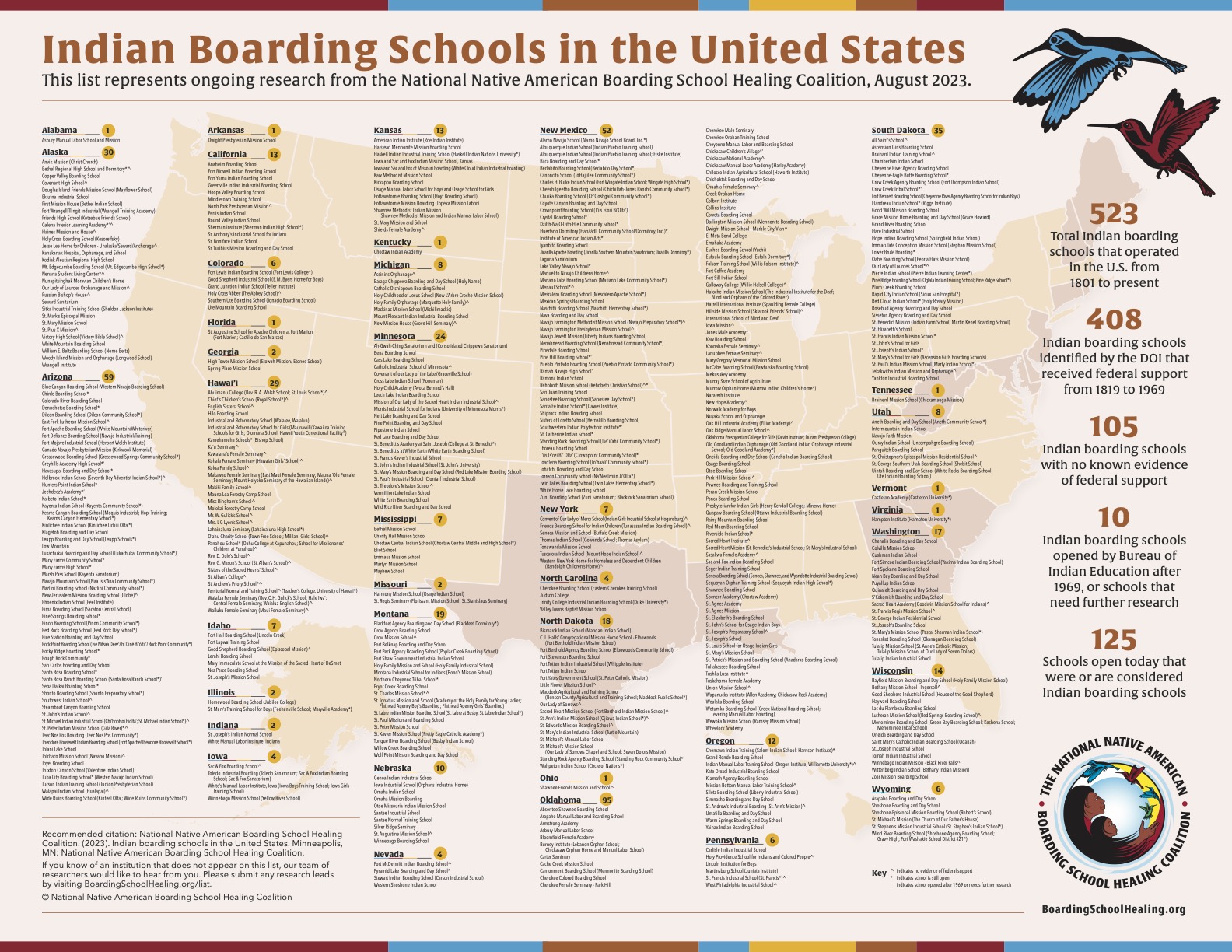
Haaland, released a report identifying 408 schools in 37 states, including 21 schools in Alaska and seven in Hawaii, from 1819 to 1969.
On Wednesday, the nonprofit National Native American Boarding School Healing Coalition announced
that they had identified another 115 schools, bringing the total to 523
in 38 states. They identified one additional school in Utah, bringing
this state’s total to 8. They found 22 more in Hawaii, bringing that
state’s total to 29. They found even more in Oklahoma, the state with
the most schools identified, now standing at 95.
Most of the additional schools did not receive federal funds, but were run by religious groups and churches, reports The Washington Post. Many were Catholic, Presbyterian or Episcopalian, but also included
small congregations of Quakers, Congregationalists and others.
Scattering the children
Richard
Henry Pratt, a military officer who fought in the 1870s to forcibly
remove multiple tribes from the Southern Plains, dreamt of abolishing
all Native American reservations and “scattering the entire population
of Native children across the country, with some 70,000 white families
each taking in one Native American child,” reports The New York Times.
While
he was not successful in bringing that vision to fruition, he started
down that road by creating the Carlisle Indian Industrial School in
Carlisle, Pennsylvania, in 1879. The school took in Native American
children from as far away as Alaska and tried to “civilize” them. In
1892, Pratt delivered a speech at a convention, where he said,
A
great general has said that the only good Indian is a dead one, and
that high sanction of his destruction has been an enormous factor in
promoting Indian massacres. In a sense, I agree with the sentiment, but
only in this: that all the Indian there is in the race should be dead.
Kill the Indian in him, and save the man.
Pratt
then praised the benefits of slavery for Black people and said it was
now the responsibility of the United States to “civilize” Native
Americans.
The
“civilizing” process, or “assimilation” was, as Pratt described by
wanting to “Kill the Indian in him,” a brutal one. Children’s hair was
cut off, their native apparel burned. They were dressed in Western
apparel, their names changed and their religion changed. They were
“hired out” to do menial jobs, with the schools retaining any fees
received.
Moderating a panel at the Leonardo in Salt Lake City last year, Utah State University student Taylor “Cheii” Begay said, “This assimilation process, the boarding school era, it was a war tactic.”
“They tried to kill us”
For
noncompliant students, punishment could border on torture. Being
whipped with a cat-o’-nine tails, being paraded naked for other students
to beat with belts, being thrown into walls, doused with fire hoses,
having food withheld, being publicly humiliated and more. Sexual abuse
was rampant, report both The New York Times and The Washington Post.
The New York Times reports
that in 1891, the Grand Junction News printed an exchange between the
superintendent of the Grand Junction Indian School in Colorado and the
secretary of the Interior. The superintendent informed the secretary
that one of the boys at the school could not fit his foot into the
government-issued shoe because he had six toes. “What shall I do?” asked
the superintendent? “Off with his toe!” came the reply. So, off came
the toe.
Not
every student counts their time at Native American boarding schools as
traumatic. For some, it was not, including Cris Polk, from the Yakama
Tribe of Washington, who told KSL earlier this year that those were the best four years of her life, and where she met her lifelong best friend.
Andy
Merrick, chairman of the Omaha Tribe of Nebraska, met his wife at
Intermountain Indian School. They celebrated their 43rd anniversary this
year.
“I love this place. I love the mountains and the memories I have here,” Merrick said to KSL. “One of the best times of my life was out here in Utah.”
Truth and healing
Those with fond memories are the exception. By 1928, the Meriam report detailed how children were “malnourished, overworked and harshly disciplined.” Forty-one years later, in 1969, a U.S. Senate report
reported on the failures of the system. That report spurred support for
the Indian Self-Determination and Education Assistance Act in 1975 and
then the Indian Child Welfare Act in 1978.
In June, the U.S. Supreme Court upheld a challenge to ICWA in a decision praised by tribes and Utah’s elected officials, including Lt. Governor Deidre Henderson.
Supreme Court Justice Neil Gorsuch summed up the importance of ICWA,
stating that it “secure(s) the right of Indian parents to raise their
families as they please; the right of Indian Children to grow in their
culture; and the right of Indian communities to resist fading into the
twilight of history.”
When Deb Haaland was appointed the first Native American to head the Department of the Interior, she brought with her boarding school legacies.
Her grandparents were stolen from their families as children and she
grew up hearing their stories. Her great-grandfather was taken to the
infamous Carlisle Indian School. She cried with her grandmother as her
grandmother shared her loneliness and sadness at being separated from
her family.
“Acknowledging
these painful truths and gaining a full understanding of their impacts”
will help heal painful “threads of trauma and injustice,” she wrote in 2021. Over the past year, she has been around the country on a “Road to Healing Tour.”
Last
year’s report was one of two. The second report will focus on the
number of children who died at the boarding schools. Investigators
expect that number to be in the “thousands or tens of thousands.”
With sparse records of the children, or even where the cemeteries are
located, the final number is likely to remain unknown. At least one
excavation in the United States this summer found no remains.
NABS launches digital map with new research of
523 U.S.
Indian
boarding
schools
We are honored to announce the release of new
research
findings and
our first-ever
interactive
digital map of
Indian
boarding
schools in the
United States.
In 2020, NABS
released a
list of 367
Indian
boarding
schools, which
at the time
was the
largest and
most extensive
list available
to the public.
Since then,
there have
been various
efforts by the
Department of
the Interior
(DOI) and
religious
institutions
to identify
their
involvement in
the
establishment
and operation
of Indian
boarding
schools
nationwide.
Our
latest
research
identified a
total of 523
Indian
boarding
schools in the
United States.This
is the largest
known list to
date,
containing
both federally
operated
boarding
schools and
church-run
schools.
This latest
research can
be explored
through a new
interactive
international
map where
people will be
able to find
information on
all 523 known
Indian
boarding
schools in the
United States,
alongside
known Indian
residential
schools in
Canada. This
tool helps
visualize the
magnitude and
deliberate
effort to
assimilate
Indigenous
peoples across
North America.
523
Total Indian boarding schools that operated in the U.S. from 1801 to present
NABS hopes
this new
research and
tool will
inspire
researchers,
educators, and
policymakers
to gain a
better
understanding
of the impact
and scope of
Indian
boarding
schools.
Ultimately, we
hope it will
help
survivors,
descendants,
and Tribal
Nations in
charting a
pathway
forward.
This project
was made
possible
through a
partnership
with the
National
Centre for
Truth
and Reconciliation.
Read more
about this
work in
The New York
Times and
Washington
Post.