BLOGGER changed, not allowing us to UPDATE this back-up blog

(UPDATED 726/2025) issues with blogger are preventing this
Showing posts with label Foster Care Statistics. Show all posts

Monday, February 7, 2022

Minnesota foster care system perpetuates legacy of racist boarding schools, Native mothers say

Department of Human Services says reforms are starting to work and newer state program shows promise.  
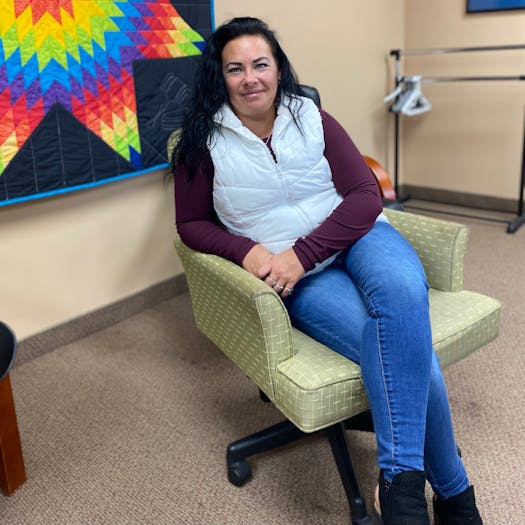
Teresa Nord regained custody of her eldest daughter several years ago, but the experience still haunts her.

"I live with this constant fear," says Nord, 42, a Navajo and Hopi Indian descendant who lives in Glencoe, Minn. "I call it child protection PTSD, that they're just gonna one day knock on my door."

In 2015, Nord's then 6-year-old daughter told her she had been abused by one of her mom's close friends. Nord reached out to a social worker for help — only to have her daughter immediately removed by child protective services.

Nord spent three years fighting to regain custody, but her daughter's time in foster care left her with deep abandonment fears and exacerbated other mental health challenges. "The foster provider told her, 'Your mom is a bad mom. You're never going to see her again [and] you might as well get used to that,'" Nord says.

Recent discoveries of mass graves on former indigenous boarding school sites have led to an international reckoning over the atrocities committed by the U.S. and Canadian governments in the name of assimilation. And political leaders like Minnesota Gov. Tim Walz have acknowledged the deep trauma the schools inflicted upon generations of Native families.

However, Native parents and experts in Native child welfare in Minnesota say that many of the underlying beliefs about Native families that fueled the boarding school systems are perpetuated by the state's modern child welfare system, with devastating effects.

Many Native mothers like Nord can't shake the fear of having their children ripped away from them or the ripple effects of generations of Native removals.

"There's a really explicit connection in the indigenous community's mind between boarding schools and the child welfare system," says Nicole Martin Rogers, a White Earth Ojibwe descendant and senior research manager at Wilder Research, a research organization that works with nonprofits and governments. That's because boarding schools are "how the system first started taking kids away from their families," she said.

The boarding schools legacy

In the 1800s, the federal government established mandatory boarding schools for Native American children, with the mission of assimilating Native children. The first boarding school in Minnesota opened in 1871. Children in these schools often were starved, beaten and forced to sever their connection to their Native heritage and language.

Although these schools mostly were discontinued by the 1950s, Native children continued to be removed from their homes at staggering rates through adoption.

Native children were removed from their families in Minnesota and other states at such high rates that outrage from Native communities led to the creation of the 1978 Indian Child Welfare Act (ICWA).

ICWA mandates that child welfare agencies give special consideration to cases involving enrollable tribal members in the form of consultation with tribes.

But for Native women like Nord, who is a tribal descendant but not an enrollable member, these protections don't apply.

Social workers and courts often fail to give Native parents adequate and culturally appropriate guidance on how to reunite with their children, a core tenet of ICWA, says Sadie Hart, an ICWA compliance court monitor in Ramsey County. And they often mandate parents to follow impossibly strict deadlines to resolve issues related to poverty or addiction to regain custody, without providing adequate support to do so, she says.

Looking back on the boarding school and adoption eras, it's easy to say they were wrong, says Shannon Smith, executive director of the ICWA Law Center. But she says the underlying mentality persists, as does the impact, often due to factors like cultural ignorance or mistaken beliefs about Native parents.

"I think a lot of times removals [are] society … equating removal with safety. And that is an equation that is just automatic. And I think that's fundamentally flawed," Smith says.

Indeed, some experts say, poverty can often look like neglect to social workers, especially in families of color. Even when poverty is causing instability that puts kids at risk, removal may not be the best option and can exacerbate rather than fix the root issues.

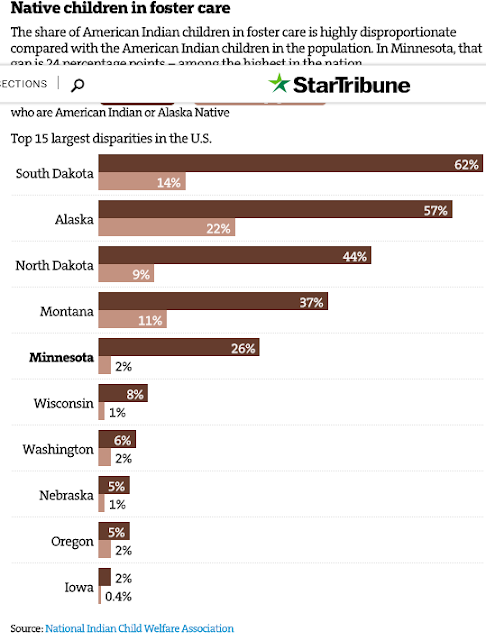
In Hennepin County, where the ICWA Law Center is located, Native Americans account for roughly 26% of those living in poverty, although they make up just 1% of the population, according to the county's 2018 report "Child Protective Services: Reform and Child Well-Being."

"There are so many indigenous families living in poverty," says MartinRogers. "It's hard not to consider it neglect … if the caseworker walks into the house and there's no food in the refrigerator or the kids don't have a bed to sleep on or other things that can result from someone just being really poor."
KEEP READING 


Friday, April 19, 2019

Too Burdensome to report or keep data on #ICWA (really?)

Adoption and Foster Care Analysis and Reporting System (AFCARS) Notice of Proposed Rule Making. Again.

Here.

We cannot currently track on a national level in any way how ICWA works, where children who are involved in ICWA cases are placed, what their outcomes are, or how many cases are transferred to tribal court, as examples. There is barely statewide data available, and most of it is on a county-by-county level. As just one example, Michigan is in a federal lawsuit over its data collection system.

I am deeply tired of hearing that tracking this information is simply too burdensome for the states that are putting children in care, and then getting hit in lawsuit after lawsuit with claims that are not supported by any data, but also cannot be refuted by data we refuse to collect.

If your tribe wants to submit comments, there will be model comments available before the deadline of June 18.

**
Consider this: The states pay foster parents - the bureaucracy secures money and keep those records, right?
Why not keep data on the kids they place? And did you know that once a child is adopted, no one from the state goes to check on the child(ren)?

read this:

Peter Lengkeek is one of 14 members of the Crow Creek Tribal Council. He said he is enraged by the number of children that the Department of Social Services has removed from his reservation. The Tribal Council recently passed a resolution saying that the state cannot remove children without the council's approval.
John Poole/NPR


Wednesday, December 16, 2015

First Nations Solutions: Remove parents, not kids

Manitoba First Nation's Solution To Foster Care Crisis: Remove Parents, Not Kids

  SOURCE


Heidi Cook
Foster care has become a crisis on Manitoba's aboriginal reserves, where many children removed from their homes are also removed from their communities, winding up in urban centres like Winnipeg. But the northern Misipawistik Cree Nation is trying a radical new solution — let the kids stay and make the parents leave.

"Ours is one approach and not a complete one, but a step towards reducing the number of children taken into custody," Misipawistik councillor Heidi Cook tells the Huffington Post Canada, noting the additional need for housing and poverty reduction programs. "Our policy is not to place blame on the parents because we recognize that our community and our people are still dealing with the intergenerational impacts of colonization, residential schools, and hydro development. We want to give parents the opportunity to seek help and to make families stronger in the end."

Derek Nepinak, grand chief of the Assembly of Manitoba Chiefs, has compared the current system to residential schools, telling CBC that "[Child and Family Services (CFS)] carries on the tradition of taking children away from their network, from their parents and their community network, and imposing a different way of thinking."

According to the Globe and Mail, "nearly 90 per cent of the more than 10,000 children in care are native." However, due to living conditions on many reserves, it's a challenge to license foster homes while meeting provincial standards.

"One thing that makes foster care difficult is the housing requirements, i.e. separate bedrooms, when adequate housing is a crisis on nearly every reserve in the country," Cook says. "Census data will show you how many of our houses have multiple families or generations living together, are overcrowded or in need of major repairs."

The result is vulnerable children being shipped to the city and placed with foster families, group homes or even hotels.  This became an even greater concern last week when a 15-year-old aboriginal girl was violently sexually assaulted in downtown Winnipeg.  Both the girl and her alleged teenage attacker were staying at the Best Western Charter House under CFS care.  It was the same hotel where Sagkeeng teen Tina Fontaine had been placed by CFS before she was found murdered last August.

The Manitoba government pledged to remove all foster children from hotels within two months, while Nepinak announced the Assembly of Manitoba Chiefs is hiring a family and child advocate and demanded "fundamental changes to the system."

"Certainly the sad incident that happened in Winnipeg with the kids being put up in the hotel proves that alternative approaches are needed and it feels timely for us to try this," Cook says.

In March 2015, the Misipawistik chief and council passed a resolution declaring that parents from the 1,100-person northern reserve will be asked to leave when child services become involved due to reports of abuse or neglect. A care worker will be sent to the homes to look after the children.

"The disruption and trauma felt by children who may be removed from their homes, separated from their siblings or removed from the community altogether is not an acceptable practice, when the child has done nothing wrong," the resolution read in endorsing "a policy of parent removal in family interventions" effective immediately. The parents or guardians will only be allowed to return once all child-welfare conditions have been met. 
"The reasoning is to prevent undue disruption in children's lives but also to focus on prevention," Cook explains. "Our CFS workers can place support workers in the home to temporarily alleviate a situation rather than being forced to apprehend. It makes it easier for families to be reunited quicker. Parents can seek help or otherwise do what they have to without worrying about where their kids are or what's happening with their home. That is the intention anyway."

Cindy Blackstock, of First Nations Child and Family Caring Society of Canada, told APTN she agrees this could be a helpful change. "Child removal at the best of times is really disruptive, so the more you can keep things normal for a child in their own family home with their brothers and sisters, access to extended family members, the same school and having even access to your pets, the better it is for the child."

Removing problem parents from their own home is possible because the Indian Act legislates that reserve land is held collectively, giving Misipawistik council "the authority to determine the occupancy of [band-owned] homes." The council will not be responsible for finding accommodations for the removed parents or guardians, but are working on support systems for them which will be key to making this new approach work.

But Misipawistik isn't the first band to try this. The Winnipeg Free Press reported that another northern Manitoba First Nation, the Nisichawaysihk near Nelson House, instituted this policy back in 2002, reducing child apprehensions.  Their success prompted the CFS to bring the idea forward to the Misipawistik council, and who knows where it might go next?

According to Statistics Canada, almost half of all Canadian children in foster care are aboriginal, despite representing only four per cent of the population.

"I posted our resolution on Facebook to share with our community and it kind of took off, lots of people made positive comments and suggested that it could be done in other places so I'm sure there will be more who will try it," Cook says.

[Solutions like this will change the world...Children must be our top priority always... Trace]

Monday, June 9, 2014

Not getting better, Native kids in foster care

NCJFCJ Disproportionality Report of Children in Foster Care for FY 2012


Page 9 of the report has Native American Disproportionality Rates by State.  21 states have over-representation of Native kids in care, including Michigan (1.3, and 1.9 in entries to care), Wisconsin (4.1), Minnesota (13.9) and Iowa (4.5).  Michigan, Wisconsin, and Minnesota have worse numbers than 10 years ago (page 3).

Report Disproportionality Rates for Children of Color in Foster Care for Fiscal Year 2012 (pdf). Website here.

[Note: There were 16 states who grabbed Native kids (85%) at an alarming rate pre-ICWA. Who were they? Those with the largest Native tribal populations like Michigan, South Dakota,Wisconsin and Minnesota. Things must change so Native foster families are now being recruited but the states are not cooperating - Is this racist?  Trace]

Sunday, March 25, 2012

Utah officials on Native children foster care statistics

American Indian children too often in foster care
Utah Officials try to keep children in their homes, out of system.

More than 33 years after Congress passed the Indian Child Welfare Act, American Indian children in Utah are still being removed from their homes and placed in foster care far too often — a troubling statistic that is the focus of the state’s tribes and government officials.
True, there has been a vast improvement in out-of-home placements over those decades. In 1976, two years before passage of the act, American Indian children in Utah were 1,500 times more likely to be in foster care than other children in the state, said Utah Appeals Court Judge William Thorne, who spoke March 16 at the first Indian Child Welfare Conference to be held in Salt Lake City.
Read story here:
http://www.sltrib.com/sltrib/news/53755655-78/indian-foster-american-care.html.csp?page=1

Indian Child Welfare Act of 1978
Congress passed the Indian Child Welfare Act to prevent breakup of American Indian families after a 1976 report showed “an alarmingly high percentage” of children were in “non-Indian” foster and adoptive homes or institutions. It governs what is supposed to happen if an American Indian child is placed in state custody, giving tribal courts jurisdiction for children who are members or eligible for membership in a recognized tribe.

Tuesday, October 25, 2011

BAD NEWS: Children of Color Disproportionally in State Foster Care

young Indian men in residential boarding school, the first step in assimilation
Yes, more bad news!
A new report Children of Color Disproportionally in State Foster Care published in May 2011, proves there are still persistent problems of Native children living in state foster care in America.  Native children are still being lost to their system today!
This 2011 study shows Native American children represented 2.6% of the foster care population, yet only encompassed 1.2% of the general child population.
Why is this? Traditional kinship adoption (children being cared for by relatives) is not implemented as in past centuries. State social workers are rarely trained on Indian customs and tradition. They do not appreciate our long history and many lack formal education about Indians.  Tribes have insisted, over and over, they want to run their own programs to care for their children, but monies from the federal government are still channeled to the states instead of the tribes!
Add to that, there are not enough Native people providing foster care services to raise these children.
Programs of assimilation, like residential boarding schools, attempted to end Indian Country by stealing children to erase tribal culture and languages.
For over a century now, Indian Country barely survived these genocidal practices of rampant racism.
A few tribes do well now with economic development like casino gaming, but most tribes suffer devastating cycles of poverty, the result of America's neglect or misguided programs.  

Regular Americans had a glimpse of rez reality with Diane Sawyer's recent 20/20 program Hidden America: Children of the Plains that aired on 10-10-11. In case you missed it, watch a clip here: http://abcnews.go.com/2020/video/hidden-america-children-plains-14708439
Pine Ridge (where they filmed over one year) is only one rez - many more Indian children suffer and are hidden right here in America. 
After the wars, Indian Reservations were isolated for a reason - out of sight, out of mind; this is one reason why Indian Country has such severe epidemics and no one in America seems to know.
Indian's isolation in grass prisons was on purpose.

If you are reading this blog and thinking or writing about adoption, the figures in this report are recent and evidence that the Indian Child Welfare Act of 1978 is not working as it was intended and enacted! State systems are violating federal law!
Who can stop this? Educated politicans who are made aware by voters.

FROM THE REPORT:  Comparisons of Disproportionality by State: Native American Children
Across the United States, Native American children are overrepresented in foster care at a rate of 2.2 times their rate in the general population. While not all state show disproportionality, 21 states do have some overrepresentation. Twenty-six percent of the states that have overrepresentation have a disproportionality index of greater than 4.1.  In Minnesota, the disproportionality is index 11.6.
Read the complete report here:
http://www.ncjfcj.org/images/stories/dept/ppcd/pdf/disproportionality%20tab.pdf

click

Contact Trace

Name

Email *

Message *

NO MORE UPDATES

GO TO:  https://blog.americanindianadoptees.com/  for updates and news. THIS BLOG cannot be updated...