Martha is a survivor of Canada’s Indigenous residential school system
and the Sixties Scoop. From the 1870s to the 1990s, Canada operated a
system of church and state-run residential schools that forcibly
separated hundreds of thousands of Indigenous children from their
families, communities and cultures with the intention of erasing
Indigenous languages, spiritual practices and identities. Abuse was rife
at these schools and thousands of children did not survive them.
The Sixties Scoop was an extension of the residential school system
and ran from the late 1950s through the 80s. During this period,
thousands of Indigenous children across Canada were forcibly removed
from their families by child welfare services and placed into
non-Indigenous foster homes or adoptive families, often far from their
home communities. Part of a broader government policy aimed at
assimilating Indigenous peoples into mainstream Canadian society,
authorities typically justified these removals by citing poverty, poor
living conditions, or perceived neglect.
Q&A: One year after Kamloops, push for answers continues
Al Jazeera speaks to Stephanie Scott about search for ‘full truth’ of unmarked graves at Canada’s residential schools.
Flowers
and tributes are left at the Kamloops Indian Residential School, where
the remains of 215 Indigenous children were discovered in May of last
year [File: Nicholas Rausch/AFP]
Warning:
The story below contains details of residential schools that may be
upsetting. Canada’s Indian Residential School Survivors and Family
Crisis Line is available 24 hours a day at 1-866-925-4419.
Canada – A year ago this week, Tk’emlups te Secwepemc First Nation announced that “an unthinkable loss that was spoken about but never documented” had been confirmed.
Warning: The story below contains details of residential schools that may be upsetting. Canada’s Indian Residential School Survivors and Family Crisis Line is available 24 hours a day at 1-866-925-4419.
Canada has promised tens of millions of dollars to help Indigenous
communities in their search for unmarked graves linked to the
government’s decades-long residential school system, which a commission
of inquiry said in 2015 amounted to “cultural genocide”.
Hundreds of unmarked graves have been discovered since late May on the grounds of residential schools across Canada.
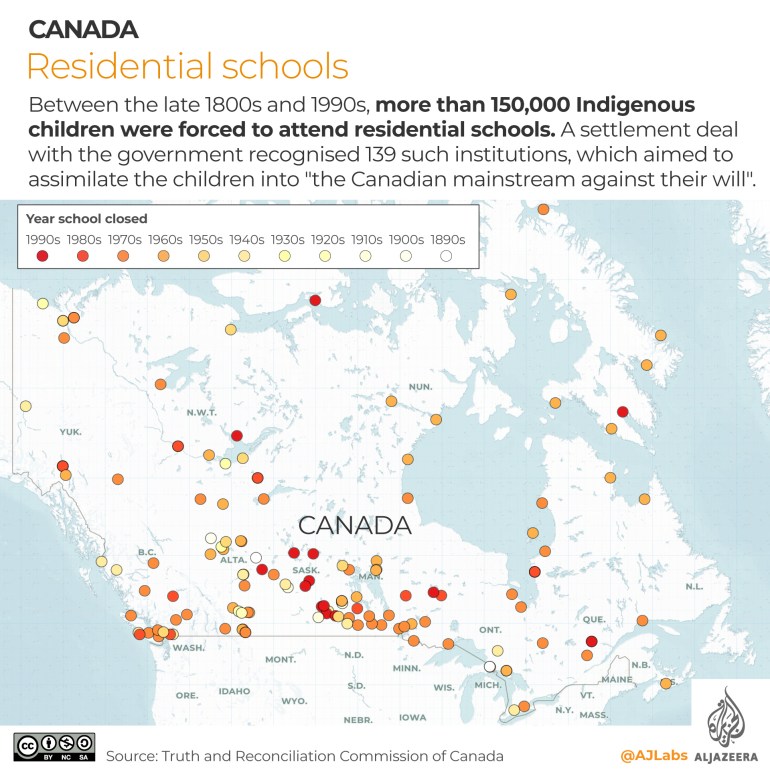
Between the late 1800s and 1990s, more than 150,000 First Nation,
Inuit and Metis children were forced to attend the institutions, which
aimed to forcibly assimilate them and destroy their cultures. Thousands
of children are believed to have died there.
In a news conference in August, Crown-Indigenous Relations Minister
Carolyn Bennett said the government would provide an additional $66.2m
($83 million Canadian dollars) to help communities search for unmarked
graves.
“As a country, we know the truth. Once you know the truth, you cannot
unknow it. First Nations, Inuit and Metis communities have lived with
the trauma caused by residential schools for generations,” Bennett said.
“So today, we are announcing an additional $83 million in funding … to
support more Indigenous communities in this extremely difficult and
necessary work.”
The announcement comes as Canadian Prime Minister Justin Trudeau is
widely expected to trigger a snap election in the coming months amid
countrywide calls for his government to do more to address the
intergenerational trauma caused by residential schools.
Since hundreds of graves were first discovered
at the Kamloops Indian Residential School in the western province of
British Columbia in late May, Indigenous community leaders and
residential school survivors and their families have been plunged into renewed trauma.
They have demanded Ottawa support Indigenous-led efforts to find more unmarked graves and pressure the Catholic Church – which ran most of the institutions – to release its records, apologise and pay reparations.
A
child holds a flag that reads 'Every Child Matters' during a march in
British Columbia after the discovery of hundreds of unmarked graves of
Indigenous children at residential schools across Canada [File: Kevin
Light/Reuters]
Experts say the graves at Kamloops Indian Residential School are only the beginning.
Tk'emlups
te Secwepemc Chief Rosanne Casimir speaks ahead of the release of
findings on 215 unmarked graves discovered at Kamloops Indian
Residential School in Kamloops, British Columbia, Canada, July 15, 2021
[Jennifer Gauthier/Reuters]
Tk’emlúps te Secwépemc First Nation Chief Rosanne Casimir on Thursday
called on Prime Minister Justin Trudeau and the Mission Oblates of Mary
Immaculate to open their student attendance records “immediately and
fully” so her community can identify the hundreds of children buried on the grounds of the Kamloops Indian Residential School.
Casimir
said her community’s search has only just begun, and she asked the
provincial and federal governments to contribute funding and resources
to help her community continue the investigation, and protect children’s
remains.
“To the Prime Minister of Canada Justin Trudeau, we’re still waiting
for you to reach out to us to acknowledge the latest truths from the
Kamloops Indian Residential School. I look forward to a fulsome
conversation where we can finalise the details of the federal government
providing the needed support as well as access to our student records,”
said Casimir at a news conference in Kamloops, British Columbia.
From the late 1800s until 1996, Canada forced 150,000 Indigenous
children to attend assimilation institutions called “residential
schools”, where they were forbidden from practising their culture or
speaking their language. Many were physically and sexually abused, and
thousands are believed to have died.
In May, Tk’emlúps te Secwépemc was the first in the country to
release a preliminary discovery of 215 Indigenous children buried in
unmarked graves at the Kamloops Indian Residential School that were found using ground-penetrating radar.
In recent months, other First Nations have used the same technology
to search residential school sites, bringing the total number of
Indigenous graves to more than 1,000 — many of which were not included
in historical records, or had headstones removed.
Searching for graves
On Thursday, experts said only two acres (0.8 hectares) of the
160-acre (65-hectare) residential school site have been searched with
ground-penetrating radar. Sarah Beaulieu, the radar specialist who
participated in the search, said she further analysed the probable grave
sites and concluded that there are approximately 200 likely graves —
not 215 as first reported.
“With ground-penetrating radar, we can never say definitively that
they are human remains until you excavate,” she said. “They have
multiple signatures that present like burials, but because of that we
need to say that they are probable until one excavates.”
Beaulieu
said survivors led the search because they knew there were graves at
the site, adding that archaeologists found a juvenile tooth near the
site in the late 1990s or early 2000s, and a tourist found a child’s rib
bone in the same area in the 2000s.
She said it was likely the graves contained children’s remains. “The
majority of the anomalies were between 0.7 and 0.8 metres (27.5 and 31.5
inches) below the surface, which is fairly shallow, and it fits with
the knowledge keepers’ descriptions of children having to dig graves,
for one. It also fits with when you have a juvenile burial, because they
are smaller in length, they typically are not dug as deeply.”
Beaulieu said no graves have been excavated yet. It is not clear when or if an excavation will happen.
“We are here today because of Indian Residential School survivors and
intergenerational survivors who were unrelenting in carrying those
painful truths about missing children forward,” Casimir said. She said
survivors witnessed abuse and were required to dig graves, and it is
because they spoke their truth that her community can verify where
children are buried.
The Truth and Reconciliation Commission (TRC), a years-long process
documenting survivors’ stories, confirmed 4,100 children who died in the
institutions – from abuse, neglect, disease, fire, and from exposure
after running away.
But the full scope of how many children died,
and the causes of their deaths, is still unknown. According to the TRC,
it was not until 1935 that the government adopted a formal policy on
how to report and investigate deaths at the institutions. The commission
found that, for half of the recorded deaths, the government did not
include the cause of death.
More than 7,000 survivors of the institutions testified before the TRC. In its final report (PDF),
the commission concluded the practice was cultural genocide, and that
Canada had “set out to destroy the political and social institutions” of
Indigenous people with a goal of seizing land.
According to the UN, the policy of forced assimilation institutions
was popular all over the world — in Canada, the United States, Latin
America, Australia, New Zealand, Asia, Russia, Scandinavia and East
Africa — because it was cheaper than waging war against Indigenous
people.
Survivors’ stories
During the news conference, survivors of the Kamloops institution shared their stories.
Mona Jules said her 13-year-old sister became sick and passed away at
the Kamloops institution, but her parents were not notified until after
her death. “They wanted to know, why wasn’t she taken to a doctor, to
the hospital? It was right across the bridge,” she said. “There were no
answers.”
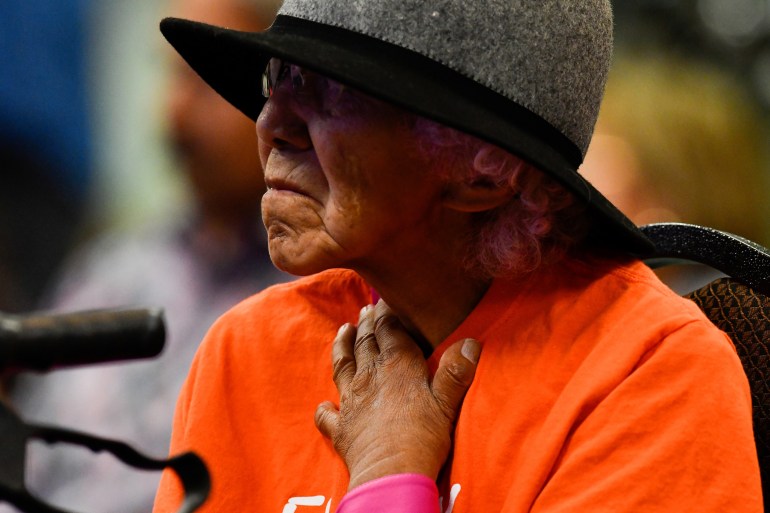
Residential
school survivor Mona Jules takes part in a presentation of the findings
on 215 unmarked graves discovered at Kamloops Indian Residential School
in Kamloops, British Columbia, Canada, July 15, 2021 [Jennifer
Gauthier/Reuters]
Jules said she and other children were beaten for speaking their
Indigenous language. She is still fluent and has spent her life teaching
it to anyone who wants to learn.
“I’ve spent years trying to revive what that school has snuffed out.
And it’s working — we have many of our young people who speak it and
they’re running language departments, having meetings in the language,
speaking it to one another. I still work with them, when I can, and I’ll
continue to do that for as long as I can.”


![A child holds a flag that reads 'Every Child Matters' during a march in British Columbia after the discovery of hundreds of unmarked graves of Indigenous children at residential schools across Canada [File: Kevin Light/Reuters]](https://www.aljazeera.com/wp-content/uploads/2021/08/2021-08-02T180901Z_1854223407_RC24XO9GZWLJ_RTRMADP_3_CANADA-INDIGENOUS-CHILDREN.jpg?resize=770%2C513)
![Tk'emlups te Secwepemc Chief Rosanne Casimir speaks ahead of the release of findings on 215 unmarked graves discovered at Kamloops Indian Residential School in Kamloops, British Columbia, Canada, July 15, 2021 [Jennifer Gauthier/Reuters]](https://www.aljazeera.com/wp-content/uploads/2021/07/2021-07-15T185644Z_664108146_RC2XKO9GTC0J_RTRMADP_3_CANADA-INDIGENOUS-CHILDREN.jpg?resize=770%2C513)
 Residential
school survivor Mona Jules takes part in a presentation of the findings
on 215 unmarked graves discovered at Kamloops Indian Residential School
in Kamloops, British Columbia, Canada, July 15, 2021 [Jennifer
Gauthier/Reuters]
Residential
school survivor Mona Jules takes part in a presentation of the findings
on 215 unmarked graves discovered at Kamloops Indian Residential School
in Kamloops, British Columbia, Canada, July 15, 2021 [Jennifer
Gauthier/Reuters]


