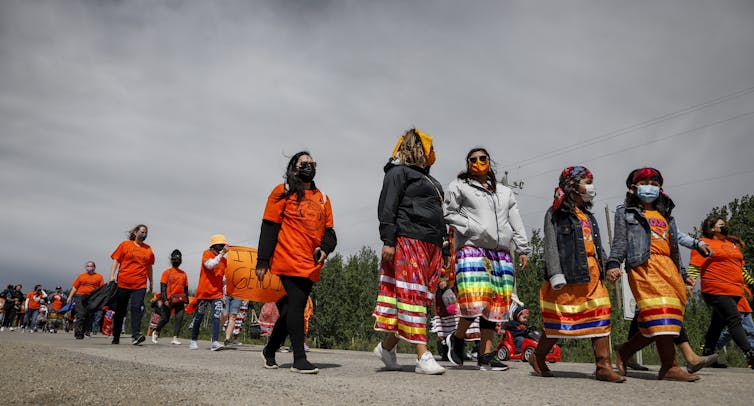
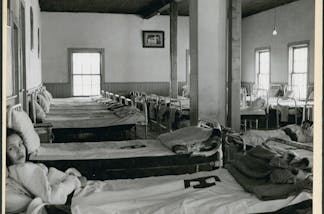
Embracing truth is all the more difficult for some because many Canadians still associate residential schooling with the positive images church and state officials used to propagandize and promote these institutions as humanitarian projects.
Such “positive” framings of residential schools justify ongoing colonial policy approaches that continue to harm Indigenous Peoples today.
Rejection, misrepresentation of basic facts
But lack of accurate historical knowledge is not the only barrier to
truth and genuine reconciliation. There are a handful of figures —
former senator Lynn Beyak, Conservative Party Leader Erin O’Toole, Conrad Black and others — who have openly engaged in denialism.
Residential school denialism
is not the outright denial of the Indian Residential School (IRS)
system’s existence, but rather the rejection or misrepresentation of
basic facts about residential schooling to undermine truth and
reconciliation efforts.
Residential school denialists employ an array of rhetorical
arguments. The end game of denialism is to obscure truth about Canada’s
IRS system in ways that ultimately protect the status quo as well as
guilty parties.
Residential school denialists begin and end with a firm belief in
innate Indigenous deficiency and settler innocence, often rooted in Christian triumphalism. Their ranks include missionary apologists, writers and academics, right-wing and anti-Indigenous editorialists and relatives of residential school staff
who uncritically refer to personal memory and work to defend their
family reputations. These are neither informed nor objective
commentators.
Avoiding truth, rushing reconciliation
Murray Sinclair, the TRC’s chair, has recently argued that residential school denialism is on the rise and real reconciliation is at risk.
Canada, Sinclair suggests, is rushing reconciliation and leaving the truth behind. In light of recent announcements of unmarked children’s graves across the country, now is the time to confront the truth about Canada’s IRS system and, in the process, disprove and discredit denialism.
The following glossary is the start of an inventory of some common
contortions used by denialists to try to undermine the overwhelming
documentary and testimonial evidence of widespread, multigenerational,
systemic and ongoing violence of the IRS system.
1. Genocide: The destruction, in whole or in part, of a nation or an ethnic group. In spite of the United Nation’s expansive official definition, denialists strategically narrow the term “genocide” to ethnic cleansing events modelled on the Holocaust. Contrary to historical evidence, denialists contend that genocide is not applicable to Canada.
The TRC’s final report shows how Canada’s treatment of Indigenous
Peoples fits the definition of genocide, specifically explaining how the
residential school system was a form of “cultural genocide.” Some denialists jump on this categorization to suggest that “cultural” genocide is not genocide. That is incorrect. The Canadian Historical Association has recently clarified that genocide is, in fact, the correct term to be using in the Canadian context.
Read more:
Canada's hypocrisy: Recognizing genocide except its own against Indigenous peoples
2. School: A place where children are taught a variety of academic subjects.
Physical assault, sorting of children according to racist assumptions and on the basis of ability and class
have long histories in Canadian education. But the particular
combination of factors distinguish residential schools from comparative
schooling contexts. These factors include: racist assimilationism;
cultural shaming and sexual violence combined with multi-generational
collusion of church and state; the explicit aim of isolating children to
neutralize community resistance to government control.
Denialists often make false comparisons between boarding schools
and the violent carceral institutions known as “residential schools.”
Canadian policy meant that for more than 100 years and multiple
generations, Indigenous children were removed from their families and
cultures to institutions where many were abused, malnourished,
trafficked to local white families and inflicted with substandard
education focused on manual labour and servitude — while government also systemically dispossessed Indigenous lands and resources.
3. “But they learned new skills”: Given little meaningful academic or effective vocational instruction,
“new skills” taught in residential institutions included religious
indoctrination enforced by corporal punishment and myriad forms of
abuse, cultural and bodily shame, alienation from family, disconnection
from subsistence economies and substandard orientation for wage labour.
Church and state officials often justify this “education” in humanitarian — even sacred
— terms. But all of these “skills” directly supported the destruction
of Indigenous ways of life and the ostensible training of children and
youth for lower-class “productive” service positions. Indigenous
children were not put on vocational or professional paths towards
economic or social competition in Canada’s capitalist settler society.
4. “They had good intentions”: No matter how many
bodies are found, how many people testify to the lifelong traumas of
extensive abuse at the hands of church officials and teachers,
denialists evoke the “good intentions” of some school officials as justification for their maintenance of a genocidal school system for over a century.
5. “You’re ignoring all the good things”: Anything
at all that made life bearable under a dominant violent context of
staff-inflicted cruelties, deprivations and separations from friends,
family and home is cited by denialists as a “good” of residential
schooling to absolve churches of culpability. Denialists insist on
focusing on a minority of individualized, positive recollections from the schools as part of a strategy to discredit those who draw attention to the overall, systemic genocidal effects of the IRS system. Even the Anglican Church of Canada, which ran approximately 30 percent of residential schools across the country, has clarified that “there was nothing good” about a school system that sought to “kill the Indian in the child.”
6. Balance: An equal weighting of different
elements. Denialists often engage in a form of bias known as “false
balance” to wrongly suggest that the “good” and the “bad” of residential
schooling were equal parts of the “whole story.”
The insistence on focusing on “positives” to provide “balance”
fundamentally misrepresents the scholarly consensus, supported by
overwhelming survivor testimony and backed by historical research, that
the overall effects of the system are genocidal.
7. “It was of the times”: The idea that we can’t
judge the past by the values of today. This notion wrongly suggests that
no one judged the IRS system harshly during its operation. In fact,
Indigenous parents, students and community leaders, church employees and even the Department of Indian Affairs’ own medical expert
critiqued the system “in their own times.” However, powerful church and
state officials chose to downplay and discredit dissent and resistance
for over a century to protect the IRS system so that it could continue
to support settler colonialism and Canadian nation-building — as a way
of protecting their assets and defend against litigation.
8. Civility: What some settlers demand from
Indigenous people when their denialism is publicly called out,
challenged and discredited. Indigenous anger, sadness and refusal are labelled as uncivil and excluded from so-called mainstream dialogue. By contrast, our public institutions accommodate public settler anger and outrage used to defend denialists.
Overall, residential school denialism is a strategy used to
manipulate and undermine the realities of Indigenous Peoples’ painful
experiences under Canadian colonialism to protect the status quo. An
honest accounting of the past makes possible an honourable future —
but only if Canadians have the courage to face it. As the TRC reminds
us, we must have truth before reconciliation — anything less will only
perpetuate the harms of that history.
If you are an Indian Residential School survivor, or have been
affected by the residential school system and need help, you can contact
the 24-hour Indian Residential Schools Crisis Line: 1-866-925-4419
Authors
-
 Daniel Heath Justice
Cherokee Nation citizen, Professor of Critical Indigenous Studies and English, University of British Columbia
-
 Sean Carleton
Assistant Professor, Departments of History and Indigenous Studies, University of Manitoba
Disclosure statement
Daniel Heath Justice receives funding from the Social Sciences and Humanities Research Council of Canada.
Sean Carleton receives funding from the Social Sciences and Humanities Research Council of Canada.
READ MORE