BLOGGER changed, not allowing us to UPDATE this back-up blog

(UPDATED 726/2025) issues with blogger are preventing this
Showing posts with label BC. Show all posts

Tuesday, December 3, 2024

Potential unmarked graves identified at former residential school in central B.C.


STORY AND VIDEO
: https://www.msn.com/en-ca/news/canada/potential-unmarked-graves-identified-at-former-residential-school-in-central-b-c/ar-AA1v2LtG

The site of a former British Columbia residential school that had its own cemetery since the early 1920s is now the location of potential unmarked graves, says the chief of a Fraser Lake area First Nation.

Nadleh Whut'en First Nation Chief Beverly Ketlo said after almost two years of geophysical survey work, the nation believes it can confirm potential unmarked graves at the site of the former Lejac Indian Residential School, located about 160 kilometres west of Prince George.

The First Nation had always known children were buried at the church-run institution because many of their graves were marked in a cemetery that had been there since 1922, when the school opened, but the survey's findings suggest a number of unmarked graves, she said at a news conference Saturday.

"We have information today that shows that there are likely grave sites in the location of the Lejac school," said Ketlo. "We know there were more children there, we just didn't know where. How many, and this is a question I ask everybody I meet, how many of the schools you attended had graveyards in the backyard?"

The survey did not positively identify any unmarked graves, but indicated "23 markers" of potential burial locations, she said.

The geophysical survey work, using ground-penetrating radar and magnetometry, started in the winter of 2023 and focused on areas identified by survivors of the residential school, said Ketlo.

About 7,850 Indigenous children attended Lejac school, which was in operation from 1922 to 1976.

The Nadleh Whut'en First Nation said there were 38 documented deaths at the institution.

Ketlo said among the Lejac Indian Residential School's darkest chapters was the deaths of four boys in 1937.


Thursday, February 24, 2022

B.C. First Nation to search for children who didn’t come home from Alert Bay residential school

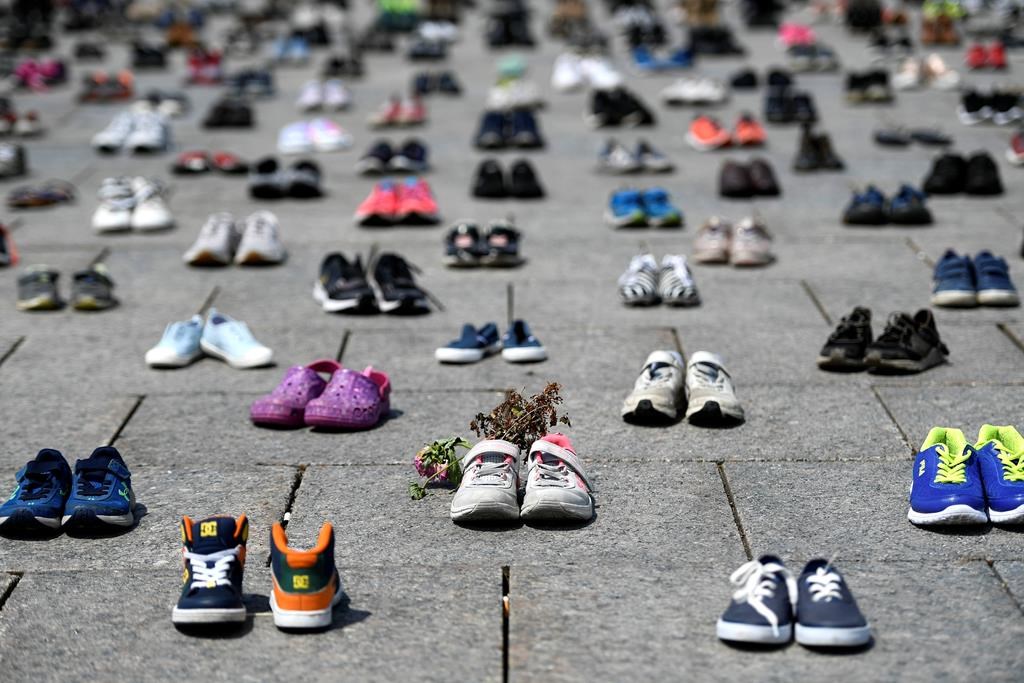
Dried flowers rest inside a pair of child's running shoes at a memorial for the 215 children whose remains were found at the grounds of the former Kamloops Indian Residential School at Tk’emlups te Secwépemc First Nation in Kamloops, B.C., on Parliament Hill in Ottawa on Friday, June 4, 2021. A British Columbia First Nation located off coast of northeastern Vancouver Island says it has started an investigation into the grounds of a former residential institution, following similar inquiries by a number of nations across the country. THE CANADIAN PRESS/Justin Tang. 
Dried flowers rest inside a pair of child's running shoes at a memorial for the 215 children whose remains were found at the grounds of the former Kamloops Indian Residential School at Tk’emlups te Secwépemc First Nation in Kamloops, B.C., on Parliament Hill in Ottawa on Friday, June 4, 2021. A British Columbia First Nation located off coast of northeastern Vancouver Island says it has started an investigation into the grounds of a former residential institution, following similar inquiries by a number of nations across the country. THE CANADIAN PRESS/Justin Tang. JDT/

Warning: This story deals with disturbing subject matter that may upset and trigger some readers. Discretion is advised.

A British Columbia First Nation located off the coast of northeastern Vancouver Island says it has started an investigation on the grounds of a former residential school, looking for the remains of children who didn’t return home.

A statement from ‘Namgis First Nation, located near Alert Bay on Cormorant Island, says its investigation into the former St. Michael’s Indian Residential School will happen in phases, starting with hiring a project manager to help the nation access funding and plan how to engage survivors.

It says survivors from 45 different nations will be invited to take part to help guide the examination of the grounds at the institution that first opened as a day school in 1878 and closed as a residential building in 1974.

KEEP READING  

Friday, February 4, 2022

Fifth Estate

Records contain school narrative for Kamloops Indian Residential School

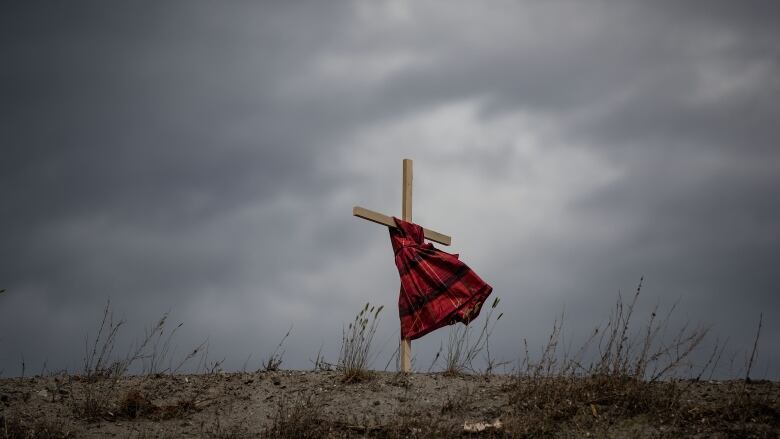
A child's dress hangs on a cross near the former Kamloops Indian Residential School. (Canadian Press/Darryl Dyck)

The leadership of Tk'emlúps te Secwépemc hopes to identify and locate missing children believed to be buried in unmarked graves near the former Kamloops Indian Residential School (IRS) with the help of previously undisclosed documents set for release by the federal government.

The federal government plans to transfer more than 875,000 records through a recently signed agreement with the National Centre for Truth and Reconciliation (NCTR), the archival repository for all of the material collected by the Truth and Reconciliation Commission.

Those files include the school "narrative" for Kamloops IRS, which summarizes the institution's history, including its administration, attendance record, key events and reports of abuse.

"We have to find answers," Tk'emlúps te Secwépemc Kukpi7 (Chief) Rosanne Casimir told CBC News.

"Access to the records means not having to re-traumatize ... residential school survivors to pinpoint information about who attended KIRS and who could possibly be in the unmarked graves."

Tk'emlúps te Secwépemc sent shockwaves around the world last May when it announced the preliminary findings from ground penetrating radar scans — 215 suspected graves of children near the site of Kamloops IRS.

Now, the community and residential school survivors are waiting for their chance to review these records for the first time, which could help piece together what happened at Canada's largest residential school. KEEP READING


 PLEASE WATCH

The Fifth Estate shows how a B.C. First Nation is dealing with the traumatic discovery of what are assumed to be the graves of children near a former residential school, as it tries to lead the way for other communities coping with a similar tragic history. 45:35

Wednesday, August 25, 2021

Squamish Nation to Investigate St. Paul’s Indian Residential School for Unmarked Graves

Squamish announcement 2
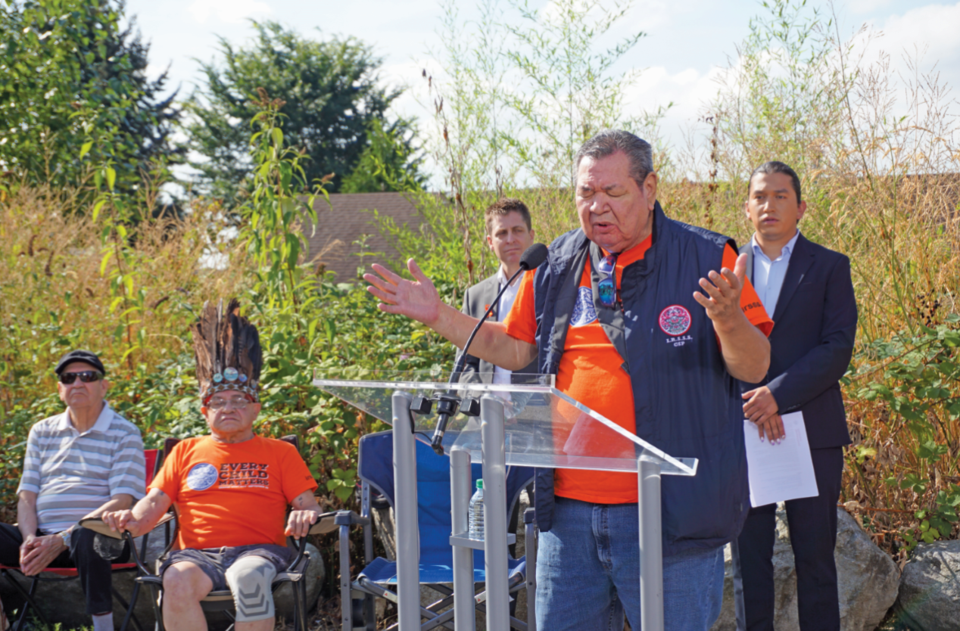
Byron Joseph, Elder, Sḵwx̱wú7mesh Úxwumixw (Squamish Nation), who led an opening prayer, called on the crowd gathered wearing orange to come together and help one another through this difficult time, as Squamish Nation begins an investigation of the former St. Paul's Indian Residential School site.

Sḵwx̱wú7mesh Úxwumixw (Squamish Nation) has announced it has launched an investigation into the former St. Paul’s Indian Residential School site to find answers about the children who attended the institution but never made it home.

On Tuesday (Aug 10) standing outside the site of the former institution, which once stood on the 500 block of West Keith Road in North Vancouver, Khelsilem (Dustin Rivers), Sḵwx̱wú7mesh Úxwumixw spokesperson, said the Nation had embarked on an Indigenous-led initiative, on behalf of its people and in partnership with its relatives, the xʷməθkʷəy̓əm (Musqueam) and səl̓ilw̓ətaʔɬ (Tsleil-Waututh) Nations, to investigate the site for burial grounds and unmarked graves.

“We will begin that work to investigate and gather all information to honour and find those children who might not have gone home that had attended St. Paul’s Indian Residential School,” he said, adding that the work would be done with the support of the Roman Catholic Archdiocese.

Khelsilem said the investigation was just in the beginning stages and the process was still taking shape but would involve an inquiry into the site and a field investigation.

The phases of the investigation will include an interview process with survivors to help narrow down or expand investigation search areas, gathering all records related to the school throughout its history, and remote sensing searches, which may include ground-penetrating radar studies.

The announcement comes after the Tk’emlúps te Secwépemc First Nation shared the discovery of the remains of an estimated 215 children in unmarked graves at the former Kamloops Indian Residential School at the end of May. Since then, further Nations have announced their own such findings.

As the St. Paul’s site is now home to St. Thomas Aquinas Secondary, Khelsilem said it had unique considerations in comparison to other sites being investigated, which had to be considered during the investigation, including the extensive development that has occurred at the site.

There were 18 residential schools in B.C. St. Paul’s, located next to the Sḵwx̱wú7mesh community of Eslhá7an, was the only institution in the Metro Vancouver area.

It was opened in 1899 by the federal government’s Department of Indian Affairs and was managed and operated by the Roman Catholic Religious Teaching Order, the Sisters of Child Jesus.

Over 2,000 Indigenous children, representing six generations of Sḵwx̱wú7mesh, xʷməθkʷəy̓əm, and səl̓ilw̓ətaʔɬ Nations, and other Indigenous communities, were institutionalized there from grades one through eight until it closed in 1959.

Children in the school were segregated by age group and gender, often not permitted to visit other family members, stripped of their culture, and punished for speaking their native languages or taking part in their cultural traditions.

Sḵwx̱wú7mesh Úxwumixw says oral histories told by St. Paul’s survivors include stories about children who disappeared.

“According to public records, 12 unidentified students died while attending St. Paul’s between 1904 and 1913,” the Nation said in a release, adding that the goal with the investigation is to find the location of each of these children and “bring them home to rest.”

Sḵwx̱wú7mesh Úxwumixw held a private gathering on Monday (Aug. 9) to tell members that the work was beginning at the site.

“This work is really sacred and really important to our people and, first and foremost, this work is about protecting and helping our survivors,” Khelsilem said. “They’re first in our minds, as we begin this work.”

James Borkowski, the archbishop’s delegate for operations for the Roman Catholic Archdiocese of Vancouver, who spoke on behalf of Archbishop Michael Miller, said the work to uncover the truth had already begun over the past two months, and “continues as an urgent priority.”

Earlier this summer, the archbishop shared an apology and a firm commitment on behalf of the local Catholic Church, to provide immediate supports and co-operation in ensuring that all documents related to residential schools be made available and accessible.

“We have much to learn and act on, as we hear from the Nations, and community members in this journey of truth and reconciliation related to the church’s historic and damaging role with residential schools,” Borkowski said.

“Our hope as Catholics is that our Creator will give us the courage and strength to follow the truth wherever it takes us.”

On June 28, the B.C. government allocated $12 million to support First Nations throughout the province with investigative work at former residential school sites, as well as cultural and wellness supports.

Each caretaker community can receive up to $475,000 for each site.

The province has also appointed First Nations liaisons to support communities through the work.

On Aug 10, the federal government also announced a further $321 million in additional support for Indigenous-led initiatives.

Chief Jen Thomas, səl̓ilw̓ətaʔɬ, whose father is a survivor of St. Paul’s, said she was “grateful for the work that’s going to be done” saying it was the “start of our healing journey for our survivors.”

Chief Wayne Sparrow (xʷməθkʷəy̓əm) added on behalf of his community that “we’re going to work with each and every one of you to get to the truth.”

He acknowledged all Nations involved, both the federal and provincial governments and the Catholic Archdiocese for stepping up to do the work.

“The only way that we’re going to heal is doing it together,” Sparrow said.

Elder Byron Joseph of Sḵwx̱wú7mesh Úxwumixw, who led an opening prayer, called on the crowd gathered wearing orange to come together and help one another through this difficult time.

“This is a time where our people come forward,” he said. “The ones that have been forgotten. Those are the ones we have to honour. Those are the ones these prayers are for.

“Keep a strong mind and strong heart as we go through this together.”

**By Elisia Seeber

**Source


click

Contact Trace

Name

Email *

Message *

NO MORE UPDATES

GO TO:  https://blog.americanindianadoptees.com/  for updates and news. THIS BLOG cannot be updated...