BLOGGER changed, not allowing us to UPDATE this back-up blog

(UPDATED 726/2025) issues with blogger are preventing this
Showing posts with label American Indians. Show all posts

Tuesday, March 19, 2019

When Two Sovereigns Collide #ProudtoProtectICWA

In this episode, renowned experts on American Indian law and policy, Matthew Fletcher and Wenona Singel, discuss the nuanced and highly complex field of American Indian Law. Matthew and Wenona begin by exploring the history of tribal sovereignty, and discuss the rights of American Indians as both tribal citizens and U.S. citizens.  We then explore jurisdiction across border lines, particularly in a criminal context. Matthew and Wenona discuss the history of violence against native women, and why, until recently, prosecution has been so difficult. The history of and current U.S. court challenges to the Indian Child Welfare Act are also examined.

Reasonably Speaking Podcast — “American Indian Law: When Two Sovereigns Collide”

by Matthew L.M. Fletcher
 

Turtle Talk Blog
Turtle Talk is the blog for the Indigenous Law and Policy Center at Michigan State University College of Law. It is the leading law blog on American Indian law and policy. Matthew Fletcher is the primary editor and author. It specializes in providing access to primary documents related to current topics in American Indian law and policy — court opinions and pleadings, federal government documents, scholarly materials, and other sources.

States and Their American Indian Citizens
Fletcher, Matthew L. M., States and Their American Indian Citizens (November 13, 2017). 41 American Indian Law Review 319 (2017).

Tribal Jurisdiction - A Historical Bargain
Fletcher, Matthew L. M. and Jurss, Leah, Tribal Jurisdiction - A Historical Bargain (February 3, 2016). Maryland Law Review, Vol. 76, No. 3, 2017.

Indian Children and the Federal-Tribal Trust Relationship
Fletcher, Matthew L. M. and Singel, Wenona T., Indian Children and the Federal-Tribal Trust Relationship (April 28, 2016). Nebraska Law Review, Vol. 95, No. 4, 2017.

Statutory Divestiture of Tribal Sovereignty
Fletcher, Matthew L. M. and Singel, Wenona T., Indian Children and the Federal-Tribal Trust Relationship (April 28, 2016). Nebraska Law Review, Vol. 95, No. 4, 2017.

Sunday, June 25, 2017

Newly Released Census Numbers

American Indian & Alaska Native Population Growing


Published June 25, 2017

WASHINGTON – On Friday, the U.S. Census Bureau released new estimates on the population in the United States. Estimates released Friday, indicate the American Indian and Alaska Native population grew by 1.4 percent to 6.7 million between July 1, 2015 and July 1, 2016.


The American Indian and Alaska Native Population – Other Key Statistics:
  • California had the largest American Indian and Alaska Native population of any state in 2016 (1.1 million), while Texas had the largest numeric increase since July 1, 2015 (10,800). Alaska had the highest percentage (19.9 percent) of the American Indian and Alaska Native population.
  • Among counties, Los Angeles County, Calif., had the largest American Indian and Alaska Native population of any county in 2016 (233,200), and Maricopa County, Ariz., held the greatest increase from the previous year (4,100). Kusilvak Census Area, Alaska, had the highest share for this group (91.8 percent).

Wednesday, November 13, 2013

Taskforce on Violence Against American Indian Children to Hold First Public Hearing In North Dakota

Archive Photo
Release here.
The advisory committee will convene four public hearings across the country beginning in Bismarck, N.D., Dec. 9, focusing on violence in children’s homes, schools and communities in Indian country.  Associate Attorney General Tony West will join the task force at the first hearing in Bismarck.  The other hearings will be held in Phoenix, Ariz., Fort Lauderdale, Fla. and Anchorage, Alaska early in 2014.

To say this is long overdue would be an under-statement...Trace

Thursday, October 31, 2013

Improving the Lives of Native American children, bill introduced

Sens. Heitkamp and Murkowski Introduce Bill to Improve Lives of Indian Children


Here is the text of the press release (bill summary here):

U.S. Senators Heidi Heitkamp (D-ND) and Lisa Murkowski (R-AK) today introduced a comprehensive plan to find solutions to the complex challenges facing Native American children throughout Indian Country.
The bipartisan legislation, Heitkamp’s first bill as a U.S. Senator, would create a national Commission on Native American Children to conduct an intensive study into issues facing Native children – such as high rates of poverty, staggering unemployment, child abuse, domestic violence, crime, substance abuse, and few economic opportunities – and make recommendations on how to make sure Native children are better taken care of and given the opportunities to thrive.   Heitkamp and Murkowski are both members of the Senate Committee on Indian Affairs.
“We have all heard stories or seen first-hand the struggles that too many Native children and their families face from extreme poverty to child abuse to suicide.  Since I’ve been in public office, I’ve worked to address many of these challenges, and I’m proud my first bill as a U.S. Senator will take a serious look at finding solutions to better protect Native children and give them the opportunities they deserve,” said Heitkamp. “Tragically, for children in our nation’s tribal communities, the barriers to success are high and they are the most at-risk population in the country, facing serious disparities in safety, health, and education.
“We need to strive for a day when Native children no longer live in third-world conditions; when they don’t face the threat of abuse on a daily basis; when they receive the good health care and education to help them grow and succeed. However, we don’t just have a moral obligation to fix this, we have treaty and trust responsibilities to do so. The federal government pledged long ago to protect Native families and children. We haven’t lived up to that promise. But we can change that.”
“Last week at the Alaska Federation of Natives, a group of kids from Tanana speak up  with tremendous courage and express that they have had enough of violence, alcohol, drugs, and suicide in their community. Their call for us to take a pledge to protect our villages against suicide, is a call to action for all of us. I am proud to be the lead Republican co-sponsor of the Alyce Spotted Bear and Walter Soboleff Commission with Sen. Heitkamp,” said Murkowski.  “We must ensure our federal government upholds the trust responsibility, especially to our Native children, and this Commission will examine from the lens of justice, education, and healthcare how to improve the lives of our Nation’s native children.”
“It is also time we honor Dr. Walter Soboleff, our champion for cultural education in Alaska. Dr. Soboleff, lived a life committed to ensuring our public education system honored cultural values, and that our University system provided an option for students to learn cultural practices with the established of the Alaska Native Studies Department at the University of Alaska Fairbanks.”
The Alyce Spotted Bear and Walter Soboleff Commission on Native Children, named for the former Chairwoman of Mandan, Hidatsa & Arikara Nation in North Dakota, and Alaska Native Elder and statesman, respectively, is already being praised by a cross-section of individuals from North Dakota, Alaska and around the country. It has been lauded by former Chairman of the Senate Committee on Indian Affairs Byron Dorgan, the National Congress of American Indians and the National Indian Education Association (quotes endorsing the legislation are below).

Background:

Conditions for young people in Indian Country are tragic. For example:

  • 37 percent of Native children live in poverty;
  • Suicide rates are 2.5 times the national average for children 15-24 years old;
  • High school graduation rate for Native students is around 50 percent, compared to more than 75 percent for white students; and
  • While the overall rate of child mortality in the U.S. has decreased since 2000, the rate for Native children has increased 15 percent.
Tribal governments face numerous obstacles in responding to the needs of Native children. Existing program rules and the volume of resources required to access grant opportunities stymie efforts of tribes to tackle these issues.  At the same time, federal agencies lack clear guidance about the direction that should be taken to best address the needs of Native children in order to fulfill our trust responsibility to tribal nations.

To help reverse these impacts, the Commission on Native Children would conduct a comprehensive study on the programs, grants, and supports available for Native children, both at government agencies and on the ground in Native communities, with the goal of developing a sustainable system that delivers wrap-around services to Native children.  Then, the 11 member Commission would issue a report to address a series of challenges currently facing Native children.  A Native Children Subcommittee would also provide advice to the Commission.  The Commission’s report would address how to achieve:

  • Better Use of Existing Resources – The Commission will identify ways to streamline current federal, state, and local programs to be more effective and give tribes greater flexibility to devise programs for their communities in the spirit of self-determination and allow government agencies to redirect resources to the areas of most need.
  • Increased Coordination – The Commission will seek to improve coordination of existing programs benefitting Native children.  The federal government houses programs across numerous different agencies, yet these programs too often do not work together.
  • Measurable Outcomes – The Commission will recommend measures to determine the wellbeing of Native children, and use these measurements to propose short-term, mid-term, and long-term national policy goals.
  • Stronger Data – The Commission will seek to develop better data collection methods.  Too often Native children are left out of the conversation because existing data collection, reporting, and analysis practices exclude them.
  • Stronger Private Sector Partnerships – The Commission will seek to identify obstacles to public-private partnerships in Native communities.
  • Implementation of Best Practices – The Commission will identify and highlight successful models that can   be adopted in Native communities.

For a summary of the bill, click here. For quotations from national supporters, click here.

Friday, March 9, 2012

Native Daughters: 10 Things You Need to Know About Native American Women


February 5, 2012
by
 
It’s no exaggeration to say that American Indian women are missing from most media coverage, history books and classroom discussions. But at least journalism students, instructors and state educators in Nebraska are doing something to help end America’s ignorance of Native women and the contributions they make to their communities, their tribes and to the nation as a whole.
 
Last year, the University of Nebraska-Lincoln College of Journalism and Mass Communications published the magazine, Native Daughters. With a grant from the Carnegie Foundation and under the guidance of five university professors, students spent 18 months reporting and writing about American Indian women who are artists, activists, lawyers, cops, warriors, healers, storytellers and leaders.
Now the Nebraska Department of Education has also released a companion curriculum for the magazine. 
 
You can download it for free here.
 
Can’t wait even one minute more to learn about Native women? 
 
Here’s a teaser of what you can learn more about in Native Daughters—and what you can share with your students via the new curriculum.

1. “A lot of people think that us women are not leaders, but we are the heart of the nation, we are the center of our home, and it is us who decide how it will be.”–Philomine Lakota, Lakota language teacher, Red Cloud High School, Pine Ridge, S.D.
2. The art forms Native women practice stand as reminders of cultural endurance. “Their crafts survived the Greasy Grass (Battle of Little Big Horn), Wounded Knee One (1890) and Two (1973),” writes Christina DeVries in Native Daughters. “Their spirits survived the Trail of Tears, the Relocation and Termination program and continued struggles against cultural annihilation.”
3. In 1997, Ms. magazine named Winona LaDuke (Anishinaabeg) Woman of the Year. That same year, the activist also debuted her first novel, Last Standing Woman.
4. Of nearly 2 million women enlisted in the U.S. armed forces, 18,000 are American Indian women. Their representation in the military is disproportionately high—and Native women are more likely to be sexually harassed, which increases their chances of developing post-traumatic stress disorder.
5. The number of Native women applying to medical school has increased since 2003, peaking in 2007 when 77 Native women applied nationwide.
6. In 2007, when Cassandra Manuelito-Kerkvliet (Diné) was named president of Antioch University, she became the first American Indian woman president of a mainstream university. Not only that, but about half of the nation’s tribal colleges are led by Native women presidents.
7. Cecelia Fire Thunder (Lakota) became the Oglala Lakota Tribe’s first woman president. She has fought against domestic abuse, saying it’s not a part of traditional culture, and been a leader for women’s reproductive rights. In 2006, when the South Dakota state legislature prohibited abortion, Fire Thunder announced plans to build a women’s clinic on the reservation, and therefore beyond state jurisdiction. She was impeached by the tribal council, who said she was acting outside her duties as president.
8. Women lead nearly one-quarter of the nation’s 562 federally recognized tribes.
9. “Through the late 1700s, Cherokee women were civically engaged. They owned land and had a say during wartime,” writes Astrid Munn in Native Daughters. “But this changed after the tribe ceded large tracts of land to the U.S. government in 1795.” Since the mid-1980s, though, a generation of Native women activists, lawmakers and attorneys have been changing that history and working to empower women again.
10. Indian Country could never survive without Native women.

Link to Native Daughters: http://cojmc.unl.edu/nativedaughters/

Tuesday, September 7, 2010

Lost Siblings

    My definition of being lost is being separated from your natural family, your genetic first family. I know a few Lost Birds who were placed into adoption with a sister or brother. In many ways I consider them fortunate because they had each other. But being adopted is no less traumatic. If you don’t believe me, read my memoir.
      I had a dream this morning about an adoptee in Australia has 20 (?) siblings who are also lost. Now they are searching for each other. Can it be true?
            This was enough to get me out of bed at 4 am. Then I thought: how many siblings are separated, lost, and not together?  Why would social workers and adoption agencies separate siblings?  That seems inhuman.
            Their answer is somewhat obvious: they can’t find or place that many kids with one adoptive family. A social worker might place one or two children together but not often. Why? The childless couple only wishes to adopt one. The agencies and adopters didn’t put much weight on our blood connection and how we are a natural family who would never choose to be separated nor would we wish to be adopted out separately.
            Being separated from your natural parent(s) is hard enough but being separated from siblings – that is a nightmare - especially when you knew them and remember them. This feeling of being lost can truly be a nightmare for those in a closed adoption.
            I feel this way because I was told I have a sister. She was lost to adoption, when my natural mother Helen had her four years prior to me, and she was adopted out. Then a psychic told me Jewel-Jules-Julie was already dead. The psychic saw their family tombstone that read Russo. I dreamt about this sister a long time. I wanted to know what she was like and see her face. I wanted to know she was ok.
            Really, I love stories about reunions with siblings, when you meet your long-lost brothers and sisters.
            In my reunion with my natural dad, he had five kids after I was born so I have five in my dad’s family, 4 boys and 1 girl. They never knew about me until I met them.
            When you meet someone who looks like you, it’s PRICELESS.
            When you hear their stories, it’s like a place in your heart is finally filled. This made me feel less alone in this tough cruel world.
            Why states and provinces in North America have not opened adoption records and files to reunite lost siblings – it’s not just a crime of humanity, it’s absolutely obscene.
            So a dream of lost siblings in Australia was the reason I woke up early. Siblings need to find one other. That alone is reason enough for countries to change their laws and open adoption records.
            It’s not about privacy, it’s about love.

American Indian girls should be with siblings

 (online source Red Lake Nation News)

LITTLE ROCK, Arkansas -- Twin girls with American Indian heritage should be placed in the custody of their mother's third cousin in keeping with the guidelines of the Indian Child Welfare Act, the state Appeals Court ruled Wednesday.
The opinion overturned a decision in 2001 by Van Buren County Circuit Judge Linda P. Collier to award custody of the 9-year-old sisters to their mother's fourth cousin in Arkansas.
The appeals court said the girls should be with their four siblings, who live with the mother's third cousin, also in Arkansas. The court noted the Indian Child Welfare Act gives preference in child custody disputes to extended family members, other members of the Indian child's tribe or other Indian families.
While neither cousin is Indian, the appeals court said the third cousin has custody of the twins' four siblings and their Indian tribe recommended they be together. The court pointed to a brief the Tohono O'odham Nation filed that said: "The only family the children have in Arkansas are each other, and their placement together is the closest approximation of placement with 'extended family' intended by the Act."
The twins' mother, Tina Gaspar, has at least 13 children, the appeals court said. The twins and four other children have the same father, Ruben Sanders, who is a member of the Tohono O'odham Nation.
Gaspar sent the girls to live with her third cousin in Van Buren County in August 2002 after Sanders abandoned the children, and Gaspar gave her relative "a signed, written statement conveying the guardianship of all six children," the court opinion said. Gaspar made the arrangements because of concern the state of Arizona would take the children from her when she went to prison in that state, the court said.
Because Sanders fathered the six children and then abandoned them, they qualify for enrollment in the Nation and the Indian Child Welfare Act applies to the custody issue, according to the opinion written by Judge Robert J. Gladwin.
Gaspar's fourth cousin then visited her in Arizona in late 2002, and obtained the mother's signature relinquishing custody of the twins to her. The fourth cousin filed the document in Van Buren County and got custody of the twins with the help of law enforcement officials.
The appeals court questioned the legitimacy of the second document and noted that "the Nation clearly and repeatedly states that its preference is for all six of the siblings to be together with appellant."
While both cousins "are on equal footing when it comes to the preferences," Gaspar's third cousin had an advantage because she has custody of the twins' four siblings. The court said she also has remained in closer contact with the Tohono O'odham Nation.

Friday, September 3, 2010

Losing your right to be Indian

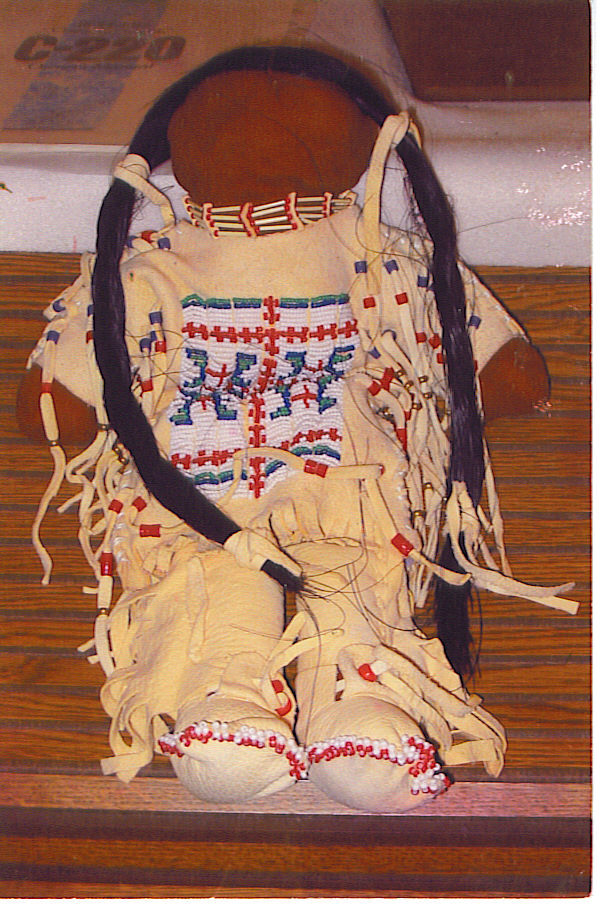
Ellowyn Locke's doll
     I’ve been thinking how some things have not changed significantly in Indian Country. The following testimony happened in 1974, when Indian leaders decided to stop the wholesale removal of Indian children to boarding schools and for adoption to non-Indian families.  Mr. Byler spoke eloquently to Senator Bartlett and Senator Abourezk about detribalization.  The result  was the Indian Child Welfare Act of 1978, which is meant to prevent non-Indians from adopting American Indian children.

            Excerpt:
            Senator BARTLETT. Do you feel that the boarding school removes some of the parental responsibility …that it creates a gap between the children and the parents, in which it makes the job of the parents more difficult and harder to achieve?

            Mr. BYLER. Yes; I think this is very much the case. In addition, I would say also we can really take the whole educational experience. Dr. Edward P. Dozier criticized Headstart programs for some Indian communities on the ground that an Indian child has such a short time in his life to learn how to behave in his own environment, to pick up the cultural and behavioral patterns of his parents. It was bad enough to start school at five or six because that bobtailed the opportunity the kids had to learn this. Now with Headstart in some communities, that age is down to 3 years, so these preschool experiences denied the children the opportunity to learn how to function properly in their own society.
            And it demoralizes the whole functioning of families when those children who grow up in a boarding school become parents themselves and have not had the opportunity to observe normal child rearing.
            In some of the early poverty programs funded under OEO, Indian tribes asked for funds to train their teenagers to be parents because they didn’t know what it was like because they had been away in boarding school.

Senator BARTLETT. What should be the structure for facing up to the emotional needs of Indian children and also in meeting the educational needs?

Mr. BYLER. I believe that in terms of the educational needs, that would be contracting the Indian schools with tribes that wish to contract for those schools. Where the tribes have taken over those schools, and there are not many yet, the educational result has been dramatic.
            For example, in Florida the Miccosukees had never had a school at all, none of their children attended school until 1961 or 1962. They took over their school about 4 years ago and, 1 year after the tribe itself had taken over the school, the comparative educational achievements of the children improved by 50 percent.
            Dropout rates have dramatically been reduced in the Busby school on Northern Cheyenne, and the Rocky Boy school, both in Montana, since Indian tribes have taken them over. So, I do think that educational needs can be met more adequately by the Indian community controlling the schools themselves.
            In terms of the emotional needs, I think perhaps one of the most central things to the emotional life of the Indian family and the Indian child, is to remove from that family the threat that their children will be taken away from them. I think this is the most dangerous aspect. It has a far greater impact on Indian emotional life than any other single factor.
            I think that in societies throughout the United States, and Indian societies, not all impoverished children or families suffer this kind of family breakdown. Among the Miccosukees, children are not taken from their parents, nor among the Coushattas of Louisiana; it’s unknown, the kind of breakdown that one sees in some Indian communities. It’s not because of Indian poverty. There are many societies in the world that are much more poverty stricken than the average American Indian community, but exhibit little or none of the family breakdown.
            I think it’s a copout when people say it’s poverty that’s causing family breakdown. I think perhaps the chief thing is the detribalization and the deculturalization, Federal and State and local efforts to make Indians white. It hasn’t worked and it will never work and one of the most vicious forms of trying to do this is to take their children. Those are the great emotional risks to Indian families.
            [More of this testimony is available at: www.liftingtheveil.org/byler]


            So what happened years ago, its effects are still being felt today. Loss of culture and language could have destroyed Indian Country but it has not. We may be wobbly but we’re still working…
            For adoptees that went through what I did, we look in a mirror and know something is wrong, yet we feel helpless to change it.  Who can discuss identity issues with you if you’re not a part of your tribal nation? I’m troubled tribes are so busy surviving they don’t reach out and search for their lost tribal members, like adoptees.
            I am so troubled by this disconnect, I try to connect adoptees to each other since we share the feeling of being lost. Our grief can’t be healed until we’re united successfully with family, relatives and tribe. Many have succeeded. Many more are trying.
            Many Native American adoptees are opening up and talking. Our identity is not mirrored back to us. We lost more than culture. We lost our right to be Indian. We have to fight to regain it. And with sealed adoption records, we may never be able to…

Wednesday, July 14, 2010

Racial Misclassification of American Indians & Suicide

"Race is important to identity and when your race is not recognized by others it is stressful." I found this study important since people are often judged by how one looks. That includes some long-held ideas of what American Indians should look like; then I thought about adoptees who are Native American by blood but have no connection to family and tribal culture. It's known adoptees do commit suicide at higher rates, obviously stress-related. Understanding how we fit into this world of humans, then how we can reconnect to culture has become my mission - Trace

Mistaken Racial Identification Causes Emotional Strain in American Indians

[Oct 3, 2007] Iowa City, IA — Research from the University of Iowa suggest that people who are routinely misidentified as members of a racial group to which they do not belong experience high levels of emotional distress and are more likely to contemplate or attempt suicide. "The Implications of Racial Misclassification by Observers," by sociologists Lisa Troyer and Mary Campbell, appeared in the October 2007 issue of the American Sociological Review.
     Troyer and Campbell analyzed data collected between 1994 and 2002 for the National Longitudinal Study of Adolescent Health, which included both the self-reported racial identification of Native American young adults in the study and the racial identity assigned by an observer.
     They found that more than a third of the American Indian youth were mis-labeled by an observer as members of another racial group.
     Among the American Indians in the study who were misidentified, 13 percent reported thinking about suicide, compared to only 6 percent of those who were identified correctly. Three percent of the misidentified young people had attempted suicide, while 1 percent who were identified correctly had done so. The misidentified young people were also more likely to be seeing a counselor or therapist (8 percent to 5 percent). They also found that mis-classified American Indians were more likely to participate in organizations that emphasize racial and ethnic identity, perhaps creating connections that help deal with the stress.
     "Previous studies of multi-racial Americans have given us anecdotal evidence that constantly having to explain your racial background is stressful for people," Campbell said. "People say, 'I'm constantly being asked what I am, and I don't fit any of the boxes.' They talk about it as if it is stressful, but until now we didn't have data to support these observations."
     This study is the first to document empirical evidence of the stress associated with not being recognized as a member of the racial group with which one identifies.
     "According to the Centers for Disease Control, suicide is the second leading cause of death among young American Indians, age 25-34 years, and the third leading cause of death among young American Indians age 10-24 years," Troyer said. "Standard explanations of suicide do not fully explain the racial gap. Our study offers a new window to understanding this disturbing disparity.
     "Adolescence is a critical time in human development, a time when identity becomes crystallized," she continued. "Race is important to identity and when your race is not recognized by others it is stressful."
     While the current study is focused on American Indians, Campbell and Troyer note that the increasing multiracial diversity in the United States makes the study potentially applicable to other populations.


click

Contact Trace

Name

Email *

Message *

NO MORE UPDATES

GO TO:  https://blog.americanindianadoptees.com/  for updates and news. THIS BLOG cannot be updated...