BLOGGER changed, not allowing us to UPDATE this back-up blog

(UPDATED 726/2025) issues with blogger are preventing this
Showing posts with label #ProudtoProtectICWA. Show all posts

Thursday, January 9, 2025

Passed: H.R. 9076, Protecting America’s Children by Strengthening Families Act : NACPA, what is it?


JANUARY 5, 2025

WASHINGTON, D.C. – Bipartisan legislation – representing the work of many members of the Ways and Means Committee – to provide critical supports to vulnerable children and families has been signed into law.  The Supporting America’s Children and Families Act (H.R.9076), introduced by Work and Welfare Subcommittee Chairman Darin LaHood (IL-16) and Ranking Member Danny K. Davis (IL-07), reauthorizes, fully for the first time in over fifteen years, child welfare programs under Title IV-B of the Social Security Act that provide federal resources to states, tribes, and territories for family preservation and to promote the safety, permanence, and well-being of children in foster care.


• In fiscal year (FY) 2022, 369,000 American children were in foster care and 19,000 youth aged-out of foster care.
• The program also provides funding for the Court Improvement Program to support child welfare legal proceedings, and Regional Partnership Grants to address parental substance use disorder as cause of child removal in order to help keep families united.

Background on the Supporting America’s Children and Families Act:

Reauthorizes Title IV-B for five years and makes reforms to modernize the program. Saves taxpayer dollars by supporting early intervention to help families stay united and reducing duplication in the child welfare system.  Uses savings from H.R. 7906, the Strengthening State and Tribal Child Enforcement Act to make targeted investments that will:

  • Reduce administrative burden by requiring the U.S. Department of Health and Human Services (HHS) to reduce paperwork and data reporting for state agencies and caseworkers by at least 15 percent.
  • Improve access for Indian tribes by streamlining funding, as well as monitoring state engagement with the Indian Child Welfare Act.
  • Support expansion of evidence-based services to prevent child abuse and neglect and ensures children are not separated from parents solely due to poverty-related neglect.
  • Address the caseworker crises by ensuring caseworkers have access to training and support to improve retention and recruitment.
  • Strengthen support systems for the 2.5 million grandparents and relatives providing kinship care for children who would otherwise enter foster care.
  • Improve outcomes for youth transitioning from foster care by including individuals with lived experience (formerly in foster care) in state service planning and ensuring youth have access to mental health services.
  • Support post-adoption services by requiring HHS to review post-adoption supports provided under Title IV-B and identify opportunities for strengthening them.

Read a one-pager on H.R. 9076 here.


READ:

https://goldrushcam.com/sierrasuntimes/index.php/news/local-news/63380-u-s-senators-susan-collins-and-ben-ray-lujan-bipartisan-bill-to-protect-native-american-children-signed-into-law 

January 3, 2025 - Washington, D.C. – On Thursday, the President signed into law the Native American Child Protection Act (NACPA), susan collins us senatorbipartisan legislation introduced by U.S. Senators Susan Collins and Ben Ray Lujรกn (D-NM). The bill reauthorizes and reforms three programs that ensure tribes have the tools needed to treat, prevent, investigate, and prosecute Native American child abuse and neglect. These programs were originally authorized in 1990 as part of the Indian Child Protection and Family Violence Prevention Act to fill funding gaps in tribal child welfare services, but the programs were never truly funded and have not been reauthorized by Congress.
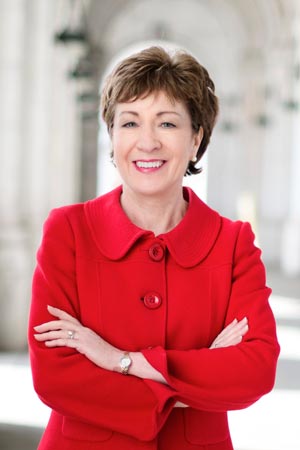
“No matter where a child grows up in the United States, they deserve to live in an environment free from abuse. The Native American Child Protection Act reauthorizes and modernizes programs that aim to assist tribes in their efforts to help victims of child abuse and prevent future abuse,” said Senator Collins. “This bill recognizes the significance of each tribe’s unique cultural values, customs, and traditions, while helping to ensure that children and families receive the support they deserve.”

“I’m proud to see President Biden sign the Native American Child Protection Act into law, which was passed in Congress with bipartisan support. In this country, all children deserve grow up without fear of being harmed or neglected,” said Senator Lujรกn. “This legislation is an important step in ensuring that tribes have access to the resources needed to provide services that reduce trauma and uncertainty for children.”

To ensure tribes have adequate resources to effectively prevent and respond to child abuse and neglect in their communities, the NACPA:

  • Establishes a single National Indian Child Resource and Family Services Center to provide tribes with technical assistance and training on addressing child abuse, family violence, and child neglect. It will also improve intergovernmental coordination between federal and tribal personnel responding to these issues;
  • Reauthorizes the competitive Indian Child Abuse Treatment Grant Program to establish treatment programs and culturally appropriate services for the victims of child abuse and neglect in Indian Country; and
  • Reauthorizes formula grants to tribes under the Indian Child Protection and Family Violence Prevention Program for child abuse prevention and investigation.

To this day, these grants are still the only tribal-specific child abuse prevention and treatment programs for Native children. However, Congress has only appropriated $5 million since their original enactment in 1990. Reauthorizing and modernizing these critical programs will help tribes develop and strengthen services to reduce trauma and uncertainty for Native American children. 
Source: Senator Susan Collins


President Carter’s Native American report card

A look back on the 39th U.S. President’s legacy and policies regarding Indigenous people

PLAINS, G.A – Former U.S. President Jimmy Carter recently passed away at the age of 100 at his home on December 19, 2024. Carter leaves behind a complex legacy among Americans and Indian Country alike. Elected in 1977, Carter oversaw many challenges throughout his presidency including stagflation, the Iranian Hostage crisis, and an energy crisis. Triumphs of Carter’s presidency include negotiating the Camp David Accords, signing the Alaska National Interest Lands Conservation Act and many major pieces of legislation that continue to benefit Indigenous peoples today.

Born in the small town of Plains, GA, Carter was born on what was formally the homelands of the Mvskoke people. Carter was the first U.S. President born in a hospital, and remained a resident of Plains for most of his life. He served in the U.S. Senate and served a term as Georgia’s governor, however one of his most well-known professions was peanut farming.

In Indian Country Carter is most well known for signing the Indian Child Welfare Act (ICWA) and the American Indian Religious Freedom Act (AIRFA). The former protects Native American children by giving adoption preference to their families, then their tribe if there are no family members available. The latter gave Native Americans the freedom to exercise their traditional religions by worshiping through ceremonial and traditional rites.

President Carter’s legacy among Indigenous people is also known to Panamainians. In 1978 Carter successfully negotiated the Torrijos-Carter Treaties, which transferred ownership of the Panama Canal to the Nation of Panama after years of tension.

U.S. Secretary of the Interior Deb Haaland (Laguna Pueblo) shared that Carter was a man of service, and left a deep impact on Indian Country.

“President Jimmy Carter exemplified what it means to live a life of faith and service to others,” Secretary Haaland said. “His love for and conservation of our shared public lands leaves a tremendous legacy, and I am grateful that the Department will continue to honor his work at the Jimmy Carter National Historical Park for generations to come. My heartfelt condolences go out to his family and the global community as we all mourn this selfless public servant.” 

In a public statement, Muscogee (Creek) Nation Principal Chief David Hill expressed condolences for the former president’s family. The statement reads,

“The Muscogee Nation is saddened to learn of the passing of President Jimmy Carter, a dedicated and selfless public servant and statesman, who lived a full life of 100 years.

President Carter signed two monumental pieces of legislation for Indian Country into law in 1978, with the Indian Child Welfare Act (ICWA) and the American Indian Religious Freedom Act. ICWA has been an enduring protection for Native families and children and the AIRF, gave our ceremonial grounds and others the confidence to hold onto and perpetuate their traditions.

MVTO President Carter for your contributions and your compassion and commitment to the betterment of your fellow man.”

A six day funeral observance is currently underway celebrating the former president’s life.  The observance began in Americus, Georgia where Carter was born, and made its way to his hometown in Plains, then made its way to Atalanta where he served as governor.  Carter’s remains will travel to Washington where a national service happened on Jan. 9.

Friday, December 6, 2024

Alarm Bells are going off ๐Ÿ””๐Ÿ””๐Ÿ””

๐Ÿ””๐Ÿ””๐Ÿ””

By Trace L Hentz, blog editor

Have you done an internet search? 

Do you use a personal computer or a phone?

To find you updates, I do use google search and firefox duck-duck go, etc.  But I noticed stories (using keywords) are not there anymore, and I do wonder how much longer this website/blog can exist...

I do research all the time, but keywords are disappearing, and it's happening so fast I hear alarm bells going off.

The internet was FREE (to get us addicted) - so NOW maybe the inventors (like Google) got what they wanted from us to train their AI, so now they don't want the internet to be free anymore - news we need to read will be behind paywalls... 

Do a google search like "adoptees" and see what you find....

I try to keep you current on all kinds of news and topics, but it's getting weird... I started this as a blog in late 2009, the internet was just starting to become a treasure trove.

Putting original writing on the internet may not exist much longer.  I KNOW that books, on paper, cannot be altered, but online, content can and does and will disappear... I have seen it with a free book I put on its own website in 2022:  https://www.findingtheinvisibles.com -  Get this: Images started to disappear.  I noticed that chapters were out of order, though I uploaded everything in order.  One chapter three disappeared! (Now it is there. I reloaded it...)

๐Ÿ‘‰๐Ÿ‘‡I had a thought I'd do an old-fashioned printed newsletter instead of this website if the internet does blow up and disappear.  I'd mail it out to you, if necessary. 

But that costs money to print and mail, right?  I'd have to charge you for a subscription! I never wanted to do that...

Are we going backwards? Will we have to get newsletters by mail? But the post office has issues, too.

Why is this happening?  

Information is needed to counter the chaos! (and outright lies and panic and craziness)

We know the adoption industry makes billions every year and their propaganda was all you'd see about ADOPTION... but adoptees (you and me) changed that... we fought back with our voices... and I think we WON!

I just wanted you to be aware that this information, years and years of articles, will remain free, as long as I can keep it up and running. (I do pay $$ for domain names.) (I do not run ads or make any money off this website.) (If you buy a book through bookshop or amazon I will see a small payment as a royalty.)

UPDATE:  The COUNT 2024 (of adoptees) didn't work. Not enough adoptees took the survey and mailed it back to me.  So that failure is on me... it didn't work.  I just wanted you to know...

So a huge thanks for reading, thanks for making comments and most of all, thank you for your emails to me.

Just keep my email if this website disappears: tracelara@pm.me.

We will work this out and build our future together... as a community

Friday, November 15, 2024

ICWA 2050 Launched by NICWA To Honor Anniversary | UTAH ICWA | NORTH DAKOTA GOVERNOR Nomination to DOI


PORTLAND, OR – Recently, the National Indian Child Welfare Association’s (NICWA) Protect ICWA Campaign released ICWA 2050, a 25-year strategy to strengthen the Indian Child Welfare Act (ICWA) and tribal child welfare.  Honoring the 46th anniversary of ICWA, ICWA 2050 casts a vision that recognizes and upholds the critical role that tribal nations play in protecting Native children, helping families in tribal child welfare systems and assisting states as they implement ICWA.

ICWA 2050 outlines a uniting vision spanning decades and sectors. It represents a holistic vision and approach to changing the interrelated systems that protect Native kids for generations to come. Achieving that vision will require work across and within many sectors, from the courtroom to the newsroom. Each goal has a powerful impact on the cultural fabric we are weaving back together to create nurturing networks for Native children, including:

  • Increasing tribal child welfare capacity to ensure the best care for Native children within their communities.
  • Improving outcomes in state child welfare systems by strengthening relationships between tribal and state governments and improving tribal advocacy.
  • Enhancing tribal-federal partnerships to ensure federal policy supports tribal sovereignty and the well-being of Native children.
  • Improving communication about ICWA as the gold standard of child welfare policy and emphasize the importance of honoring tribal sovereignty.

“ICWA 2050 is a collective effort guided by Indian Country, including tribal leadership across all regions of the United States and the technical expertise of tribal child welfare directors,” said Sarah Kastelic, National Indian Child Welfare Association Executive Director. “We are inspired by the collaboration and shared vision that shaped this effort. ICWA 2050 represents a commitment to one generation of work that can change the trajectory of many generations of Native children.”

“ICWA 2050 not only fortifies protections for Native children today, but also builds a path for generations to come, ensuring that our children remain grounded in their cultures and communities,” said Larry Wright, Jr., National Congress of American Indians Executive Director. “This forward-looking strategy reflects the strength of tribal sovereignty and collaboration across Indian Country, empowering tribal nations to lead in defining the future of child welfare for Native families. The National Congress of American Indians and its members are proud to support and join this vision, rooted in the resilience and self-determination of our communities.”

“ICWA 2050 offers a powerful vision to strengthen and protect ICWA, ensuring that Native children remain deeply connected to their cultures and Nations,” said Kim Mettler, Association on American Indian Affairs Next Generations Director. “By supporting ICWA 2050, we help affirm and protect the fundamental human rights of every Native child – to family, cultural identity, freedom from forced assimilation, and the right to self-determination. ICWA 2050 is an investment in our shared future.”

๐Ÿ‘‡

READ:  https://www.kuer.org/politics-government/2024-11-14/utahs-version-of-the-indian-child-welfare-act-could-make-a-2025-comeback
 

๐Ÿ‘‰Donald Trump to nominate North Dakota Gov. Doug Burgum for Secretary of Interior

Known as an independent-minded Republican for much of his tenure as governor, Burgum has since embraced Trump's hardline rhetoric and MAGA Republicanism. Trump included Burgum on his final short list as vice president before picking JD Vance.

Burgum's second term as governor ends next month when Gov.-elect Kelly Armstrong, a GOP congressman, is sworn in.

Born and raised in the tiny farm town of Arthur, North Dakota, with a population of 328, Burgum in 1983 mortgaged farmland he inherited from his family to invest in Fargo-based Great Plains Software. He became the company's president the next year, and by 2001 sold the company to Microsoft for $1.1 billion. At Microsoft, Burgum worked as senior vice president through 2007.

Today, Burgum has a net worth of more than $100 million, according to Forbes magazine. Burgum is the founder of Kilbourne Group, a Fargo-based real estate firm, and is co-founder of Arthur Ventures, a software venture capital firm based in Minneapolis. He is also board chairman of Atlassian and SuccessFactors.

As governor, Burgum took steps to improve relations with the state's native tribes. That includes signing legislation codifying the federal Indian Child Welfare Act to give preference to Native American families in the adoption of native children.

SOURCE:  https://www.usatoday.com/story/news/politics/elections/2024/11/14/trump-cabinet-doug-burgum-interior-secretary/76203334007/


Tuesday, November 5, 2024

Native American Heritage Month

NDN COLLECTIVE image


November 4, 2024 - President Joe Biden's Proclamation on National Native American Heritage Month, 2024.

During National Native American Heritage Month, we honor the history, rich cultures, and vast contributions of Native peoples.  We celebrate the hundreds of Tribal Nations that are ushering in a new era in our Nation-to-Nation relationships.  And we recommit to respecting Tribal sovereignty and self-determination and working in partnership with Tribal Nations to bring new prosperity and security to Native peoples.

     Indigenous peoples’ history in the United States is defined by strength, survival, and a deep commitment to and pride in their heritage, right to self-governance, and ways of life.  Native peoples have built and sustained powerful Tribal Nations, and the knowledge they developed still benefits us today.  However, our Nation’s failed policies of the past subjected generations of Native peoples to cruelty, violence, and intimidation.  The forced removal of Native peoples from their homes and ancestral homelands; attempts to assimilate entire generations; and stripping of Indigenous peoples of their identities, cultures, and traditions are some of the darkest chapters of our Nation’s history.  The trauma and turmoil fundamentally altered their communities.  As the first President to visit Indian Country in 10 years, I delivered a national apology for the unspeakable harms caused to Native peoples at Federal Indian Boarding Schools.

     Indigenous peoples have persisted and survived — a testament to their resilience and resolve.  Today, Native communities are leading the way forward and continuing to strengthen the fabric of the United States.  They have long served in the United States military and currently serve in the highest levels of government — including the Secretary of the Interior, Deb Haaland, America’s first Native American Cabinet secretary.  In every field and sector, Native peoples are pushing for progress and contributing to our shared prosperity.  

     Since I came into office, the Federal Government has made record investments in Tribal Nations.  Federal contracts with Native American-owned companies increased by over $8 billion from 2020 to 2023.  My American Rescue Plan made the largest direct Federal investment in Tribal Nations ever, helping vaccinate Tribal communities during the COVID-19 pandemic and keeping the economy going.  My Bipartisan Infrastructure Law made the single biggest investment in Tribal roads, bridges, water, high-speed internet, electricity, irrigation, environmental cleanup, and so much more.  My Inflation Reduction Act made the biggest investment in fighting climate change ever — including funding to help Tribal communities lead in the just transition to clean energy and ease the impact of droughts, wildfires, and rising sea levels, which threaten Native lives and precious homelands. 

     My Administration is also working to ensure that Native communities are safe and secure and have the resources they need to thrive.  I signed an Executive Order that improves the Federal response to the epidemic of missing and murdered Indigenous peoples.  When we reauthorized the Violence Against Women Act in 2022, we included historic provisions to reaffirm Tribal sovereignty and expand Tribal jurisdiction in cases where outside perpetrators harm members of their Nation.  And for the first time ever, my Administration also secured advance funding for the Indian Health Service so hospitals can plan ahead, order supplies, and hire doctors.  We have provided historic funding to Tribal communities to help fight the behavioral health crisis and taken significant steps to improve maternal health for Native American women, who are twice as likely to die from pregnancy-related complications as white women. 

     I have always believed that we must know the good, the bad, and the truth of who we are as a Nation — we must acknowledge our history so that we can begin to remember and heal.  That is why I became the first President to issue a formal apology for the Federal Indian Boarding School era, one of the most horrific chapters in our Nation’s history.  For 150 years, the Federal Government mandated the removal of Native children from their families and Tribes — and as a result, generations of Native children had their childhoods stolen and whole Tribal cultures were erased.  I am proud to formally end the silence surrounding this shameful era and I remain proud that my Administration defended the Indian Child Welfare Act in court, ensuring that our Nation respects Tribal sovereignty and protects Native children by helping Native families stay together and grow up with their languages and cultures.  And we are working to support Native American families and communities as they heal from the Federal Indian Boarding School era through the Department of the Interior’s Road to Healing initiative and by supporting Native language preservation and public safety initiatives.  

     My Administration has also worked with Tribal Nations to preserve, protect, and steward important ancestral Tribal lands and waters.  Through more than 200 co-stewardship and co-management agreements signed under my leadership, we are working side by side with Tribes to make decisions about how to manage the lands that are most precious to them.  And to date, I have protected and conserved more than 45 million acres of our Nation’s lands and waters.  That includes the Chumash Heritage National Marine Sanctuary, vast offshore waters off California’s coast and the first sanctuary to be proposed by Indigenous communities.  I have also established, expanded, and restored 11 national monuments, many containing sites considered sacred to Tribal Nations — from Bears Ears National Monument, Grand Staircase-Escalante National Monument, and Avi Kwa Ame National Monument to Baaj Nwaavjo I’tah Kukveni-Ancestral Footprints of the Grand Canyon National Monument, Berryessa Snow Mountain National Monument, and others.  

     During National Native American Heritage Month, we honor the heritage and contributions of Native peoples, and we work tirelessly to build a future grounded in dignity, respect, and partnership.  We remain committed to working with Native communities to write a new and better chapter in American history for Tribal Nations — one that honors the solemn promise the United States made to Tribal Nations, fulfills our Federal trust and treaty obligations, and works together to rebuild Tribal economies and institutions.  

     NOW, THEREFORE, I, JOSEPH R. BIDEN JR., President of the United States of America, by virtue of the authority vested in me by the Constitution and the laws of the United States, do hereby proclaim November 2024 as National Native American Heritage Month.  I urge all Americans, as well as their elected representatives at the Federal, State, and local levels, to observe this month with appropriate programs, ceremonies, and activities.  Also, I urge all Americans to celebrate November 29, 2024, as Native American Heritage Day.

     IN WITNESS WHEREOF, I have hereunto set my hand this thirty-first day of October, in the year of our Lord two thousand twenty-four, and of the Independence of the United States of America the two hundred and forty-ninth.

    JOSEPH R. BIDEN JR.
Source: Office of the White House

Tuesday, October 8, 2024

Minnesotans Rally On State Supreme Court Steps to Protest Latest Challenge to the Indian Child Welfare Act

Minnesotans Rally On State Supreme Court Steps to Protest Latest Challenge to the Indian Child Welfare Act
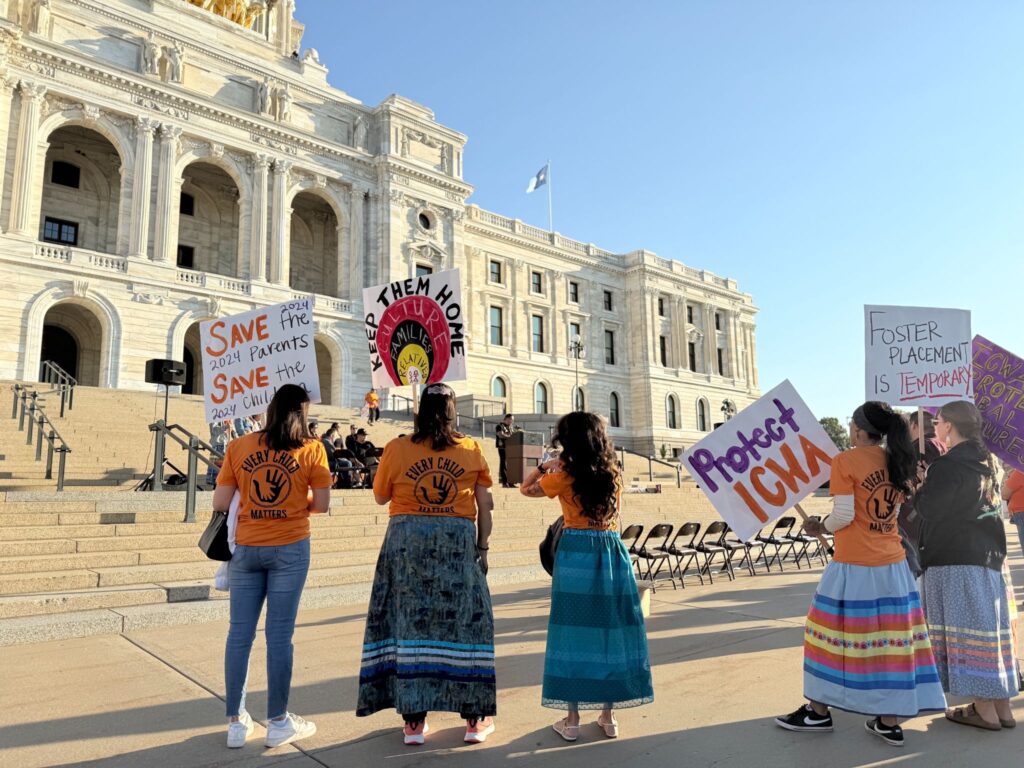
As rally preparations were underway, early arrivals showed their support for ICWA with signs in hand. Photo by Alex Perez.

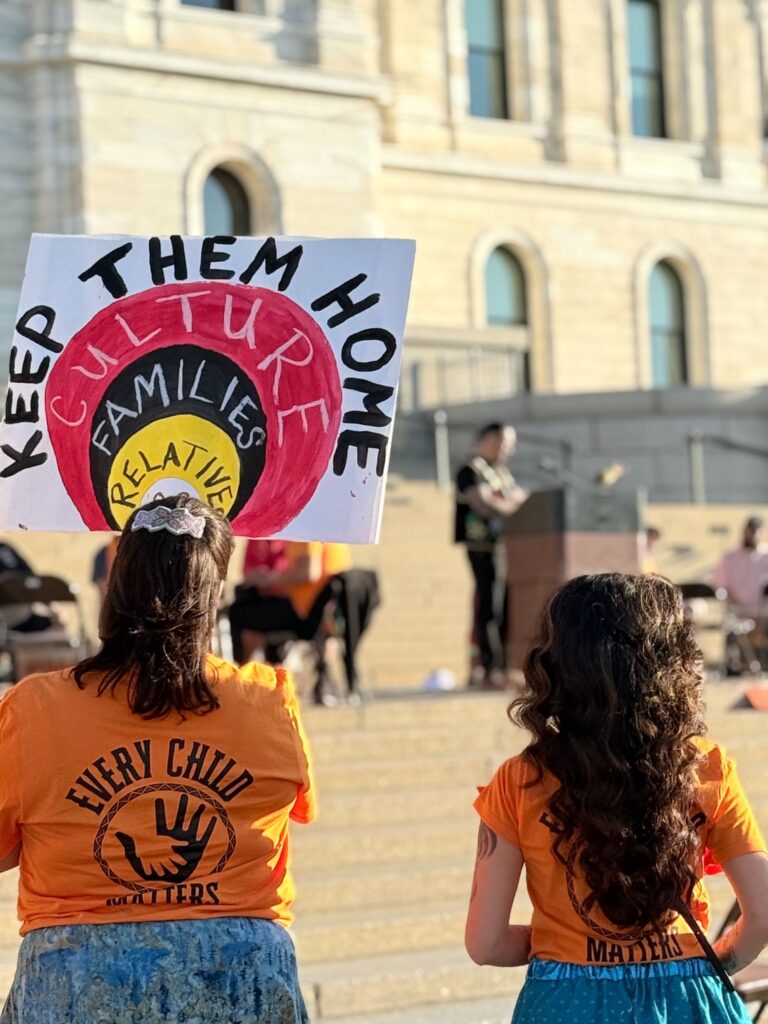
Amid drums, smudging and chants to “bring our children home,” supporters of the Indian Child Welfare Act gathered early this morning outside the Minnesota Capitol building, as the state’s highest court considered the latest legal threat to the bedrock 1978 law. 

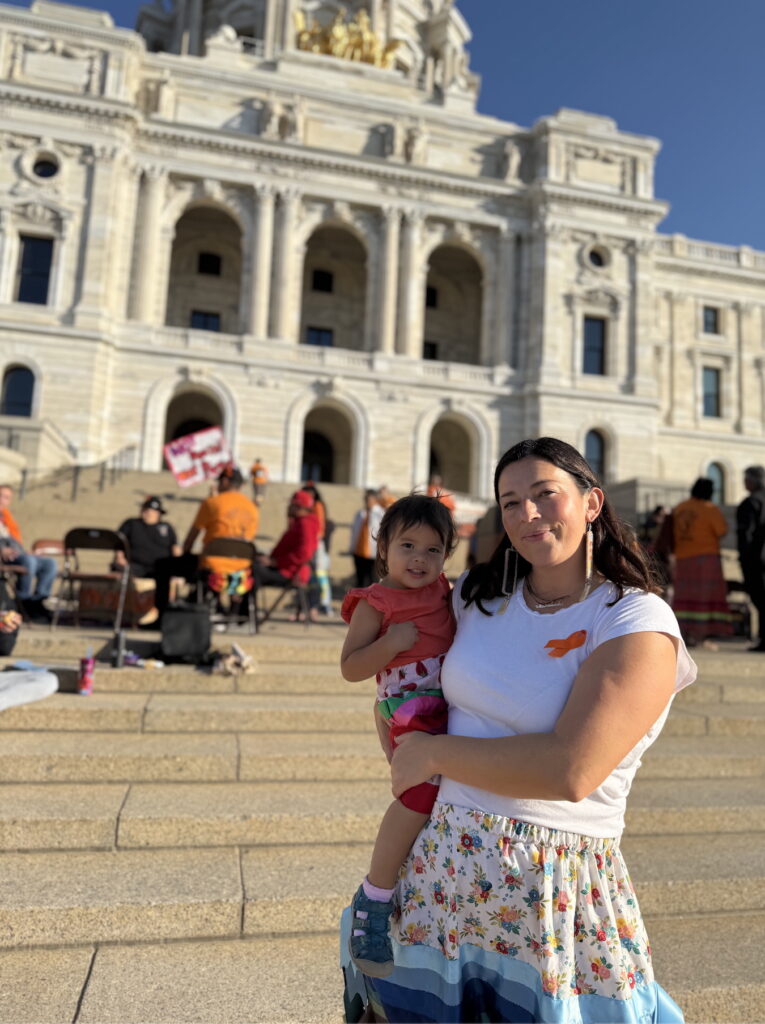
The rally outside the Supreme Court today was deeply personal for Korina Barry, of the Leech Lake Band of Ojibwe. After losing her siblings to foster care, now she worries that her 2-year-old daughter could be taken from her by child welfare workers.

Minnesotans Rally On State Supreme Court Steps to Protest Latest Challenge to the Indian Child Welfare Act
Korina Barry and her daughter joined those rallying in support of the Indian Child Welfare Act and the Minnesota Indian Family Preservation Act. Photo by Alex Perez.

“For me that trauma is very real,” she said. “And that’s why I’m here because we should be pushing back against these attorneys who are challenging ICWA’s constitutionality.”

A crowd of more than 50 people attended what became part celebration, part protest — including state lawmakers, activists, mother-daughter pairs and county workers, some wearing regalia and dancing, others pushing strollers.

“We’re all part of the solution,” state Rep. Heather Keeler, a member of the Yankton Sioux Tribe, told the assembled. “If we’re mad that Native children are getting placed outside of our homes, that means we need more of us to step up — it’s a job for the entire community.”

Keeler, in an orange dress, joined others wearing the color to mark Canada’s Indigenous holiday marking National Day for Truth and Reconciliation, which commemorates survivors of Indian boarding schools and their descendants.

Rose, a young Lakota woman, said she showed up to dance for children “dealing with generational trauma.” Tamra Edwards, who works with Minnesota’s ICWA Guardian Ad Litem program described herself as an “ally,” working “to keep children with their families and relatives.” 

Red Lake Nation case

Inside the Capitol building later that morning, Supreme Court justices heard oral arguments in the case named for parents L.K. and A.S., which centers on two Red Lake Nation foster children. The case is before the state supreme court following a June appeals court ruling.

Plaintiffs Kellie and Nathan Reyelts of Fairmont, a white couple, seek custody of twins who now live with their maternal grandmother.

The Fairmont couple say they should have custody of the twins, who lived with them for more than a year shortly after they were born in 2022. Their legal argument centers on a constitutional challenge to the Indian Child Welfare Act, as well as the local version of the law, the 1985 Minnesota Indian Family Preservation Act, or MIFPA.

The justices did not rule from the bench today. A lower court has already struck down the couple’s claim that the two laws — which seek to ensure the preservation of tribal families — discriminated against them because of their white race.

The Fairmont couple, who have fostered more than 30 children, are represented by the same attorneys who took a similar challenge all the way to the U.S. Supreme Court in the Brackeen v. Haaland case. Thus the case is being closely watched by legal experts across the country.

The Reyelts’ attorney, Mark Fiddler of the Turtle Mountain Band of Chippewa Indians, has devoted much of his legal career to dismantling the 45-year-old ICWA law. In this case — similar to Brackeen v. Haaland — his clients are white foster parents who allege that ICWA’s provisions are discriminatory. In a previous interview, Fiddler said when the twins went to live with their relative, they “were harmed by ICWA by being removed from a loving home where they were thriving.” 

The Reyelts continue to request the children be returned to their custody. Arguing on their behalf alongside Fiddler is attorney Timothy Sandefur, the vice president of legal affairs for Goldwater Institute. The Arizona-based Libertarian think tank has opposed ICWA in more than a dozen cases since 2015. 

They are opposed in court by attorneys for the Red Lake Nation, and the Minnesota Attorney General.

They’re joined by the biological mother of the two children at the center of the case. She is being named only by her initials, L.K., to protect her confidentiality. 

But a statement sent by her attorney Ryan Gustafson reads:

“The Mother wants it to be known that she is grateful for the protections of the Indian Child Welfare Act and the Minnesota Indian Family Preservation Act. She recognizes that these laws have helped her Native community and its children, both in Minnesota and elsewhere.”

Gustafson further stated that “the children’s Mother agrees with her tribe and the state of Minnesota that ICWA and MIFPA are constitutional” and remains opposed to the current attempts to dismantle them. She said remaining with her children’s relatives is in their best interests and they are thriving, even as “this litigation has dragged on.”

In oral arguments, the Minnesota Supreme Court justices queried both sides intently, at times having heated debates during the hour-long proceeding.

Minnesotans Rally On State Supreme Court Steps to Protest Latest Challenge to the Indian Child Welfare Act
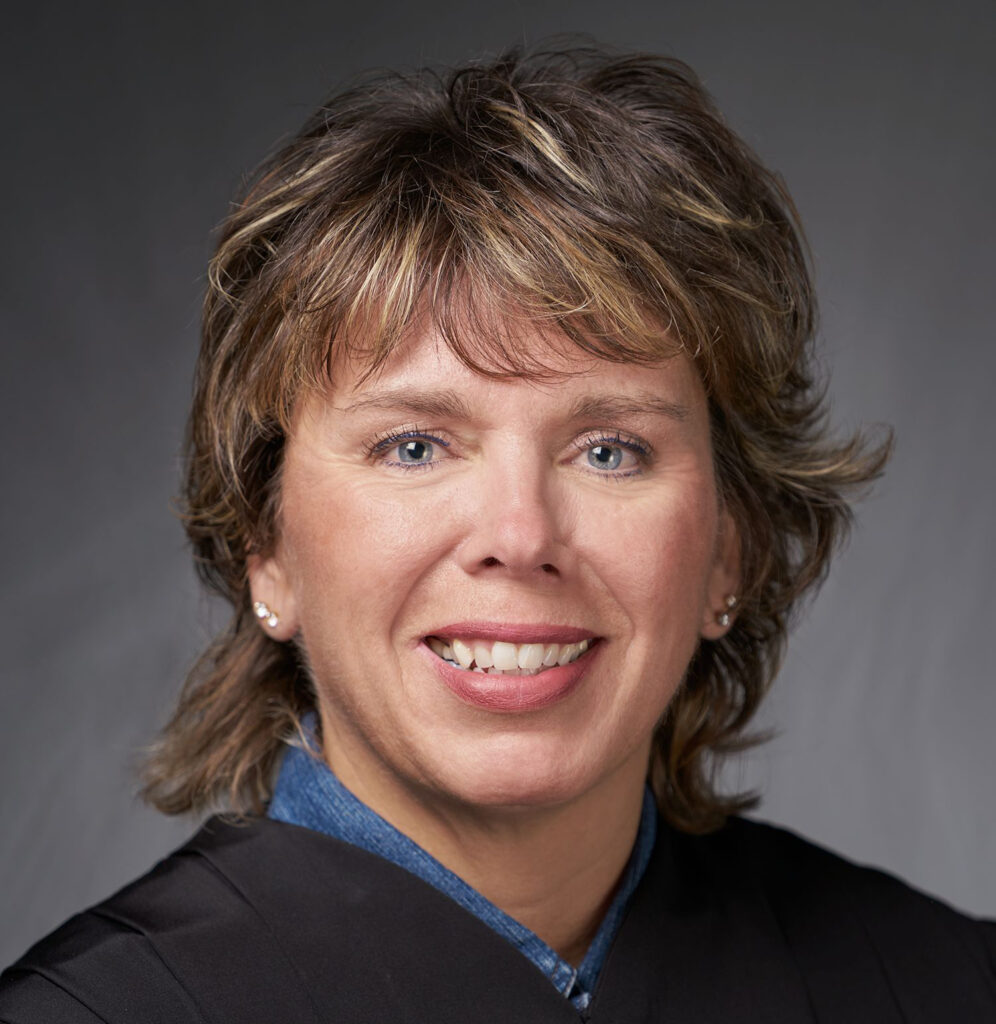
Minnesota Supreme Court Justice Anne McKeig. Provided photo.

Chief Justice Natalie Hudson and Associate Justice Anne McKeig, a descendant of the White Earth Nation, questioned Sandefur on a number of his arguments. There was particular focus on whether his clients, the Reyelts, had “standing” in the case — in essence, whether they had grounds to bring the constitutional issue before the court. 

McKeig wondered aloud whether ICWA opponents had larger aims — and were using the state court as an “avenue to try to get the issue of constitutionality of the Indian Child Welfare Act before the United States Supreme Court.”

The justices also debated why the court should, or could, review the challenge to the U.S. Constitution’s equal protection clause, based on the claim of racial discrimination before the court today. Both ICWA and MIFPA grant special status for people who are members of tribes or who are eligible for membership, not because of their race, but because they are citizens of sovereign nations within this country.

In his opening remarks, Sandefur said due to ICWA and MIFPA, his clients “compete on an unequal playing field when they pursue their custody petition, and they are currently injured because of this pending matter.” He maintained that the laws were based on “biological” and “immutable characteristics determined by the accident of birth.”

Justices Hudson and McKeig repeatedly challenged that assertion.

“Your argument appears ahistorical to me, when you’re talking about federally recognized sovereign tribes,” Chief Justice Hudson said. “There is a history there that we cannot ignore, but I hear you minimizing that history.”

Sandefur shot back: “These children are citizens of the United States and citizens of the state of Minnesota,” Sandefur said, “and they are entitled to the same equal protection rights as all other children.”

Hudson had another quick retort:

“But that undercuts the whole purpose of ICWA,” she said. “What ICWA was all about was because our country had proceeded along a path designed to disrupt the tribes. It’s about the tribes being able to control their future and their children.”

Attorney Joe Plumer, representing Red Lake Nation said that to date, the Reyelts have not been granted standing by lower courts, have been unable to establish any injury, and have not explained how the bench could redress their grievances. 

Like some of the justices, Plumer pointed to the appearance of a larger aim sought by the plaintiffs, one that goes well beyond the best interests of the Red Lake Nation twins.

“We believe the appeal on the constitutionality should be dismissed because it’s not properly before the court,” Plumer said. “This Court’s not in the business of issuing advisory opinions, and that’s exactly what they would be issuing.”

ICWA supporters vow to fight on

Dozens of ICWA supporters who rallied in the early morning on a bright and windy day say they will be watching intently for the state Supreme Court’s decision, which is expected in the coming months.

Rep. Keeler said her Native-rich state continues to be a battleground for opponents of the laws that preserve Indigenous families, and she pointed to the toll that takes.

“Minnesota is a stomping ground for cases against ICWA and it’s just really exhausting and harmful,” Keeler said in an interview. 

Dozens of ICWA supporters rallied today outside the Minnesota state Supreme Court, after Fred Desjarlait led them in prayer. Photo by Alex Perez.

Those who gathered alongside her wore orange to honor Phyllis Webstad, the inspiration behind the “Orange Shirt Day” campaign and ongoing efforts to honor and preserve the legacy of boarding school survivors. Their centuries-long history is closely connected to the forced removal of tribal children into white foster and adoptive homes. 

Webstad’s orange shirt movement is represented by a wound she suffered. Her grandmother gave her an orange shirt to wear on her first day at the Canadian boarding school that she was forced to attend. It was snatched from her the day she arrived. That shirt never made its way back to the family.

Rep. Alicia Kozlowski, who is of Ojibwe descent, and state Sen. Mary Kunesh, who is of Standing Rock Lakota descent, also attended the rally.

“When they come to us and say ICWA and MIFPA are unacceptable, we have to fight back and educate them — it’s not a racial issue,” Sen. Kunesh told the crowd gathered on the Capitol steps. 

Some of the assembled came to honor family members who they’ve lost contact with in the child welfare system, and to reflect on ongoing attempts to erase Indigenous culture. Chairman Faron Jackson of the Leech Lake Band of Ojibwe noted his personal loss.

“My brothers were in foster care — taken away from our families before ICWA was established,” he said. “That law was put in place to keep our families together, learn the language, learn to trap, learn to hunt.”

Now, it’s up to supporters to teach the public on the vital importance of the law, he added.

“We’re going to keep educating and we’re going to talk about things that are important to us — and most of all, we’ll never leave our children behind.”

Oct. 1 correction: This story has been revised to clarify that the twins’ current placement is with their maternal grandmother.

IMPRINT NEWS: https://imprintnews.org/top-stories/minnesotans-rally-as-supreme-court-hears-latest-icwa-challenge/252057

Friday, September 13, 2024

New Law Helps CA Tribes Keep Kids Out of Foster Care | SoCal Matters

Native American children in California's foster care system are frequently placed in non-relative, non-native homes. Although the U.S. Supreme Court upheld the 1978 Indian Child Welfare Act, ensuring child welfare agencies investigate ancestry, contested cases still emerge. This story explores the long-standing issues and the ongoing fight to protect Native foster care rights in California. 

 Learn more at https://bit.ly/3NNzJ4T

Friday, July 26, 2024

Fearless: Veronica Krupnick is a voice for change in New Mexico

Alexandra Wittenberg | Navajo-Hopi Observer


SANTA FE, NM. — On her great-grandmother’s 91st birthday celebration at Jemez Pueblo in April, Veronica Krupnick gave her the news she would be on the ballot for the New Mexico State Senate.

With tear-filled eyes, she looked at Krupnick, hugged her, and then sat her down to eat.

“She went from seeing Native Americans in New Mexico not be able to vote until 1948 to now seeing her great granddaughter on a ballot,” Krupnick said.

Krupnick is 28; her great-grandmother was 24 when Native Americans got the right to vote in the state.

 “If you’re bold enough to dream big and fight for the changes you want to see, you can see that kind of radical turnaround in one person’s lifetime,” Krupnick said. “But you have to feel the fear and do it anyway.”

Though Krupnick lost the Democratic primary election for District 24 in Santa Fe to Linda Trujillo in June, her work in the New Mexico House of Representatives and as a fierce advocate for child welfare has anything but slowed.

“(Running) taught me a lot,” Krupnick said. “This is something that I want to do, maybe not in the near future but down the road. It definitely takes a lot out of you.”

Krupnick said although an estimated 45% of New Mexicans are under the age of 35, they don’t really have representation.

She also thought her expertise in child welfare would fill a much-needed gap in the state, especially with the upcoming retirement of two long-time legislative officials.

“One of the biggest (changes) that could really shift things for child welfare is proactively getting people with experience involved, whether that’s at a local or a state (level),” Krupnick said. “Lived-experience people are going to tell you what works and what doesn’t…I think in child welfare we get really lost in the numbers and the statistics and we forget that there’s people behind them.”

 Krupnick uses her own experience in the foster and adoption systems to try and spark change, and she strives to bring others that have been in the system to use their own voices.

Early life

Krupnick was born in Tuba City, Arizona, to teenage parents. Her biological father is Hopi and she grew up in Moenkopi on the Hopi reservation. Krupnick also has Jemez and Navajo heritage.

“I kind of bounced around to different family members for those first couple of years,” Krupnick said. “My biological parents really struggled with addiction and were involved in the incarceration system and juvenile justice pretty early.”

When she was 4-years-old, Krupnick moved with her mother to Albuquerque to be closer to her mother’s family on the Jemez reservation.

“She was really hoping I think to turn things around … but you know, life doesn’t go according to plan,” Krupnick said.

Krupnick said her mother fell into the drug scene in Albuquerque, and got into legal trouble. By the time Krupnick was 6, her mother was facing charges of child abuse and neglect, and Krupnick was put into the foster care system, going between her mother and a group home at first, until it was determined she would be adopted.

At 7, Krupnick’s younger sister was born to an African American father. Though their mother had family on the Jemez reservation, she was not registered to the tribe. That meant Krupnick had legal kinship placement through her biological father’s Hopi side, but her half-sister had none.

 “That kind of made it complicated,” Krupnick said.

The Indian Child Welfare Act (ICWA) of 1978 mandates that American Indian children should be adopted into American Indian families.

“Our legal case then became a question of, do we come from ICWA because it does apply to me and separate us, or do you keep us together? That’s why (adoption) took about a year, because we had to get my tribe involved.”

Until she was adopted at 10, Krupnick was placed in seven different foster care families, many non-tribal.

Stakeholders helped the girls’ team navigate through the hoops of the adoption process, and it was ultimately decided that Krupnick and her half-sister — who were very close — should be adopted together. However, a Native home that would take them as a package could not be found, so they were adopted into a white family.

“We were adopted and it opened up a whole new wave of different struggles,” Krupnick said. “Those first 10 years were just a struggle to survive, and then after adoption I feel like it was the first time I had processed any of the stuff that had happened before.”

Krupnick said although her adopted parents had the best intentions, she struggled with the disconnect from her culture and the struggle that many transracial adoptees — and regular adoptees —face.

“A lot of times in adoption cases like mine, once an adoption is closed, everything before that day in the child’s life is cut off,” Krupnick said. “Family, friends, schools, pets, home — all of that — it no longer looks the same.”

Krupnick got involved with the juvenile detention system at 14 for petty crimes like theft.

“I was a really angry teenager who kind of had an ‘I don’t know who’s driving’ period of life, (which) is not something uncommon to see in post adoptees,” Krupnick said. “(I was) living off of impulses and harmful decisions.”

At 16, Krupnick ended up at a residential treatment facility in Utah.

“I felt like for the most part, I was kind of given some space to kind of actually heal myself without the pressure (to also) fit into a new family,” Krupnick said. “I think that was what I really needed and I think I really thrived there.”

Krupnick graduated the program in 10 months and moved to a transitional/independent living program nearby before heading to Fort Lewis College in Durango, Colorado.

“I showed up to college with two suitcases and that’s about it,” Krupnick said.

She paid for the majority of her schooling on her own, working as a student ambassador during the day between her classes, and a pharmacy technician at night. She majored in public health with a minor in psychology.

A taste of advocacy

Early on in her college career, Krupnick became a wellness peer advising counselor through a program called eMPAS.

“We focused on suicide and sexual assault prevention, both areas that I have struggled with,” Krupnick said. “(It) gave me a little taste of lived-experience advocacy, which I really enjoyed.”

Krupnick attributes the program to the start of her advocacy career, which started in 2018 with the Court Appointed Special Advocate (CASA) Program and Tewa Women United. She worked for the Casey Family Programs and won a national Casey Excellence for Children Alumni Award this year for her dedication to youth mentorship.

She still volunteers at CASA, now as the vice president on the board of directors, and volunteers on several other boards and programs while maintaining her full-time job as a Leadership Analyst for the New Mexico House of Representatives Majority Leader Representative Gail Chasey.

“I do a little bit of everything,” Krupnick said. “Everything from answering constituent concerns to serving as a child welfare specialist, vetting legislation, setting up meetings with stakeholders, helping with classifiers and going to community meetings.”

Krupnick said during legislative sessions, where she sits as senate liaison, she averages 16 hour days, but she loves the work and staying busy.

Cultural connection


Veronica Krupnick testified for U.S. Secretary of the Interior Deb Haaland’s Supreme Court case, defending the Indian Child Welfare Act, in 2023. (Photo/Veronica Krupnick)

In spring 2023, Krupnick testified nationally during the Haaland vs. Brackeen Supreme Court case, which could have dismantled ICWA, but kept it intact after a 7-2 vote.

“I was using my voice as much as possible; I was speaking at summits, at rallies. I was writing op-ed pieces, all of that good stuff,” Krupnick said. “ICWA definitely became a really big part of my professional life and really I was trying to call the importance of keeping the adopted in Native communities, and in the worst case, if they are adopted outside of them, really working (to make sure) those children have a lifeline back to their culture and their community and those doors are open.”

In 2022, Krupnick played a role in establishing the Indian Family Protection Act (IFPA), New Mexico’s counterpart to the Indian Child Welfare Act (ICWA).

“It has things which the federal law doesn’t and is inclusive of what they call a cultural contract,” Krupnick said. ‘So that’s what is in the adoption decree … essentially saying if you are going to adopt this child from this tribe, this is the plan to keep this child connected to their culture and their connections.”

Krupnick is now helping to set up IFPA courts around the state, and said the first IFPA court has higher rates of success for adoption and foster youth than ICWA.

“I think (IFPA) gives clarity to the adopted parents and I think it gives the adoptee something to stand on,” Krupnick said. “If you are going to adopt this child you are going to take this cultural identity with them.”

Looking back, Krupnick expressed gratitude for the week-long visits to the Hopi reservation that her adoptive parents arranged. During these visits, she volunteered with the Red Feather program to help build houses. These experiences allowed her to form positive connections with other Hopi families and stay connected to her cultural heritage.

“My roots and my culture have been so foundational and so key to my healing that it always kinds of make me wonder — had those not been so distinctive, would it have been something that could have helped me?” she said.

She is now connected to her Hopi and Jemez family excluding her parents. She now has two other younger siblings on her mother’s side and four on her father’s. The half-sister she was adopted with is now 21, and the two are still as close as can be, roommates and dog moms in Santa Fe.

With the small amount of time Krupnick’s not working or volunteering, she relaxes by binging Netflix ‘junk food’ shows like Dancing with the Stars, The Bachelor and Bridgerton.

But she can’t help watching Law and Order and Criminal Minds, too.

“My brain apparently doesn’t like to turn off,” she laughed.


click

Contact Trace

Name

Email *

Message *

NO MORE UPDATES

GO TO:  https://blog.americanindianadoptees.com/  for updates and news. THIS BLOG cannot be updated...