
Experts available to comment ahead of National Day for Truth and Reconciliation
Topics include Indigenous health, preservation of culture and languages, Indigenous history and Indigenous knowledge
Topics include Indigenous health, preservation of culture and languages, Indigenous history and Indigenous knowledge


WARNING: This story contains distressing details
Leah Redcrow never went to residential school but that doesn't mean she escaped its long reach.
Three generations of her family were sent to the Blue Quills residential school in Saddle Lake, a Cree First Nation located 170 kilometres northeast of Edmonton.
Her grandfather survived the institution, but 10 of his siblings did not.
One of those siblings, a seven-year-old girl named Eva, has no burial record.
"She's not even listed as deceased," says Redcrow, executive director of the Acimowin Opaspiw Society, a group investigating the school's history.
Redcrow only learned of Eva's existence during her research. "We don't know where her body is," she says. Like countless other children, Eva simply never came home, vanishing from the historical record.
Correcting that record was a key recommendation of the Truth and Reconciliation Commission (TRC) report when it was released in December 2015.
Such inquiries are now happening across the country, led by Indigenous nations, groups and organizations trying to untangle the dark mysteries left in the wake of Canada's residential school system while providing some clarity and closure for survivors, families and affected communities.
Sept. 30 is the National Day for Truth and Reconciliation, designated in 2021 to recognize the tragic legacy of residential schools. At that time, the commission had documented 4,117 deaths of Indigenous children at residential schools but the actual number could surpass all estimates.
The rate of deaths among children in residential schools was far higher than that of the general school-aged population, and parents were rarely informed about their child's illness, death or burial.
"No one took care to count how many died or to record where they were buried," reads the TRC's final report, summing up the need for and challenges of the ongoing inquiries.
But the first obstacle to that work is the cost.
In 2009, one year after the TRC was established, the commission asked for $1.5 million to perform research work similar to what is now being done. The federal government denied the request.
More than a decade later, in June 2021, the federal government launched a major funding program for groups to perform research. The program, which received criticism for the slow pace at which money has gone out the door, has been funded through the first quarter of 2025.
As of Sept. 25, 150 applications had been received, with 117 approved for a total of $160 million, according to a statement from Crown-Indigenous Relations and Northern Affairs Canada.
Of those not approved, three projects were deemed ineligible, two not recommended for funding, three applications were withdrawn, and one application was redirected to another funding program. The remainder are still under assessment.
Several provinces have also provided similar funding, including Ontario, British Columbia and Saskatchewan.
The Alberta government announced its program in 2021. The $8-million fund was created to provide grants to Indigenous communities and groups conducting research into deaths at residential school sites. Funding was capped at $150,000 for proposals from individual groups, with no cap for joint submissions.
According to a spokesperson for Indigenous Relations, the province approved grants from 43 different Indigenous communities or organizations, paying out all $8 million in the 2021/2022 fiscal year.
Redcrow's grandfather, Stanley Redcrow, went on to lead a sit-in at Blue Quills Residential School, forcing the federal government to the negotiating table and ultimately transferring the school to First Nations' control in 1971.
Perhaps drawing on that hard-nosed heritage, Leah Redcrow, alongside survivors with the Acimowin Opaspiw Society, negotiated with the federal government to move from its initial offer of $300,000 to an eventual $1.1 million.
"They're tough negotiators," Redcrow says of the survivors, with a laugh. "They kept rejecting and rejecting and rejecting."

Asked about those negotiations, a spokesperson for Crown-Indigenous Relations and Northern Affairs Canada said in a statement that "the Acimowin Opaspiw Society and the departmental program officer responsible for the file clarified the proposal's objectives, activities and budget and they were able to agree on a funding amount that supported those activities and objectives."
After writing a preliminary report detailing progress, particularly with church records, the group received additional money. The almost-$6.4 million allocated to the society over four years is the most of any Alberta group, and the fourth-highest nationally.
The funding is crucial because costs for groups doing historical research are considerable — and over multiple years, things start to get pricey.
There are wages for staff, such as a project manager and investigators, document translation and office expenses. There are costs associated with the work of commemoration, community engagement or interviews with elders, sometimes including travel expenses.
And then there's the specialized work, like the ground-penetrating radar (GPR) used to detect anomalies consistent with unmarked graves.
The use of GPR has resulted in headline-grabbing finds that fixed the national gaze on the human toll of residential schools, even if they only served to confirm what was already known.
The May 2021 news of 215 potential unmarked graves at the Kamloops Indian Residential School on Tk'emlúps te Secwépemc First Nation made international news, marking something of a turning point in the use of the technology at former residential school sites.
"I do think the announcement from Tk'emlúps resonated nationally and internationally in a way that we had never seen before," says Kisha Supernant, director of the Institute of Prairie and Indigenous Archaeology at the University of Alberta.
"Even when other kinds of related issues have been raised — even after the Truth and Reconciliation Commission or the whole chapter on the missing children — we hadn't seen this kind of resonance and the response of non-Indigenous people, especially in Canada."
While other organizations do GPR in this context, Supernant has become one of its most prominent practitioners in Canada. She says that she and her team have done work at 12 former school sites, held over 20 engagement sessions with interested communities, and had more than 50 nations and other groups reach out about residential school searches.

Supernant says GPR has to be used in concert with other information, like archival research or oral histories, in order to identify possible unmarked graves of children. The many discovery announcements that followed Tk'emlúps — including at Cowesses, Star Blanket Cree, Blue Quills and elsewhere — and the ensuring swirl of news coverage contributed to false expectations of what GPR can do. As Supernant notes, there were often years of work behind those announcements.
The significance of those discoveries are often mischaracterized.
It has long been known that the residential school system, which ended in 1997 after more than a century, resulted in significant numbers of deaths and disappeared children. The oral histories of Indigenous communities affected by residential schools are rife with stories of children who were taken and never returned home. Records from schools or parishes, while often spotty, also bear testament to these disappearances and deaths.
"We don't need to find them to know children died in the thousands. We have extensive records of that," Supernant says. "What we're trying to do is find specific locations and provide additional information for communities who want to investigate further."
What's crucial, according to those involved in this work, is that the communities are in control, determining what work needs to be done and how best to do it.
Governments have provided funding within a fairly broad set of parameters, but local groups have been left to determine their path forward, often with survivors leading the way.
"My big worry at this point is that people will stop paying attention," says Supernant. "And once that attention is no longer paid, what will happen to the funding? What will happen to the supports?"
In St. Albert, Alta., a city on the northwest edge of Edmonton, the St. Albert-Sturgeon County Métis Local are part of a collaborative inquiry with multiple First Nations and Innu groups affected by the Youville residential school.
Archie Arcand, president of the local, says the work is important and overdue for communities.
It's also an opportunity to help others better understand what the residential school system has wrought in human terms.
Arcand recalls a story he was told.
"In this particular instance, they'd go by boat along the river. There was an RCMP [member] in the boat and the person from the residential school. They'd stop at a community, isolated community, and they'd pick up kids. No choice, gotta come," he says. "I put myself in the place of those people and say, holy moly. How would you react?"
He adds: "You can understand why there's so much trauma."
A national Indian Residential School Crisis Line is available to provide support for survivors and those affected. People can access emotional and crisis referral services by calling the 24-hour service at 1-866-925-4419.
Mental health counselling and crisis support is also available 24 hours a day, seven days a week through the Hope for Wellness hotline at 1-855-242-3310 or by online chat.
little kids... ah the horror they suffer
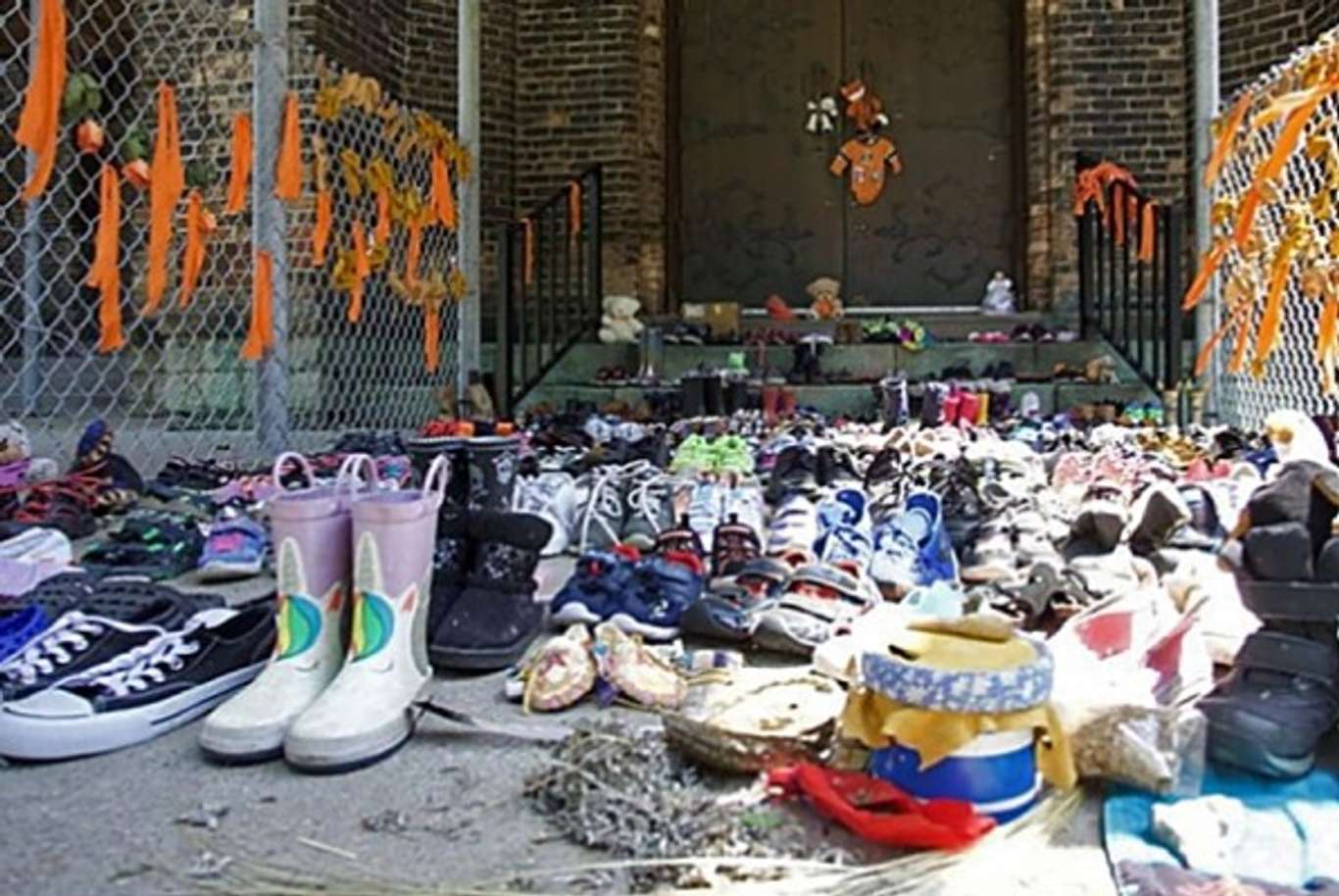 |
| Shoes left at Assumption Church on July 9, 2021 (Photo courtesy of the University of Windsor) |
Orange Shirt Day honours the story of Phyllis (Jack) Webstad, a residential school survivor, who wore a bright orange shirt on her first day of school. The shirt was a gift from her grandmother. It was taken from the six-year-old but became a symbol of remembrance for all Indigenous children who were forced to attend the schools where Indigenous language and culture were repressed, and many suffered abuse.
The National Day for Truth and Reconciliation is a call to action for all levels of government, institutions and Canadians to consider how the Indigenous were and continue to be treated in Canada. It came out of the Truth and Reconciliation Commission, which chronicled the experiences of residential school survivors.

September 11, 2023
September 30 is the National Day for Truth and Reconciliation in Canada. It is a time to recognize and commemorate the intergenerational harm that residential schools caused to Indigenous families and communities, and to honour those who have been affected by this injustice.
We urge our members, staff and allies to take this opportunity to learn about, and reflect on, our past and how we can meaningfully participate in reconciliation in Canada.
The Truth and Reconciliation Commission ran from 2008 to 2015, providing those directly or indirectly affected by the legacy of the Indian Residential Schools policy with an opportunity to share their stories and experiences. The Commission released its final report detailing 94 calls to action. The National Day for Truth and Reconciliation responds to Call to Action 80 from the Truth and Reconciliation Commission of Canada: Calls to Action, which reads:
80. We call upon the federal government, in collaboration with Aboriginal peoples, to establish, as a statutory holiday, a National Day for Truth and Reconciliation to honour Survivors, their families, and communities, and ensure that public commemoration of the history and legacy of residential schools remains a vital component of the reconciliation process.
The National Centre for Truth and Reconciliation (NCTR) has become the permanent archive for the statements, documents and other materials the Commission gathered, and its library and collections are the foundation for ongoing learning and research.
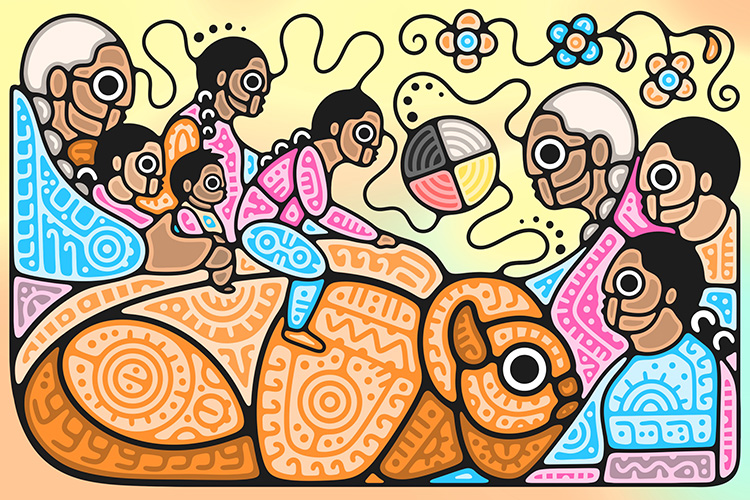 Our 2023 National Day for Truth and Reconciliation artwork was created by Anishinaabe Onyota’a:ka artist, Tsista Kennedy (https://hotdogwaterart.com/.)
When I first read the theme of "healing and care", as well as the theme of "remembering the children" being worked into this art, the image of this first draft immediately came to mind.
The bison is a common image I use in my artwork, and I often use it to portray healing, resiliency, and strength, and wellness. When the buffalo were brought to near extinction, we as Indigenous people struggled due to our diverse relationships with these animals, and the nourishment, shelter, and tools they provided us. Since colonization began, both the bison and we as Indigenous people have maintained our strength and resiliency, and now we both are growing in numbers once again. Because of this, I wanted the bison to be a place for the past generations, the children and elders, to rest upon.
The elder and children on the bison fit the theme of "remembering the children", but also represent the children and elders of the present day who will pass on and receive the traditional knowledge our ancestors succeeded in passing down to us. The individuals on the far right looking at these children and the elder represent those that support the children and the elders in any way they can, ensuring that they are doing their part in the passing down of our culture, wellbeing, and way of life. This is all connected by a medicine wheel, and some floral patterns in the top right corner, which to me represents new life, and continuity.
Tsista Kennedy, Anishinaabe Onyota’a:ka artist
Orange Shirt Day is a legacy of the St. Joseph Mission (SJM) Residential School (1891-1981) Commemoration Project and Reunion events that took place in Williams Lake, BC, Canada, in May 2013. The events were designed to commemorate the residential school experience, to witness and honour the healing journey of the survivors and their families, and to commit to the ongoing process of reconciliation.
Each year on September 30, people across Canada wear orange shirts to raise awareness of, and start a conversation around, the history and legacies of the residential school system in Canada. Watch the video at right to learn more about how Orange Shirt Day came to be and to listen to Phyllis Webstad's story.

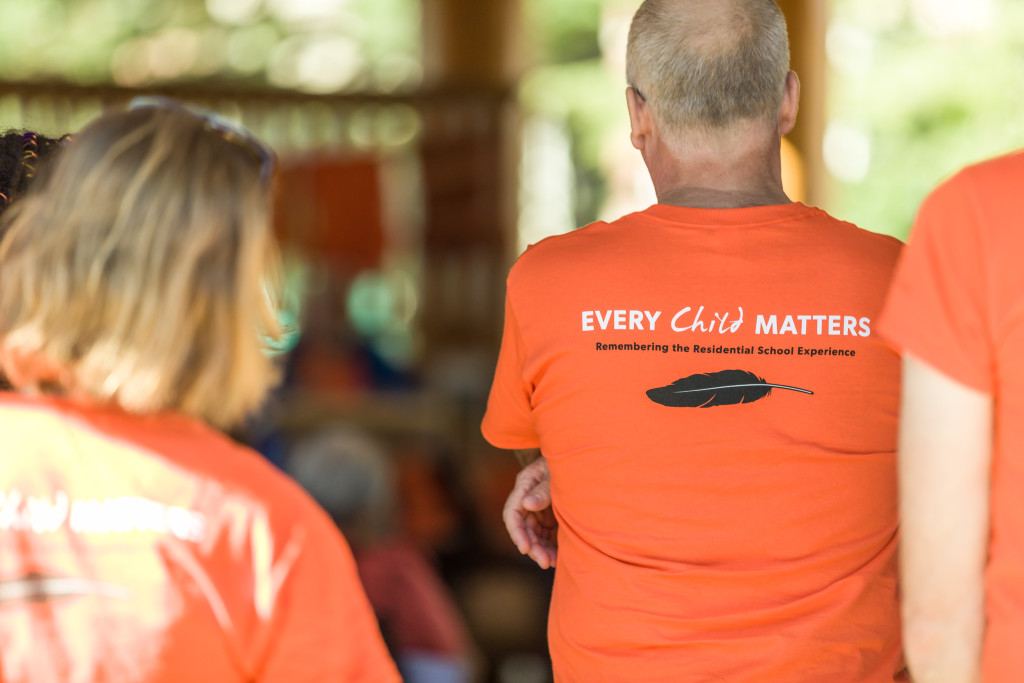
Camosun encourages students to wear an orange shirt on Sept. 29 and 30, and to take the time to learn and reflect as an act of reconciliation.
“Orange Shirt Day is an important day to honour Indian residential school survivors, as well as those who didn’t survive or died, often, young and tragically as a result of the horrors they experienced in these schools,” says Ruth Lyall, Chair of Indigenous programs at Eye? Sqa’lewen: The Centre for Indigenous Education & Community Connections (IECC) and Orange Shirt Day spokesperson.
Elder Dr. Barney Williams, Nuu-chah-nulth Nation from the Tla-o-qui-aht First Nation, will be emceeing the gathering. Hosted by Eye? Sqa’lewen, the event will include invited guests from Quilts for Survivors, a poetry reading by Beth Mills, as well as drumming and music.

from unlearn.com
Wawa, Ontario | September 30th – Orange Shirt Day has been recognized by the Federal Government as the National Day for Truth and Reconciliation, a new statutory holiday. The Truth and Reconciliation Call to Action #80 states that the federal government will work with Indigenous people to establish a statutory day to “honour Survivors, their families, and communities, and ensure that public commemoration of the history and legacy of residential schools remains a vital component of the reconciliation process”. There are 94 Calls to Action.
In Wawa, the Town Hall and all municipal facilities will be closed and staff is encouraged to continue to expand their education as part of their individual reconciliation efforts.
Municipal Council notes that anyone who is interested in developing a better understanding can visit the Truth and Reconciliation Commission of Canada’s website, or use the Libby App to access digital books by Indigenous authors, such as “21 Things You May Not Know About the Indian Act” by Robert P.C. Joseph.
Other books that residents may find educating are:
Residents may wish to visit these two websites:
A new broadcast special, National Day for Truth and Reconciliation, in partnership with APTN, CBC/Radio-Canada, Insight Productions and Canadian Heritage. In recognition of the new federal statutory holiday, also known as Orange Shirt Day, this unique one-hour, commercial-free primetime special honours the stories and perspectives of Indigenous Peoples affected by the tragedies of the residential school system in Canada, with musical tributes and ceremonies in Indigenous communities across the land. National Day for Truth and Reconciliation will broadcast and stream live Thursday, September 30 at 8 p.m. ET on APTN, CBC, CBC Gem, ICI TÉLÉ and ICI TOU.TV.
Additionally, the Wawa Goose Monument will be illuminated in orange on September 30th, to honour survivors of residential schools, along with their families and communities.
“Council has prioritized relationship building with our Indigenous neighbours,” said Mayor Rody. “We will continue to work with local Indigenous leaders to best determine how we can support their efforts and find opportunities to learn and highlight the First Nation roots of the community. Thank you to municipal staff for having the orange lights illuminating the Wawa Goose in honour and recognition of the residential school survivors and their families on September 30th. This is only a small part of recognition, and we have much more work to do.”
In June, the federal government passed legislation recognizing Sept. 30 as a federal holiday, a paid day off for federal workers and employees in federally regulated workplaces. On Sept. 9, the Ontario government confirmed that the day will not be a holiday for the province.
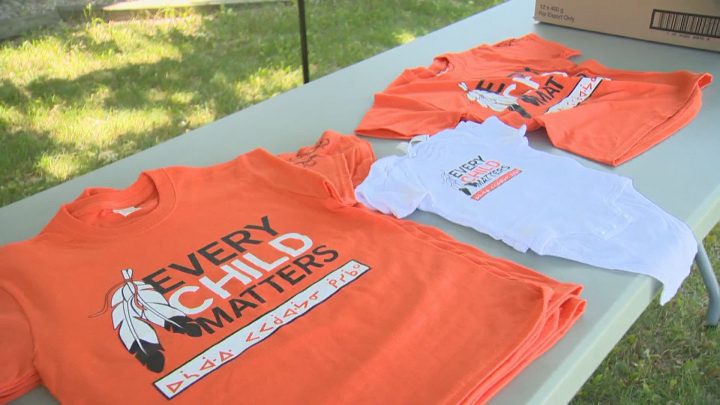 |
| For the first time, Sept. 30 will mark the National Day for Truth and Reconciliation. Files / Global News |
In June, Ottawa declared it a federal statutory holiday that is meant to give public servants an opportunity to recognize the legacy of residential schools.


