BLOGGER changed, not allowing us to UPDATE this back-up blog

(UPDATED 726/2025) issues with blogger are preventing this
Showing posts with label Indigenous children. Show all posts

Saturday, June 19, 2021

$10M not enough for uncovering all unmarked graves in Ontario


The Chief of the Association Of Iroquois & Allied Indians said that while Ontario’s $10-million announcement is a good start, it’s a small portion of what is needed to uncover all the unmarked graves at residential schools.“It’s a good gesture for sure, and it’s going to be appreciated, but the reality is the amounts the federal and provincial governments have put in are going to be a drop in the bucket as to what will be needed,” said Grand Chief Joel Abram.

On Tuesday morning, the Ford government announced $10 million in funding over the next three years to help identify and commemorate unmarked burial sites at former residential schools.

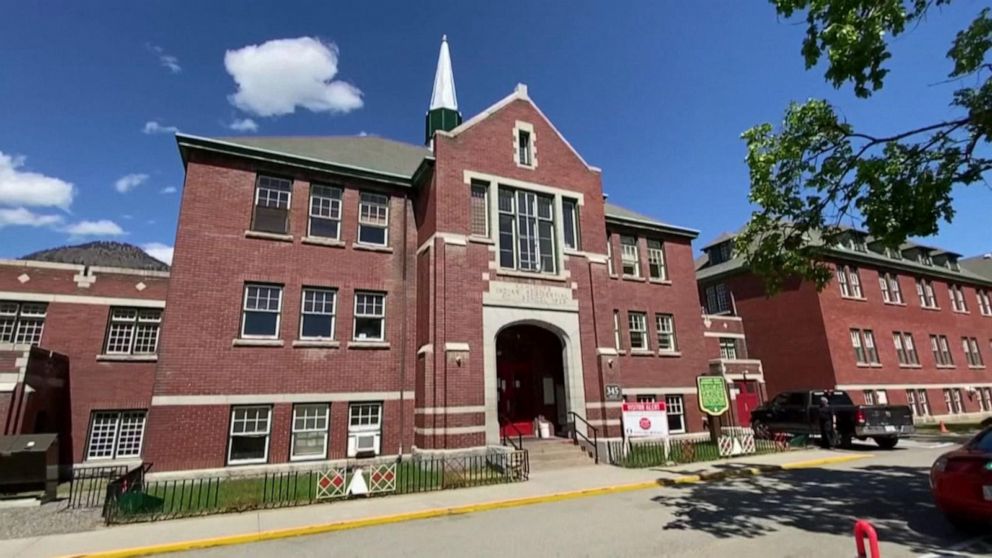
This announcement comes in the wake of the discovery of the remains of 215 children in unmarked graves at the former Kamloops residential school.The graves have lead to calls for action investigations on the grounds of all residential schools across the county.

Source: Southern Ontario Chiefs say $10M not enough for uncovering all unmarked graves | Globalnews.ca


Sunday, June 6, 2021

TRC requested $1.5M to find graves at residential schools. The feds denied the money in 2009

 continuing news...

Canadian Prime Minister Justin Trudeau says it’s not an isolated incident that over 200 children were found buried at a former Indigenous residential school

READ: Canada: Bodies at Indigenous school not isolated incident


In 2009, the TRC asked the federal government to help fund investigating the location of gravesites where residential students are believed to be buried. The request was denied.

Read more: Work underway for forensics experts to identify and repatriate B.C. school remains

...She said she had visited schoolyard cemeteries across Canada in an attempt to find where missing children were buried. But the process of finding the unmarked graves was slow because the “TRC suffers from a chronic lack of funding.”

“That second step of doing the ground-penetrating radar is not something that we’re funded to do,” she told the media outlet. “There are approximately 140 schools on the list now. … There will be probably as many cemeteries as there are schools and in five years we just don’t have the time to do an in-depth investigation of each one of them.”

Cindy Blackstock, executive director of the First Nations Child & Family Caring Society, told Global News that the underfunding of Indigenous projects, like the missing Children Project, is repeated in history.

“They’re making a conscious choice that these kids are not worth the money,” she said. “Like these inequalities, like water, etc., like they were always complaining, ‘Oh, well, we don’t have the money,’ therefore, the default is, ‘We’re going to racially discriminate against children as fiscal policy.'”

Under the TRC, there are six proposals for the Missing Children Project.

Click to play video: 'Mary Ellen Turpel-Lafond on B.C.’s residential schools'
Mary Ellen Turpel-Lafond on B.C.’s residential schools – May 29, 2021
 Among them is a call for former residential school students to establish an online registry of residential school cemeteries, including, plot maps showing the location of deceased children.

According to the Crown-Indigenous Relations and Northern Affairs Canada website, the 2019 federal budget announced $33.8 million over three years to develop and maintain the National Residential School Student Death Register and help maintain an online registry of residential school cemeteries.

Morton argues more needs to be done to help Indigenous communities find the unmarked graves, as there may be many more sites across Canada.

The same survey techniques used in Kamloops — such as the use of ground-penetrating radar to detect bodies — are needed, she said, as well as funds to access archival research, like residential schools survivor stories and archives from the churches or provinces.

“The research components have a cost associated, but the actual physical work of searching the grounds itself would also have a cost component,” she said.

READ: TRC requested $1.5M to find graves at residential schools. The feds denied the money in 2009 | Globalnews.ca


Tuesday, March 29, 2011

Colonizer and Assimilation (great quotes)

Kenn Richard, director of Native Child and Family Services of Toronto, and the man who commissioned the “Our Way Home” report:

“British colonialism has a certain process and formula, and it’s been applied around the world with different populations, often Indigenous populations, in different countries that they choose to colonize,” says Richard. “And that is to make people into good little Englishmen. Because the best ally you have is someone just like you. One of the ones you hear most about is obviously the residential schools, and residential schools have gotten considerable media attention over the past decade or so. And so it should, because it had a dramatic impact that we’re still feeling today. But child welfare to a large extent picked up where residential schools left off....

“The lesser-known story is the child welfare story and its assimilationist program. And you have to remember that none of this was written down as policy: ‘We’ll assimilate Aboriginal kids openly through the residential schools. And after we close the residential schools we’ll quietly pick it up with child welfare.’ It was never written down. But it was an organic process, part of the colonial process in general.”

"...Even now, researchers trying to determine exactly how many Aboriginal children were removed from their families during the 60s Scoop say the task is all but impossible because adoption records from the ‘60s and ‘70s rarely indicated Aboriginal status (as they are now required to).

Those records which are complete, however, suggest the adoption of native children by non-native families was pervasive, at least in Northern Ontario and Manitoba. In her March, 1999 report, “Our Way Home: A Report to the Aboriginal Healing and Wellness Strategy on the Repatriation of Aboriginal People Removed by the Child Welfare System,” author Janet Budgell notes that in the Kenora region in 1981, “a staggering 85 percent of the children in care were First Nations children, although First Nations people made up only 25 percent of the population. The number of First Nations children adopted by non-First Nations parents increased fivefold from the early 1960s to the late 1970s. Non-First Nations families accounted for 78 per cent of the adoptions of First Nations children.”

Quote from news article: STOLEN NATION (article posted on this blog! use google to find it)

[Child welfare is (in fact) the permanent and closed adoptions of North American Indian Children by non-Indian parents... these quotes are from my archives... Trace]

Alaska tribes win adoption court case

Alaska tribes win adoption court case: "FAIRBANKS — The Alaska Supreme Court has ruled that tribes share jurisdiction with the state in most child custody issues, providing the second major victory for tribal sovereignty advocates..."

click

Contact Trace

Name

Email *

Message *

NO MORE UPDATES

GO TO:  https://blog.americanindianadoptees.com/  for updates and news. THIS BLOG cannot be updated...