I don't know about you but I saw this coming - that the Truth and Reconciliation (TRC) in Canada would end with money paid to victims. Canada is first. Will America be next? Or Australia?... Blog Editor TLH
The Canadian government announced
Tuesday that it had reached what it called the largest settlement in
Canada’s history, paying $31.5 billion to fix the nation’s
discriminatory child welfare system and compensate the Indigenous people
harmed by it.
For those who were following this case, it involves the First Nations
Child and Family Caring Society, which is led by Cindy Blackstock. The
settlement attempts to reform Child and Family Services and address Jordan’s Principle. This is a major settlement and significant milestone for Native children and families in Canada.
Stephen Bronstein was suspended for one month and fined $4,000 after admitting to mishandling the cases of Sixties Scoop survivors. A
First Nation in B.C.’s Cariboo region is condemning the B.C. Law
Society’s handling of a Vancouver lawyer’s mishandling of residential
school survivor cases.
Bronstein was fined $4,000 after admitting
to mishandling the cases of residential school survivors. He was also
barred from acting as counsel for any ’60s Scoop claimants in the
future.
The
’60s Scoop was a large-scale program that allowed child welfare
organizations to remove Indigenous children from their families and
place them in the foster care system and allow them to be adopted by
white families.
The
Tŝilhqot’in Nation on Wednesday condemned the law society for not
adequately punishing Bronstein, noting that many of his clients were
from the First Nation.
The bill codifies provisions from the federal Indian Child Welfare Act in state law and will ensure that Oregon's practices better serve Indian children, ...
Phyllis Webstad was 6 years old when the new orange shirt she chose for
her 1st day of school was stripped off her back. It was the early 70s
& she was the 3rd generation to attend St. Joseph’s Residential
School in Williams Lake, BC.
While the suggestion is daunting, the 53-year-old member of the
Stswecem’c Xgat’tem First Nation said she cannot help but think about a
picture of a bridge hanging on her living room wall that her Aunt Agnes
Jack purchased at a yard sale.
“The bridge is woven together with rope and tree roots,” she said.
“It’s not pretty, it’s not perfect, but it’s enough that you could walk
across it.”
Webstad said she keeps thinking about that.
“That’s been my life it seems because I grew up on the reserve, I’m
half Secwepemc, I’m half white and I have lighter skin so I’ve been more
readily accepted in the non-Indigenous community and I’ve been able to
be a bridge builder or gap person.”
She described the time period since the announcement confirming the
remains of 215 children buried at the former Kamloops Indian Residential
School as a whirlwind.
Webstad’s mom Rose Wilson gave birth to her in July 1967 at her grandmother Lena Jack’s home in Dog Creek. She found her birth father in Kamloops a few years ago. “I have eight other siblings, one passed away, so there are seven. They all live in Kamloops.”
Tom McMahon is former general counsel of
the Truth and Reconciliation Commission, former executive secretary of
the Manitoba Aboriginal Justice Inquiry and former senior counsel at
Elections Canada.
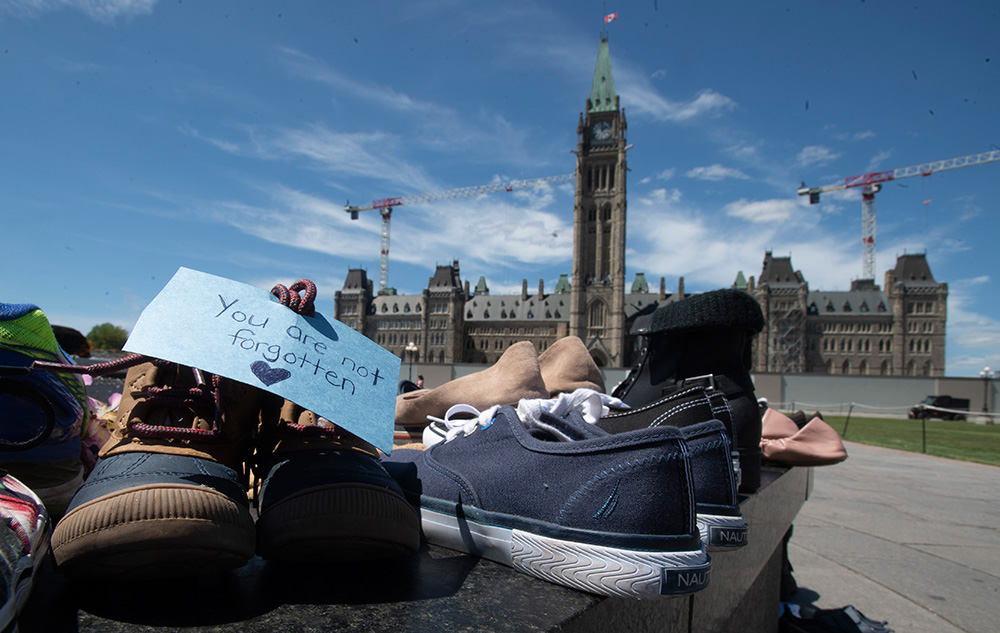
Shoes placed near Parliament Hill in
recognition of the discovery of children’s remains at the former
Kamloops Indian Residential School. Why are there still no public
monuments honouring these children, as the Truth and Reconciliation
Commission has called for?
Photo by Adrian Wyld, the Canadian Press.
As we all struggle with the
news of 215 Indigenous children found in a Kamloops graveyard, many are
demanding that the Canadian government finally implement the Truth and
Reconciliation Commission’s 94 Calls to Action.
I was general legal counsel to the TRC and previously executive
secretary to the Manitoba Aboriginal Justice Inquiry, both under the
direction of Murray Sinclair and the other commissioners.
Some media have noted
that five of six Calls to Action relevant to these children have yet to
be fulfilled. But there are other calls that matter, and failing to
name them hurts our ability to hold the government to account. The media
needs to get this right.
(And when the government says that some of
these Calls to Action are “in progress,” do not believe it. It has been
six years since the commission finished its work. When does “progress”
become “completed”? Those of us who have worked in government and seen
replies to various reports know that “in progress” means the government
does not intend to implement the recommendation but is trying to figure
out a way to get credit for having done so.)
I want to highlight two of the TRC Calls to
Action in particular: 81 and 82. Every time there’s an article about
missing children, about a John A. Macdonald statue, about a Hector-Louis
Langevin place name, and every time I see an article about a new monument for Canada’s dead soldiers in Afghanistan or the victims of communism, or a new parliamentary statement about a foreign genocide, I look to see if the news articles mention those two Calls to Action about Indian Residential Schools.
They never do. Why is that?
81. We call
upon the federal government, in collaboration with Survivors and their
organizations, and other parties to the Settlement Agreement, to
commission and install a publicly accessible, highly visible,
Residential Schools National Monument in the city of Ottawa to honour
Survivors and all the children who were lost to their families and
communities.
82. We call upon provincial
and territorial governments, in collaboration with Survivors and their
organizations, and other parties to the Settlement Agreement, to
commission and install a publicly accessible, highly visible,
Residential Schools Monument in each capital city to honour Survivors
and all the children who were lost to their families and communities.
Why do I care about TRC Calls to Action 81 and 82? It’s empty symbolism, right?
I care because I see them as being such an
easy, inexpensive thing to do. I see 81 and 82 as a litmus test for our
governments. If you’re not even willing to do this simple thing, what
does it say about your sincerity, honour, goodwill and credibility on
the other Calls to Action?
I care because our current monuments and
place names and flags are such “in-your-face” and “rub-your-nose-in-it”
strutting examples of colonialism and white supremacy. Canada
desperately needs balance and diversity in our public symbols. We
desperately need some historical accuracy.
I care because national and provincial
public monuments would be a daily public statement that we remember,
that we accept the truth of what we have heard and that we commit
ourselves to be better.
I care because we create monuments to
ourselves and our ancestors all the time. The lack of balance in
monuments for other Canadians is a painful reminder of who we value and
who we don’t value.
I care because the purpose of Calls to
Action 81 and 82 is “to honour Survivors and all the children who were
lost to their families and communities.” Who could be opposed to that?
Here are other Calls to Action that are relevant to the missing children.
67. We call upon the
federal government to provide funding to the Canadian Museums
Association to undertake, in collaboration with Aboriginal peoples, a
national review of museum policies and best practices to determine the
level of compliance with the United Nations Declaration on the Rights of
Indigenous Peoples and to make recommendations.
68. We call upon the
federal government, in collaboration with Aboriginal peoples and the
Canadian Museums Association, to mark the 150th anniversary of Canadian
Confederation in 2017, by establishing a dedicated national funding
program for commemoration projects on the theme of reconciliation.
69. We call upon Library and Archives Canada to:
i) Fully adopt and implement the United
Nations Declaration on the Rights of Indigenous Peoples and the United
Nations Joinet-Orentlicher Principles, as related to Aboriginal peoples’
inalienable right to know the truth about what happened and why, with
regard to human rights violations committed against them in residential
schools.
ii) Ensure that its record holdings related to residential schools are accessible to the public.
iii) Commit more resources to its public education materials and programming on residential schools.
70. We call upon the
federal government to provide funding to the Canadian Association of
Archivists to undertake, in collaboration with Aboriginal peoples, a
national review of archival policies and best practices to:
i) Determine the level of compliance with
the United Nations Declaration on the Rights of Indigenous Peoples and
the United Nations Joinet-Orentlicher Principles, as related to
Aboriginal peoples’ inalienable right to know the truth about what
happened and why, with regard to human rights violations committed
against them in the residential schools.
ii) Produce a report with recommendations
for full implementation of these international mechanisms as a
reconciliation framework for Canadian archives.
77. We call upon
provincial, territorial, municipal and community archives to work
collaboratively with the National Centre for Truth and Reconciliation to
identify and collect copies of all records relevant to the history and
legacy of the residential school system, and to provide these to the
National Centre for Truth and Reconciliation.
79. We call upon the
federal government, in collaboration with Survivors, Aboriginal
organizations and the arts community, to develop a reconciliation
framework for Canadian heritage and commemoration. This would include,
but not be limited to:
i) Amending the Historic Sites and
Monuments Act to include First Nations, Inuit and Métis representation
on the Historic Sites and Monuments Board of Canada and its Secretariat.
ii) Revising the policies, criteria and
practices of the National Program of Historical Commemoration to
integrate Indigenous history, heritage values, and memory practices into
Canada’s national heritage and history.
iii) Developing and maintaining a national
heritage plan and strategy for commemorating residential school sites,
the history and legacy of residential schools and the contributions of
Aboriginal Peoples to Canada’s history.
Here is what the media is reporting as being the only Calls to Action relevant to missing children.
71. We call upon all chief
coroners and provincial vital statistics agencies that have not provided
to the Truth and Reconciliation Commission of Canada their records on
the deaths of Aboriginal children in the care of residential school
authorities to make these documents available to the National Centre for
Truth and Reconciliation.
72. We call upon the
federal government to allocate sufficient resources to the National
Centre for Truth and Reconciliation to allow it to develop and maintain
the National Residential School Student Death Register established by
the Truth and Reconciliation Commission of Canada.
73. We call upon the
federal government to work with churches, Aboriginal communities, and
former residential school students to establish and maintain an online
registry of residential school cemeteries, including, where possible,
plot maps showing the location of deceased residential school children.
74. We call upon the
federal government to work with the churches and Aboriginal community
leaders to inform the families of children who died at residential
schools of the child’s burial location, and to respond to families’
wishes for appropriate commemoration ceremonies and markers, and
reburial in home communities where requested.
75. We call upon the
federal government to work with provincial, territorial, and municipal
governments, churches, Aboriginal communities, former residential school
students, and current landowners to develop and implement strategies
and procedures for the ongoing identification, documentation,
maintenance, commemoration, and protection of residential school
cemeteries or other sites at which residential school children were
buried. This is to include the provision of appropriate memorial
ceremonies and commemorative markers to honour the deceased children.
76. We call upon the
parties engaged in the work of documenting, maintaining, commemorating,
and protecting residential school cemeteries to adopt strategies in
accordance with the following principles:
1. The Aboriginal community most affected shall lead the development of such strategies.
2. Information shall be sought from
residential school Survivors and other Knowledge Keepers in the
development of such strategies.
3. Aboriginal protocols shall be respected
before any potentially invasive technical inspection and investigation
of a cemetery site.
It is not too much to expect our media and
our politicians to actually read all of the TRC Calls to Action and to
discuss them specifically.
For about 100 years, the U.S. government supported a system of boarding schools where more than 100,000 American Indian and Alaska Native children were stripped of their culture, their languages, and their religions and forced to assimilate to white customs.
That policy, which continued until the 1960s, has continued affects on native communities today, says a bill filed this week by Sen. Elizabeth Warren, D-Mass., and Rep. Deb Haaland, D-N.M.
The United States has never fully accounted for the harms caused by the schools, the lawmakers said. Their bill, which has attracted a bipartisan list of cosponsors, would form a "Truth and Healing Commission on Indian Boarding School Policy" to compile records and oral accounts of what happened in at 367 Indian boarding schools across 30 states. Those schools educated children as young as five years old and sometimes forced them into labor in white communities far from their homes, advocacy groups say, but many records of their practices have been lost or destroyed.
The numbers are mind boggling, to say the least. Here.
Over 5,000 Aboriginal children are in care of the province of Alberta. They represent nearly 70 percent of kids. The number grows to 5,600 Aboriginal children in Saskatchewan or 83 percent of all kids in care. But it’s Manitoba that has the highest numbers. More than 10,000 Aboriginal children, 87 percent, are under the care of the province.
*****
2014: Church leaders admit to knowing about scheme in which single mothers were pressured to give up their newborns for adoption (in Chile, South America)
Money, Money, Money - child trafficking, dire poverty, Third World conditions, complicit governing bodies, churches, priests, First Nation families, lawyers. It all sounds so familiar, all so inhumane... Until we end poverty, we are repeating history again and again... Trace
WINNIPEG – A Toronto judge has agreed to lock up sensitive residential school student testimony for 15 years.
Justice Paul Perell of the Ontario Superior Court ruled in a decision
released yesterday (Aug. 6) that the records will be destroyed after
that time period unless survivors individually decide they want theirs
saved.
What is not up to survivors, however, is whether the names of alleged
abusers are blacked out. The judge ruled those names will be redacted
whether survivors want them identified or not.
Those alleged abusers are people who worked at the schools or other students.
Survivors’ records would be kept at the National Research Centre on
Residential Schools at the University of Manitoba in Winnipeg.
Perell’s decision comes after two parties in the Indian Residential
Schools Settlement Agreement (IRSAS) asked him for direction last month.
They were: the Truth and Reconciliation Commission (TRC), which wants
all the information saved for a complete record on the legacy of
residential schools; and the Indian Residential Schools Adjudication
Secretariat (IRSAS), which wants the testimony destroyed.
The judge said survivors can opt in or opt out of the record keeping.
He then charged the TRC with collecting survivors’ responses.
The TRC had asked the judge for a 30-year waiting period, while IRSAS
wanted survivor testimony destroyed immediately. Its senior adjudicator
Dan Shapiro said survivors were guaranteed confidentiality so they
would reveal as much information as possible to prove their financial
claims for abuse.
Both parties have different mandates under IRSAS: the TRC’s is to
gather survivors’ stories publicly and use them for educational and
historical purposes, while IRSAS is to process abuse claims under the
Independent Assessment Process (IAP).
IRSAS says it has accumulated about 800,000 pieces of information
from nearly 38,000 IAP claims. These include IAP forms, transcripts and
audio recordings of hearings, decisions, and tens of thousands of
supporting medical, education, employment, corrections and other
personal records.
Justice Perell is one of the nine supervising judges of the IRSSA.
Truth and Reconciliation Commission officials expect toll to rise as more records reviewed
OTTAWA
— Thousands of Canada’s aboriginal children died in residential schools
that failed to keep them safe from fires, protected from abusers, and
healthy from deadly disease, a commission into the saga has found.
So far, the Truth and Reconciliation Commission has determined that more than 4,000 of the school children died.
Read more here: ottawa citizen
Note from Trace: If it happened in Canada, it happened in America, too. Are tribes here investigating? I hope so...I'll be reporting on this blog as more truth comes to light...