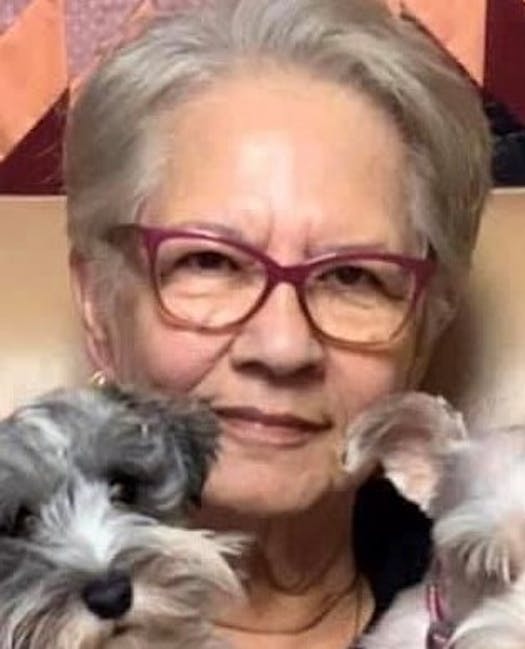
Tina Taphouse is pictured in Langley, B.C., Monday, June 7, 2021. Photo by: The Canadian Press/Jonathan Hayward
#Langley woman says her mother gave her up for adoption to spare her
residential school experience. #residentialschool #Sixtiesscoop
LANGLEY, BRITISH COLUMBIA, B.C. — Tina Taphouse has spent a lot of
time lately reflecting on the impact the Kamloops Indian Residential
School has had on her life's path.
Taphouse didn't go to the school because her mother, who worked there and had also grown up in residential school, made theimpossible decision to put her up for adoption so she wouldn't have to attend.
While Tina escaped the horrors that many survivors of the '60s Scoop and residential schools endured, Taphouse said she also wasn't brought up in her culture, with her family or her traditions and she felt lost.
She began reconnecting with her roots after her biological father reached out to her through an adoption reunification registry in 1994. Over time, she has learned more about her own family and story, although she said she doesn't push her mother to share sensitive details.
Warning: The information and material here may trigger
unpleasant feelings or thoughts of past abuse. Please contact the
24-hour Residential School Crisis Line at 1-866-925-4419 if you require
emotional support.
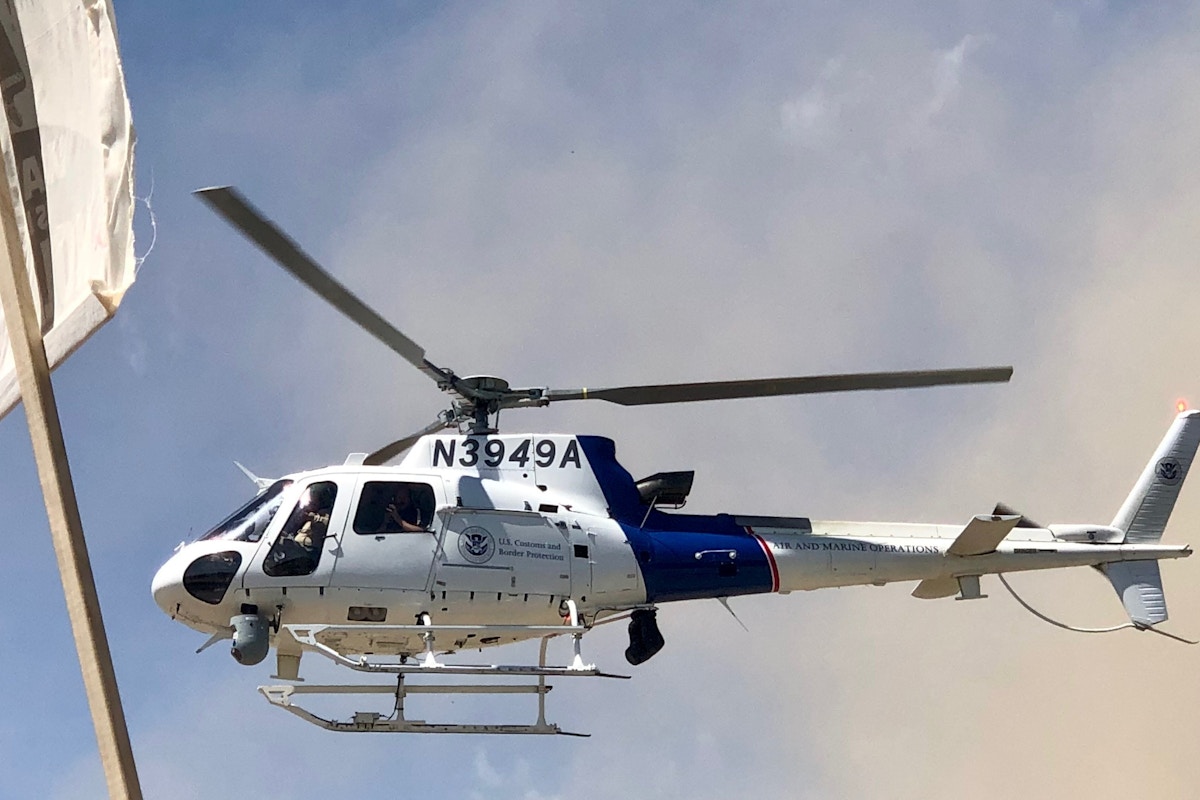
DHS/Border Patrol is using helicopter rotor wash to try to clear out activists out from an occupied #Line3 pump station north of Park Rapids. More than 24 activists are locked down to equipment inside. @MPRnewspic.twitter.com/ArTN6FAqwC
Authorities said the risky low-flying maneuver was used to warn demonstrators to disperse, but the reasoning doesn’t hold up.
The largest civil disobedience yet against new pipeline construction in Minnesota was met by a furious response — and a cloud of debris. A Department of Homeland Security Border Patrol helicopter descended on the protest against the Enbridge Line 3 tar sands pipeline, kicking up dust and showering demonstrators with sand, in an unusual attempt to disperse the crowd.
“I couldn’t see because it got in my eyes,” said Big Wind, a 28-year-old Northern Arapaho organizer with the anti-pipeline Giniw Collective, who was there when the helicopter swooped over the civil disobedience action. “After it pulled up there were a lot of people who were ducking, who were in the fetal position, just because they didn’t know what was going to happen and were trying to protect themselves from the sand.”
***
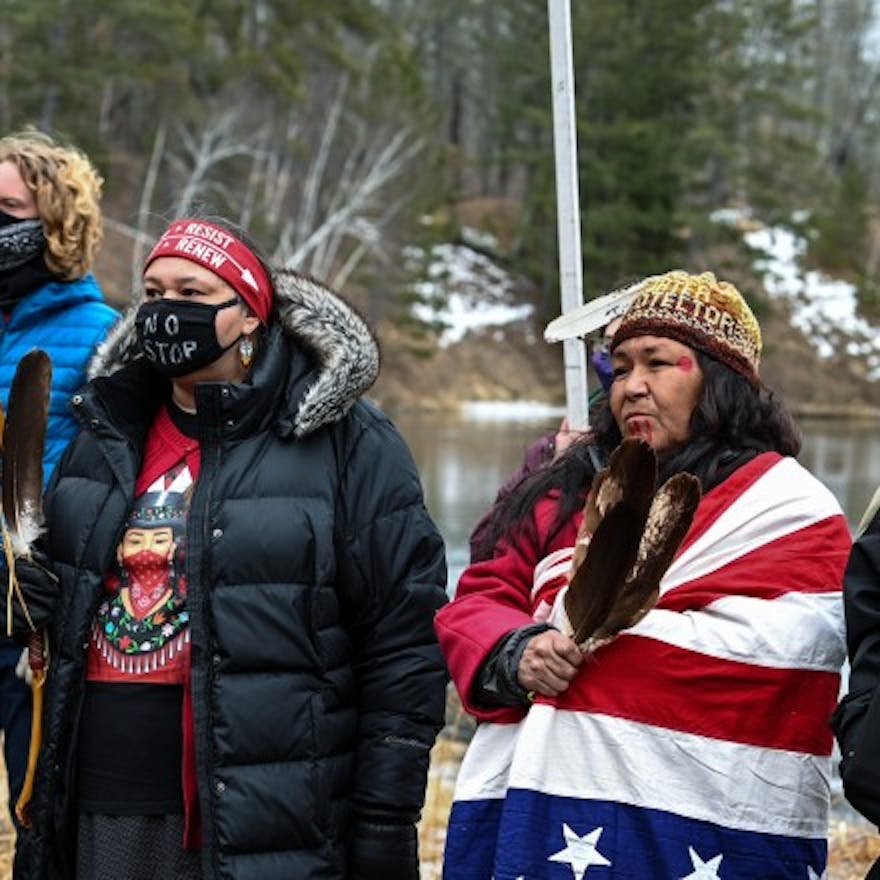
The anti-pipeline protests are in response to plans from the Canadian
energy firm Enbridge to ramp up construction as a springtime hiatus
lifts. Enbridge is preparing to drill under northern Minnesota rivers
that are central to the lifeways of local Ojibwe people — and are
protected by treaties between tribes and the federal government.
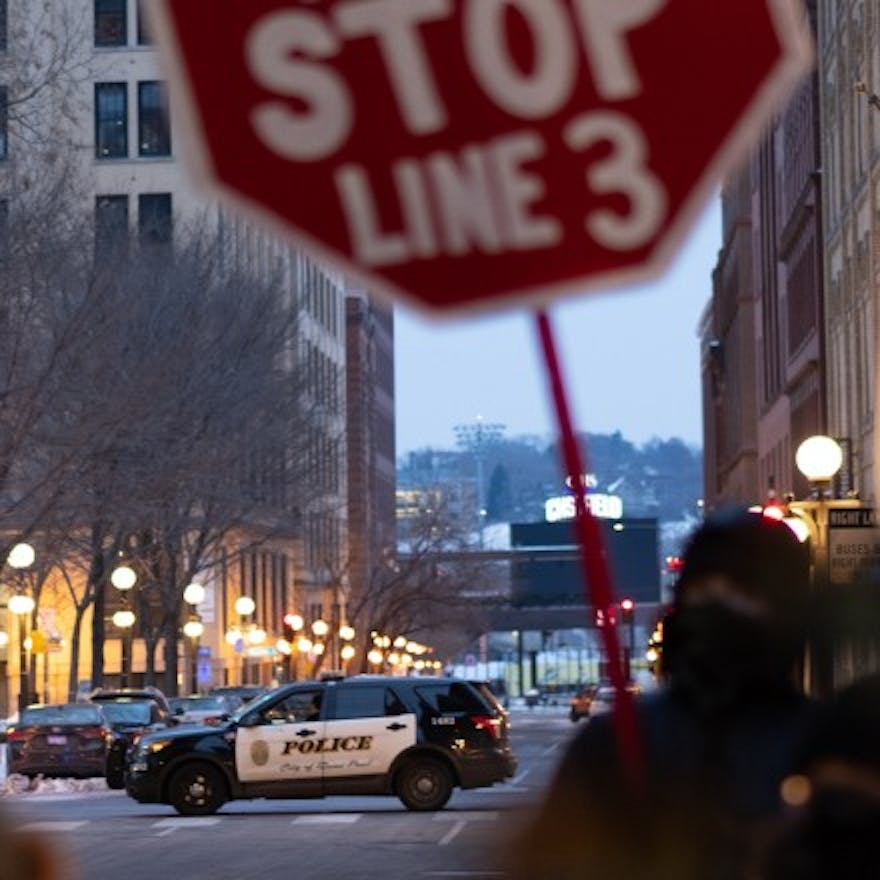
Pipeline opponents have for weeks asserted that this weekend’s Treaty
People Gathering would draw more than 1,000 people to northern Minnesota
to fight the tar sands pipeline.
Here’s the story from @dan_kraker and I about everything that happened at the #Line3 pump station yesterday. Listen for it on Morning Edition too https://t.co/cVNjH1U5E9
Author: Beverly Jacobs, Acting Dean and Associate Professor, Law, University of Windsor
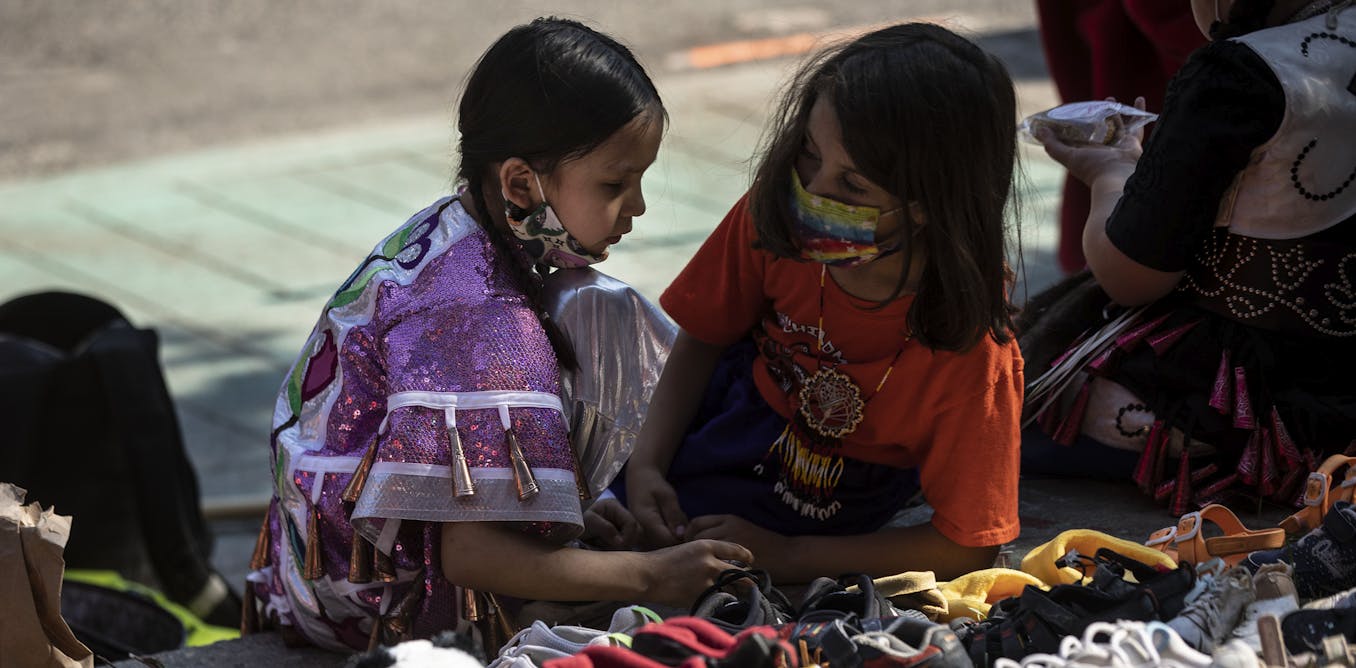
Two young children sit next to shoes left in front of a statue
of Egerton Ryerson, who was instrumental in the design and
implementation of the Indian Residential School System.
THE CANADIAN PRESS/Chris Young
Like others who have been speaking out, I want the ground-penetrating radar that was used at Kamloops Indian Residential School to be used at all other former residential school sites.
What happened to Indigenous children is genocide, and the legacy of that continues through denial and inaction.
Legally speaking, this genocide consists of a composite wrongful act
that triggers the responsibility of the Canadian state under
international law. Canada has breached its international obligations
through a series of actions and omissions taken as a whole, and this
breach will persist as long as genocidal acts continue to occur and
destructive policies are maintained. Under international law, Canada has
a duty to redress the harm it caused and to provide restitution,
compensation and satisfaction to Indigenous peoples.
I have watched and felt the aftermath of this genocide. I’ve felt it
all my life and I know my parents and grandparents felt it too. My
grandmother went to a residential school and didn’t talk about it until
she was sick and dying. She told my aunt that she saw a child being
buried beside the laneway to the Mohawk Institute, also known as the Mush Hole, in Brantford, Ont.
The Mohawk Institute is
one of the last standing Indian Residential Schools in Canada. It has
since been turned into the Woodland Cultural Centre.
Resiliency and survival
As a lawyer working with Sunchild Law, I represented residential school survivors at their Independent Assessment Process (IAP) hearings.
The IAP was established to resolve claims of serious physical, sexual
or emotional abuse suffered at Indian Residential Schools.
While advocating for survivors, I found this process not only
difficult as an Indigenous lawyer and intergenerational survivor, but as
someone who had to witness the re-traumatization of survivors. I also saw and felt their amazing strength as they persevered through this process.
As a professor of law at the University of Windsor, I am grateful our students have been able to learn Indigenous Legal Orders from Indigenous faculty with specializations in Haudenosaunee, Nêhiyaw and Anishinaabe laws.
We have done a lot at the University of Windsor Faculty of Law to implement the Truth and Reconciliation Commission’s Call to Action 28
— which calls upon “law schools in Canada to require all law students
to take a course in Aboriginal people and the law.” We’ve done more
than establish one course and in fact have established an Indigenous Law
Stream Certificate. It’s not nearly enough, but it is a start.
The strength of the Tk’emlúps te Secwépemc peoples was seen with healing ceremonies, songs and dances to respect and honour the spirits of the 215 children.
‘Ohero:kon Under the Husk’
by Katsitsionni Fox shows young Mohawk women who are on a spiritual,
emotional and physical journey to womanhood through their traditional
rites of passage.
Ongoing genocide
I’ve seen and felt the strength of our people to recover and heal
from the impacts of genocidal, colonial laws and policy — like The Indian Act and the ‘60s Scoop — that have been happening for decades. These feelings of pain and trauma are not new.
But first and foremost, Canada’s violation of one of the most
fundamental rules of international law necessitates an obligation of
cessation: Canada must put an end to its perennial pattern of violence
against and oppression of Indigenous peoples.
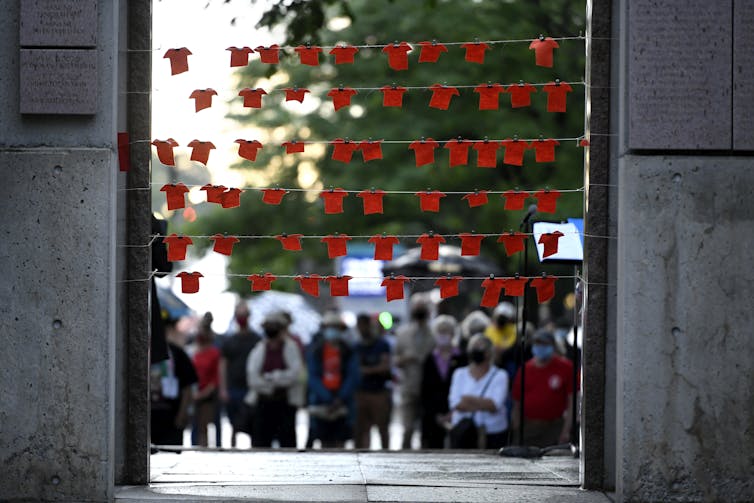
Orange fabric cut in the shape of
shirts are pinned to string at the Human Rights Monument in Ottawa,
during a vigil to honour the 215 children whose remains were found at
the grounds of the former Kamloops Indian Residential School.THE CANADIAN PRESS/Justin Tang
The discovery of the remains of Indigenous children must be
investigated as a crime against humanity and further investigation must
happen at other former residential school sites. The perpetrators must
be held accountable so that genocide will stop and healing and
reconciliation can occur.
I urge all Canadians to care, learn, listen, respect and unlearn the
lies that have been told. I wish for all Canadians who are unaware of
this genocide to learn the truth and accept that they’ve benefited from
Canada’s genocidal policies and laws that have tried to erase us from
existence.
Our children and survivors have to be celebrated, honoured and respected.
Byron Louis, Chief of the Okanagan Indian Band in British Columbia,
posted on LinkedIn a message that should stay with all of us:
“Do not lower your head and cry, hold your head up in praise and
honour them and most importantly support them. This is what they
rightfully deserve in their service to our People. They need our praise
not pity!”
If you are an Indian Residential School survivor, or have been
affected by the residential school system and need help, you can contact
the 24-hour Indian Residential Schools Crisis Line: 1-866-925-4419
Republish our articles for free, online or in print, under a Creative Commons license.
Beverly Jacobs does not work for, consult, own shares
in or receive funding from any company or organization that would
benefit from this article, and has disclosed no relevant affiliations
beyond their academic appointment.
Across the country, more than 150,000 First Nations, Métis and Inuit children were forced to attend the government-run school system between the 1870s and 1997.
The final report by the Truth and Reconciliation Commission in 2015 identified 3,200 children who died as a result of residential schools, including 38 in Quebec. But Indigenous leaders and other experts believe the true figure could be far higher.
In her testimony before the TRC, Marthe Basile-Coocoo recalled the grey day when, as a six-year-old, she first saw the school at Pointe-Bleue.
"The
nuns separated us, my brothers, and then my uncles, then I no longer
understood," she said. "That was a period of suffering, nights of
crying. We all gathered in a corner … and there we cried."
The Roman Catholic school in Fort George was the first residential school in Quebec. It opened in 1931. (Truth and Reconciliation Commission/Deschâtelets Archives)
Pope Francis met with two Canadian Cardinals on Saturday amid mounting pressure on the Catholic Church to take responsibility for Canada’s residential school…
Some 150,000 First
Nations, Metis and Inuit children were forcibly sent to residential
schools, where many suffered abuse and even death.
The Missionary
Oblates of Mary Immaculate ran about 47 per cent of Canada’s
residential schools, including the one in Kamloops. The Oblates have
refused to release their records to help identify the remains.
Prime
Minister Justin Trudeau also put pressure on the Catholic Church
Friday, calling on officials to “step up” and take responsibility for
its role in the system and urging the release of records related to the
schools.
Trudeau said he was “deeply disappointed” by the
position the Catholic Church has taken, adding that he personally asked
Pope Francis in 2017 to consider apologizing for the institution’s part
in the government-sponsored, church-run schools.
“It’s something we are all still waiting for the Catholic Church to do,” Trudeau said.
“The judiciary should conduct criminal investigations into all
suspicious death and allegations of torture and sexual violence against
children hosted in residential schools, and prosecute and sanction the
perpetrators and concealers who may still be alive,” the experts said in
the release.
The signatories to the release included Mama Fatima
Singhateh, an expert on the sexual exploitation of children, and
Francisco Cali Tzay, an expert on the rights of Indigenous people.
The call from former Senator Murray Sinclair, who chaired the TRC from 2009 to 2015, comes after the remains of 215 children were recently found in an ...
Part of that agreement is the Truth and Reconciliation Commission. READ MORE: Canadian control. Authorities are lining up agencies to deal with the ...
... provinces and territories have recently made changes to their curriculums in response to the Truth and Reconciliation Commission, or are working to ...
Oral histories and documents collected by the Truth and ReconciliationCommittee tell the shocking stories of the misery of generations of Indigenous ...
Canadian Prime Minister Justin Trudeau says it’s not an isolated incident that over 200 children were found buried at a former Indigenous residential school
In 2009, the TRC asked the federal government to help fund investigating the location of gravesites where residential students are believed to be buried. The request was denied.
...She said she had visited schoolyard cemeteries across Canada
in an attempt to find where missing children were buried. But the
process of finding the unmarked graves was slow because the “TRC suffers
from a chronic lack of funding.”
“That second step of doing the
ground-penetrating radar is not something that we’re funded to do,” she
told the media outlet. “There are approximately 140 schools on the list
now. … There will be probably as many cemeteries as there are schools
and in five years we just don’t have the time to do an in-depth
investigation of each one of them.”
Cindy Blackstock, executive
director of the First Nations Child & Family Caring Society, told
Global News that the underfunding of Indigenous projects, like the
missing Children Project, is repeated in history.
“They’re making a
conscious choice that these kids are not worth the money,” she said.
“Like these inequalities, like water, etc., like they were always
complaining, ‘Oh, well, we don’t have the money,’ therefore, the default
is, ‘We’re going to racially discriminate against children as fiscal
policy.'”
Mary Ellen Turpel-Lafond on B.C.’s residential schools – May 29, 2021
Among them is a call for former residential school students
to establish an online registry of residential school cemeteries,
including, plot maps showing the location of deceased children.
Morton argues more needs to be done to help Indigenous
communities find the unmarked graves, as there may be many more sites
across Canada.
The same survey techniques used in Kamloops — such
as the use of ground-penetrating radar to detect bodies — are needed,
she said, as well as funds to access archival research, like residential
schools survivor stories and archives from the churches or provinces.
“The
research components have a cost associated, but the actual physical
work of searching the grounds itself would also have a cost component,”
she said.
Moose Jaw’s Hadwen, '60s Scoop survivor, to meet biological father for first time in 45 years
Search for birth parents comes to fruition, meeting to take place on Saturday afternoon at St. Andrew’s Church By: Randy Palmer
Moose
Jaw’s Timothy Hadwen will have a chance to meet his biological father
on Saturday afternoon outside of St. Andrew’s Church. Facebook photo
A lifelong quest to find his biological parents is about to come to fruition for Moose Jaw’s Timothy Hadwen.
Hadwen, 45, will meet his birth father for the first time this
Saturday afternoon (June 5) when the two finally cross paths outside of the St.
Andrew’s Church memorial to the lost 215.
“It seems to be one of those happy-ending stories where we’ve been
hearing so many sad stories with so much heartbreak and racism and
finger-pointing, who’s to blame and who should take responsibility,”
Hadwen said on Friday afternoon.
“But not every story has a happy ending like this… I’m one of the
lucky ones to gets to meet my birth father, who I never met. And there
are a lot of children who are still out there who are looking.”
Hadwen and his three sisters were adopted by Larry and Rosa Hadwen
when he was a young child, and he grew up in an environment that was
“wonderful, and I still talk about them and rave about them and how much
they did for us... They’ve always wanted me to know about my background
and who my birth parents are and now we do.”
Even growing up, the question of ‘where did I come from’ was in the
back of his head, which eventually led Hadwen to reach out to
Saskatchewan post-adoption services. At first, they weren’t a lot of
help as records of his biological birth parents weren’t available, but
his birth record was. And on that record was his birth mother’s name.
That led Hadwen to get in touch with his advocate from Montreal Lake Cree Nation, and a startling revelation.
“After I e-mailed that to him he replied right away ‘I know where
your biological parents are, I’ve known them my whole life almost’,”
Hadwen said with an incredulous laugh. “They only live a kilometre apart
from each other up in Little Red. It’s amazing how close we are
together and how we were still so far away.”
Unfortunately, his birth mother had passed away. But Timothy had a
phone call to make to 78-year-old Stanley Halkett of Little Red River
First Nation, located a half-hour north of Prince Albert.
“It was very nerve-wracking at the beginning,” Hadwen said of making
that first connection. “It took me a while to muster up the courage to
move forward and make that first call. And when I did make that call,
you could hear it in my voice, it was shaky, very emotional, but I
pushed through it and we had a good conversation.”
That first contact also brought forward another surprise.
“Stanley never stopped looking for me the whole 45 years,” Timothy
said. “Now he’s so excited and he said ‘I’m dropping everything and I’m
coming to see you, I don’t care about the weather, I have to see you and
I have to hold you’. It’s an amazing feeling and at the same time it’s a
very exciting moment.”
It was also a moment tinged with sadness, given what he and his adopted parents had been told.
“I was led to believe that my birth parents didn’t want me and that’s
why I was up for adoption, but my adopted parents, they were lied to
this whole time,” Hadwen said. “It’s heartbreaking because I’m not the
only one, there are so many kids who never had a chance to be with their
biological families.”
In other words, exactly the situation so, so many other Indigenous
people went through as part of the 60’s Scoop. Hadwen has chosen to let
that part of the past stay the past, though, even as he continues to
deal with the outcome of that heinous chapter of Canadian history.
“I don’t want to point fingers or blame anyone for what happened, it’s time to move forward and heal,” he said.
Part of that healing will happen Saturday.
Stanley is making the four-hour trip south from Little Red River, and
when the two finally meet, Timothy has little idea how it will go other
than it will be an amazing moment for both men.
“I know it’s going to be emotional, we spoke again this morning and
we’re just moving ahead with the meeting, however it goes,” Hadwen said.
“It was 45 years ago I was in my mother’s stomach and he didn’t even
know I was born, what day I was born, time I was born… apparently they
decided my birth mother wasn’t worth keeping me and that’s how I ended
up in the system.
“But now I get to meet my birth father, and it’s going to be incredible.”
Tom McMahon is former general counsel of
the Truth and Reconciliation Commission, former executive secretary of
the Manitoba Aboriginal Justice Inquiry and former senior counsel at
Elections Canada.
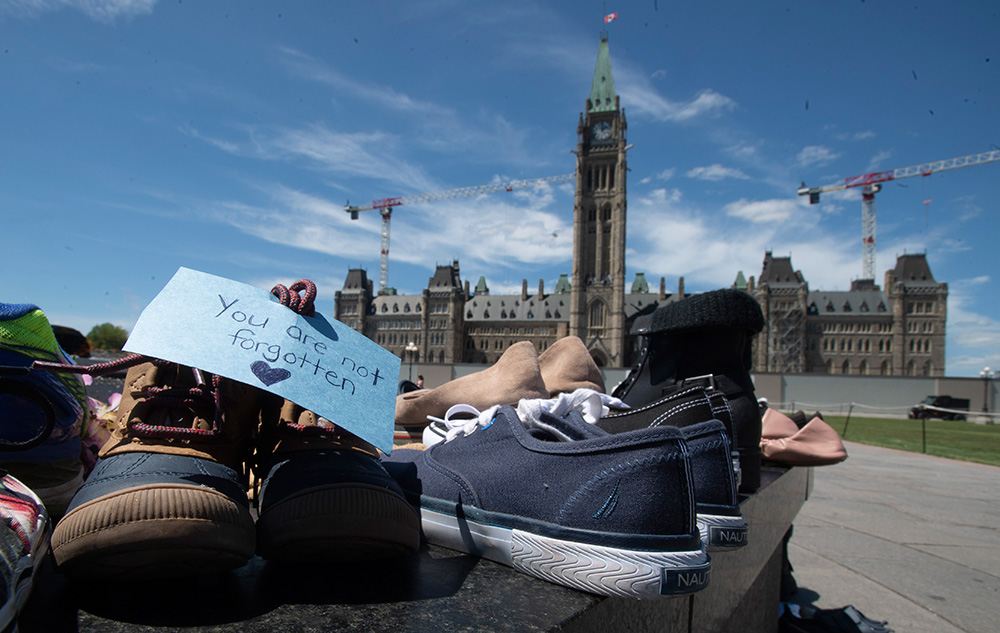
Shoes placed near Parliament Hill in
recognition of the discovery of children’s remains at the former
Kamloops Indian Residential School. Why are there still no public
monuments honouring these children, as the Truth and Reconciliation
Commission has called for?
Photo by Adrian Wyld, the Canadian Press.
As we all struggle with the
news of 215 Indigenous children found in a Kamloops graveyard, many are
demanding that the Canadian government finally implement the Truth and
Reconciliation Commission’s 94 Calls to Action.
I was general legal counsel to the TRC and previously executive
secretary to the Manitoba Aboriginal Justice Inquiry, both under the
direction of Murray Sinclair and the other commissioners.
Some media have noted
that five of six Calls to Action relevant to these children have yet to
be fulfilled. But there are other calls that matter, and failing to
name them hurts our ability to hold the government to account. The media
needs to get this right.
(And when the government says that some of
these Calls to Action are “in progress,” do not believe it. It has been
six years since the commission finished its work. When does “progress”
become “completed”? Those of us who have worked in government and seen
replies to various reports know that “in progress” means the government
does not intend to implement the recommendation but is trying to figure
out a way to get credit for having done so.)
I want to highlight two of the TRC Calls to
Action in particular: 81 and 82. Every time there’s an article about
missing children, about a John A. Macdonald statue, about a Hector-Louis
Langevin place name, and every time I see an article about a new monument for Canada’s dead soldiers in Afghanistan or the victims of communism, or a new parliamentary statement about a foreign genocide, I look to see if the news articles mention those two Calls to Action about Indian Residential Schools.
They never do. Why is that?
81. We call
upon the federal government, in collaboration with Survivors and their
organizations, and other parties to the Settlement Agreement, to
commission and install a publicly accessible, highly visible,
Residential Schools National Monument in the city of Ottawa to honour
Survivors and all the children who were lost to their families and
communities.
82. We call upon provincial
and territorial governments, in collaboration with Survivors and their
organizations, and other parties to the Settlement Agreement, to
commission and install a publicly accessible, highly visible,
Residential Schools Monument in each capital city to honour Survivors
and all the children who were lost to their families and communities.
Why do I care about TRC Calls to Action 81 and 82? It’s empty symbolism, right?
I care because I see them as being such an
easy, inexpensive thing to do. I see 81 and 82 as a litmus test for our
governments. If you’re not even willing to do this simple thing, what
does it say about your sincerity, honour, goodwill and credibility on
the other Calls to Action?
I care because our current monuments and
place names and flags are such “in-your-face” and “rub-your-nose-in-it”
strutting examples of colonialism and white supremacy. Canada
desperately needs balance and diversity in our public symbols. We
desperately need some historical accuracy.
I care because national and provincial
public monuments would be a daily public statement that we remember,
that we accept the truth of what we have heard and that we commit
ourselves to be better.
I care because we create monuments to
ourselves and our ancestors all the time. The lack of balance in
monuments for other Canadians is a painful reminder of who we value and
who we don’t value.
I care because the purpose of Calls to
Action 81 and 82 is “to honour Survivors and all the children who were
lost to their families and communities.” Who could be opposed to that?
Here are other Calls to Action that are relevant to the missing children.
67. We call upon the
federal government to provide funding to the Canadian Museums
Association to undertake, in collaboration with Aboriginal peoples, a
national review of museum policies and best practices to determine the
level of compliance with the United Nations Declaration on the Rights of
Indigenous Peoples and to make recommendations.
68. We call upon the
federal government, in collaboration with Aboriginal peoples and the
Canadian Museums Association, to mark the 150th anniversary of Canadian
Confederation in 2017, by establishing a dedicated national funding
program for commemoration projects on the theme of reconciliation.
69. We call upon Library and Archives Canada to:
i) Fully adopt and implement the United
Nations Declaration on the Rights of Indigenous Peoples and the United
Nations Joinet-Orentlicher Principles, as related to Aboriginal peoples’
inalienable right to know the truth about what happened and why, with
regard to human rights violations committed against them in residential
schools.
ii) Ensure that its record holdings related to residential schools are accessible to the public.
iii) Commit more resources to its public education materials and programming on residential schools.
70. We call upon the
federal government to provide funding to the Canadian Association of
Archivists to undertake, in collaboration with Aboriginal peoples, a
national review of archival policies and best practices to:
i) Determine the level of compliance with
the United Nations Declaration on the Rights of Indigenous Peoples and
the United Nations Joinet-Orentlicher Principles, as related to
Aboriginal peoples’ inalienable right to know the truth about what
happened and why, with regard to human rights violations committed
against them in the residential schools.
ii) Produce a report with recommendations
for full implementation of these international mechanisms as a
reconciliation framework for Canadian archives.
77. We call upon
provincial, territorial, municipal and community archives to work
collaboratively with the National Centre for Truth and Reconciliation to
identify and collect copies of all records relevant to the history and
legacy of the residential school system, and to provide these to the
National Centre for Truth and Reconciliation.
79. We call upon the
federal government, in collaboration with Survivors, Aboriginal
organizations and the arts community, to develop a reconciliation
framework for Canadian heritage and commemoration. This would include,
but not be limited to:
i) Amending the Historic Sites and
Monuments Act to include First Nations, Inuit and Métis representation
on the Historic Sites and Monuments Board of Canada and its Secretariat.
ii) Revising the policies, criteria and
practices of the National Program of Historical Commemoration to
integrate Indigenous history, heritage values, and memory practices into
Canada’s national heritage and history.
iii) Developing and maintaining a national
heritage plan and strategy for commemorating residential school sites,
the history and legacy of residential schools and the contributions of
Aboriginal Peoples to Canada’s history.
Here is what the media is reporting as being the only Calls to Action relevant to missing children.
71. We call upon all chief
coroners and provincial vital statistics agencies that have not provided
to the Truth and Reconciliation Commission of Canada their records on
the deaths of Aboriginal children in the care of residential school
authorities to make these documents available to the National Centre for
Truth and Reconciliation.
72. We call upon the
federal government to allocate sufficient resources to the National
Centre for Truth and Reconciliation to allow it to develop and maintain
the National Residential School Student Death Register established by
the Truth and Reconciliation Commission of Canada.
73. We call upon the
federal government to work with churches, Aboriginal communities, and
former residential school students to establish and maintain an online
registry of residential school cemeteries, including, where possible,
plot maps showing the location of deceased residential school children.
74. We call upon the
federal government to work with the churches and Aboriginal community
leaders to inform the families of children who died at residential
schools of the child’s burial location, and to respond to families’
wishes for appropriate commemoration ceremonies and markers, and
reburial in home communities where requested.
75. We call upon the
federal government to work with provincial, territorial, and municipal
governments, churches, Aboriginal communities, former residential school
students, and current landowners to develop and implement strategies
and procedures for the ongoing identification, documentation,
maintenance, commemoration, and protection of residential school
cemeteries or other sites at which residential school children were
buried. This is to include the provision of appropriate memorial
ceremonies and commemorative markers to honour the deceased children.
76. We call upon the
parties engaged in the work of documenting, maintaining, commemorating,
and protecting residential school cemeteries to adopt strategies in
accordance with the following principles:
1. The Aboriginal community most affected shall lead the development of such strategies.
2. Information shall be sought from
residential school Survivors and other Knowledge Keepers in the
development of such strategies.
3. Aboriginal protocols shall be respected
before any potentially invasive technical inspection and investigation
of a cemetery site.
It is not too much to expect our media and
our politicians to actually read all of the TRC Calls to Action and to
discuss them specifically.
The NDN Collective is an action network built on principles of community organizing, building political power and advancing the rights of Indigenous people.
Last week it was discovered that they are forcibly putting in IUDs into Native kids under 10, this week they discovered 215 bodies of Native kids under a school. These are issues that are person to me and so many of us.
the government of Canada 🇨🇦 covered up the death and murder of those 215 children in that government run school, a school only 60 km from where I grew up, if I was born one generation earlier I would have been forced into that school! My father was a residential school survivor
The long history of discrimination against First Nations children Learn more about how Canada repeatedly chose to not act on solutions to stop the harm to, and deaths, of children and why it is still a problem. https://t.co/7CnMuImGyH
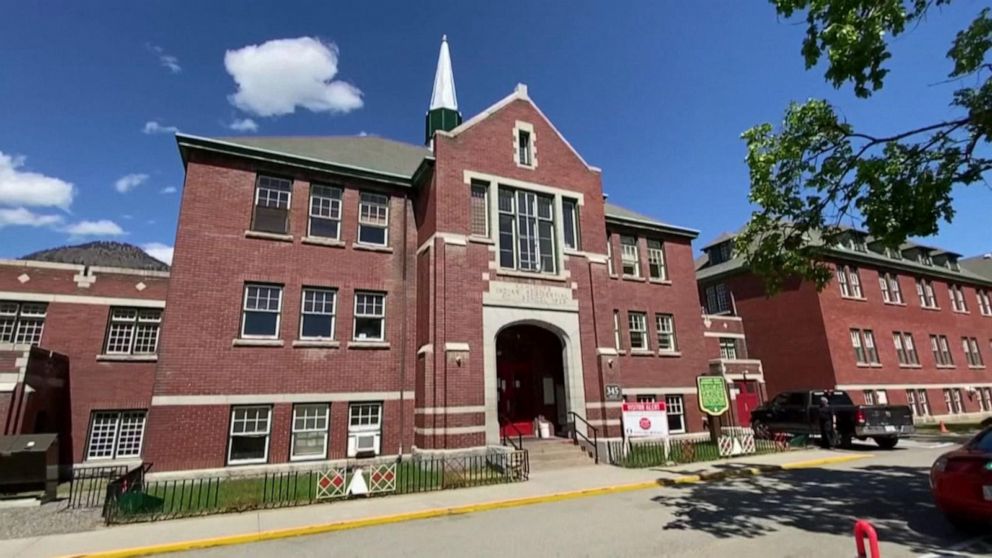
The
former Kamloops Indian Residential School is seen on Tk’emlups te
Secwépemc First Nation in Kamloops, B.C., on May 27, 2021. The remains
of 215 children have been found buried on the site, the First Nation
said. (Andrew Snucins/The Canadian Press)
Lindstrom helped tribes and counties across the nation to develop
programs to ensure that federal law was followed and Indian children
were not forcibly removed.
Janice
L. Lindstrom spent much of her adult life pushing for stronger
protections for American Indian children. She died on May 7 of cancer at
age 75.
Janice
L. Lindstrom, a social worker and champion of legal rights for American
Indians, and who testified in Congress for stronger protections for
Indian children and families, died of cancer May 7. She was 75.
Lindstrom
helped tribes and counties across the nation to develop programs to
ensure that federal law was followed and Indian children were not
forcibly removed from Indian families.
Her work was made possible by the Indian Child Welfare Act
(ICWA), a landmark federal law passed in 1978 designed to end the
practice of taking Indian children from their homes and placing them in
boarding schools or foster care. The law gives tribes the right to
intervene in adoptions in which Indian children are put up for adoption
and placed with non-Indian families.
At
the time, many Indian children were being removed from their birth
parents not for abuse or neglect, but because of perceived or real
poverty. Harsh living conditions prompted social workers to make
unwarranted removals, and poverty made it difficult for Indians to
qualify as adoptive parents. Before ICWA, 25% to 35% of Indian children
were being removed from their homes; of these, 85% were placed outside
of their families and communities — even when able and willing relatives
were available.
A
member of the White Earth Nation of Ojibwe, Lindstrom experienced this
injustice firsthand. She watched as two of her younger sisters were
placed in separate homes in Stillwater with non-Indian foster parents.
Adding to the trauma of this separation, the family later discovered
that one of Lindstrom's sisters had been sexually abused and underwent
forced sterilization while in foster care.
"My
mother could not stand the desecration of our families — the way they
were breaking up our people — and she fought with tenacity to prevent
it," said Lindstrom's daughter, Sheri Riemers, government and community
relations director at the Ain Dah Yung Center, a St. Paul-based shelter for runaway and homeless youth.
Lindstrom
was the oldest of five children born on the White Earth Indian
Reservation in northwestern Minnesota. As a child, she went to live in
nearby Park Rapids with her grandparents, who lived in a rustic wood
cabin with an outhouse and wood-burning stove.
At 16, Lindstrom moved to the Twin Cities and did a series of odd jobs before being hired at the Minneapolis American Indian Center.
The center's director, Frances Fairbanks, was impressed by Lindstrom's
toughness and asked her in the early 1980s to coordinate a new program
to monitor the state's compliance with ICWA and ensure that tribes were
notified when Indian children were being removed from their homes.
Lindstrom
and her team faced numerous barriers, including local social workers
and judges who were not familiar with the new federal law and the unique
status of tribes. But she persuaded counties in the metro area to allow
her team to monitor court proceedings and to intervene in cases where
Indian children were being removed or parental rights were being
terminated. Tribes across the nation would adopt similar
court-monitoring programs.
"Janice
was tenacious," said Rose Robinson, a longtime friend and former
director of the Minnesota Indian Women's Resource Center. "She
understood that when you take a child away, then you are disconnecting
that child from their community and their relationships."
For the past 17 years, Lindstrom was executive director of Juel Fairbanks Recovery Services,
a treatment center in St. Paul for men with substance abuse disorders.
She put the center on sounder financial footing while encouraging
healing through Indigenous culture and traditions.
In
her final days, Lindstrom continued to counsel residents. "They revered
her like a mother," said Riemers, her daughter. "She took them under her
wing like they were her own sons."
Despite Canada’s benevolent veneer, its history is replete with examples of genocidal medical violence inflicted upon Indigenous communities, including children, with Canadian physicians often leading the charge. This includes coerced and forced sterilizations targeting Indigenous women and girls.
In her landmark book, “An Act of Genocide: Colonialism and the Sterilization of Aboriginal Women,” women and gender studies professor Karen Stote describes how formal eugenic legislation in provinces like Alberta and British Columbia spanned decades in the twentieth century, while other provinces had similar practices that may have been informal, but with the same devastating end-result: the sterilization of thousands of Indigenous women and girls, forced to give up the ability to bear children.
These are recent reports of missing children made to local law enforcement. If you think you have seen a missing child, contact the National Center for Missing & Exploited Children at 1-800-THE-LOST (1-800-843-5678). https://t.co/gzcU0ba9WK






![[Tyee]](https://thetyee.ca/ui/img/ico_fishie.png)


/https://www.thestar.com/content/dam/thestar/opinion/contributors/2021/03/08/coerced-and-forced-stereilization-of-indigenous-women-and-girls-this-is-what-genocide-looks-like-in-canada/cpt127524354.jpg)


