BLOGGER changed, not allowing us to UPDATE this back-up blog

(UPDATED 726/2025) issues with blogger are preventing this

Saturday, August 8, 2020

My Friend Jeff

Avon man receives long-awaited answers in search for biological family


Jeff Hancock finally received information he'd waited a long time to see: Information in his search for his biological family (WHAM photo)
Avon, N.Y. - An Avon man’s lifelong search has finally come to an end. His long-sought answer came in the mail, and 13WHAM was there to see it revealed.
The letter to Jeff Hancock held the answers for a man whose journey began as a boy, a foster child adopted when he was four.

“When I first found out I was adopted, I felt like a guest at my own funeral,” he said. “The person I had known my whole life was dead. I felt like my whole life isn’t valid to this point, because I wasn’t who I always thought I was.”

Hancock was 42 when he went to apply for a passport and realized he did not have a required birth certificate.
“I said, ‘Mom, I need my birth certificate,’” he recalled. “I actually had never seen it. And she goes, 'Oh, I don't have that anymore.'"
That was when Hancock’s search for his biological family and his original birth certificate began. He joined a group lobbying to unseal state adoption records, giving adoptees access to their birth certificate.
“We just want what everybody else has,” he said.
In 2019, adoptees won the fight for adoption rights. Immediately, Hancock applied for his birth certificate. The COVID-19 pandemic delayed it for months – but, finally, the day Hancock received his letter finally arrived.
“I was five pounds, seven ounces when I was born,” he said, looking over the papers. “I was little.”
“This is something I’ve been wanting to know for a long time: I was born at Booth Memorial Hospital in Buffalo, New York,” he said. “...I learned something today, and I also have confirmation that’s my mom.”
Now, because of the work by Jeff Hancock and others, adoptees in New York no longer have to wait a lifetime for the paper that's a birthright.
“I felt complete for the first time since discovery,” he said.

VIDEO: https://13wham.com/news/local/avon-man-receives-long-awaited-answers-about-his-own-adoption

Ed. Note: Jeff is an LDA - late  discovery adoptee, one who didn't get told he was adopted until he was an adult.

Thursday, August 6, 2020

How Native Tribes Started Winning at the Supreme Court


(excerpt) The Tribal Supreme Court Project is already working on a Firth Circuit case concerning the Indian Child Welfare Act, which Hedden-Nicely calls “the single most important issue for Indian Country today.” Brackeen v. Bernhardt asks whether ICWA, through which Congress granted tribes priority in deciding foster care placements for Native children, violates an alleged Constitutional restriction on “racial preferences.” A judge ruled in 2018 that overturning the law would violate tribal sovereignty. Hedden-Nicely thinks the case isn’t really about children but is just one of many “unrelenting attacks on the idea that Indians have any special status under the law.”
He doesn’t expect the Supreme Court, which has already twice upheld ICWA, to hear the Brackeen case. And if it did, given recent trends, it’d be unlikely to decide against tribes.“At a time where Congress is not being particularly helpful on Indian policy, and the executive is being actively antagonistic, it’s very comforting to have at least one branch of government acting in a way that’s consistent with their trust responsibility to Indian tribes,” says Hedden-Nicely. When the court sides with Congress and the president in ignoring tribal sovereignty, “bad things start to happen.”

GOOD READ: How Native Tribes Started Winning at the Supreme Court – Mother Jones

Wednesday, August 5, 2020

60s Scoop Adoptees: Where Do We Fit In?

Stewart Garnett, 41, was adopted by a San Francisco family as a kid, but has come back to Manitoba to try to retrace his heritage. (Erin Brohman/CBC)


Stewart Garnett


Stewart Garnett was born in Winnipeg and is from Long Plain First Nation, but he grew up in California after being adopted by a white family during the Sixties Scoop.
Garnett said he struggled with questions of identity growing up and was frequently confused by the way people would label him.
He returned to Manitoba about a week ago in attempt to regain a sense of his culture.
"It's been rough. I see people who do know who they are and they're comfortable in their own skin, but me, no," he said.
"You try walking in the non-aboriginal world, you don't fit in; you try and walk in the aboriginal world and you don't necessarily fit in, so you're on this fence of 'Where do we fit in?'"

SEE MORE ADOPTEES HERE 

Manitoba Premier Greg Selinger apologizes for Sixties Scoop

Manitoba Sixties Scoop apology moves indigenous families to tears


Maryland Laws affecting adoptees : HB1039 Overwhelmingly Passes Full House

READ HERE

HB1039 Overwhelmingly Passes Full House


The Maryland House of Delegates overwhelmingly passed HB1039 on March 11, sending the equal rights bill to the Senate for final consideration.
The vote, initially reported as 130-8, became official later at 131-7. Two delegates who are adopted spoke strongly in favor of the bill: Republican April Rose of Carroll County and Delegate Courtney Watson, Democrat of Howard County. HB1039 is sponsored by Republican Michael Malone, and it has now moved to the Senate, where its companion bill is already under consideration in the Judicial Proceedings Committee. Senator Susan Lee is the sponsor of the Senate bill.
“We are pleased that the overall response from our legislators has been positive and very supportive,” said Susie Stricker, the founder of Maryland Adoptee Rights, a member of the Capitol Coalition for Adoptee Rights. “We have cleared a huge hurdle, but need to keep the momentum moving forward by urging our lawmakers to vote for the HB1039 as it is written and keeps it equal.”
“Moving this legislation along has been a dream of mine for over 10 years,” said Peggy Klappenberger, a Maryland adoptee and advocate with Maryland Adoptee Rights. “To be sitting where we are today is surreal, and I know it couldn’t have happened without Susie Stricker and all the hard work she put in to get this bill written and into both chambers. It also wouldn’t have been possible without the support of the adoptee community both nationally and here in Maryland. Everyone has been amazing.”

Equality for All Adopted People

We are a coalition of organizations and allies in the District of Columbia, Virginia, and Maryland, working to secure equal rights for all adult adopted people who were born or adopted in the region.
Join Us  More Info

Monday, August 3, 2020

Indigenous children for sale: The MONEY behind the Sixties Scoop #HumanTrafficking

Adoptive U.S. parents paid thousands for Indigenous Manitoba children


Carla Williams was adopted by a Dutch family during the Sixties Scoop. (CBC)

Marlene Orgeron recalls the day her adoptive Louisiana parents told her they bought her for $30,000. Her brothers, they told Marlene, were "freebies."
It left her feeling worthless.

"They told me I should feel grateful they paid anything for me at all," Orgeron said. "I felt so guilty."
Marlene Orgeron was taken from her home in Shoal Lake, Man., in the 1970s and adopted by a family in the U.S. (CBC)
It's the latest revelation in a story survivors say has haunted them for decades: the money behind the Sixties Scoop.
The scoop, as it is called, refers to the era from the 1960s to the 1980s, when child welfare authorities scooped up Indigenous children and adopted them out to non-Indigenous families.
Those placed in homes outside the country weren't just adopted out of their Indigenous homes and into mostly white American families — they were bought and paid for.
"It hurts so much, but I have waited so many years for someone to finally talk about this," said Dianne Fast, whose brother Willy was seized from their Eriksdale, Man., home and adopted by a couple in Indiana.
His value? Fast said her brother went for $10,000.
"His mother used to say she owned him."
Carla Williams, also from Manitoba, was adopted by a family in Holland for $6,400.
Manitoba twins Alyson and Debra ended up in Pennsylvania. They said they were valued at $10,000 as a pair.
Wayne Snellgrove calls it human trafficking.
"[My adoptive parents] paid a lot of money for me," said Snellgrove, who started out in foster care.
"They farmed us out to an [American] adoption agency and then they sold me."

'It sickened me'

Williams said the thought of the transactions is revolting.
"It sickened me," she said.
Barbara Tremitiere was surprised to hear this. Now retired, during the 1970s she was an adoption worker with the Pennsylvania-based Tressler Lutheran Home for Children.
They worked hard to find homes for children with "special needs," she said. Canadian Indigenous children were deemed special needs.
"Because you didn't want them," Tremitiere said. "I was once told by a native person from [Manitoba], on one of the reservations ... 'We passed on to you what we didn't want.' And they were probably right."

Keep Reading 

The Promise Not Kept


Prof. Matthew L.M. Fletcher

Prof. Matthew L.M. Fletcher | The Promise Not Kept

“I grew up surrounded by adults talking about federal recognition and the promise of ‘Indian money,’ compensation for lost treaty rights.”
I come from Anishinaabe communities, the Grand Traverse Band Odawa and Pokagon and Gun Lake Bodewadmi, who signed numerous treaties from 1795 to 1855 that suffered through administrative termination from the 1860s through the 1980s and 1990s. I grew up surrounded by adults talking about federal recognition and the promise of “Indian money,” compensation for lost treaty rights.
My relatives had nothing, no reservation, no tribal government, no HUD money for housing, no IHS, no BIA, but they still ended up getting removed to boarding schools and foster care with white families, going to jail, and dealing with suicide and addiction. I went to law school and chose to work with tribes to be a part of the restoration of Anishinaabe government and culture.
A friend once asked me what standards apply in tribal courts when a prosecutor moves to charge a juvenile as an adult. I was taken aback. No Anishinaabe tribal judge I know would ever agree to that. Indian children are special, considered by some to be supernatural creatures, deserving respect and deference. The word in Anishinaabemowin for child is benodjhen, which loosely translated means spirit coming forth.
As a policy matter, the last thing a tribal judge would want to do is sentence a child to a jail where they could be brutalized and converted into a hardened criminal. Tribal communities already struggle with the reintegration of our adult prisoners. It would be so much worse for our children.
Matthew L.M. Fletcher is professor of law at Michigan State University College of Law, director of the Indigenous Law and Policy Center, and editor of the leading blog on Indian law, Turtle Talk. He is a member of the Grand Traverse Band of Ottawa and Chippewa Indians. 

Wednesday, July 29, 2020

Ivanka Trump’s Empty Spectacle on Violence Against Native Women #MMIWG

 July 29, 2020
ivanka-trump’s-empty-spectacle-on-violence-against-native-women

The picture tells a nice story: Ivanka Trump—smiling with a big golden key in hand—stands alongside assistant secretary for the Bureau of Indian Affairs Tara Sweeney, Lower Sioux Indian Community Vice President Grace Goldtooth, and Interior Secretary David Bernhardt. They are there to mark the opening of an office in Bloomington, Minnesota, dedicated to cold cases in Indian Country. Specifically, the office is designed to address the Missing and Murdered Indigenous Women and Girls, or MMIWG, crisis, and is one of seven such offices that the Trump administration has said it will open across the country, each the result of an executive order the president signed last November.  On its face, it’s an urgent commitment in response to years of federal neglect. 
But in typical Trump style, it was little more than a P.R. stunt, just another branding exercise for Ivanka and a weak attempt by the administration to gin up some short-lived goodwill in Indian Country.
KEEP READING 

LISTEN

Sunday, July 12, 2020

Adopters, Blogging and Privacy for Adoptees

There are many adopters who are blogging about their adopted child.  THIS MUST END NOW!
 
Looming hot issue concerning "privacy" for minor adoptees

By Trace L. Hentz (Blogger- Adoptee) (repost from 2014)

I am an adoptee, well past the age of majority, and because of my closed adoption, I had to climb a mountain and claw my way up to discover any details about who my natural family was. Records were sealed in Wisconsin. Growing up, I had no medical history. I did not share my adoptive parents blood or ancestry. Mine, on paper, didn't exist.

Even recently I told a surgeon I am not sure about most of my birthmom Helen's medical history, though I do know she died from complications of diabetes.

I have not stopped thinking about the post I wrote on the LOST DAUGHTERS BLOG that APs need to stop blogging about adoptees. This is a looming hot issue concerning "privacy" for minor adoptees. At the MIT adoption conference, I heard it loud and clear.  I'm sure many adoptive parents had not considered the ramifications of blogging about their children's lives, especially when adoptees are still minors. The dangers of sharing on social media and blogs are REAL yet being ignored.

APs are, in my opinion, in essence creating an "unsafe environment" for their child.* 

A toddler cannot consent to having his or her life experiences documented on public spaces. (I predict some day some clever lawyer will take this on and attempt to sue an adoptive parent for publicizing and publishing an adoptee's early private experiences, albeit from the APs perspective.) (There might already be stalkings and kidnappings due to the increased use of social media. You can find anyone with the click of a mouse.) (There was already one lawyer in CA suing adoption agencies for damaged goods - when an adoptee is ungrateful or not what the APs expected. This is what lawyers do!)

If someone must blog, then private password-protected blogs, shared between family members, is the only way to protect any child. Parenting blogs are one thing; blogging about the children you adopt is another.


Many adoptees have told me and related on social media, much needs to be changed about "adoption" - ending the lack of access to our own adoption files, having a copy of our real birth certificate, knowing our ancestry, our medical history and so much more....including an understanding of birth trauma, anxiety and stress disorders in adoptees.

My goal as a writer/adoption author/adoptee is to advocate for adoptees too young to advocate for themselves. I will do whatever it takes to make this issue understood from the adoptee perspective. (Add to this I taught blogging and a course on social media.)

In my foster care training in Oregon back in the 1990s, there was no mention of protecting a minor child's privacy but people were not blogging and tweeting and Facebooking back then!

Yet there was plenty to read about confidentiality for birthmoms - if they chose not to tell anyone and gave a baby up for adoption - adoption agencies like Catholic Charities assured them no one would ever have to find out. The child (like me) would have a new identity and the records were sealed permanently.

This created a fantasy I had to deal with and live with as an adult. Until I met my dad Earl, I had no medical history or ancestry.

So much needs to change about adoption. It's a complicated mess. For 10+ years, I've done research on adoption as a topic. I am not a lawyer. More and more is coming to light that "adoption" is not at all what we thought.  Much of what we read is/was created by the billion dollar adoption industry so it's their sale pitch, aka propaganda for adoptive parents (APs) and potential APs.

I am old enough now to advocate for those adoptees who can't.  And I will.

If I run into APs and lawyers who get upset with me (or my blog) for voicing my opinion, get in line.


**************************************************************

Here is a very revealing post from Jason on his blog concerning failed adoptions and the practice of advertising adopted children you no longer want: REHOMING:

Children For Sale: Get 'Em While They're Hot

His post
Hi Anonymous, Thanks for taking the time to comment. You've raised an important issue: every child should have a safe and supportive home. Do you advocate that only adoptive children who are in homes with parents unable or unprepared to raise a child be taken away? Should parents of biological children who are unprepared, unwilling, or unable to raise their children be allowed to offer up their children to better homes?

As we consider posting pictures or information about the lives of children on the internet, we must also consider the impact on the children (you are considering only the needs of potential adoptive parents). Does the internet have a right or need to know any information about these children? How might the children be impacted in the future with their personal and private information being shared with any stranger that comes across it?

What baffles me--and endangers children--is when adults think of their needs and fail to reflect on what children need. In this case their is an enormous impact that you are failing to consider.


and:  Hi Anonymous, you've raised some important concerns about the foster care system, which is a different issue than what this post is about. I'm deeply concerned about what happens when the private and personal information about children is shared publicly. Children can have safe, secure, and supportive homes without their backgrounds being put up on the internet and shared with the world


I will end with Von's comment on Adoptive Parents blogging about adoptees: The full exposure some adopters give to adoptees is seriously wrong and abusive. Some of you might remember the 'Potty Wars' and the 'Slant Eyes Fiasco' when adoptive mothers were adamant that their right to write whatever they wanted trumped the rights of children. Many claim they are not racist or abusive and that adult adoptees are over-sensitive and need to get a life, be prayed for or learn to be grateful. They pretend to pity us for our sad lives and state that their adoptees do not suffer and will not as we have. They know so little of the trauma of adoption and do so little to protect those they have adopted from further trauma. Anything posted is forever available and will undoubtedly be used by someone somewhere to bully, castigate, abuse etc because that sadly is the down side of our social media. Anyone who overlooks this is either naïve, stupid or deliberately abusive.

Thursday, July 9, 2020

How the ‘only family’ argument is used against Indigenous families


Fletcher: “How the ‘only family’ argument is used against Indigenous families”

by Matthew L.M. Fletcher

In High Country News, here.
Excerpt:
There’s a powerful dog whistle attacking American Indian families and tribes who assert their rights to keep Native children with Native families under the Indian Child Welfare Act (ICWA). Increasingly, foster and adoptive parents are fighting those families and tribes who seek to reunite with their children by claiming to be “the only family the child has ever known.” It was the racism in the child welfare system against Indian families that initially compelled Congress to establish ICWA in 1978. Now, as America continues to grapple with its racist history and systems of white supremacy, it’s time for courts to see through racist dog whistles and prioritize families of color.

Tuesday, July 7, 2020

Crosscut Article on Greer Case


Crosscut Article on Greer Case

by ilpc

This court case could weaken Washington’s Indian Child Welfare Act

The law protects Native children from being taken from their homes without tribal involvement. The case before the state Supreme Court could tighten those rules.
 

The law protects Native children from being taken from their homes without tribal involvement. The case before the state Supreme Court could tighten those rules.

READ: This court case could weaken WA’s Indian Child Welfare Act | Crosscut

ICWA was thereafter applied to the case, but the damage was done — the children were placed in foster care without the normal protections the law would have offered them. Now, the Central Council of Tlingit and Haida Indian Tribes of Alaska are challenging the decision in the Washington State Supreme Court. If the court’s decision is upheld, advocates say the case could significantly weaken the use of ICWA in Washington by raising the bar for what qualifies as a “reason to know” that a child is “Indian” in the eyes of the law.
Kathryn Fort, director of Michigan State’s Indian Law Clinic, who is arguing on behalf of the tribes in the case involving Greer and Graham, says that it shouldn’t be so difficult. The burden of checking in with a tribe is low, she says, but the outcome has immense implications for the family, children and tribe.
Briefing and oral arguments here.

Monday, July 6, 2020

News from Twitter #NoDAPL


Monday, June 29, 2020

Indian Lives Matter | The "Indian Problem"


Stanford Law Review Online Publishes “Indian Lives Matter — Pandemics and Inherent Tribal Powers”

by Matthew L.M. Fletcher

Fletcher's paper, "Indian Lives Matter -- Pandemics and Inherent Tribal Powers," is now available online (PDF).


The1918 and 1919 influenza pandemicdevastated American Indian communities.In several states in the west and southwestArizona, Colorado, Mississippi, New Mexico, and Utah4%to 6%of American Indian people died.35“Among Alaskan Natives, entire communities were stricken, and some towns were abandoned.”36Nearly 3,400 Diné (Navajo) people walked on during this time.37Overall,2%of American Indian people walked on because of the pandemic.3


Saturday, June 27, 2020

Remembering Von Hughes #adopteerights

Von and her daughter
Lost Daughters is sad to announce the passing of one of our long-time members, Von Coates. Von was one of Australia’s stolen babies during an era which mirrored that of the “Baby Scoop Era” in the United States (and worldwide). She was instrumental in the official apology issued by the WA government. She stood unapologetically by the wronged mothers as they refused to accept. She was a pioneer in establishing Post-Adoption support in WA. She was also a tireless advocate for bird populations of her homeland and for justice everywhere. She lived a long, fulfilling life. She will be missed.

ETA: Von’s family has asked for donations for a mental health fundraiser in Von’s honor: https://www.mycause.com.au/page/230210/memorial-to-elizabeth-ann-hughes


Her death on May 17, 2020 has been devastating to family, friends and the online community


By Trace Hentz, Blog Editor

Every adoptee I know wants to understand why we feel the way we do, and that we are not alone. Von Coates Hughes in Australia was one of my best teachers and she was an outspoken adoptee. She gave in-depth, easy-to-read insight and had the words when I would struggle with how to explain how I felt about being adopted.
Von had a blog on blogger (Once was Von) and someone reported it was not good so it was taken down. What the HELL??? Criticizing the adoption industry and propaganda was dangerous, we soon discovered - and Von and I discussed it via email.  She came to my defense many times. She would openly argue with first mothers/birthmothers and adoptive parents on Facebook - battling as if there was only one victim in the adoption game.
She made many comments on this blog and interviewed me for her blog. Von was also a contributor to LOST DAUGHTERS blog.

Out of necessity, Von moved her blog to wordpress. Below: this was her first post in 2012.


It’s Just A Stage I’m Going Through!

I’m a cat person, a Greyhound person, a goose person – well, let’s just say an animal person or an ‘everything that lives and moves person’ and then some. I love fossils, rocks, gemstones, crystals, mushrooms, toadstools, lichens and all the non-green plants. Yes, I even love spiders and have a large Huntsman named Mathilda living in close proximity. Freaky!  It’s not normal in the eyes of some, but then I’ve got adoption to thank for that. My beloved maternal aGrandfather was the same. He loved and was fascinated by everything that moved, didn’t move, lived or had lived. He was born in Victorian times, so was also a collector, kept a pair of chimpanzees and a Cassowary in the garden.
Every Summer he camped out with his geologist mates from the city museum so that they could collect fossils and set up the collection which is still on show today, still neatly labelled with the source, which reminds me of him every time I visit!  I have photos of those times, taken long before I was born, when my amother was a child raised to a life of respect for living creatures and a love of the area I took my family to live in decades and decades later, long after she had died.
Continuity happens in families, whether they are biological families or adoptive families. Adoptees if they are lucky enough to experience reunion can connect with the bits they wish to, not the bits they don’t. Sometimes, just sometimes, we have choices others do not. Does it make up for not having a choice about losing our mothers, the trauma of adoption?  Of course not, nothing ever does. It can’t even be viewed as compensation; often too complicated or fraught for that, but at least it is choice of a sort. Mainly of the “I choose not to take any more of your shit” variety or “I choose not to go to this funeral” or take on a poisonous sister-in-law who hates our guts for being born and then turning up late to the party. At least we can choose not to let these people and situations abuse us, make us victims and categorise us.
In four lifetimes I’ve seen a lot of that!  Each part of my life as been so very different, it feels as if I have had four lifetimes so far, with another yet to come; not completely coinciding with Brodzinsky’s five stages of the adopted life, but fairly close, with some overlaps. I have no anger about my adoption, I don’t hate anyone, although I believe some of them could have behaved much, much better. I’m not bitter. I refuse to let anyone define my life, what it has been, what it is now and what it will be. I do not believe adoption is ethical or the best we humans can do for children and families, for those living in the poverty others created, manipulated or unsupported for the gains of others. I will not ever allow a group of damaged mothers to define what adoption is to me or stand by while they tell other adoptees what adoption is or is not for adult adoptees. Not in a million years. That is abusive, unacceptable and these days very ill-advised.
Adoption and the adoption industry needs to clean up it’s act, get real and begin to be about finding the very best families for the children who have to become adoptees because their parents cannot, should not or will not raise them. It needs to stop being about baby selling, commodification of human lives and filling orders, greed, profit and lies. Easy?? It could be with the right commitment, intentions and goals and a true belief that is is about the best interests of children and not adults.

Go read her blog - from the beginning. Von made us smart. I will miss her so much. My heart is broken.

This is the bio on Lost Daughters:
Von --Life &Wisdom Columnist
Von is an Australian adoptee of the forced adoption era and has lived the adopted life for 66 years. She is known by her family and dearest friends as someone who takes no prisoners and has a horror of bigotry and injustice.She is a strong believer in the rights of children, the power of love and the medicinal powers of chocolate. She speaks her truth and often describes herself as an adoptee who is 'out, proud and loud". She had the benefit of Yorkshire genes for direct speaking and Somerset genes for perseverance. The Grandmother in her avatar she never knew but has taken as a role model and an inspiration. She is still waiting to be told she is not the oldest blogger on adoption in the blogosphere. Von blogs regularly at her personal blog The Life of Von.

She was also known as Elizabeth Ann Hughes. 

QUOTE
For adoptees, the right to know, the belief in the fundamental human right of knowing who we are, where we came from and who our people are, keeps many of us moving forward, steadily, sometimes haltingly, sometimes fearfully and in trepidation and sometimes with confidence and always with the knowledge that we are right to want the truth, to clear away the lies and to hold liars and abusers accountable.  Adult adoptees won’t be going away any time soon, nor will they be keeping quiet or allowing gains to be lost. We have everything to gain – we already lost everything when we lost our mothers,our identity, our history and our names. 
Another post about Von

Friday, June 26, 2020

Friday, June 5, 2020

Sense of Place - Indigenous Perspectives on Earth and Sky, with Leroy Little Bear..

Go here for more information:

The Indigenous Education Institute is honored to announce a collaboration BLM called “A Sense of Place: Indigenous Perspectives on Land and Sky” and the first speaker is Dr. Leroy Little Bear.

READ Listening to Stones

Wednesday, June 3, 2020

I Can't Breathe

 Charles (left) and an actor playing Abe Lincoln.
By Trace L Hentz (taking a break/blog hiatus)
I can't breathe. That is the way I feel.

JUNE 2020: We have multiple pandemics: The 2020 Depression, Covid-19 and the murder of George Floyd, an unarmed man, shown on live TV.
Then I find out my cousin has died.  Dr. Charles Bland, a film scholar historian and genealogist, was almost 80 and he and I had been working on a Native history project for the better part of seven years. I have mentioned him many times on my wordpress blog.

For over a year Charles was suffering with Myasthenia Gravis.  The day before he died (on April 25), I texted and said I wanted to kidnap him and bring him here to western MA and break him out of that New York nursing home. (There were Covid-19 cases but he never caught the virus.)

He texted back, calling me Bonnie and my husband Clyde.
Sadly our rescue didn't succeed. Charlie stopped breathing.
I am raw. I can't breathe.


Everything we are seeing globally is seeding a new future. What kind of future? My husband is African-American and he is dealing with the murder of George Floyd in ways I am not. The violence, injustice, racism, what has been happening with the protests, has filled my husband's reality his entire life.  He can't breathe.
The scene in Minneapolis, where I lived for years, is beyond words.  I lived on James Avenue South near Lake Calhoun, or Bde Maka Ska, off West Lake St. I don't think I'd recognize it anymore.
James Avenue
I walked around the lake daily in good weather.  Recently the MN Supreme Court ruled that "Lake Calhoun" in Minneapolis will officially now be known as "Bde Maka Ska." Lake Calhoun was named after John C. Calhoun, the South Carolina senator who became vice president in 1825. Supporters of the change wanted to distance the lake from Calhoun, a documented supporter of slavery.  In 1837, Calhoun gave a speech on "the positive good" of slavery.   He also authored the Indian Removal Act
Bde Maka Ska is pronounced "b-day ma-kha skah" (translates to "White Earth Lake" in Dakota)

Mourning takes time. Protests take time. Changing the world takes time.


Headlines:

Migizi Communication burns in Minneapolis protests

NBC News| 5 days ago
Democrats on Friday slammed President Donald Trump for what they said was inciting violence against protesters who were demonstrating in Minneapolis over the death of George Floyd while he was in police custody.

Riots, arson leave Minnesota communities of color devastated

StarTribune|10 hours ago
When the nonprofit's executive director, Kelly Drummer, returned to the scene a few hours later and saw the destruction, she said, "I knelt down and I just cried." The riots and arson that followed protests of George Floyd's death have devastated organizations and businesses that serve communities of color.


The anger behind the protests, explained in 4 charts

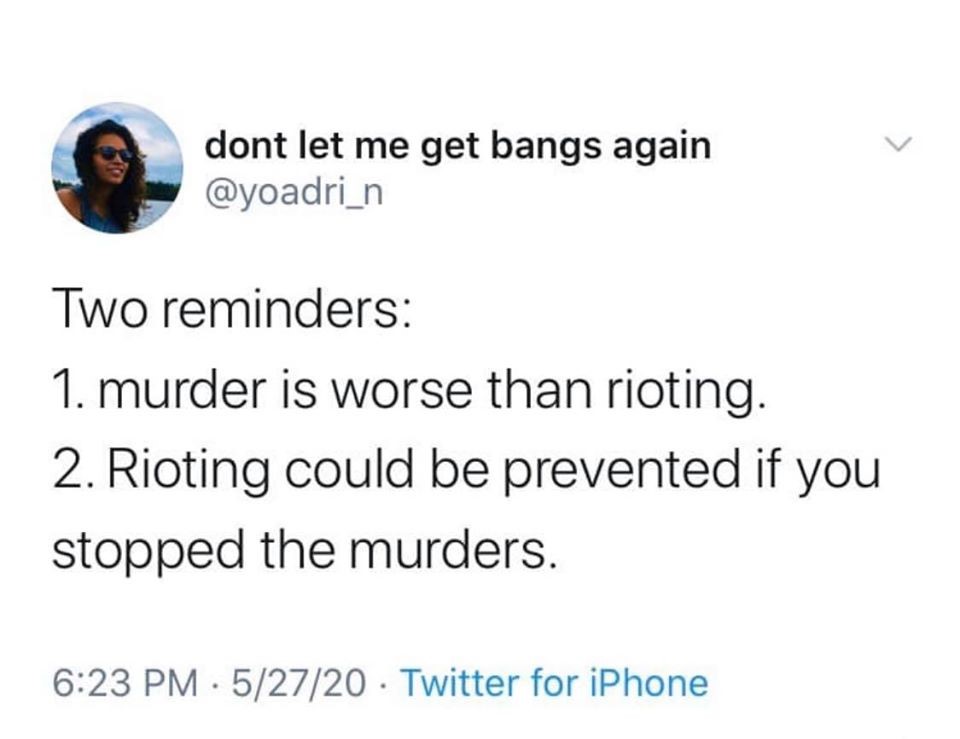
murder vs riot
Icantbreathe

Wednesday, May 27, 2020

Modern-day Colonialism

"All records stemming from the redress process of the Indian residential school legacy should be public record and not subject to more legal wrangling," said Garnet Angeconeb, who attended Pelican Lake Indian Residential School, near Sioux Lookout and received the Order of Canada, in an email. "We often hear that the Indian residential schools legacy is our 'collective' or 'shared' history as a country. Why then is that one side is driving this contemporary history through the use of law? It looks like, smells like, feels like modern-day colonialism at its best."

READ: Ottawa's move to block statistical reports on residential schools 'modern-day colonialism,' says survivor | CBC News

Tuesday, May 26, 2020

American Holocaust: The Destruction of America's Native Peoples

How Being Separated From My Family and Tribe Affected Me


By Jacqueline Davis, Activist          

Today the Supreme Court will hear Adoptive Couple v. Baby Girl, a case about a South Carolina Indian girl who the South Carolina Supreme Court ruled that the child must be returned to her Indian father. The child's mother ignored the Indian Child Welfare Act (ICWA) of 1978, a federal law designed to protect Indian families from "abusive child welfare practices that resulted in the separation of large numbers of Indian children from their families and tribes through adoption or foster case placement" and, as a result, both the tribe and the father were denied their rights under ICWA.
As the Supreme Court hears this case, the coverage has been largely one-sided. I thought it was important for people to hear my story, and how being separated from my family and tribe has affected me.

My name is Jacqueline Davis. I am one of six siblings affected by a decision made by the state of South Carolina. I am a member of the Cheyenne River Sioux Tribe in South Dakota and my grandfather is Chief Dave Bald Eagle. My father, who is African-American, met my mom and married her while he was stationed in the Air Force. They eventually moved off the reservation to South Carolina. Their lives changed one day when my mother applied for WIC and the nurse realized that she spanked her children as a form of discipline. Their children were taken and placed in foster care. We were split in pairs. The charges were piled on, and our parents lost custody. The Bald Eagle family offered to take us on the reservation and for reasons I still don't know they were told our case had nothing to do with ICWA. I can remember my parents coming to visit us for years.

Read the rest here:
http://www.aclu.org/blog/racial-justice/how-being-separated-my-family-and-tribe-affected-me

The Risk of Extinction due to #Covid-19

Native communities in the U.S. have suffered disproportionately from COVID-19, with higher rates of infection and death. The Navajo Nation has implemented a series of strict lockdown measures in an effort to protect its population, but health care facilities have still been overwhelmed. In fact, tribes across the country see the pandemic as representing an existential threat. Stephanie Sy reports.

Back in New Mexico, there are significant clusters of cases in the state's Pueblos. By one estimate, 11 percent of the Zia Reservation of only 646 members were infected. At that rate, leaders are concerned about the risk of extinction.

WATCH: Native communities have been hit hard by COVID-19 -- and fear for their survival

For more information on reports, helpful prevention tips, and more resources, please visit the Navajo Department of Health’s COVID-19 website at http://www.ndoh.navajo-nsn.gov/COVID-19.
To contact the Navajo Health Command Operations Center, please call (928) 871-7014.
For the latest news from the Office of the President and Vice President, please visit http://www.opvp.navajo-nsn.gov/ or find us on Facebook, Twitter, and Instagram

Thursday, May 14, 2020

Rural Matters — Coronavirus and the Navajo Nation

Navajo Nation Doc: Matthew L.M. Fletcher


From the New England Journal of Medicine, here.

The Navajo Nation, Diné Bikéyah, is 27,000 square miles of high-altitude desert, steep canyons, red rock spires, and extinct volcanoes, which, at this time of year, are still spotted with snow. The population density is among the lowest in the contiguous United States: seven people per square mile. If you didn’t know better, the vast landscape would seem a perfect setup for social distancing.
HIGHLY RECOMMENDED.

Monday, May 11, 2020

Midnight Shine - Sister Love (Celebration of Sisters!) @midnightshineon

FUN FACTS
Ø  Adrian
Sutherland, Midnight Shine founder and frontman, wrote Sister Love from a poem written by his sister Iris Sutherland – she shares co-writing credit on the song. 
Ø  Adrians
Mom played acoustic guitar, keyboard, and sang, instilling in him his love of music, and inspiring him to play. 
Ø  Sister
Love
 is Midnight Shine’s 2nd most streamed song on Spotify – second only to Heart of Gold (which now has more than 227,000 YouTube views).
Ø  Sister
Love
 reached #1 on Canada's Indigenous Music Countdown when it was released.

Friday, May 1, 2020

Coming Up: Native America Calling

Native America Calling is a national call-in program that invites guests and listeners to join a dialogue about current events, music, arts, entertainment and culture.

The program is hosted by Tara Gatewood (Isleta Pueblo) and airs live each weekday from 1-2 pm Eastern.


Join the conversation by calling 1-800-996-2848.


There is no one way to address the coronavirus threat. The state of Alaska has relatively few COVID-19 cases. But some vital modes of transportation are already shut down and Native villages are working on keeping potential virus exposures at bay. It's a different story in urban centers that the U.S. Census says is home to nearly seven out of every 10 Native Americans. In Los Angeles, the Native population is large and diverse. Organizations like United American Indian Involvement is helping elders and others coping with a significant and growing health threat. We'll hear the various ways leaders are tackling the coronavirus emergency to suit the needs of their people.


Isolation because of the coronavirus doesn't stop the need to raise awareness of a tragic statistic for Native people. May 5th is the National Day of Awareness for Missing and Murdered Native Women and Girls. Organizers are encouraging virtual walks, candles in windows, and twitter campaigns to keep the light on the disproportionate number of victimized Indigenous women and girls.


The COVID-19 pandemic axed the much-anticipated U.S. theater release of the film, "Blood Quantum." The good news is audiences can now see it online. The film is about a zombie outbreak near a Mi'gmaq reserve in Canada. It's directed by First Nations filmmaker, Jeff Barnaby and has a host of Native stars, including Michael Greyeyes (Cree), Elle-Máijá Tailfeathers (Blackfoot and Sami), Forrest Goodluck (Diné/Mandan/Hidatsa /Tsimshian) and Gary Farmer (Cayuga/Tuscarora/Mohawk).


Expecting mothers face added anxiety because of the coronavirus pandemic. They may be separated from their newborn if they test positive for the virus or are showing symptoms. At the same time, just going to a hospital to give birth increases the chances of getting exposed to coronavirus. We'll get medical advice on what precautions pregnant women can take and hear from those who facing difficult decisions during their pregnancies. Have a question? Send us an email at comments@nativeamericacalling.com.


The global COVID-19 pandemic generates fear and confusion for a lot of people. As always, scam artists are ready with new and creative ways to exploit people's fears and steal their money. The Federal Trade Commission is coming down on marketers who falsely claim to have COVID-19 cures. The agency is also warning about phone calls from criminals pretending to be sick family members needing money. We'll get reminders on how to protect yourself from the latest frauds and scams.


click

Contact Trace

Name

Email *

Message *

NO MORE UPDATES

GO TO:  https://blog.americanindianadoptees.com/  for updates and news. THIS BLOG cannot be updated...