Roxanne
Dunbar-Ortiz on the Roots of the NRA and the Second Amendment
FROM THE INTERCEPT PODCAST April 2018
JEREMY SKAHILL: There’s a new book that just came out that lays out a
provocative argument for getting rid of the Second Amendment in its entirety,
and the book asserts that the NRA has become a white nationalist organization.
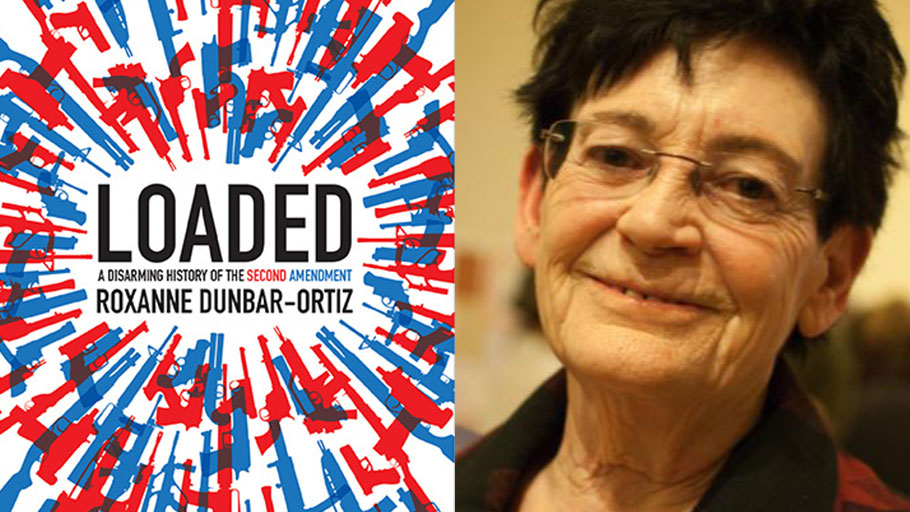
That book is titled “Loaded: A Disarming History of the Second Amendment” and
it was written by the radical historian Roxanne Dunbar-Ortiz. Her book tells a
very different tale about the so-called gun culture in the United States and
about how the Second Amendment was, at its core, a solidifying of the rights of
white people to bear arms to steal native land by force, to capture so-called
runaway slaves and to prevent rebellions from oppressed people. It wasn’t about
hunting. It wasn’t about protecting against the tyranny of government. It
wasn’t about simply protecting your property from criminals and thieves. Sure,
those arguments are made by Second Amendment enthusiasm. They’re certainly
representative of a lot of people’s motives for possessing guns.
Roxanne Dunbar-Ortiz is the author
of many books, including “An Indigenous People’s History of the United States,”
“Roots of Resistance: A History of Land Tenure in New Mexico,” and “Blood on
the Border: A Memoir of the Contra War.” Her latest book, again, is called,
“Loaded.”
Roxanne Dunbar-Ortiz joins me now.
Welcome to Intercepted.
Roxanne Dunbar-Ortiz: Thank you, Jeremy.
JS: If the United States has a gun culture, what is that gun
culture?
RDO: It’s a weapon of settler colonialism, all over the world:
Australia, New Zealand, Canada, Argentina, where settler colonialism was used.
But in the United States, by putting it in the Constitution, that sacred
document, as an individual right, it veered considerably from those other
settler colonies.
From the very beginning, guns and
ammunition were required in the colonies, in Virginia and then in Massachusetts
Bay Colony and then in Virginia first, that every man, every household had to
have firearm and a certain amount of gun powder and bullets. And if they
couldn’t afford that, the colonial government would subsidize it.
So, what were they so afraid of?
That they had to have all these guns because they were on land that they had
stolen by burning people’s villages down, by killing, raping, maiming and
driving Native people into the periphery where they fought back and tried to regain
their land and also keep them from taking more.
So, U.S. settler colonialism was
really required, the whole build-up of the United States, a white nationalist
democracy: Every man a king with land. And, of course, then, institutionalized
slavery took hold by the 1670s — out of these militias they carved slave
patrols as well.
So that dual usage: you know, the
right to own human bodies and land and to steal them, kidnap people, and kill
people — really genocide — is just written into the very cellular structure of
the United States: The Constitution, every institution.
And that, plus the militarism that
lasted from before, during and after independence, and continued until 1890,
more than 100 years of daily, moment-by-moment warfare against native people,
at the same time invading other countries: The Barbary wars in 1806 and 1809,
and then Mexico, 1846 to ’48, that just continued and continued and then jumped
over the Pacific and into the Caribbean and then into the whole world. So, the
militarism is the key component of it and only a third of the population even
own a gun, and there’s a good portion of those who are combat vets.
JS: Hmm. The exact text, “A well regulated Militia, being
necessary to the security of a free State, the right of the people to keep and
bear Arms, shall not be infringed” — now, I’m not asking you about more
recent interpretations by various courts, but at that time, in 1789, when they
were referring to a well-regulated militia being necessary to the security of a
free state, what was the historical context, and what did they refer to when
they were talking about well-regulated militia?
RDO: Well they certainly weren’t talking about state militias,
because those were provided for in the Constitution itself, that’s the
genealogy of the National Guard. But the Bill of Rights which was, came later
[than] the amendments, these were individual rights, very specifically
individual rights, so they could only have referred to the existing citizen’s
militias.
But they came to be self-organized
— they were very well organized for selfish interests, for their own
purpose — the state, the government had no authority over them whatsoever.
And this was how the whole continent was taken, was these settlers themselves
organized, that every, every settler a soldier, they’re all armed, they say,
out in their fields and everything and they’re, they’re all well-organized, so
they could in minutes call up of a militia and they knew what to do. It was in
their self-interest, so.
JS: Well, what were these militia doing?
RDO: Killing Indians! Taking their land. And, then the land was
theirs. And the slave patrols were also self-organized. It was really every
white man had an obligation to keep an eye out, even if they didn’t own slaves
to keep an eye out and turn in any stray black person that didn’t have a permit
on him, that he’s doing some errand for the owner, and if he didn’t have that
then he was considered a renegade — you know, had to be captured and
returned to the owner.
keep reading🔻
JS: Right, you write in the book, and this is a quote, “The
astronomical number of firearms owned by U.S. civilians, with the Second
Amendment considered a sacred mandate is also intricately related to
militaristic culture and white nationalism. The militias referred to in the
Second Amendment were intended as a means for white people to eliminate
indigenous communities in order to take their land and for slave patrols to
control black people.”
RDO: Slave patrols, several scholars have traced the genealogy
of slave patrols into modern police forces so we still see the controlling of
especially young black men by police forces. It’s not just history; it has led
up to the exact kind of situation, both militaristic and institutionally
violent society that we have now.
JS: When you listen and watch the current debate about guns in
this country, what is your critique of the way that the Second Amendment is
discussed by opponents of guns? Can you lay out your perspective on that?
RDO: You know, their arguments are “you don’t need an automatic
weapon, you don’t need an assault rifle to kill a deer.” It is so stupid. It
was never ever, ever about hunting. It’s never had anything to do with that.
And of course for these gun nuts, you know, they think that is hilarious
because they know what guns are for: guns are to kill people.
The other argument that liberals
make is they create a bogeyman. It’s all about money and it’s advertising and
sales and, you can say it’s capitalism. Well, of course everything is related
to the evils of capitalism, but it’s not all about money. There is a populist
basis, very large and it’s much larger. I consider the NRA the largest and most
powerful hardcore white nationalist organization maybe in the world right now,
except maybe for the U.S. government at this point. But they argue that either
the gun industry or the NRA or both together in cahoots are the problem. It’s
because they have so much money and they bribe congressman.
What they do is get these people
unelected or elected or out of office through their base. They are a mass-based
organization with chapters everywhere in the United States and they’re
activists. That is what they live for. They are gun nuts, gun fetishes, and
they’re one-third of the population, 80 percent of those are white, but 61
percent are white males.
That is the constituency. It’s like
liberals, and even a lot of leftists, do not want to face the fact that there’s
this much power. There’s been very little legislation ever, because as long as
it was a nice, secure white republic up to World War II, with Jim Crow fully in
charge, legal segregation, redlining and everything throughout the north, it
was secure.
And then, then the civil rights
movement which, of course, had always gone on — black resistance, native
resistance — but it had a great success right after World War II, and that
was the desegregation decision of the Supreme Court. That was the trigger, that
was the earthquake, the tsunami that set off the new wave of white supremacy.
It wasn’t really even needed. It always was there. But it wasn’t really needed
in an organized way, as long as they controlled everything. I mean they were —
they ran the whole government. Southern senators ran the Senate. They had
nothing to worry about.
So, you see this tighten up with the
founding of the LAPD, the new LAPD: It was an all-white, paramilitary, white
nationalist police force. It’s never really lost that veneer or structure. It
still has problems.
You know this is a rebellion. This
is counter-revolution that started almost, I mean really at the time of the
first victory, and built up and built up until it was taken over, the NRA was
taken over by a gun nuttery group founded two years earlier, Harlon Carter,
former vicious Border Patrol agent.
Harlon Carter: Thanks to you, the members and supporters of NRA, no
national gun law has passed this year. We will stand together strong,
dedicated, shoulder to shoulder for what is right.
RDO: And they infiltrated and got the vote and took over the
NRA: That’s when it became a completely white supremacist organization and
started emphasizing the Second Amendment.
HC: Any national gun law, no matter how innocent in appearance,
presupposes a still further growth, in a centralized, computerized, gun-control
bureaucracy in Washington D.C., a monstrous invasion of the rights to privacy
of you law-abiding and decent people who have never committed a crime and
concerning whom there is no evidence you ever will.
JS: You write: “By the time of its 1977 convention, the Second
Amendment Foundation and its lobbying arm, the Citizens Committee for the Right
to Keep and Bear Arms, which was founded in Washington state in 1974, seized
leadership of the NRA. And you state: “The Constitution is the sacred text of
the civic religion that is U.S. nationalism, and that nationalism is inexorably
tied to white supremacy.”
RDO: Yes. We are weird in the world and the United States with
this sanctification of a constitution. They built into the Constitution almost
an inability to change it. But again, the originalism arose with this
counterrevolution against black freedom.
But it really is an individual
right. It was meant to be an individual right from the very beginning. So, you
know, it really needs to be abolished, that’s what it needs to be. But it’s not
the vehicle that produces the violence; it’s the violence that leans on this
phony, sacred object, the Second Amendment, to the point that even all of these
liberal congress people, you hear them, over and over, preceding their efforts
for gun control, but:
Senator Bernie Sanders: But we have millions of people who are gun owners in this
country, 99.9 percent of those people obey the law. I want to see real serious
debate and action on guns. But it is not going to take place if we simply have
extreme positions on both sides.
RDO: But that’s ridiculous, you know? What are they supporting?
You know, do they know what that supporting? And then other liberals like Nancy
Pelosi, they argue that it’s out of date, and if you think through what that
means, it means, well, we don’t have to kill Indians anymore.
House Minority Leader Nancy Pelosi: We all support the right, the Second Amendment right to
bear arms.
RDO: She forgets we still have to kill black people, though,
apparently, and Muslims and Mexicans. So, it’s really an ineffective argument
because they just go round and round: “Well, if you really believe in the
Second Amendment.”
But I’ve heard it before. They say,
“Oh, these old guns back then.” And, you know: “If we had individual right to a
musket and plenty of gunpowder, then that would be fine.”
But, you know, they killed a hell of
a lot of Indians with those muskets, they were good with those things, you
know, they had whole wars, people were killed in Europe with muskets. It’s not
nothing.
JS: Well and you also write quite bluntly, “White nationalists
are the irregular forces, the volunteer militias of the actually existing
political economic order. They are provided for in the Second Amendment.”
RDO: Yeah. They are. If people want that, then they should
continue supporting the Second Amendment, but if they want to find out what the
Second Amendment is really about and that takes a historical contextualization,
because it wasn’t even debated at the time. It was already in the colonists —
when they broke away with the Declaration of Independence, they each formed
sovereign states. And of course the Constitution, seven, eight years later was
to bring them together in a federation. But in their constitutions, they had
already put in the mandate for the continuation of these citizen’s militias and
the right of carrying arms. And Thomas Jefferson wrote the one in the Virginia
Constitution and imported it to the Bill of Rights.
So, there was no discussion, there
was no argument, no one said, “Oh, should we do this? Is it an individual
right?” There was no argument. Everyone knew what it was about. What else could
it have been for? Since they had actual state militias and the Army and the
Navy in the Constitution.
JS: You mentioned earlier, you were giving some of the
statistics, 74 of gun owners in the United States are male, 82 percent of gun
owners are white, meaning 61 percent of all adults who own guns are white men
and that group is around 30 percent of the total U.S. population, and then, I’m
quoting here: “The top reason U.S. Americans give for owning a gun is for
protection. What are the majority of white men so afraid of? Does anyone
believe that centuries of racial and economic domination of the United States
by white men have left no traces in our culture, views or institutions?” What
are you saying there?
RDO: White men have a problem. We have a problem with white men.
It’s not the people I come from: the tenant farmers, the sharecroppers, the
poor people — they have their own gun problems. It really is the powerful
defense industry, the powerful agribusiness industry, more and more the tech
industry, that I think is — we have to bring class into the — I tell you,
most of the poor white men in this country can’t afford those — weapons are
very expensive and the really nice ones are very expensive. The average gun
owner owns eight.
And that means some people, like the
Las Vegas shooter, he owned something like 45 high-powered weapons all bought
legally, and he’s a very wealthy man, you know, so.
And then we get into ROTC [Reserve
Officer Training Corps], Junior ROTC, in all the schools teaching little kids
to shoot lethal weapons, many of them, of course, go into the actual army, but
this kid in Florida was from age 11 in Junior ROTC and he was a fanatic.
Everyone interviewed said all he would ever talk about was, “Guns, guns, guns,
and ROTC.”
And yet in these funerals, you know,
and all they’re honoring these JROTC kids who were killed and not at all
putting any focus on these defense industry-funded programs in all of our
public schools and even middle schools.
JS: And in the book, you make that connection. You’re talking
about the way that we discuss so-called mass shootings in our society, and you
write: “Just why these events, horrific as they are and tragic for the families
and communities traumatized by senseless violence and loss, loom so large in
the public mind is a mystery when during the entire period since the 1966
Whitman massacre, the United States has perpetrated massive amounts of violence
around the world responsible for killing millions of people and families.”
What you’re talking about there is
something that you, I don’t know if we’ve ever heard that kind of connection
being made from politicians on Capitol Hill, the idea that all of these wars
that the United States is engaged in around the world to this moment and all of
that history of slaughtering indigenous people, the slave patrols, the
lynchings, etc., that they are also connected to the violence that we see
happening in our movie theaters, our churches and our schools.
RDO: Every U.S. war, if you exclude the two shortest wars, World
War I, World War II, where the U.S. came in at the end and took the spoils in
both, there’s never been a moment in U.S. history that it’s not at war
somewhere. Most people don’t even know about all these wars, the endless ones
in Central America and the Caribbean all through the 19th century and 20th century,
sort of ingrained, you know?
But now they’re more in the open and
they were actually covertly with CIA counterinsurgencies during the ’50s,
because people were tired of war. And after Vietnam, they had to go convert
back into Central America and Afghanistan, those were covert CIA-run wars.
But with the Gulf War, H.W. Bush
said, “Well finally, we got rid of the Vietnam syndrome and we can be proud of
invading a country.”
President George H. W. Bush: Should military action be required, this will not be
another Vietnam. This will not be a protracted, drawn-out war.
RDO: The school shootings, and especially workplace shootings
did not start just then. They started with the Vietnam veteran who shot from the
Texas towers. He was never in Vietnam by he was trained as a sniper.
Reporter: This is a KLRN news bulletin. A sniper with a high-powered
rifle has taken up a position on the observation deck on back of the tower on
the campus of the University of Texas. He is firing at persons within his
range. All Austin-area residents —
RDO: And then you have the workplace shootings, the postal
workers, as they begin to shrink the post office and government institutions,
you know, in the late ’70s, and “Going Postal” became the phrase.
Reporter: Good evening. Here’s what’s happening: Someone in the post
office had killed 14 people inside, then taken his own life. That somebody was
44 year-old Pat Sherrill. He shot everybody in sight.
RDO: Other kinds of shootings: Charleston, South Carolina.
Reporter: Witnesses say he announces that he is there to shoot black
people and he does, opening fire, killing nine people: six women and three men.
JS: You’re talking about Dylann Roof and something about that
case that I had never heard before that you pointed out was that he carried out
that massacre on the 193rd anniversary of the Vesey-led revolt. Denmark Vesey
who was born into slavery, then won the lottery, purchased his own freedom was
unable to purchase the freedom of his wife and his sons.
Then this potential opportunity
arises when the Missouri Constitution is being discussed in 1820 and he thinks,
maybe it will go in his direction and he could actually facilitate freedom for
his wife and his children. It doesn’t go that way. He, and again, there, you
know, you’re saying that you’re citing your own historical research on this,
but you believe that he felt extremely disappointed and felt like there was no
hope of getting them freed through the law and he began to, inspired by the
Haitian revolution, organize other free Africans to engage in an uprising in
Charleston. And before that uprising could kick into effect, white militia and
slavers descend on him and his cohort and they very brutally murder them.
RDO: He’s a very charismatic preacher, and he had an open public
church. Slaves on their Sunday, you know, on their off-time could come to the
church, they could see his family there, even. They started plotting and you
know these slave patrols, they had ears everywhere, so they were able to
prevent it from happening and then they hung and desecrated the bodies.
And that church, you know, still is
a sacred place to all descendants of enslaved Africans and that Dylann Roof
chose this place and came into a prayer meeting where he was welcomed, there
were only 8 or 9 people at that prayer meeting, I, you know, I grew up in the
Southern Baptist church and I know those Wednesday night prayer meetings, and
he sat there through the whole prayer meeting, and then killed almost all of
them. He actually left one alive to tell what happened.
Well, you know, very quickly they
found out that Dylann, he had been in delving into the white nationalist
websites. Dylann Roof was completely unrepentant, was very proud of what he
did, obviously in no way mentally disturbed.
This mental disturbance thing, you
know I would think Barack Obama could be considered mentally disturbed, if you
ask who’s killing people every day, isn’t that crazy? But, you know, in fact
it’s normalized. So certain things were in the boundaries of being normalized,
and Dylann Roof was, I didn’t hear anyone calling him mentally ill and he was,
they didn’t even make that argument at trial, he refused it.
But I don’t think it’s just
marginal, I think it’s almost like, in a nutshell, symbolic of what I said of
it being a counter-revolution, this whole Second Amendment, it’s rise again and
importance and the sacredness of it. We’ve just got to stop giving that to
them, and that means soul-searching about the gun fetish, and gun culture.
JS: Roxanne Dunbar-Ortiz, we’re going to have to leave it
there. Thank you so much for joining us on Intercepted.
RDO: Thank you, Jeremy.
JS: Roxanne Dunbar-Ortiz is author of the new book “Loaded: A
Disarming History of the Second Amendment”
[Musical interlude.]


:max_bytes(150000):strip_icc()/GettyImages-640487433-32d1b5524d614d80bdec6e1f07ceb3cb.jpg)