BLOGGER changed, not allowing us to UPDATE this back-up blog

(UPDATED 726/2025) issues with blogger are preventing this

Sunday, July 11, 2021

Vicar of Oblate of Mary Immaculate Missions and St Joseph’s Industrial School (Canada)

(WHO RAN THESE RESIDENTIAL BOARDING SCHOOLS?? It is important to remember that early Church missionaries were actively raising money to run schools to educate savages and ultimately kill children in the process. The Oblates are still in business!  TLH)


GRANDIN, HENRI (named at birth Henri-François), Roman Catholic priest, Oblate of Mary Immaculate, and educator; b. 20 May 1853 in Sillé-le-Guillaume, France, son of Florent-Thomas Grandin, a butcher, and Modeste-Françoise Morin; nephew of Vital-Justin Grandin*; d. 16 Feb. 1923 in Paris.

Like his uncle, the bishop of St Albert (Alta), Henri Grandin attended the Petit Séminaire de Précigné and the Grand Séminaire du Mans. On the occasion of the Oblates’ general chapter in France in 1873, Bishop Grandin spoke at the seminary attended by his nephew and persuaded the young man to accompany him to Canada. After his arrival the following year, Henri attended the noviciate of Notre-Dame-des-Anges at Lachine, Que., and he made his perpetual profession of faith on 27 May 1875. He then journeyed to St Albert, where he was ordained by his uncle on 30 November. The young priest celebrated his first mass the following day and his first high mass on 5 December.

Henri Grandin was immediately placed in charge of the minor seminary established by Bishop Grandin in St Albert; he also taught there. As an administrator, he demonstrated qualities that soon ensured his appointment to positions entailing more responsibility. In 1880 he was made superior of the Lac Ste Anne mission, where he provided instruction to novices who were completing their theological studies prior to ordination. Three years later he was appointed the first resident priest in Fort Edmonton (Edmonton) and curate of St Joachim’s parish. In 1889 he became superior of the Lac la Biche mission, which had been transferred from Bishop Grandin’s jurisdiction to that of Bishop Henri Faraud* of Athabasca-Mackenzie. The status of the mission had been a constant source of controversy between the two bishops, and Henri Grandin was sent there to ensure that the interests of the diocese of St Albert were protected when Faraud relinquished control. In 1897 he was named superior of the Saddle Lake district, and he later became temporary curate of Saint-Paul-des-Métis (St Paul, Alta), where he built a new church. He returned to Lac la Biche as superior for the years 1903–5.

In the latter year Bishop Émile-Joseph Legal* of St Albert decided that the Oblates serving in his diocese should have their own organization, distinct from that of the diocese, and he asked to be replaced as vicar of missions, that is, superior of all the Oblates in the diocese. Consequently, on 8 Sept. 1905 Grandin was appointed to this position. The following year, Bishop Albert Pascal of Saskatchewan also asked to be relieved of his responsibilities as vicar of missions, and Grandin assumed charge as well of the Oblates serving in the vicariate apostolic (soon to be the diocese of Prince Albert). When the Oblate province of Alberta-Saskatchewan was created in 1921, he would be appointed provincial.

As Oblate superior, Henri Grandin was responsible for, among other things, recruiting and preparing new members. To this end, he inaugurated the Juniorat de Saint-Jean l’Évangéliste in Pincher Creek, Alta, in 1908; two years later this institution was moved to Edmonton. He was also instrumental in establishing the Scholasticat de Marie-Immaculée in Edmonton in 1917 to enable western candidates for the priesthood to study in the west, rather than have to complete their theological and philosophical studies in Ottawa. Grandin had to deal with John Thomas McNally*, bishop of Calgary from 1913, who felt that there were too many French orders in his diocese. As part of his solution to what he regarded as the legacy of a “dead and useless past,” McNally ordered the Oblates to vacate their parish in his episcopal city and St Patrick’s parish in Lethbridge. The question of ethnicity also involved Grandin and McNally in a controversy over St Joseph’s Industrial School for native students at Dunbow, which was having serious problems attracting and retaining pupils from southern Alberta. 

The school was under the jurisdiction of the Oblates, and McNally alleged that it was not being properly conducted because none of the staff was English-speaking or competent to teach that language. 

For his part, Grandin argued that some of the institution’s problems resulted from the fact that the Department of Indian Affairs and its agents were not assisting the Oblates with recruitment. He would not bow to pressure from McNally to close the school, and he informed the bishop that he alone would have to make the decision as to the institution’s future.

In his capacity as religious superior, Grandin devoted much time and energy to overseeing the efficient management of the Indian residential schools administered by the Oblates. He was aware of the necessity of maintaining harmonious relations between the missionaries attached to these institutions and the female religious communities who performed certain functions in the schools. 

As a missionary and an administrator, Grandin was also concerned with the welfare of the native populations served by the Oblates. He made representations to the federal authorities for the services of a doctor to treat the Indians and asked that the Oblates be provided with medicines and instructions on how to dispense them. 

In his report to the general chapter in 1908, Grandin expressed the fear that the native population in his vicariate was on the verge of extinction as a result of epidemics and diseases. 

He was supportive of continuing the Oblate ministry among the Métis, even when their economic and spiritual welfare declined as a result of contact with whites.

In the last years of his life Henri Grandin suffered ill health, and in January 1923 he returned to France to seek medical attention. He died in Paris after undergoing surgery and was buried in the Oblate vault in Montmartre. A skilled administrator, as evidenced by his many years as religious superior, he had also demonstrated a keen interest in education. Grandin was a warm and generous individual, and his personal charm endeared him to everyone who knew him. Unfortunately, he remains relatively unknown and his contribution largely ignored because he has been eclipsed by both his uncle and the legendary Albert Lacombe*.

Written by Raymond Huel

Arch. Départementales, Sarthe (Le Mans, France), État civil, Sillé-le-Guillaume, 20 mai 1853. Arch. of the Roman Catholic Diocese of Calgary, Bishop J. T. McNally papers. PAA, Arch. of the Oblates of Mary Immaculate, Prov. of Alberta-Saskatchewan, 71.220, items 3376, 7732; 84.400, items 883, 893–95, 898, 900. “Alberta et Saskatchewan,” Missions de la Congrégation des missionnaires oblats de Marie Immaculée (Rome et Bar-le-Duc, France), 47 (1909): 133–34. P.-É. Breton, “Histoire du collège,” in Collège Saint-Jean: cinquantième anniversaire, 1911–1961, ed. A. Duhaime (Edmonton, [1961]), 32–33. Gaston Carrière, Dictionnaire biographique des oblats de Marie-Immaculée au Canada (4v., Ottawa, 1976–89), 2: 105–6. The diaries of Bishop Vital Grandin, 1875–1877, trans. A. D. Ridge, ed. B. M. Owens and C. M. Roberto (Edmonton, 1989). “Feu le R.P. Henri Grandin, o.m.i.,” Les Cloches de Saint-Boniface (Saint-Boniface [Winnipeg]), 22 (1923): 51–54. R.[-J.-A.] Huel, “La mission Notre-Dame-des-Victoires du lac la Biche et l’approvisionnement des missions du nord: le conflit entre Mgr V. Grandin et Mgr H. Faraud,” in Western Oblate Studies 1: proceedings of the first symposium on the history of the Oblates in western and northern Canada . . . , ed. R.[-J.-A.] Huel et al. (Edmonton, 1990), 17–36. “Jubilé d’or du R.P. Gabillon, o.m.i.,” Missions de la Congrégation des missionnaires oblats de Marie Immaculée (Rome), 65 (1931): 755–58. “Lettre du R.P. Leduc au P. Aubert,” Missions de la Congrégation des missionnaires oblats de Marie Immaculée (Paris), 15 (1877): 297–306. “Oblations,” Missions de la Congrégation des missionnaires oblats de Marie Immaculée (Paris), 14 (1876): 562–66. “Le premier siècle de Saint-Joachim,” Missions de la Congrégation des missionnaires oblats de Marie Immaculée (Rome), 87 (1960): 70. “Le R.P. Grandin, vicaire des missions de Prince-Albert,” Missions de la Congrégation des missionnaires oblats de Marie Immaculée (Rome et Bar-le-Duc), 44 (1906): 469. “Rapports au chapitre général de 1908: Alberta et Saskatchewan,” Missions de la Congrégation des missionnaires oblats de Marie Immaculée (Rome et Bar-le-Duc), 47 (1909): 133–41. [E.] B. Titley, “Dunbow Indian Industrial School: an Oblate experiment in education,” in Western Oblate Studies 2: proceedings of the second symposium on the history of the Oblates in western and northern Canada . . . , ed. R.[-J.-A.] Huel with Guy Lacombe (Lewiston, N.Y., and Queenston, Ont., 1992), 95–113. M. B. Venini Byrne, From the buffalo to the cross: a history of the Roman Catholic diocese of Calgary (Calgary, 1973).

Saturday, July 10, 2021

Methodist Missionary Caroline Knott and the Coqualeetza Residential School

Coqualeetza (Chilliwack Home) - NCTR
 (Examining who was in charge of some of the residential schools is disturbing... TLH)

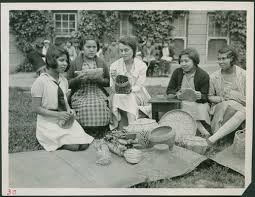
Young girls practicing basket weaving
A group of young girls practicing basket weaving on the front lawn of Coqualeetza

KNOTT, CAROLINE SARAH (Tate), Methodist lay missionary and teacher; b. 1842 in London, England, eldest daughter of John Knott, a piano maker, and Caroline Sarah ---; m. 24 Oct. 1879 the Reverend Charles Montgomery Tate in Fort Simpson (Lax Kw’alaams), B.C.; d. 7 May 1930 in Victoria, British Columbia.

Caroline Knott came to Upper Canada with her family from England in 1856 or early in 1857. Shortly after their arrival in Hamilton, Caroline’s mother died, leaving her in charge of seven brothers and sisters. When they grew up, she applied to the general committee of the Wesleyan Methodist Missionary Society for mission work. She was posted as a schoolteacher to aboriginal children, first at Rice Lake and then at Sault Ste Marie. When the call came for teachers to go to the Methodist mission at Fort Simpson in 1875, Caroline responded and was chosen, despite the fact that she was already 33 and was somewhat older than most applicants. At Fort Simpson she established herself as a good worker, winning the esteem of prominent Methodist missionary Thomas Crosby*. Four years after her arrival, she met and married Charles Tate. Together they embarked on over 31 years of missionary service, the longest of any couple in British Columbia, including postings at Bella Bella, Rivers Inlet, Burrard Inlet, Clayoquot, and Chilliwack.

Caroline Tate was both remarkable and typical of her time. The mere fact that her missionary career lasted so long indicates incredible fortitude and faith. Historian Rosemary Gagan has argued that home mission work, particularly among the First Nations, was often more physically and psychologically demanding than similar work in Asia. The majority of home missionaries left their jobs within five years and few continued until their retirement. Even at the time of her marriage, Caroline had outlasted many of her contemporaries in Fort Simpson. In total, she worked as a missionary among the First Nations for over 35 years and spent an additional 15 years in church organizations in Victoria. In many of her attitudes towards her work and towards the indigenous peoples with whom she associated, however, she was typical of her time.

As a missionary, Caroline lived an adventurous life for which little in her previous experience would have prepared her. She worked at a time of high mortality among the First Nations and so witnessed countless epidemics and deaths. Always reliant on the goodwill of aboriginal leaders for their survival, the Tates boarded in traditional longhouses, travelled in canoes over the ocean, and, when they reached a new posting, often had to build the mission from the ground up. On their arrival at Bella Bella in 1881, for instance, the crew of the steamer Princess Louise made a raft out of the lumber the Tates had brought to construct a house and a church and set them adrift on it as they approached the village. The Heiltsuk chief Humcheet organized a party to rescue the missionaries and welcomed them into his home. While other missionaries soon tired of the damp isolation of the northwest coast, the Tates endured.

Despite her many varied experiences in the field, Caroline Tate shared the negative attitudes towards aboriginal peoples then common among missionaries. Like them, she disdained aboriginal culture, particularly the feasting rituals associated with marriage and death. She approached indigenous healers with fear and loathing. Her attitudes towards women were mixed. She frequently blamed the deaths of children on what she saw as the poor housekeeping skills of their mothers. Yet she also viewed herself as saving indigenous women from a misogynist culture. On a speaking tour of Ontario in 1897 she reported to audiences of the Woman’s Missionary Society and the Woman’s Christian Temperance Union that only the work of missionaries saved the lives and honour of aboriginal women and children. Though Indian agents and others rightly disputed her claims, she reported that infanticide was widespread, that children were sold into marriage, and that widows were often killed or maimed. She supported the ban on the potlatch on the grounds that the traditional feasting abused women by forcing them to generate wealth by prostitution. Her diary is replete with references to her efforts to disrupt aboriginal funerary practices with prayer and singing. She reports few aboriginal women friends, although her husband’s diary frequently refers to indigenous men he respected and relied on. Her fear of aboriginal culture never abated and fuelled her work to replace it with Christianity.

Like many other missionaries, Tate believed that cultural change could best be accomplished by removing children from their families. At Chilliwack she started to take into her home aboriginal girls who were orphaned or who were estranged from their community. Out of this endeavour emerged the Coqualeetza Home (later the Coqualeetza Institute), a Methodist boarding school which opened in 1889 on Stó:lo land at Sardis. Like that of many residential schools, Coqualeetza’s legacy is mixed. It was not immune from the cultural, emotional, and physical abuse that plagued other institutes. 

A report issued in 1905, after the Tates had moved on to another post, stated that over 20 per cent of Coqualeetza graduates died shortly after they left the school and pointed to poor institutional conditions as the cause. Yet the institute also helped produce a generation of aboriginal leaders in the province, of whom Haida chief Peter Kelly* is the most prominent example.

The Tates retired to Victoria in 1910. Caroline Tate remained active in church work until 1925, becoming the first member of the Woman’s Missionary Society of the Methodist Church of British Columbia. She died in 1930. Charles Tate died three years later.

Mary-Ellen Kelm

AO, RG 22-205, no.2073. BCA, MS-0303. British Columbia Vital Statistics Agency (Victoria), Marriage registration records, 1872-1925 (mfm. at Victoria Geneal. Soc.). LAC, RG 10, 6422, file 869-1, pt.1; RG 31, C1, 1861, Hamilton, [Ont.], St Lawrence Ward: 368; 1871, Hamilton, St Andrew’s Ward, div.1: 65. New Outlook (Toronto), 4 June 1930. Victoria Daily Times, 7 May 1930. Directory, Hamilton, 1858, 1862-63. R. R. Gagan, A sensitive independence: Canadian Methodist women missionaries in Canada and the Orient, 1881-1925 (Montreal and Kingston, Ont., 1992). Jan Gould, Women of British Columbia (Saanichton, B.C., 1975). C. M. Tate, “A story of missionary adventure,” Western Recorder (Victoria), December 1929: 20-22. Western Recorder, May 1930. Margaret Whitehead, “Women were made for such things: women missionaries in British Columbia, 1850s-1940s,” Atlantis (Wolfville, N.S.), 14 (1988-89): 141-50.

BIOGRAPHY 

 THE SCHOOL https://chelancody.opened.ca/life-at-coqualeetza/ 

Coqualeetza: The Residential School that Stood Apart

While the assimilationist agenda of the government and church were being implemented daily at Coqualeetza, work was done by two principals to introduce Indigenous practices into the curriculum for the students. Principal Raley insisted on displaying approximately 800 pieces of Aboriginal artwork around the school, all from his personal collection. Raley was the one who suggested improvements to the new building, and it would be in this new building that he would introduce basket weaving and wood carving. R.C. Scott, the principal who succeeded Raley, continued this forward. He introduced carding, spinning, dyeing, knitting, and weaving for the girls. For the boys he introduced machinery to aid in carving, and encouraged the production of miniature totem poles. After officials began to question his focus, he promised to direct more attention to practical training that would be “useful” for the students after leaving Coqualeetza. Nevertheless, administrators traveling to the school noted that Coqualeetza stood out in its well kept facility and highly regarded education. Although the motivations may not have been right, it was clear that many of the staff members deeply cared for the students. 

(We will have to wait and see if they also have hidden unmarked graves...)


Friday, July 9, 2021

Grave Digger Bishop and Architect of some Residential Schools (Canada)

 (written by historian Raymond Huel, Professor of history, University of Lethbridge, Alberta.)

Original title:  Mgr. Émile Legal, OMI, [1897-1920]. (OB3272 - Oblate Collection at the PAA)

Source: Link

LEGAL, ÉMILE-JOSEPH, Roman Catholic priest, Oblate of Mary Immaculate, and bishop; b. 9 Oct. 1849 in Saint-Jean-de-Boiseau, France, son of Julien Legal and Perrine David, millers; d. 10 March 1920 in Edmonton.

Émile-J. Legal studied at the petit and grand séminaires in Nantes, the Collège de Machecoul, and the Université de France. He was ordained on 29 June 1874 and served in the diocese of Nantes prior to entering the Oblate noviciate in Nancy in 1879. As a result of restrictive state legislation governing religious orders, he was sent to Lachine, Que., where he completed his probationary year and made his perpetual vows on 24 Sept. 1880. Before being posted to the Canadian northwest, he served in Plattsburgh, N.Y., Montreal, and Buffalo, N.Y., where he studied English.

Legal arrived in St Albert (Alta) in August 1881 and was sent to minister to the Peigan in October. He spent the winter of 1881–82 on the Peigan Indian Reserve and visited other Blackfoot camps in the summer months in addition to ministering to the needs of Catholics in nearby Fort Macleod. In 1886 Legal opened a small school on the Peigan reserve and, two years later, he organized missions among the Blood. In 1889 he founded Saint-François-Xavier mission at Stand Off on the Blood Indian Reserve. He succeeded in having the Department of Indian Affairs build a hospital there in 1893 and confided its administration to the Grey Nuns of Nicolet, Que.

In the mid 1890s the health of Bishop Vital-Justin Grandin* of St Albert was causing concern among the clergy of the diocese, who believed that the appointment of a coadjutor was crucial. Legal’s candidacy had been suggested earlier by Father Albert Lacombe. On 29 March 1897 Legal was named titular bishop of Pogla and coadjutor of St Albert. He received the news of his nomination on 6 May, shortly after having personally buried a young resident of the Blood reserve, and thus the influential La Croix (Paris) referred to him as “the grave-digger bishop.” He was consecrated in St Albert on 17 June 1897 and chose as his episcopal motto Nos autem in nomine Domini (“As for us, we speak in the name of the Lord”). The Blackfoot named him Sspomitapi, meaning “he who sits on high.” Upon the death of Grandin on 3 June 1902, Legal became bishop of St Albert; he was made archbishop of Edmonton on 30 Nov. 1912.

As both missionary and prelate, Legal demonstrated remarkable intellectual and creative talents. He designed and constructed many buildings while serving in the Blood and Peigan missions. As bishop, he drew plans for numerous churches and carefully scrutinized those that were submitted by parish priests. He designed residential schools at Brocket, Stand Off, Blackfoot Crossing, and Saint-Paul-des-Métis (St Paul). He also marked out construction sites, purchased materials, and obtained the necessary authorizations to build. His plans for the cathedral in St Albert combined Gothic, neo-Roman, neo-Baroque, and Moorish styles. Construction began in 1902 but Legal had to modify his design to reduce costs in view of local economic conditions. With the creation of the archdiocese of Edmonton in 1912 and the subsequent transfer of the episcopal seat to that city in 1917, a cathedral in St Albert was no longer necessary and Legal turned his attention to constructing one in Edmonton.

Legal’s creative activities found expression as well in numerous studies of the traditions and customs of the Blackfoot and their language, including articles published in Les Missions catholiques (Lyon), the Catholic encyclopedia (New York), and the Bulletin of the Société de Géographie de Paris. He also collaborated with Lacombe in the preparation of a Blackfoot, Blood, and Peigan vocabulary. In addition, he undertook geological studies and corresponded with the Smithsonian Institution. He was awarded an lld honoris causa by the University of Alberta in 1915.

Upon being named coadjutor in 1897, Legal had assumed responsibility for the expansion of the diocese of St Albert, especially the creation of new parishes and institutions to serve a rapidly growing immigrant population. These activities he later recalled in Short sketches of the history of the Catholic churches and missions in central Alberta. As bishop, Legal also concerned himself with the status of Catholic schools in his diocese and he communicated with federal and territorial officials. 

In 1904, prior to the creation of the provinces of Alberta and Saskatchewan, he was asked by the apostolic delegate, Donato Sbarretti y Tazza, to prepare a draft clause for the Autonomy Bills safeguarding the principle of denominational schools in the new jurisdictions. Legal felt that the compromise clause negotiated between the apostolic delegate and Prime Minister Sir Wilfrid Laurier was inadequate: although it conferred separate-school privileges on the religious minority in any district, it did not define precisely the school system that was to be established. Nevertheless, since the apostolic delegate approved of it, Legal believed that it had to be upheld. In February 1905 Legal was interviewed for the newspaper United Canada (Ottawa). He expressed his hope that separate schools would be maintained and that Catholics would take action to support them. The published version, however, indicated that Legal was satisfied with the educational clause of the bills, and this allegation outraged other members of the hierarchy such as Archbishop Adélard Langevin of St Boniface. Undoubtedly the bishops did not appreciate Legal giving an interview to a non-Catholic paper on such a delicate issue. They were, moreover, anxious to present a united front.

In the last years of Legal’s life his fellow French-speaking prelates were concerned over his succession. With the appointment of an English-speaking bishop, John Thomas McNally*, in Calgary in 1913 and the creation of the archdiocese of Winnipeg out of the archdiocese of St Boniface in 1915, ethnic rivalries had become a matter of fact in western episcopal nominations. Despite his declining health – he was a diabetic – Legal had not secured the appointment of a coadjutor and, in 1920, there were fears that Rome rather than the bishop himself would choose a successor or that it would appoint an English-speaking auxiliary. Legal died on 10 March 1920 and both French- and English-speaking factions of the hierarchy made representations to Rome on behalf of appropriate candidates. The appointment of Henry Joseph O’Leary* as archbishop of Edmonton in September seriously undermined the domination of the French element in the western sees.

WRITTEN BY Raymond Huel

Legal’s compilation of Short sketches of the history of the Catholic churches and missions in central Alberta was published in Winnipeg around 1914. Archival material concerning the subject is found in the collections of the Arch. Deschâtelets, Oblats de Marie-Immaculée (Ottawa), the Arch. Générales des Oblats de Marie-Immaculée (Rome), the Arch. des Oblats de Marie-Immaculée (Montreal), the Arch. de la Prov. Grandin (St Albert, Alta), and the Arch. of the Oblates of Mary Immaculate, Prov. of Alberta-Saskatchewan, held at the PAA.

Gilles Cadrin, “Émile Legal: de l’architecture des missions à l’architecture monumentale,” in Western Oblate Studies 2: proceedings of the second symposium on the history of the Oblates in western and northern Canada . . . , ed. R. [-J.-A.] Huel with Guy Lacombe (Lewiston, N.Y., 1992), 237–19. Gaston Carrière, Dictionnaire biographique des oblats de Marie-lmmaculée au Canada (4v., Ottawa, 1976-89). R.[-J.-A.] Huel, “The Irish French conflict in Catholic episcopal nominations: the western sees and the struggle for domination within the church,” CCHA, Study sessions, 42 (1975): 51–70. 

BIOGRAPHY

Thursday, July 8, 2021

It’s long past time for our country to apologize publicly for what it did to Native people

 Ed. Note: It's time Native People correct the his-story, our-story, and that won't be easy. TL Hentz


A dozen long years ago, we led the congressional effort to issue an official apology by the U.S. government to Native peoples. Now it's time for the U.S. president to make good on that sentiment and say it publicly.

It’s time — long past time — to officially acknowledge what our country did and to speak an apology. Not only for taking children from Native families, but for the broken treaties and the carnage visited upon First Nations people by U.S. government policy. Without this necessary step, the healing process our community desperately needs cannot truly commence, and we cannot repair the resentment that stems from our troubled past.

GOOD READ: Opinion | It’s long past time for our country to apologize publicly for what it did to Native people - The Washington Post


Wednesday, July 7, 2021

'One day there will be no children in care,' says Cowessess Chief after historic child welfare deal inked

 Agreement signed in ceremony on Saskatchewan First Nation Tuesday

Cowessess First Nation Chief Cadmus Delorme said he hopes to see the day when there are no local children in care. (Matthew Howard/CBC)

WARNING: This story contains distressing details

Cowessess First Nation in Saskatchewan is the first Indigenous group in Canada to ink an agreement with Ottawa for federal funding of locally controlled child welfare services since the Act Respecting First Nations, Inuit and Métis Children, Youth and Families came into force last year. 

But Cowessess First Nation Chief Cadmus Delorme is already looking to the future. 

"One day there will be no children in care," he said at a ceremony on the reserve marking the pact Tuesday. 

"[I'm] 39 nine years old and I hope that happens in my lifetime. But we have a lot of work to do."

WATCH | 'We are gaining control,' Cowessess First Nation Chief Cadmus Delorme says: 

Work to be done on healing and growing for Cowessess First Nation

Chief Cadmus Delorme shared his hopes for the future of Cowessess First Nation, but stated that the community would need to 'roll up our sleeves' to turn hope into reality.

The act allows for First Nations to assume authority over local child welfare systems under so-called co-ordination agreements and paves the way for children in care to remain in their home communities. 

Cowessess First Nation is the first Indigenous group in Canada to sign such an agreement. The deal also comes with $38 million in funding over the next two years to support the band's further implementation of its own child welfare system, which actually began operating in April. 

"Across the country, we are working with other First Nations to reach similar agreements," said Prime Minister Justin Trudeau, who joined Delorme and Saskatchewan Premier Scott Moe for the ceremony.

WATCH | Justin Trudeau signs local child welfare pact with Cowessess First Nation: 

Trudeau signs child welfare agreement with Cowessess First Nation

VIDEO: Prime Minister Justin Trudeau visited Cowessess in southeastern Saskatchewan on Tuesday.

As of last month, Indigenous Services Canada received requests from 38 bodies representing 100 Indigenous groups and communities who want to follow in the same footsteps as Cowessess First Nation, according to a news release

Eighteen formal discussion groups focused on signing future agreements are now underway.

Trudeau did not cite a goal or timeline for finalizing those pacts.

'Intergenerational trauma is very real'

Cowessess has not had decision-making power over children in care since it was stripped of it in 1951, according to a letter distributed by Delorme on Monday. 

More than 80 per cent of children in care in Saskatchewan are Indigenous, according to a 2018 children's advocate report

That began to change with 2019's passage An Act Respecting First Nations, Inuit and Métis Children, Youth and Families, federal legislation aimed at reducing the number of youth in care and allowing communities to create their own child-welfare systems. 

Cowessess did that in 2020, when it asserted its inherent rights over its children and families. 

While noting the recent discovery of 751 unmarked graves associated with the former Marieval Indian Residential School, Trudeau said his government has been working with Cowessess on the child welfare funding agreement for years.

Moe said it's no surprise Cowessess is the first Indigenous community in Canada to reach such an agreement. 

"This is a progressive community [that] leads in so many other areas," he said.

Saskatchewan Premier Scott Moe lauded Cowessess for its progressiveness. (CBC)

The First Nation nation has opened a transition home for girls 14 and up.

Mia Buckles, chair of the Cowessess Youth Council, joined other speakers in linking the legacy of residential schools with the current situation of children in care. 

"First Nations intergenerational trauma is very real," she said. "I recognize that in my life and others lives around me. It plays a huge role in why so many of our people end up in foster care, incarcerated, addicted and uneducated."

Mia Buckles, the chair of the Cowessess Youth Council, said a local transition home will help efforts to reduce the number of children in care. (CBC)

Buckles said the transition home, Chief Red Bear Children's Lodge, will work proactively to prevent children from ending up in care in the first place. 

Funding to address root causes also needed: advocate

Cindy Blackstock, executive director of the First Nations Child & Family Caring Society of Canada, applauded Tuesday's agreement.

"The closer authorities are to the children, the better the outcomes are going to be, because they'll be able to see their needs and monitor those needs and respond to them over time and culturally appropriate ways," she said.

Advocate Cindy Blackstock says Ottawa also needs to fund efforts to address the reasons Indigenous children wind up in care. (CBC)

But Blackstock cautioned that federal funding is also needed to address the underlying socio-economic factors that land Indigenous children in care in the first place.

Those factors include poverty, housing, substance abuse and mental health issues related to residential school trauma, she said. 

"Unless the federal government is also announcing sufficient funding for that, then what we'll have is a child welfare program — a quality one, culturally appropriate — sitting atop this raging fire of inequality that is going to disable the community from being able to realize the goals they wish to realize with these kids."


Support is available for anyone affected by their experience at residential schools, and those who are triggered by the latest reports.

A national Indian Residential School Crisis Line has been set up to provide support for former students and those affected. People can access emotional and crisis referral services by calling the 24-hour national crisis line: 1-866-925-4419.

Indian Boarding School Survivors Take Action at Cathedral of Saint Paul


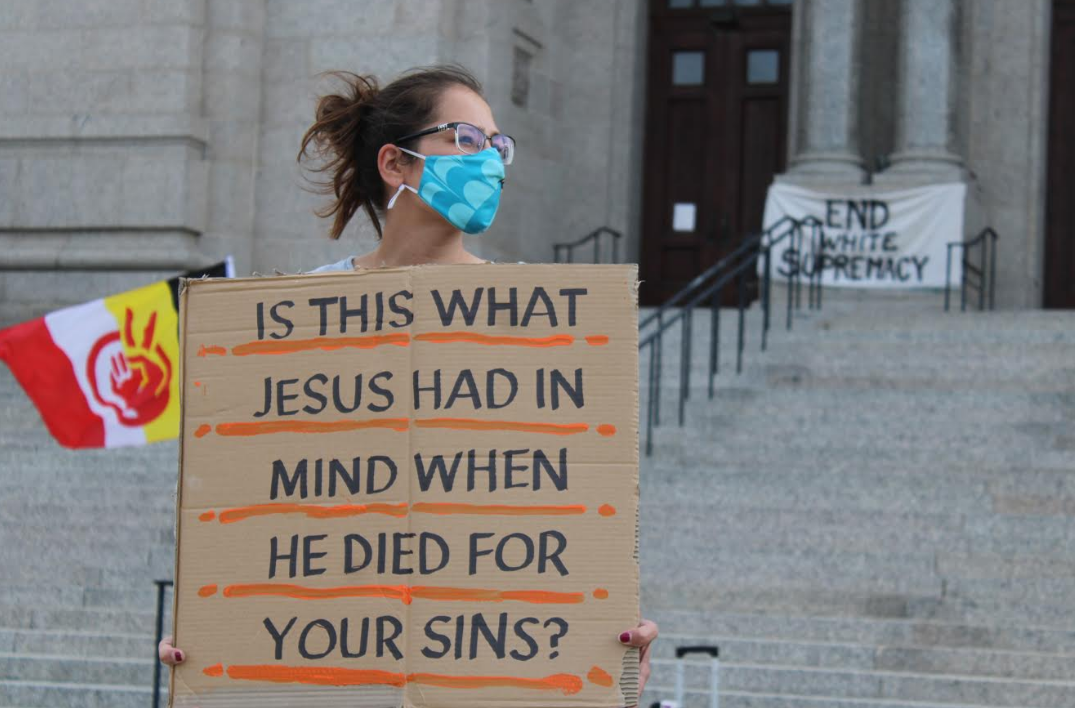
A demonstrator holds a sign at the steps of the Cathedral of Saint Paul on July 1, 2021. (Photo/Darren Thompson)


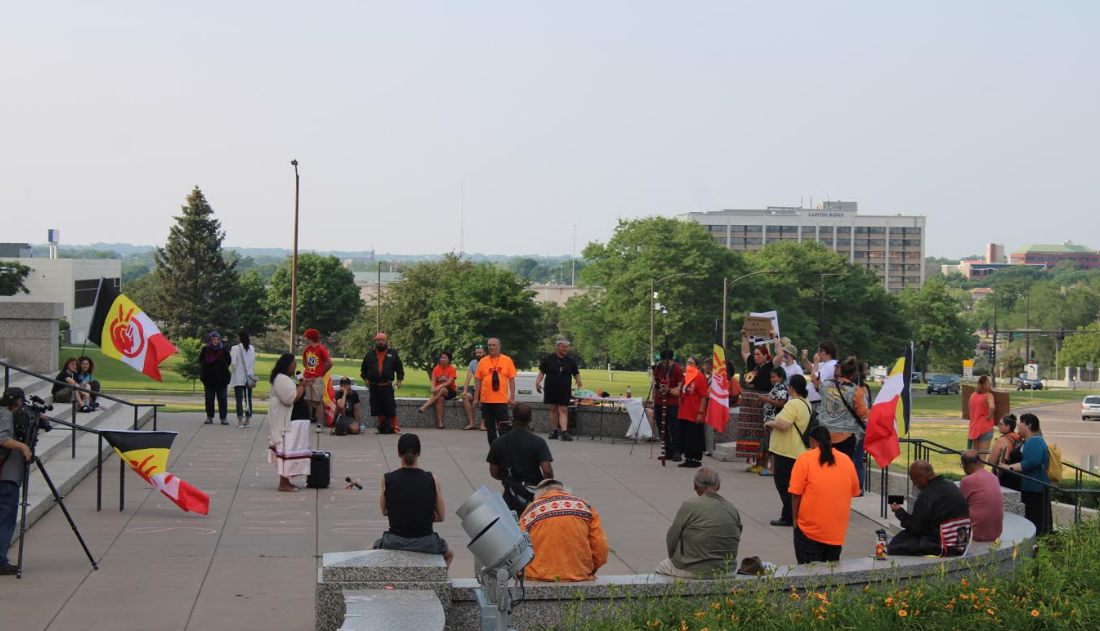
SAINT PAUL, Minn. — The American Indian Movement (AIM) Twin Cities chapter held a press conference and protest on Thursday outside the Cathedral of Saint Paul in the Saint Paul, Minn,

The event brought several dozen people from around the Twin Cities to protest the recent discoveries of more than 1,000 children found in an unmarked graves at various residential schools in Canada. 

“My name is Michael Anthony, after the Saint Michael and Saint Anthony,” AIM Twin Cities Chairman Mike Forcia said at the press conference. “The church must acknowledge its participation in the genocide of our people.”

Last year, Native News Online reported that Forcia was charged and convicted last year for the toppling of the Christopher Columbus at the Minnesota State Capitol grounds. 

Organizers posted American Indian Movement flags, sang on the drum, and addressed the history of boarding schools and its complicated relationship with the Catholic church. Demonstrators held signs in traffic that read "Search Every School!” and “From Canada to the USA, Honor Native Treaties.” 

Demonstrators host a press conference at the steps of the Cathedral of Saint Paul in St. Paul, Minnesota on July 1, 2021. (Photo/Darren Thompson)

A confrontation between tourists of the Cathedral and a demonstrator erupted into an argument over the land the church is built on. Shortly after, a fight broke out between a man who claimed he attended church at the Cathedral and a participant in the demonstration. 

The demonstration was held in conjunction with Cancel Canada Day, where tens of thousands of people demonstrated and marched throughout towns and cities in Canada. On day normally celebrated by Canadians for their country’s confederation on July 1, statues of Queen Victoria and Queen Elizabeth II were toppled. Thousands protested from coast to coast over the mass graves of Indigenous children being discovered at residential boarding schools that were operated for decades by the Canadian federal government and Catholic churches. 

“As more stories break of the bodies of over one thousand children being recovered from mass graves at boarding school sites in Canada, I find myself holding my eight-year-old daughter close each night,” Minnesota Lieutenant Governor Peggy Flanagan said to Native News Online. “These children never got to go home to their parents and their communities who loved them. They endured physical and sexual abuse, and their childhoods were stolen under the guise of ‘Kill the Indian, and save the man.’”

“Kill the Indian, and save the man” was the ethos instilled by General Richard H. Pratt—founder of the Carlisle Indian Industrial School in Pennsylvania, which established a model for other Indian boarding schools. It's goal was to strip American Indian children of their culture in order to "Americanize" them. At the Carlisle Indian School and at other Indian boarding schools, American Indian children were strictly forbidden to speak their tribal languages or practice their spirituality. Their clothing was burned and replaced with military drab, and long hair was cut and styled in Euro-American fashion. 

For American Indians, the boarding school left a lasting distrust of the entire U.S. education system. According to the National School Boards Association, Native American students performed two to three grade levels below their white peers in reading and math. They were two times more likely to drop out of school than their white peers, according to a study conducted by National Caucus of Native American State Legislators.

“This is not ancient history or a Canadian issue; our parents and grandparents in Minnesota and across the United States attended these institutions, but too many people do not know about this painful chapter in our history,” Flanagan added. 

Recently, at the National Congress of American Indians’ Mid Year Conference, Secretary of Interior Debra Haaland announced that she established the Federal Indian Boarding School Initiative, which is tasked with identifying past boarding schools throughout the country and investigating possible burial sites, then identifying those buried and returning the remains to their rightful tribes. A report from the initiative is due to Secretary Haaland on April 1, 2022.

“It is time to tell the whole truth about our history, and it is time to take action to ensure that Native children and people are safe, valued, and protected in their communities now and in the future,” Flanagan said.  SOURCE

Tuesday, July 6, 2021

Sixties Scoop survivor speaks her truth: 'I'm not going to hide it'


Sharon Boutilier was born in September of 1966, she is a survivor of the Sixties Scoop. (Photo courtesy of Sharon Boutilier).

CALGARY (660 NEWS) — Sharon Boutilier is of Whitefish River First Nation in Ontario, but she did not know that until she was 18 years old.

Born in 1966, Boutilier was taken from her family and adopted out to a Catholic family in Toronto, during a period known as “The Sixties Scoop”.

“My adoptive parents always told me that I was ‘Indian’, but I didn’t know what that meant, or if it was true,” Boutilier told 660 News.

“It was like growing up without an identity because you know people would ask me ‘where are you from’ and ‘what nationality are you?’ and I didn’t even really know who I was,” Boutilier explained.

“My [adoptive] mother was really good, but my dad was sexually abusive, and that was kind of hard. It was like, why are you doing this? Is it because I’m not your child?” Boutilier said.

She says that in order to move past this she had to learn to be honest about her story and speak her truth.

“I’m not going to hide it to protect anybody. Protecting other people was hurting me,” Boutilier explained.

When she turned 18, Boutilier went to the Catholic Children’s Aid Society with her adoptive mother, where she was given information about her birth family.

“You can get information about your family once you turn 18, but it’s non-disclosure so they don’t name them,” Boutilier explained.

“So when I got that information from the Catholic Children’s Aid, I knew I was Native. Even though I had blonde hair and blue eyes, now I knew for sure that I was Native,” she added.

Now that she was sure of her ancestry, Boutilier began to search for her family.

“I got the information to contact a woman on the reserve named Jenny Jocko, who happened to be friends with my family,” Boutilier explained.

LISTEN: Reporter Devon Banfield speaks with Sharon Boutilier 

Jocko was able to connect Boutilier with her birth mother.

“Then I got to meet my brother and sisters, and it was awesome,” Boutilier said.

When she reconnected with her family, she had wanted to learn more about her culture and background. But Boutilier learned that her family had been forcibly converted to Catholicism.

“They went to residential schools; they were taught from an early age to disconnect from your identity. Being traditional was sacrilegious,” Boutilier explained.

Despite this, she said that when she first went to meet her relatives, she felt like that was where she belonged.

“It was freaky but I felt like I was at home on the reserve. It’s called Blood Memory — that familiar feeling even though I hadn’t been there since I was a baby,” she told 660 NEWS.

Still looking to learn more about her ancestry, Boutilier soon got a job at the Native Canadian Centre of Toronto.

“I worked with a program called visiting schools where we would teach students about Native culture, like how to create regalia, drumming and dancing, and other things,” she explained.

Boutilier says that through her time working with the Native Canadian Centre of Toronto she gained a better understanding of how the residential school system has affected generations of families in First Nations, Metis, and Inuit communities.

“How’re you going to know how to be a parent when you never had parents, if you were raised in an institution. If you weren’t shown that love and caring of what it is to be a family or what is to be a mother, then how are you going to know when you have your own children?” Boutilier explained.

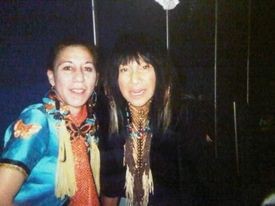
“My [adoptive] mom would always say that I was Indian like Buffy, but I didn’t understand what it meant to be Indigenous.” Boutilier with Buffy St. John, Toronto 2008.

“My mother has struggled with addictions her entire life, after spending most of her childhood seperated from her family and culture by these institutions,” she added.

It’s been over 30 years since Sharon Boutilier first reconnected with her family, and Boutilier says that meeting them was the first step in healing from her own trauma.

“One thing that really helped me in my journey was when an Elder told me that we come from the stars,” she explained. 

“We are put on this Earth to learn more, it made me feel like I was on the right path by learning about my Peoples.”

Boutilier says the Canadian Government’s reaction to recent discoveries on the grounds of former residential schools is insulting to Indigenous communities.

“When Stephen Harper made his apology in 2008 I worked at the Native Centre. I watched the Natives breakdown in tears, the Elders, watching the apology on TV and I heard the stories about what they went through,” Boutilier explained.

“I believe the Prime Minister needs to stand up and stop saying that the Canadian Government is shocked. This was planned by the government, executed by the churches as a cultural genocide,” she added.

Boutilier said that recent marches, protests and vigils in support of the Indigenous communities has given her hope for the future.

“Seeing all the people turning out to these events brought tears to my eyes, because it feels like Canadians are finally waking up,” Boutilier said.

“The Sixties Scoop” occurred from the early 1950s through the 1980s, and saw tens of thousands of Indigenous children removed from their families and adopted out to non-Indigenous families.

Monday, July 5, 2021

Safety During a Violent Encounter


From
: StrongHearts Native Helpline

Be aware that in an abusive relationship, violence is used as a tactic for the abuser to maintain power and control over the victim-survivor. The violence will continue and may escalate in intensity and frequency.

Safety planning is an individualized process where a practical plan is created that includes ways to remain safe while in an abusive relationship. An advocate can help you produce a plan and discuss your options with you.

If a violent encounter seems imminent and unavoidable, there are a few options to consider to keep you safe. These tips cannot guarantee your safety, but by using your experience and intuition, along with these tips, you may be safer. You are the best person to judge your safety.


     Try to control your breathing in through your nose and out through your mouth so you can continue to think clearly.

     Say or do whatever you can to de-escalate the situation.

     Avoid rooms or areas without an easy escape.

     Stay on the ground floor if possible.

     For example, a basement with stairs and one point of entry will be difficult to escape from during a violent attack.

     Mentally plan how you might escape from each room in advance.

     Be aware of your surroundings. Think about what you could use to shield yourself when your partner becomes abusive.

     Avoid getting into a vehicle.

     Avoid areas where weapons are easily accessible.

     Kitchens are dangerous because of the access to knives. Bathrooms are dangerous because of slipping and the many hard surfaces in a small area. Garages or sheds can also be dangerous because of access to tools and other heavy equipment.

     Avoid any areas where firearms are stored or kept, even if they are locked securely.

     Remove necklaces and scarves if possible as these could be used to strangle you. Remove earrings.

     Move away from any children in the area.

     Consider safe places to go after escaping.

     Choose a code word or signal that would let children, relatives or neighbors know they should call for help.

     Hide spare keys and money in a safe place or ask a safe person to hold onto them for you in case you need to flee unexpectedly.

     If you are unable to get away from the abuser and are being assaulted, try to make yourself as small as possible to minimize any injuries. Get into a corner or put your back to a wall, bring your knees to your chest and use your arms to cover your neck.

     You have the right to protect yourself and that includes calling the police. 

After the Violence

After a violent encounter, it can be difficult to process what has happened, take time for yourself to recover and reconnect with yourself. Seek medical attention if needed and is safe to do so. Consider documenting the violence and abuse. Take pictures and write descriptions of the abuse in a journal or open an email account and email them to yourself. If there are any medical or police reports documenting the abuse, keep the records. Make sure your information is kept in a safe place. Keeping documentation will allow you to have an option to pursue legal action in the future.

Participating in self-care activities like exercise, eating healthy, counseling, journaling, knowing when and how to emotionally check out during times of duress could be helpful. Be gentle with yourself mentally and physically. Practice your spirituality by smudging, praying or sitting with your traditional medicines if this helps heal your spirit.

“Immediate safety is important and long-term safety planning should be considered when you are in or exiting an abusive relationship,” said StrongHearts Services Manager Joy Samuelson (Standing Rock Sioux Tribe). “Our advocates can help you plan for your safety, no matter what your current situation is.”

StrongHearts Native Helpline is a 24/7 culturally-appropriate, anonymous, confidential and free service dedicated to serving Native survivors, concerned family members and friends affected by domestic, dating and sexual violence. 

Call or text 1-844-762-8483 or click on the chat icon at strongheartshelpline.org to connect with an advocate. 

StrongHearts Native Helpline is a project of the National Indigenous Women’s Resource Center and the National Domestic Violence Hotline.

*Tips adapted from The National Domestic Violence Hotline.

Sunday, July 4, 2021

Restoring and Reclaiming Indigenous Family Names (Canada)

 She Struggled To Reclaim Her Indigenous Name. She Hopes Others Have It Easier


A new Canadian policy answers a 2015 call for government action. Danita Bilozaze hopes it means that no one will face the resistance she did to rescue her name from a history of forced assimilation.


For as long as she can remember, Danita Bilozaze knew that the name on her birth certificate, "Danita Loth," didn't reflect her Indigenous identity.

From the stories her mother recounted to her, she knew that Catholic missionaries had changed her family's name. Her great-grandfather, a man known as Lor Bilozaze, was written into priests' logs as "Loth Bilozaze." Government record books in Canada ultimately dropped the "Bilozaze," and Loth became their surname.

She never felt a connection with that name. But "Bilozaze," which means "the makers" in her native Denesuline language, she said, is integral to the preservation of her identity and culture as a member of the Cold Lake First Nations.

"It means everything to me because it lines up with who I am," she said. "I am an educator, I am a teacher, I am a baker, I'm an artist. I'm always, always, forever making things. So when you have something that was taken away from your family, like your birthright or your name and you have a chance to make that right for future generations, it means everything to take back what is rightfully mine."

A step toward reconciliation

Earlier this month, federal officials in Canada announced a new policy process that allows Indigenous citizens to restore their names on government-issued identification, including passports, for free until May 2026.

It's unclear how many Canadians, 5% of whom are Indigenous, will pursue name reclamation under the new policy.

PLEASE READ: She Struggled To Reclaim Her Indigenous Name. She Hopes Others Have It Easier

The investigation that will change how America thinks about its past

In truth, the 367 boarding schools in operation in the U.S. were camps of strategic cultural genocide: This is what achieving civilization looked like in practice: 

Students were stripped of all things associated with Native life. 

Their long hair, a source of pride for many Native peoples, was cut short, usually into identical bowl haircuts. 

They exchanged traditional clothing for uniforms, and embarked on a life influenced by strict military-style regimentation.

Students were physically punished for speaking their Native languages. 

Contact with family and community members was discouraged or forbidden altogether. 

Survivors have described a culture of pervasive physical and sexual abuse at the schools. 

Food and medical attention were often scarce; many students died. 

Their parents sometimes learned of their death only after they had been buried in school cemeteries, some of which were unmarked. -The Atlantic

  Jeva Lange | July 2, 2021

Uncovering the abuses of Indigenous boarding schools will be Deb Haaland's most important legacy...

The horrors of the boarding school system are an open topic in Canada where, earlier this year, the remains of 215 Indigenous children were found in a mass grave at the Kamloops Indian Residential School in British Columbia. That sickening announcement was followed last week by the report of an additional 751 unmarked graves of children found near a residential school in Saskatchewan. Already this week, another 182 graves were found at a former school east of Vancouver, Canada. In total, an estimated 6,000 children are thought to have died at schools in Canada, while "it's likely that the number of students who died in the United States is much higher," Christine Diindiisi McCleave, the executive director of the National Native American Boarding School Healing Coalition (NABS), told High Country News.

GOOD READ: The investigation that will change how America thinks about its past

**

(click headlines)

ABC News
There were reports from the TRC -- a commission funded by the Canadian government as part of a legal settlement to address the wrongs of the system ...
 
TownandCountrymag.com
In 2015, the Truth and Reconciliation Commission identified this as "cultural genocide," and national anger has been mounting ever since. 

"We Were Children" trailer 2012


New legislation strengthens Oregon’s commitment to help preserve Tribal families

Oregon is the seventh state to pass a state-based ICWA in alignment with the federal act, joining states such as Minnesota and Tennessee. Before the federal act passed in 1978, generations of Tribal children across the country were removed from their families and communities, often placed without connection to their Tribal culture. 

“The passage of the Oregon Indian Child Welfare Act (ORICWA) in 2020 spoke to the State of Oregon’s commitment to protecting and preserving Tribal children and families,” said Adam Becenti, ODHS Tribal Affairs Director. “The recent changes to ORICWA will now enhance how Child Welfare engages with Tribal families and strengthen partnership with Oregon Tribal Nations. This is a significant step forward in repairing historical wounds and honoring the government-to-government relationship with Tribal Nations.”  MORE

Saturday, July 3, 2021

Shawnee man, victim of 60s Scoop, seeks truth about his life, heritage

SHAWNEE, KS (KCTV) -- There is a terrible secret about what happened 50+ years ago. Most of us have never heard about it.

It’s referred to in history as “The 60s Scoop.” It involves “scooping” Native American babies from their tribes in Canada for adoption to mostly white families.

Although it sounds long ago and far away, it’s become the defining fact in the life of a Shawnee, Ks, man.

“Being kidnapped at birth and human trafficked to an American couple it just floored me,” said Tim Tizya. “I can’t believe it happened.”

Tizya is a 60s Scoop survivor—a tragic story just coming to light. Tens of thousands Indigenous babies and children were advertised and adopted out to mostly white families.

Although the name references the 1960s, the practice started in the 1950s and continued well into the 1980s. Canada is now acknowledging the truth and offering reparations to survivors.

But to Tim Tizya, the money doesn’t make up for he’s lost.

“It's very insulting,” Tizya said. “I think it's a slap in the face, really.”

Growing up in White America

Tizya’s adoption story is told through tears, and years-old documents. Tim’s adoptive parents struggled with fertility. His dad was a firefighter in the Air Force and was stationed at a military base in Canada, but Tizya has spent most of his life in Shawnee, KS.

He grew up as Timothy Alan Vandruff and he says his parents were the best.

“My parents didn't know, and they always wanted to bring me back up to find out what happened,” said Tizya. “They wanted me to meet my mom, they wanted to be part of it. And if that's not love. I don’t know what is.”

But his life was full of questions.

“What had I done that my mom would want to give me up?” he asked. “I lived with that all my life.”

About ten years ago, he finally got answers. He learned he was born “Baby Boy Tizya.” Paperwork claims he was surrendered but Tizya now doubts that is true.

The search for family

With help from his daughter, he found other Tizyas. They were stunned to learn he was alive. Turns out his aunt had tried to track him down.

‘The government told her that I got killed in a car wreck in 1976. So that's when the search stopped when they got that phone call,” said Tizya.

Tim was the first born. He had a brother, Dane, who was also scooped and went to a family in Vancouver. A third brother, Mark, remained with the tribe. Tim’s mother took in her nephew, Justin.

So Tizya now has some information and papers he considers full of lies. He never had that important conversation with his birth mother to find the truth, because she died of brain cancer shortly after their meeting.

“I cry about every day,” said Tizya. “Yeah, we do that to people. I didn't do anything to anybody.”

Canada offering reparations

In 2017, Canada signed a class action settlement to compensate those children taken during the 60s scoop. They can apply for compensation from between $25,000 and $50,000. Reports in the Canadian Press reveal the range depends on what a person when through. The government concedes some children in foster homes faced physical, sexual and mental abuse, forced labor, starvation and neglect.

A graphic from the official website reveals just how widespread the 60s scoop really was.

So far, more than 34,000 people have applied for reparations, and about 16,000 claims have been approved.

Tizya’s claim was approved, but he has not yet received a payment. It’s clear he doesn’t feel reparations can adequately compensate him for his splintered soul. Part of him is with his tribe in Canada, part here in Kansas with his children.

“You don’t know where you belong,” said Tizya. “You belong to both, but it’s twisted.”

But he knows how the Scoop affected is people.

‘It's like we're lost.” He said. “A lost culture right in front of your face."


click

Contact Trace

Name

Email *

Message *

NO MORE UPDATES

GO TO:  https://blog.americanindianadoptees.com/  for updates and news. THIS BLOG cannot be updated...