BLOGGER changed, not allowing us to UPDATE this back-up blog

(UPDATED 726/2025) issues with blogger are preventing this

Thursday, June 20, 2019

Is It Time for Truth and Reconciliation in the U.S.? #BadHistory

Canada and South Africa both used similar commissions to grapple with their histories of racism and genocide. The U.S. could benefit from following suit.

GOOD READ: Is It Time for Truth and Reconciliation in the U.S.? by Yasmeen Wafai — YES! Magazine

YES, it is time for a Truth and Reconciliation Commission in the USA... We are still dealing with bad history...Trace 
 
The Maine Wabanaki-State Child Welfare Truth and Reconciliation Commissioners in 2016. Left to right Sandy White Hawk, Gail Werrbach, gkisedtanamoogk, Matthew Dunlap, and Carol Wishcamper. Photo from TRC.

Is It Time for Truth and Reconciliation in the U.S.?

For more than 100 years leading up to the late 1970s, Native children in the Wabanaki group of tribes of Maine were removed from their homes by state authorities and placed with White families in an attempt to erase their indigenous identity. To try to heal from this trauma, state and tribal child welfare workers collaborated to create the Maine Wabanaki-State Child Welfare Truth and Reconciliation Commission. “We were led by a real desire to make a difference in the child welfare system and native families, because playing nice wasn’t doing it,” said Esther Anne, a board member of the nonprofit Maine Wabanaki REACH. REACH, which stands for Restoration Engagement Advocacy Change Healing, is a cross-cultural collaborative organization with both Wabanaki people and non-Natives focused on restorative justice, education, and healing and wellness work, said Barbara Kates, a community organizer for the group. This system has been effective in other places. Canada completed a truth and reconciliation commission in 2015 to address the suffering of First Nations children in the residential school system. The report the Canadian commission produced detailed the abuse and subsequent trauma the children and families suffered. But every year since then, organizers in the village of Fort Langley, British Columbia, host a Walk in the Spirit of Reconciliation to honor the report’s release and to show solidarity with survivors.
The Maine Wabanaki-State Child Welfare Truth and Reconciliation Commissioners in 2016. Left to right Sandy White Hawk Gail Werrbach gkisedtanamoogk Matthew Dunlap and Carol Wishcamper. Photo from TRC.
Maine Wabanaki REACH conducted a 27-month investigation, which ended in 2015, into the family separations. Today, the group is continuing to stay focused on the self-determination of the Wabanaki people, said Anne, who is a member of the Passamaquoddy Tribe, one of the five in Maine and Quebec that make up the Wabanaki Confederacy. The commission’s work was the subject of the 2018 documentary, Dawnland. Kates also played a part in the commission, of which Anne was a co-founder. Kates worked in the Maine child welfare system and reached out to colleagues there to ask if they would be interested in coming forward and telling about their experience working with Native children who had been taken from their families. The truth and reconciliation commission was a grassroots effort, she said. “This came from the bottom up,” Kates said. This echoes a statement from Joshua Inwood, a geography professor at Pennsylvania State University, who said that truth and reconciliation commissions in the U.S. have typically taken a bottom-up approach. “Commissions that are successful in the United States are really grassroots driven,” he said. Inwood said how such commissions are run varies from case to case. For example, in an effort to heal from the 1979 attack on a unionization protest by members of the KKK in Greensboro, North Carolina, in which five demonstrators were killed, there was a public call for commissioners who researched archives, held a series of events to collect public testimony, and wrote a report that was then unveiled in a public ceremony. He also said several public meetings were held after the commission ran its course to keep that conversation going.
Tissues used by people who gave statements to the commission being burned in a sacred fire. Photo from TRC.
This is similar to the approach taken by the Maine-Wabanaki commission, which was modeled on the Greensboro commission, Anne said. Along with revealing the truth about family separations and promoting healing between Native and non-Native people, one of the goals for the commission was fostering change. The commission outlined 14 recommendations near the end of the report, released in 2015, that reflect the change it hoped to see, including some that touch on tribal sovereignty. Among the proposed changes for this are committing to state and tribal jurisdictions, supporting the healing and cultural resurgence of the Wabanaki people, and building cultural awareness. The commission also made recommendations pertaining to the U.S. Indian Child Welfare Act of 1978, which was created to protect Indian children and promote the stability and security of Indian tribes and families. The commission recommended funding the renewal of an ICWA work group and the regular monitoring of compliance with ICWA. There were also care-focused recommendations. One called for better and more consistent support for non-Native foster and adoptive families, while another recommended exploring the creation of more Native foster homes.
A still from Dawnland a documentary that focuses on the work of the TRC. Georgina Sappier-Richardson who was placed in foster care as a child sharing her story at a TRC community visit. Photo by Ben Pender-Cudlip/Upstander Project.
Different people had different experiences with the commission, but powerful change has been occurring in Indigenous and non-Native communities in Maine, Kates said. She explained that, because of the complicated nature of the issue, drawing absolute conclusions about what happened during the period of child separation is difficult, and as a non-Native, she said, she can’t make assumptions. But she has heard from others that people are connecting over their newfound understanding of the intergenerational trauma that occurred to the families and children. This included abuse and neglect, and suppressing the use of their Native language, according to the commissions’ report. Anne said one of the biggest changes she saw in tribal communities was that, after a long time of asking, “What is wrong with us?” they were talking about their trauma and trying to heal and understand, asking, “What happened to us?” However, not all truth commissions include a reconciliation portion. Bonny Ibhawoh, a professor of history and global human rights at McMaster University in Hamilton, Ontario, said South Africa’s commission after the apartheid ended was the first example of an emphasis on reconciliation. For Ibhawoh, the attraction of a truth and reconciliation commission is the opportunity it provides to address human rights violations on a mass scale. It allows victims to speak their truths, something you cannot always get from a trial, he said.
Nelson Mandela left receives a five volumes of the Truth and Reconciliation Commission final report from Archbishop Desmond Tutu in Pretoria on October 29 1998. The report reveals human rights abuse by various political parties during the Nationalist Party rule. Photo by Walter Dhaladhla/AFP/Getty Images.
A general debate runs within transitional justice circles as to whether or not there should be a reconciliation portion to truth commissions established by the state, Ibhawoh said. Some people argue that the state has no business trying to impose reconciliation, and that some people are just not ready to reconcile with or even confront their abusers, which risks further victimization, he said. The Truth Commission of Ecuador established by the government to investigate human rights violations committed by the government over many years serves as an example of a truth commission influenced by this view, Ibhawoh said. In other cases, as in South Africa, leaders like Nelson Mandela thought the country could be healed through a reconciliation process. In the context of the commission in Maine, Anne said she thinks the word “reconciliation” can be problematic in how people understand it and what their perspective is. During the commission’s work, White people wanted to get right to the healing, but the tribes needed to tell their truth, she said. Ibahawoh said he thinks the U.S. should seriously consider a truth and reconciliation commission as a model to try to heal from injustices like slavery and persistent racism.
The final meeting between staff and advisors from REACH and the TRC. Photo from TRC.
However, for a truth and reconciliation commission to be successful anywhere, he said, the victims and the government must communicate to find the best way to go about healing, whether it be through reconciliation or reparations. “The government wants to put (out) a reconciliation narrative at the expense of victims,” Ibhawoh said. Anne said commissions are just one way of approaching truth. Depending on the goals, restorative practices and informed knowledge in communities can happen anywhere. There is value in different ways of truth-telling and healing that do not need to be formal or institutionalized, she said. It would take a lot of time and resources, but if people were invested, she said, she thinks a commission could work nationwide. “The truth-telling that happened since the commission has been impactful,” Anne said. Editor’s note: An earlier version referred to Esther Anne with the surname Attean. 

This article originally appeared in Yes! Magazine at https://www.yesmagazine.org/social-justice/2019/06/19/reparations-truth-and-reconciliation-united-states.

Yes! Magazine is a nonprofit, independent media organization dedicated to telling stories of ... . Learn more at Yes! Magazine

Follow up NY Times Article on ICWA

Follow up NY Times Article on ICWA

Here.
“I think it means a lot to our foster kids that we’re Cherokee,” said Carney Duncan, a gentle, soft-spoken man whose hair falls below his shoulders. “My mom and dad always helped people and took them in. I have an ‘Uncle Joe’ who is no kin but we took him in. And a ‘brother’ who lived with us who is no blood kin. We help our own. It’s a Cherokee value.”

Given the daily racism that Native people endure, Schon said, he thought it was important for Native children to grow up in Native families, to ground themselves.

Tuesday, June 18, 2019

Sad News: Frank LaMere Walks On

siouxcityjournal.com photo

Sad News: Frank LaMere Walks On

by Kate Fort
 
Few of yesterday's articles about his life mention just how much work he did on behalf of Native children, including the March for Lost Children. In this interview, he speaks about making people uncomfortable--"Nothing changes until someone feels uncomfortable."
If you worked on ICWA in any capacity, you knew Frank LaMere. Keep making people uncomfortable.

**
Winnebago activist Frank LaMere, far right, speaks to the family of Zachary Bear Heels outside the bus station in Omaha, Nebraska, where the Native man first arrived on June 5, 2017. He later died after being beaten by police officers. A prayer walk took place in his honor on December 8, 2018. Photo by Kevin Abourezk
excerpt

‘We’re going to keep it going’

Matt Ohman, executive director of Siouxland Human Investment Partnership, a nonprofit in Sioux City, Iowa, that LaMere had worked with for nearly a decade, said LaMere was pivotal in bringing together leaders from many nonprofit and government agencies to help improve the lives of Native people in Sioux City.
Among those he built relationships with were Iowa Department of Human Services leaders, whom LaMere had heavily criticized following the deaths of several Native children in non-Native foster homes over 16 years ago.
“There was a lot of anger,” Ohman said about the deaths of the Native children. “It’s a testament to Frank because he used that to really develop a relationship with the Department of Human Services here, and now they are some of the biggest allies to the Native people.”
LaMere’s latest effort involved seeking Indian Health Service funds to build a detox center or halfway house for Native men in Sioux City. He and Ohman had traveled several times to Washington, D.C., to try to convince Congressional leaders, including Rep. Steve King of Iowa, to support efforts to fund the project.
Ohman said language has been included in the Interior appropriations bill now being considered by Congress to provide funding for treatment programs for Native people in Sioux City.
Last Tuesday, Ohman and other representatives from his organization visited with LaMere in his hospital room in Omaha.“His body had been through so much, but he was in good spirits,” he said.
“His biggest concern was, ‘I’ve got so many things going on right now, there’s so much work to do and here I am.’”
“I just assured him, ‘Hey, we’re not going to let the momentum die on any of these things while you’re recuperating. We’re going to keep it going and make sure all of this stuff keeps moving forward.’”

READ
Republished with permission from Indianz.com.

Monday, June 17, 2019

Intercept Article on ICWA and the Brackeen Case #ProudtoProtectICWA

Veronica Brown protest
“Babies don’t get born and run down to the citizenship office and file a petition,” said Matthew Fletcher, director of the Indigenous Law and Policy Center at Michigan State University. When his own child was born, he and his partner took a year to register him as a tribal member, in part because he was eligible for more than one tribal nation. “To say that somehow this kid hasn’t been enrolled yet and therefore doesn’t have a political relationship is really quite disingenuous.”

***

Reflecting on the rhetoric used by ICWA opponents like Sandefur, Nicole Adams, a spokesperson for Partnership for Native Children, pointed to the institutions that pushed for the use of boarding schools and adoption for decades before ICWA’s passage. “They were led by very well-intentioned Christian coalitions purporting that Indian children needed to be saved, and they were just the ones to do it. If you look at the rhetoric being put out by some of ICWA’s most staunch opponents, it is eerily and frighteningly similar.”

Intercept Article on ICWA and the Brackeen Case

by Kate Fort

Let’s tell the true story of the founding of America #TRC


Many believe that “the past is past,” and it’s time to move on. Such thinking ignores the traumatic impact of genocide on future generations and the continued oppression of indigenous Americans. I recently watched the film “Dawnland” at Amherst Cinema, which highlights the first U.S. truth and reconciliation commission to investigate the government of Maine’s removal of generations of indigenous American children from their families. In the 19th and 20th centuries, tens of thousands of children on reservations were severed from their families and sent to residential schools and foster homes in order to eradicate indigenous Americans through forcibly acculturating their children — another form of genocide.
The Indian Child Welfare Act was established in 1978 to end this century-long practice and to instead “... protect the best interests of Indian Children and to promote the stability and security of Indian tribes and families by the establishment of minimum Federal standards for the removal of Indian children and placement of such children in homes which will reflect the unique values of Indian culture.”
Critics of the ICWA argue that the law is race-based, ignoring the sovereignty of tribal nations. A Federal Appeals Court judge will soon be deciding the fate of this 41-year-old law based on a case heard in March. The consequences of overturning the ICWA would once again threaten the welfare of Indigenous American families. Today, indigenous American children are three times more likely to be removed from their homes than white children, according to “Dawnland.”

READ: Columnist Sara Weinberger: Let’s tell the true story of the founding of America

Monday, June 10, 2019

Readers on Adoption That Crosses Cultural Lines


[embed]https://www.nytimes.com/2019/06/07/reader-center/adoption-cross-cultural.html[/embed]


The New York Times
In the more than 700 comments posted on our site, we heard from adoptive parents and adoptees, Native Americans, foster parents, child welfare experts ...
Comments:
Alan Berkowitz
Mount Shasta, CA
The stories from adoptive parents and children are touching and raise many important issues. Many (both adoptive parents and children) point out the advantages of being raised in a loving home that is safe and secure in which they are also able to pursue and celebrate their tribal/cultural identity. This is a strong argument which however does not apply to the case in question, in which the adoptive parents show no interest in affirming or celebrating their children's native ancestry and culture AND there is a healthy and loving family of relatives that wants to adopt the two siblings in a home with other biological siblings. Therefore, as much as the arguments provided in the NYT article may merit discussion, they do NOT apply to this case, which represents a modern form of the legalized kidnapping that the dominant culture has perpetuated on Native peoples, notwithstanding the the adoptive parents claims of 'love' and 'religiosity.


linda diane
vancouver, bc
I was born in Canada to a Metis woman whose husband died just before the birth. I was adopted during the "Sixties Scoop" where thousands of indigenous children were taken from their home communities. An adoption to a white middle class family with an engineer father was seen as a big step up from the working class environment I came from. I had very conscientious adoptive parents, who were loving and did their best to help me be a part of a family of 6. They never lied to me. Unfortunately, that was not enough. I was taken from my mother. And my indigenous roots. Trauma. Period. This was never addressed, I muddled through life with an underlying sense of not being ok, faked alot and used various means of escaping. When I eventually found my birth mother, she had died two years previous. I have connected with cousins, but I have siblings i have not been able to locate. This kind of trauma and it's lifelong impact needs to be accounted for. It's a systemic issue. Not all, but many adoptive parents are entitled, short sighted, and will be dealing with the fallout when the children grow up and reject them outright for their hubris and folly. Children are not accessories to complete your magazine lifestyle. The cousins I have spoken to who knew my biological mother speak fondly of her; I think she must have hidden alot of pain, as she never spoke of children.

Wednesday, June 5, 2019

A Place Between – The Story of an Adoption #60sScoop

By Trace Hentz (blog editor)

I run across comments by adoptive parents and PAPS (potential adoptive parents) all the time on why is it wrong for non-Natives to adopt Native kids? Volumes have been written about this, on this blog, and in medical studies and published reports but we STILL have people who don't understand.

Here is an example on Adoption.com:


I'm watching this documentary right now on demand. Its about these two Native American boys (now adults) who were adopted from foster (care) in Canada to an American (CC) family in Redding, PA. They were adopted as young boys so they remembered being with the bmom and now one of the boys is making a film about being between both families. I thing that bothers me is the younger brother has basically at 18 yrs old left his adoptive family and went back to Canada to bio family and he hasn't talked to his AP's in 8 years. His issues are growing up without his NA identity and racism he dealt with being NA in a all CC environment. Actually both boys are living in Canada now. The older brother still has a relationship with his AP's. As an AP I would take it as a slap in the face if my kid just left and wouldn't talking to me for 8 yrs. Its like these boys bio mom was an alcoholic who had her kids taken away because she was neglecting them. She said herself she would be drunk for 6 weeks straight and have no idea what day or month it is. Also leaving these babies at home by themselves while she's out partying and they have to change each diapers etc... So you have this family come in and give you a stable home and love and yet because they are CC you just leave?? Im wondering if this something that happens more often with older kids adoption from foster care? Like I said earlier it really annoys me but a great watch anyways. LINK


 WATCH   


A Place Between – The Story of an Adoption is a 2007 documentary film dealing with cross-cultural adoption and aboriginal life in Canada. It was directed by First Nations adoptee Curtis Kaltenbaugh and produced by the National Film Board of Canada.

Curtis and Ashok Kaltenbaugh were born in Manitoba and are of First Nations ancestry. After the 1980 death of their younger brother, at ages of 7 and 4 respectively, they were removed from the custody of their birth mother and placed for adoption with a middle-class white family living in Pennsylvania.

The film chronicles their search for identity and the meeting of their adoptive and birth families.
The film won Best Public Service Award at the Annual American Indian Film Festival, held in San Francisco during November 2007.[wiki]


Tuesday, June 4, 2019

"This is genocide": Full statement on MMIWG report

MMIWG inquiry's final report and its 'calls for justice' | CBC Power & Politics

Inquiry into MMIWG issues final report, sweeping calls for change

Canada Blamed for ‘Genocide’ Against Indigenous Women


An inquiry concluded that high rates of violence against indigenous women in Canada amount to a genocide fueled by government abuses


WALL STREET JOURNAL

Mr. Trudeau has said the relationship between the Canadian government and indigenous people needs to be rebuilt and the process will likely take decades.

Monday’s report isn’t the first time Canada’s treatment of indigenous people has been labeled a genocide. A separate inquiry released in 2015 found Canada’s centurylong practice of forcibly removing indigenous children from their homes and educating them at government-funded residential schools was a “cultural genocide.” (We call this the 60s Scoop but it was before and after the 1960s)

Matthew Fletcher, who directs the indigenous law and policy center at Michigan State University, said Native Americans have faced similar wrongs in the U.S., including the forced removal of children from Native American families. He said Canada has done more in recent years to recognize the problem publicly.


READ: Canada Blamed for ‘Genocide’ Against Indigenous Women - WSJ

Democracy Now on 6-4-19

Monday, June 3, 2019

The New Genocide #MMIWG #AMINext

National Inquiry Deems Missing, Murdered Indigenous Women Canadian Genocide; Leaked Report

by Red Power Media, Staff

The final report from the national inquiry into cases of missing and murdered Indigenous women and girls across Canada has deemed the situation a genocide.

WHAT IS HAPPENING in North America: I wrote an article in May HERE
PAGE #MMIWG 2019 (click on this)
When will tribes determine this to be urgent enough and assign bodyguards for these young women who are being hunted and murdered? 

Approximately 1,200 indigenous Canadian women have been murdered or gone missing since 1980. Holly Jarrett began the hashtag #AMINext to put more pressure on the Canadian government to investigate the high murder rate of First Nations women after her cousin, Loretta Saunders was found killed. 

The Truth Sharing Podcasts (Partage des vérités)


 LISTEN


I added a page MMIWG in the reference section(above)...Trace

Thursday, May 16, 2019

Wednesday, May 15, 2019

Sending Them Home #ICWA

“The prayers of the children are very powerful, and I believe the prayers of the children are what brought us here,” LaMere said during his opening remarks. “Our children feed the system, and all of us let it happen. We make it easy for them, but that time has to stop.”

Researchers in the 1960s had found that up to 35 percent of all Native children were being taken from their families and tribes and placed in white homes or institutions.  ICWA, passed in 1978, aimed to curtail that practice, and to preserve Native culture and tribes by placing children with Native families when their biological parents could not care for them. A few states – including Iowa and Nebraska, where American Indian children are removed from their families at higher rates than their white peers – have adopted their own versions of ICWA.

GOOD READ: Sending Them Home

Saturday, May 11, 2019

ICWA case update

2018 ICWA Case Update PowerPoint


I get this request a lot, here so is a pdf of a PowerPoint with detailed citations and information for 2018/annual TICA update.

Thursday, May 9, 2019

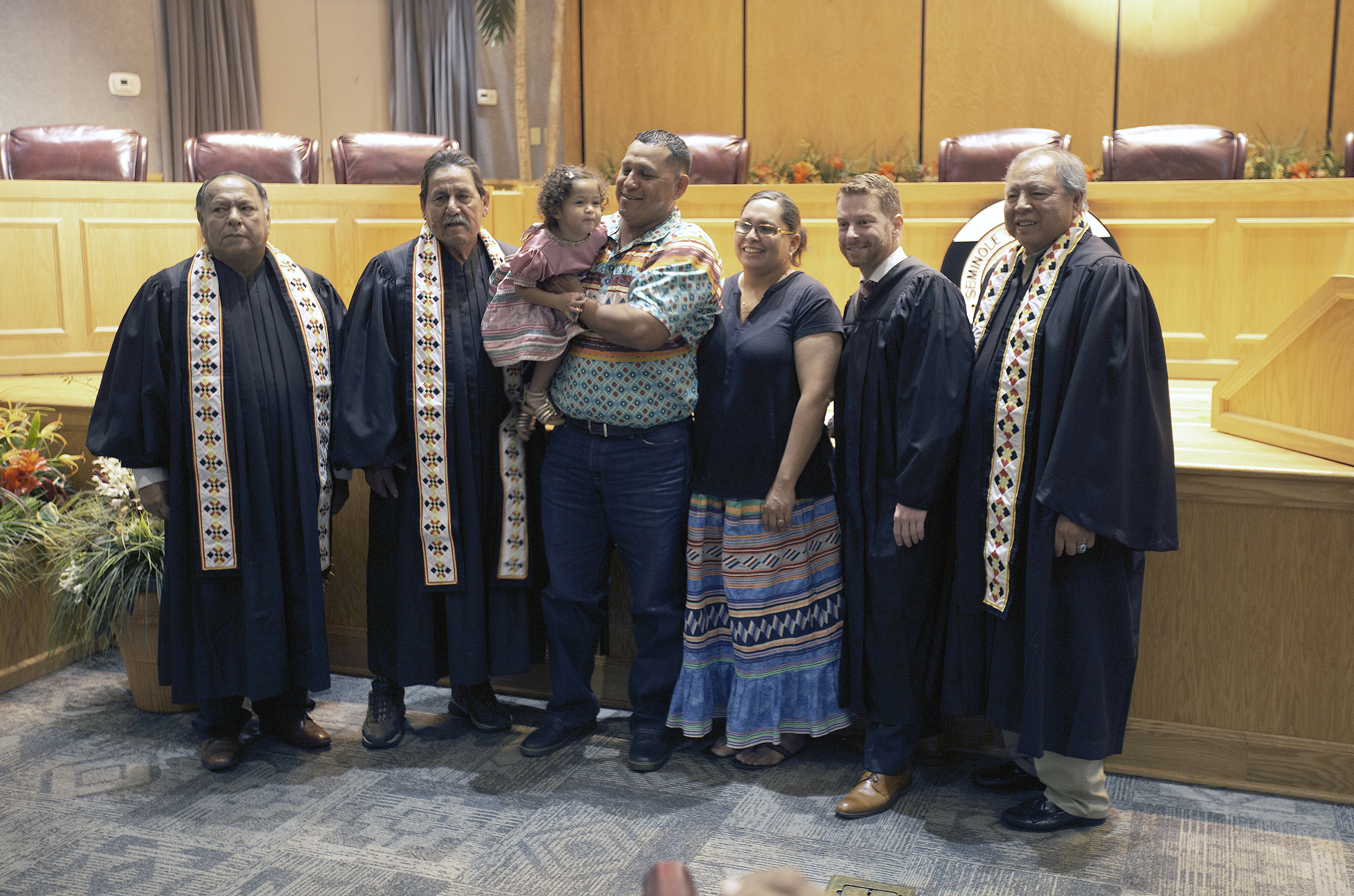
Seminole hold adoption ceremony

Participating in the Seminole Tribe’s first family adoption finalized on a Seminole reservation are, from left, Chief Justice Willie Johns, Associate Justice Moses “Bigg Shot” Jumper Jr., Loraine Marie Stewart Jumper, Joshua Jumper, Andrea Jumper, Circuit Court Judge Jose Izquierdo and Chief Judge Moses B. Osceola. The ceremony was held April 18 in the auditorium at Tribal headquarters in Hollywood. (Photo Damon Scott)
“This is a rare moment and occasion that we’ve been working for for almost 10 years,” Chief Justice Johns said. “That we would come collaboratively with the state and the Tribe to do the adoptions and to work with families and children through the [Florida Department of Children and Families]. This is our very first. It’s a moment that we’re going to all treasure.”
Chief Justice Johns congratulated the Jumpers on their latest addition to the family.

GREAT NEWS: Adoption ceremony marks a first at Tribal Court • The Seminole Tribune

Monday, May 6, 2019

OP-ED: Preserve the Indian Child Welfare Act


Preserve the Indian Child Welfare Act

Published


Navigating the U.S. child welfare process can be a highly emotional venture. As a judge who works in child welfare I know this better than most. Our end goal will always be to protect children’s best interests and ensure they have the love and support of a family so they flourish as they grow to adulthood. But the process of trying to protect children can be as painful and difficult as it is rewarding.
Because child welfare cases are so complex, a number of laws and legal practices are specifically designed to ensure the best outcomes. Perhaps one of the most highly regarded among these laws has been the Indian Child Welfare Act, or ICWA, which at its core helps keep Native American children within their families, communities and heritage.

KEEP READING 

Take it from someone who sees the benefits of ICWA in her own court. Or take it from the Native American tribes, the people most invested in the well-being of their own children. Or take it from the history books. ICWA supports the best interests of children and our Native American communities, and losing this law would set our country back decades.

Darlene Byrne has served as presiding judge of the 126th Judicial District Court in Travis County since January 2001. She is a commissioner on the Texas Children’s Commission, a past president of the National Council for Juvenile and Family Court Judges, and a past Judge of the Year of National CASA, Texas CASA and CASA of Travis County.

Sunday, May 5, 2019

National Day Of Awareness | INVISIBLE NO MORE #MMIWG - Vital Billboard Campaign VIDEO


National Day Of Awareness For Missing And Murdered Indigenous Women (& Girls) #MMIWG

Guest Commentary Published May 5, 2019

“I stand before you today, a full-blooded Native American woman, a Northern Arapaho/Hunkpapa Lakota. The statistics that hang over my head are these: I am among the most stalked, raped, murdered, sexually assaulted, and abused of any women in any ethnic group, and I am among those who suffer domestic violence 50 times higher than the national average.” 

I use that statement to open my presentations on the Murdered and Missing Indigenous Women (MMIW) crisis. I travel around Indian Country, as I have for years, to raise awareness and inform our people of the scale of the tragedy and, crucially, how to make a safer environment for their communities and families. I have done this work for over a decade, and when I committed to it the term “MMIW” had not been coined.

I am somebody who works with data, but Chairman Gerald Grey of the Rocky Mountain Tribal Leaders Council (RMTLC) recently made a statement that should resonate with us all, that speaks to more than numbers: “I choose not to quote statistics because our women and girls are human beings not statistics. This is mom. Auntie. Sister. Niece. Daughter. Cousin. And sometimes, grandma. We know the names of some of the victims, but study after study shows that MMIWG cases are underreported, so there are many, many names we do not and may never know.” This is personal. When we learn of another victim near or far, in our reservations communities we can relate on a deep, emotional level. We may not know the victim or their family, but we know the socio-economic conditions; we know the struggle.
READ MORE


Visit: www.mmiw-gic.com

Lynette Grey Bull is Senior Vice President of Global Indigenous Council and the founder of Not Our Native Daughters. In 2017, Lynette provided statistics and research on missing and exploited Native women and children for the UN World Conference on Indigenous Peoples. She previously served as Chair of the Arizona Commission of Indian Affairs at the Governor’s office, and on the Arizona Governor’s Human Trafficking Task Force.

Monday, April 29, 2019

The Traumatic Legacy of Indian Boarding Schools

Statutes of limitations for civil or criminal cases make any legal action impossible in the United States, according to the Native American Rights Fund attorney Donald Wharton. Lawsuits against Christian denominations would need to take place in individual state courts, and would likely be costly and burdensome. Attempts at gaining reparations at the state-legislature level have failed, too; in February, the South Dakota legislature killed a bill that would have extended the window for childhood survivors of boarding-school abuse to file suits against organizations such as the Catholic Church.

READ: The Traumatic Legacy of Indian Boarding Schools - The Atlantic

Has anyone read a book by Boarding School Survivors who were molested in the Catholic Churches? Please leave a comment.

**

Brooklyn Diocese Ignored Protocol And Unwittingly Accepted Priest Accused Of Abuse

link

After the Boston Globe’s 2002 Spotlight investigation of sexual abuse, the USCCB created the Charter for the Protection of Children and Young People, which called on church leaders to more thoroughly vet priests in order to prevent sexual abuse. In 2003, the USCCB published guidelines for vetting international priests, acknowledging the unique difficulties of conducting cross-border background checks. Despite the attention to more thorough vetting, a 2007 USCCB audit found that half of the credible sexual abuse allegations from children that year who were still minors were made against international priests.
Last year, the Diocese of Brooklyn posted names of 13 priests on its website who have been accused of sexually abusing minors and have been laicized, the most serious punishment in Catholicism. In the interview with W Radio earlier this year, Tobón said he referred the sexual abuse allegations against Cadavid to the Vatican after suspending him in 2012, and that he was no longer a priest. The 13 priests named on the diocese website are priests from the Diocese of Brooklyn, so Cadavid is not included.

Thursday, April 25, 2019

Navajo Nation Wins Appeal in Indian Child Welfare Act Case #ICWA

The Arizona Court of Appeals decided the juvenile court did not meet the requirements of the act.
window rock navajo code talker hero Navajo Code Talker Memorial at Window Rock, Arizona.
Photo: Ron Cogswell/Flickr (CC BY 2.0)

The Arizona Court of Appeals ordered a new hearing Thursday over the guardianship of a 6-year-old child who is subject to the Indian Child Welfare Act.
The Navajo Nation appealed the case, The Navajo Nation v. Department of Child Safety et al., in October 2018 after the juvenile court failed to hear the testimony of a qualified expert witness as required by the ICWA in the child's guardianship case.
The child, R.Y., falls under the act because his mother is a member of the Navajo Nation.
Tamara Shanker, the attorney who represented the Navajo Nation, said the act is an effort to rebuild indigenous culture after centuries of the removal of indigenous children from their families.
When an indigenous parent cannot care for his or her child, the ICWA prioritizes the placement of the child in the custody of a relative or someone from the same tribal nation.
Shanker said that since the juvenile court awarded permanent guardianship without the testimony of an expert witness, it opened the door for future courts to disregard other aspects of the act.
"A Diné individual is as different from a Pascua Yaqui, as an Italian is from a Dane," Shanker said. "Just because they may all just be European doesn't mean that they're the same individual and have the same child rearing practices."
She said cultural experts are necessary to accurately assess an adult's ability to care for a child by his or her cultural standards.
The act allows for three types of qualified experts to testify in its cases. One type of expert is a fellow tribal member who is a specialist in the culture's childrearing practices. The person could also be someone who provides child and family services to tribal members and is an expert on the tribe's familial organization. The court will also hear testimonies from a specialist with extensive experience and knowledge on a certain topic pertaining to the case.
The expert or experts testify as to whether the parents or an indigenous relative could raise the child without causing severe emotional or physical harm.
"We needed to have this decision, because to not get this would have set a very dangerous precedent. If you start chipping away at critical requirements under the ICWA or any law, it's like, 'If we can chip away that requirement, we can chip away this one next time,'" said Shanker.
She said that since the juvenile court did not follow all of the act's requirements, R.Y.'s custody was legally unstable. Someone could appeal the ruling and possibly remove him from his guardian's care. She said this was not the Navajo Nation's goal in pursuing the appeal.
Shaker said she hopes the new hearing solidifies the boy's custody and reinforces that even permanent guardianship cases must follow all aspects of the Indian Child Welfare Act.

Wednesday, April 24, 2019

In "Bitterroot," a Native transracial adoptee explores identity, race, and belonging

Apr 23, 2019 

On this edition of Your Call, we’ll speak with oral historian Susan Devan Harness about her book Bitterroot: A Salish Memoir of Transracial Adoption.
The memoir explores her search for answers to difficult questions about race, identity and family as an American Indian woman adopted by a white couple. She also chronicles her reconnection with her biological family and conversations with other transracial adoptees.

Guest:
Susan Devan Harness, writer, lecturer and oral historian, and author of Bitterroot: A Salish Memoir of Transracial Adoption

Web Resources:
Hippocampus Magazine: Review: Bitterroot: A Salish Memoir of Transracial Adoption (American Indian Lives) by Susan Devan Harness

Friday, April 19, 2019

Too Burdensome to report or keep data on #ICWA (really?)

Adoption and Foster Care Analysis and Reporting System (AFCARS) Notice of Proposed Rule Making. Again.

Here.

We cannot currently track on a national level in any way how ICWA works, where children who are involved in ICWA cases are placed, what their outcomes are, or how many cases are transferred to tribal court, as examples. There is barely statewide data available, and most of it is on a county-by-county level. As just one example, Michigan is in a federal lawsuit over its data collection system.

I am deeply tired of hearing that tracking this information is simply too burdensome for the states that are putting children in care, and then getting hit in lawsuit after lawsuit with claims that are not supported by any data, but also cannot be refuted by data we refuse to collect.

If your tribe wants to submit comments, there will be model comments available before the deadline of June 18.

**
Consider this: The states pay foster parents - the bureaucracy secures money and keep those records, right?
Why not keep data on the kids they place? And did you know that once a child is adopted, no one from the state goes to check on the child(ren)?

read this:

Peter Lengkeek is one of 14 members of the Crow Creek Tribal Council. He said he is enraged by the number of children that the Department of Social Services has removed from his reservation. The Tribal Council recently passed a resolution saying that the state cannot remove children without the council's approval.
John Poole/NPR


Wednesday, April 10, 2019

Proposed California law would make it easier for Native Americans to argue their side in child custody cases

California lawmakers are considering a proposal to make it easier for Native American tribes to make their arguments in child custody cases.
Technically, the proposed legislation, AB 686, would let lawyers or other representatives of Native American tribes appear by phone or electronically in cases involving the possible removal of Native American children from their families and tribes.Such hearings are held as part of the Indian Child Welfare Act, a federal law enacted in 1978 to stem the systemic removal of tribal children from their families and cultures — a practice that at one time touched as many as one in three Native American children. But the problem AB 686 aims to fix is as much about geography as culture.
Often, the hearings that determine where Indian children are placed are held hundreds of miles from tribal lands, making it difficult for all sides to be well represented in court. And without tribal presence during those proceedings, judges are denied information that might make their decision more compliant with the federal law, according to a statement from the Juvenile Court Judges of California to the Judiciary Committee, which passed the bill April 2.

GREAT NEWS: Proposed California law would make it easier for Native Americans to argue their side in child custody cases

Monday, April 8, 2019

American Indian adoptees deal with painful past and family separations

Larry Brown, Navajo, prepares for the November powwow ceremony at the Minneapolis American Indian Center. The ceremony provides a space for American Indian families to heal after decades of family separation. (Photo: Camille Erickson. )
The Indian Child Welfare Act has faced numerous constitutional challenges in federal courts since its enactment in 1978, attempts to undermine tribal nations’ authority in child welfare matters
Jane Harstad gave birth in 1986 to her first child, a son. Soon after, a pediatrician asked for her family’s medical history. She didn’t have a clue. She didn’t know who her biological mother or father was, let alone what medical conditions they had.
Harstad, who is Red Cliff Band of Lake Superior Chippewa, was adopted shortly after birth through Catholic Charities adoption services in 1965. The agency placed her in a white, middle-class family living in St. Paul, Minn.
After obtaining her biological mother’s address through the adoption agency, Harstad sat down to write a letter. She felt immediately overwhelmed.
“It took me a long time, you know, days or weeks [to write]. Even the first word like, ‘Hello,’ or ‘Dear Mom,’” she said. “It took a long time to carefully choose my words.” Harstad provided her phone number in the letter and said she wanted to meet her mother.
Harstad, now 56, would later reflect on that moment: “I was searching for a part of myself that was missing, and I knew she was the answer whether it was good or bad or ugly. It was like a puzzle and you’re missing one piece. You’re just never going to be complete.”
KEEP READING

Announcing the first comprehensive study on child removal in Native communities

READ PRESS RELEASE

If you have any questions about the study, you can visit www.boardingschoolhealing.org or contact members of the research team at info@nabshc.org or liebler@umn.edu. You may also request a paper copy of the survey or the research report when the study is completed.  

Visit us online to learn how you can join the Coalition. 

Friday, April 5, 2019

Mountain West Tribes And States Join #ICWA lawsuit

Apr 4, 2019
So far, 325 tribes and states, including Montana, Idaho, Utah and Colorado, have joined forces to preserve a law that gives Native families preference in adoption of Native children.
Texas, Indiana and Louisiana argue the Indian Child Welfare Act creates a special and unequal status for Native children that's unconstitutional. A Texas judge sided with them last December, but a federal appeals court is keeping the law in place while it considers.
Eastern Shoshone councilman Leslie Shakespeare from the Wind River Reservation in Wyoming said, before the 1978 law was adopted, there was a long history of removing Native children from the reservation. Even after the boarding school era, there was the Indian Adoption Project of the 1950's and 60's.
"It was actually a term, Indian extraction, where they took Indian children," said Shakespeare. "They adopted them primarily to non-Indian families in order to reduce reservation populations and to reduce spending time at boarding schools."
Back then, almost a third of all Native children were removed from tribal communities through boarding schools and adoption.
"I think that is the very heart of the Indian Child Welfare Act is children losing their identity and then further, because they're our next generation, the tribe losing our identity through that process."
Shakespeare said almost 40 percent of his tribe lives somewhere other than the Wind River Reservation in Wyoming and half of those members are children. He said if they came up for adoption, it's critical to the survival of the tribe they maintain their identity as Shoshones.
This story was produced by the Mountain West News Bureau, a collaboration between Wyoming Public Media, Boise State Public Radio in Idaho, KUER in Salt Lake City and KRCC and KUNC in Colorado.

Tuesday, April 2, 2019

Fate of Native Children May Hinge on U.S. Adoption Case

Stateline: Indian Child Welfare Act likely headed to Supreme Court


Fate of Native Children May Hinge on U.S. Adoption Case

By Teresa Wiltz
Stateline, an initiative of The Pew Charitable Trusts
pewtrusts.org/Stateline

A case before a federal appeals court could upend an historic adoption law meant to combat centuries of brutal discrimination against American Indians and keep their children with families and tribal communities. For the first time, a few states have sued to overturn the federal Indian Child Welfare Act, which Congress enacted in 1978 as an antidote to entrenched policies of uprooting Native children and assimilating them into mainstream white culture. Now, in a country roiled by debates over race and racial identity, there’s a chance the 41-year-old law could be overturned by the U.S. 5th Circuit Court of Appeals, considered the country’s most conservative court. (The law applies to federally recognized tribes.) Overturning the law, its proponents say, could significantly increase the number of American Indian children adopted into non-Native families.
Hundreds of tribal nations vehemently oppose the lawsuit. They say it threatens the sovereignty of Indian Country and seeks to “return Indian children to the arbitrary and discriminatory whims of state courts and state agencies, unfettered by the centuries-old trust obligations this nation owes to Indian tribes and Indian peoples.” Meanwhile, some states and private adoption attorneys pushing for change argue the Indian Child Welfare Act interferes in state affairs and “requires them to place Indian children in accordance with statutory requirements based on race, rather than the children’s best interests.” Oral arguments in the case were heard last Wednesday in New Orleans. Whatever the outcome, the case is likely headed for the U.S. Supreme Court.


Graphic © The Pew Charitable Trusts
 
Brackeen v. Bernhardt pits Texas, Indiana, Louisiana and a coalition of conservative legal groups, including the Goldwater Institute, against the federal government, hundreds of tribal nations, 21 state attorneys general, Native American civil rights groups and child welfare organizations, including the Annie E. Casey Foundation and the Children’s Defense Fund. The plaintiffs, who include several families interested in adopting Native American children and a non-Native biological parent who wants her American Indian child to be adopted by a non-Native family, argue that the law, often called ICWA (pronounced ICK-wah), is race-based and violates the Equal Protection Clause of the U.S. Constitution. Tribal nations counter that “Indian” is a political, rather than a racial, designation. The Supreme Court agrees with that classification. In 1974, it said that with federal hiring preferences for American Indians in federally recognized tribes, “preference is political, rather than racial in nature.” The plaintiffs also charge that in enacting the law, Congress exceeded its authority over federal affairs with tribal nations. “I want to see ICWA overturned completely,” said Mark Fiddler, co-counsel on the Brackeen case representing adoptive families, and an enrolled member of the Chippewa Nation. “ICWA has been a miserable failure.” 

click

Contact Trace

Name

Email *

Message *

NO MORE UPDATES

GO TO:  https://blog.americanindianadoptees.com/  for updates and news. THIS BLOG cannot be updated...