BLOGGER changed, not allowing us to UPDATE this back-up blog

(UPDATED 726/2025) issues with blogger are preventing this

Saturday, January 7, 2012

Adopters battle with Cherokee Father

Couple battles tribe over adoption


Columbia, South Carolina (WLTX) - A Lowcountry couple with a Midlands connection is working to get back the little girl they adopted two years ago, after a judge granted custody to the biological father under the Indian Child Welfare Act.
"I'll always remember her crying when we had to - we had to walk out of that office and leave her there," says Melanie Capobianco. Two years ago, she and her husband Matt first helped to welcome Veronica into the world.
According to their website, her birth mother selected the Charleston couple to adopt her and they remain close. They also say her birth father signed a document saying he wouldn't contest the adoption. But after a court battle, Veronica's birth father claimed custody under the Indian Child Welfare Act of 1978. "Specifically, it says that tribes have to be notified when children of their members, or eligible members, are being placed outside the home. Tribes have to be given a chance to intervene," explains David Simmons with the National Indian Child Welfare Association.
He says their culture is an important aspect of the Native American community. "Their culture, nobody else can provide that for them. And they have a right to be able to experience that relationship with their tribe," says Simmons.
On New Year's Eve, Veronica's birth father took her with him to Oklahoma, where he lives. While Simmons is sympathetic to the Capobiancos' struggle, he's seen similar cases before. "Oftentimes, when we hear about cases like this, we find out that there hasn't, the person who was facilitating - sort of the expert in doing this work - wasn't following the Indian Child Welfare Act as closely as they should've been," he says.
The couple did get to talk to Veronica on the phone earlier this week. "She said, 'Hi mommy! Hi daddy!' She sounded really excited to hear us and she said, 'I love you, I love you,' numerous times," says Melanie. 
But they're still fighting to have more than just her voice back in their home.
Melanie is originally from Winnsboro. She and her husband's appeal to the South Carolina Supreme Court is already underway, but the case probably won't be heard until this spring.
News19 did leave a message for Veronica's birth father's attorney, but has not yet heard back. Click here for the TV broadcast

My thoughts:
The slant in this story is the child is/was better off with the adoptive parents and the bio-dad is not enough Indian to matter - if you read the comments after this story.
The idea behind the Indian Child Welfare Act (ICWA) was to protect children. Adoption does not protect us if the courts place a child outside of their tribal family. The courts should respect a father's right to parent and have custody... in this case the mother had given consent for adoption of Veronica but not the father who is Cherokee.
If both parents consent to adoption, if that is the only option for a child, then other family needs to raise the child within the tribe...
Disregarding federal law and the sovereignty of Native American people is obvious in too many cases of adoption in the last 30 years since ICWA. South Carolina is among them.
Trace

Friday, January 6, 2012

What you need to know about REUNIONS

The Reunion
http://library.adoption.com/articles/search-and-reunion-etiquette-.html 

Reunions come in many styles and with many variations, but the essence is still the same. This is the "meeting" - the reconnection - of two people who for all intents and purposes are closely related, but who are relative strangers. Like the development of any relationship, that of adoptee and birth relative takes time and effort. There is something profoundly mystical and magical about reunions. They require lots of work, lots of concentration and, above all, a sense of humour. Rules of etiquette which have been developed through experience may make things run more smoothly.

Do be honest. There have been enough lies and secrets.

Do share information as appropriate, both in the initial call (if there is one) and later, when you meet. Sometimes questions come as a reflex and may not need to be answered that very moment. For example, to "How did you find me?" you might respond "It was not easy. I'll tell you the whole story sometime. Right now let's enjoy this wonderful meeting." To "Who is my birth father?" one might respond "I will tell you the whole story, but right now I need some time to reflect on what has happened. But I promise I'll tell you the truth." A related principle is that if an immediate answer to your questions is not forthcoming, try to be patient-within reason-with the other person.

Do try to laugh. This is a joyful situation. Don't make it into a frightening experience. There is enough inherent drama in the incredible event taking place without adding to the tension. Be prepared to go whitewater rafting and hang on tight!

Do try to keep it simple. In birth parent searches, do not try to find both parents at once (unless, of course, they are still together). The emotional upheaval that may ensue could spoil the hope of future successes.

Do plan your first meeting in a place where either party can feel confident and safe. The situation is emotional enough without adding to it the fear of not being able to "get away" if there is a problem. A cozy corner in a public place (behind the potted palms in a large hotel lounge) can be just fine. If you decide this is working well, you can move to somewhere more private.

Do keep the first meeting shorter rather than longer, if possible. This gives everyone time to take a breather, re-assess the situation and consider the future relationship. It is always easier meeting for the second time. (If you have to travel some distance to meet, the "second time" may be the day after your initial meeting.)

Do try to avoid a huge family picnic as the way to introduce your new-found relative to the clan. It can be very overwhelming to meet 50 relatives at once.

Do keep an open mind. The birth family may be very different from the adoptive family. Try not to judge one against the other until you get to know them better.

Do have realistic expectations. The moment of reunion is not the time to decide you really only wanted "medical information" or that you are not ready to pursue a relationship. It is cruel to set the other party up to expect more than you are prepared to give. Be honest with yourself and try to look at your reasons for searching and the limits of what you can accept. Talk with your support system ahead of time about the limits; if you're in an uncomfortable situation, try to resolve it directly and privately. 

Do have a frank discussion of how the adoptee will address the birth parent and other birth relatives, and vice versa, following the reunion. Some birth mothers want their surrendered children to call them "Mom," but adoptees already have one "Mom" in their life and may not be comfortable using that title for anyone but their adoptive mother. Likewise, some adoptees are eager to call their birth mother "Mom," but the birth mother may not be comfortable being called "Mom" by a child she did not raise. Good manners would also direct that any discussion of how the adoptee will refer to his or her birth relatives not take place in the presence of a roomful of relatives. One needs to be very flexible. If this issue becomes one of contention, a re-examination of expectations may be in order.

Don't try to compete with established family holiday procedures unless everyone agrees. Like the name issue, this is not worth the anguish it can cause. Keep it simple. Many reunited relatives get bogged down in the minutiae of names and festivals instead of being thrilled that they have found each other.

Do try to respect the other person's wishes about sharing the reunion with other members of the family. For some birth parents, a reluctance to share can go on too long. Try to set limits to your impatience and wait it out. At some point adoptees in this situation may need to re-assess their expectations and make decisions about the future path of the relationship. Advice from an experienced searcher or support group is recommended.

Do be stoic if the other party feels a need to pull back for a while. It is very wise to agree without a huge fuss, great grief, or gnashing of teeth. Such need to pull away is often seen in the reunion process. It allows the person to take stock or re-assess the reunion and its effect on his or her life. Although very painful to the other person, it is best treated with patience and lots of reading. Support groups are great for dealing with the sadness. No one can fix anyone else. They can only fix themselves.

Don't blame yourself for problems in the other person's life. Birth mothers often feel great guilt if the child they relinquished did not grow up as advantaged as they might have hoped, or if religion is not as important in their child's life as it is to them (or vice versa). Adoptees can sometimes feel guilty if the relinquishment experience had a negative impact on the birth mother's life. We cannot turn the clock back no matter how much we might want to. Your relationship starts from the day you meet again. Keep it positive.

Don't plan on moving in with your new relatives. They may be delighted to meet you but they are not looking for a permanent house guest.

Do enjoy the reunion. It's a gift from God.

So...is Search and Reunion a good thing? You bet! Should it be carefully thought through? Absolutely! Will it be 100% successful? If we knew the answer to that, we'd be setting up shop in Las Vegas!


[I wish I had known more prior to my reunions in 1994 - this is very good advice...Trace]

Thursday, January 5, 2012

Help for Minnesota Adoptees (I am one, too)

I am an adoptee who was born in Minnesota in 1956.
When I was searching, I did call Catholic Charities since they handled my adoption. This was in the late 1970s and they, of course, were shocked I was asking for my birth certificate and wanting to know who my parents were. They didn't slam down the phone but they were no help at all - but times have changed somewhat since then and this is the  link  to contact Minnesota for access to your birth records and birth certificate.
It is "conditional" access - which means your birthparent has had to file a consent form - and if they have done that, the adoptee will be able to have a certified copy of the original birth records. (read below)
You can check my blog here about what was in my adoption file from Wisconsin; the judge ordered an investigation before my adoption was finalized and the investigator had to get a copies of my files which listed days spent in a Minnesota Catholic orphanage, other records from Minnesota, my foster care address in Wisconsin - prior to my being legally adopted. (Yes, states did transfer children around like Minnesota-Wisconsin-Illinois). I was born in MN but adopted in Wisconsin - which meant I had two places to look. A Wisconsin judge let me read my files in 1979.
In 2010, I did contact Minnesota to request a copy of my original birth certificate. Because records are still sealed, they said NO. My birthmother Helen died in 2007, so she obviously will not ever give her consent.
This also presents a problem since the government will be refusing to give certain people with strange-looking birth certificates a driver's license in the not-too-distant future. (REAL ID ACT OF 2005)
My friends at Soaring Angels on Yahoo Groups (search angels for adoptees & birthfamilies) posted this so I wanted to share it with adoptees who need help in Minnesota!

Access to Original Birth Record in MN


A child, age 19 or older who was adopted, may request a non-certified copy of the original birth record. To request a non-certified copy, complete the Adoptee's Request for Original Birth Record Information and Search for Affidavit of Disclosure or Non-Disclosure( Interactive PDF: 60KB/1 page)
<http://www.health. state.mn. us/divs/chs/ osr/disclosesear chnew.pdf> . 

Mail the completed form with a fee of $13 to the Minnesota Department of Health, Central Cashiering - Vital Records, P.O. Box 64499, St. Paul, Minnesota 55164-0499.

If a birth parent has given permission to release the original birth information to the child, MDH will send the child a non-certified copy of the original birth record. If no Affidavit of Disclosure or Non-Disclosure
has been filed, MDH will notify the child that a non-certified copy of the original birth record cannot be released at this time. MDH will also notify the Department of Human Services for the purpose of conducting a search for
the birth parent(s) according to Minnesota Statutes, section 259.89. The search may take up to six months. MDH will contact the child when the search is complete.


Searches for Information about Siblings or Parents who were Adopted
The Minnesota Department of Health does not retain adoption information. The Office of the State Registrar retains:

1) current birth records that include the post adoption names of adopted persons and their adopted parents; and
2) the original birth record that includes original birth information.

The original birth record may be released only:

1) by court order
2) to the adopted person if the parent(s) named on the original birth record have been given permission; or
3) to a parent named on the original birth record.
Other than releasing the original birth record as described above, the Office of the State Registrar does not provide post adoption services and cannot help with searches for information about siblings or parents. If you are looking for information about a sibling or a parent who was adopted, please contact the adoption agency or the Minnesota Department of Human Services at 651-431-4682 or write to: Minnesota Department of Human Services, Child Safety and Permanency Division, Adoption Assitance Program, P.O. Box 64944, St. Paul, MN 55164-0944.

Wednesday, January 4, 2012

The Time to Mourn


First, let me say Happy New Year to everyone.
Let me share a bit about the past month... while I have been mourning and tending my spirit.
Mourning ignited with the loss of Edie, the only mother I knew for 50+ years, when a cruel disease, dementia, erased her memory and caused her death on December 9 in Oregon. 
Until her diagnosis in 2007 and her move to Oregon in 2010, I had a very close and loving relationship with my mom. We spent months together each year, goofing off in Wisconsin, or if I was in Massachusetts, we spoke daily on the phone. Over the years, we grew inseparable. Our love was real.
Also last year two cherished aunts in my adoptive family died, and I had not properly grieved them and I needed to... and with mom gone, I had to... suddenly, grief erupted like a volcano and swallowed me up.
During my grieving, I felt it was important to be “real” about the people and events that shaped my life. I lived far too many fantasies as a child-young adult and never will go back into that “fog” mode. I choose to be as clear and real as humanly possible. 
The mind will naturally want to block what is painful so I made time to look at old photos, an important part of a grieving process. I looked at them with heart and eyes wide open. 
I could see in the photos how my parents adopted a stranger's child yet pretended it wasn't relevant to them they’d adopted me. They decided not to talk about it. (At least they didn’t in front of me.)
I see my a-parents unaware of how my emotional edges grew raw and ragged. I see my spirit go cold and numb in the photos. They ignore the child staring back at them and simply pretend everything is fine and normal. After many years, it does get to the point when we do become family. Your adoptive parents are the only parents you’ve known and the only truth you have known.
But this taught me a lesson. Adoption was forced, when parents force us to adapt and accept them as parents or you go insane. 
I admit I had a very difficult childhood which can kill you or make you strong. There was alcoholism and abuse at home. I will never completely understand what happened. I comprehend some parts as the child and others parts as an adult. 
Never could I tell them of my decision to open my adoption or when I did it. They would have seen it as my rejecting them. Still I had to do something about it and I did. Adoptees learn quickly what is possible and what is impossible with each parent and each situation. At home I was expected to adjust and adapt without any discussion or therapy. That’s the juggle for adoptees.
We know THAT needs to change. Adoptees confirm this on blogs and in books and in support groups.
No great surprise, the adoption industry didn't educate my parents before my adoption that I would have emotional difficulties being their adopted daughter.  That apparently wasn't discussed.
Sadly, there is too much the adoption industry will not disclose to adoptive parents. 
In 2012, ignorance is no longer an excuse.
Today's adoptive parents can turn to the internet and numerous books on how to deal with our emotional hurt, grief and adoption trauma. They can understand adoption better today because of adoptees. Parents can educate themselves and advocate for the child they adopt or foster. Some of these parents deal in truths and get their child into therapy. There isn't a cure for the primal wound (post-traumatic stress disorder, or severe narcissistic injury) but there are new treatments discussed every day on the internet.
I was not able to speak to Edie about my reunion with my natural father and my siblings. She had no interest in this or my search or how I felt. That was not a part of our relationship.  
Edie's death also made me realize I had not mourned my other mother Helen who I never met. I do admit it's a delayed reaction - because when you lose someone so important to you , other losses and grief can surface and erupt out of nowhere. I'll cry in spurts. I'll cry for myself. I'll cry because I miss their voices and the many stories of our life.

With my parents (adoptive and natural) all gone, it felt to me like my own history was disappearing.  
I know it's very important to mourn our relatives, and then let them go.  It would be selfish of us to try and keep their spirits here. The dead visit us in dreams. We can still speak to them.
Grief simply pours out of our soul because it needs release. I made the time to mourn. 


Tuesday, January 3, 2012

i have no indian name


Rita Coolidge explained in an interview she met a young woman who was adopted and the result of their meeting was this song…. beautiful song…tragic, too…

Monday, January 2, 2012

Minnesota's Healing Spirits


MINNEAPOLIS - A unique program in south Minneapolis is finding success helping American Indian boys in long-term foster care. The director of the Healing Spirit program for boys, Kirk Crow Shoe, says the group home they operate takes in teens with a history of running away, skipping school and runs-ins with police. Many have been placed in multiple foster-care situations without success.

"They go into these homes and they're not making it. They're not connecting; they're not getting their needs met, so then they go back to the emergency shelter. They wait for yet another placement; they go to another placement, then they disrupt from that placement. Healing Spirit was developed as an answer to this particular problem."

At Healing Spirit, Crow Shoe explains, the focus is not just on school and living skills, but also on the sacred Native American culture, which he calls a significant part of helping the kids believe in themselves.

What makes Healing Spirit effective, Crow Shoe says, is that the teen boys are overseen by staff members who share the same Native American background.

"Many of them have been in long-term foster care themselves. They struggled greatly in their upbringings, and as adults they have the heart to give back to the community. The kids know that they've been in their shoes, as well, so there's an immediate sense of respect that's paid to one another in that relationship."

It is key for the troubled teens to connect with their culture and community and feel a sense of family - particularly in a system in which they've been shuffled from one place to another, Crow Shoe adds.

"These kids, after a period of time, they feel like they're throwaways and they're very broken kids. Because we understand that and because many of us have lived that life, they know that we are going to be more patient, more generous - and we're not going to give up on them quite so easily."

Since Healing Spirit was founded in 2003, the average length of stay has grown to around 2.5 years, and most boys now stay until they "age out." Crow Shoe says with that success, the program has generated interest from across the country.

"Because we have done as well as we have over the years, there are other communities that are interested in what we're doing; and as such, we then shared our model at the National Indian Child Welfare Act conferences."

A similar foster home for girls opens in south Minneapolis in January. American Indians make up just over one-percent of Minnesota's population, but account for 12 percent of the children in the state foster care system.

More information is available at http://diw.gmcc.org/programs.php.
Public News Service - MN » December , 2011

Sunday, January 1, 2012

Guest Column: Johnathan Brooks JOINING THE DOTS

http://www.spiritbearcoaching.com/

Joining The Dots: 

The Spiritual Purpose of My Life

It has become popular in counselling for clients to be encouraged to write their story and so come to recognise how detrimental experiences can be used as opportunities for living life to the full.  In a sense this could be called allowing oneself to move into new situations, places or environments where this can happen.
I believe adoption and fostering offers a unique opportunity for adopter and adoptee for personal growth and the healing of the wounds we all carry, and may have to re-experience several times in order to except the wisdom of their lesson and move on. Before we are born our spirit/soul chooses the particular set of circumstances and the environment that will give us the greatest opportunity for growth into self responsible adult instead of remaining a victim.
When we are born we are totally dependent on others, but if we are unable to bond with a parent or nurturing figure with any degree of closeness, we may find it difficult to become self reliant and free to create a life of our own.
We may allow the values of others and the culture to dictate the patterns of our lives and try to fit in, or equally restricting, being constantly at war with that culture instead of freeing ourselves to fulfil the reason for incarnation.
In my own case I can now look back and recognise certain significant sets of circumstances that have led to being able to heal sum of my earlier wounding. My birth mother was a Native American of the Cree tribe which was not compatible with my birth fathers Northern Cheyenne. The Catholic Church arranged for my adoption after a few months old by an American Jewish man and Austrian/German then Protestant wife, at least four different types of cultural influences.
This was at a time when it was popular to adopt little Vietnamese orphans and babies from countries where America had been involved in destructive wars. While I was not from the Far East it could be said that White Americans had progressively destroyed my birth parents culture. I was never able to bond with my adopted mother, nor do I feel she was able to nurture me in any way. I felt very unclear who I was, felt deeply insecure, and separate from those around me. It is I think significant that when I married it was to a South Korean girl who was also adopted as a very young child and also had problems with bonding.
As I see it now part of my life task is to heal the wounds inflicted on First Nation peoples through myself as a First Nation individual and learn to recognise the Unity of Humanity, we are not separate.
The next significant event was when at age five my adopted parents moved from the USA to England. I was eventually sent to a Steiner school where both teachers and pupils were multi-national so being one of two Native Americans there was no big deal about my race. However, by this time I had become so inhibited and unable to express or be myself in any way to my adopted mother I was considered a bit slow and unresponsive. In fact, I still felt lonely, imprisoned and separate from the love of anyone who understood me, and I believe I was re-living a prison like isolation experience when the Cheyenne’s were split into two and vanished from their tribal grounds.
When I was later able to find my birth parents and was enrolled as a Northern Cheyenne I achieved a healing sense of belonging, and a cultural philosophy with which I could resonate. I began to feel who I was.
However, before this took place I was sent to live with foster parents during term time. These were an Austrian/Australian and his English wife together with their son who was in the same class at school, and was four days older than myself.
This son’s name was John to my Johnathan in a sense we were like dissimilar twins finding each other after a long separation. My foster parents never regarded me as anything but a welcome second son, and frequently said “How lucky we are to have two such good boys” and missed me when I was away.
My foster mother regarded the extraordinary world-wide travelling experiences on both our parts that had brought us all together as a sign of a beneficent and supportive universe, pointing to the fulfilment of the cosmic plan for Humanity. To Unify everything and return to Source through the magnetism of Love.
It was my foster mother who discovered I was Dyslexic. Dealing with this problem and wound led to me studying acting and later to become a NLP Master Practitioner. So a wound became an asset.
I remained with these foster parents for over 18 years before moving to London and training and working in several jobs which while I did not find particularly satisfying at the time were all useful in helping me on my way to a recognition of my sacred contract as Caroline Myss puts it [www.myss.com].
A greater understanding of this contract was given me by a tribal elder when I was working in a home for under privileged children on the Northern Cheyenne reservation. He remarked on the number of mothers I had, had. I slowly began to realize the importance of mothering, of grounding, of security on Mother Earth and bonding of all humanity.
During the summer of 1985, I had been given the Right to build and lead sweats in England by the Northern Cheyenne Sacred Hat Keeper, he’s a bit like the Pope.  When I got back, I built a sweat lodge in the garden and invited my foster brother to our first sweat not knowing that the covering of this place of purification creates feeling of returning  to the dark womb of Mother Earth, where we can safely release all the negative conditionings we have acquired and re-emerge re-born. I was, much later, to understand the value of ritual for impressing our minds in a learning/healing process.
A further opportunity to develop the theme of mothering, security and bonding when my daughter was born, at the same time of night on the same date as my foster mother 81 years before.
Circumstances arose that it became necessary/convenient for me to become a full time house father while still seeing clients. This has made me more and more conscious of the feminine, nurturing life and each person’s uniqueness while the male role is to encourage and give support for change and progress.
When Father Sky and Mother Earth unite, life can become an adventure, instead of something to be endured while every wound is seen as a valuable sign post and opportunity for becoming Whole or Healed.
 
In A Nutshell:
I feel my sacred contract is to help others recognise their legitimate and unfulfilled needs or wounds as the reverse of the positive qualities they are here to manifest.
Life is a paradox and unless we are able to recognise both opposite poles in ourselves we cannot make life meaningful, adventurous or creatively joyous. If we do not achieve this recognition or healing we will pass the problem onto the next generation.
This is a particular time of a return to the Great Mother.

‘Walk in Peace;
Walk in Beauty.’
Johnathan

Johnathan Brooks, PG Dip, MAC, CBT, MNLP, EFT is a Cognitive Behavioural Coach who has trained in a wide range of treatment methods including the “Power Therapies” (CBT Cognitive Behavioural Therapy (post grad), EFT Emotional Freedom Technique, Master NLP Neuro Linguistic Programming) and has a Post Graduate Diploma in ‘Coaching and NLP’ - passed with a ‘Commendation’ from Kingston University.
Is a registered Gold member of The Professional Guild of NLP and is a full member of the Association for Coaching UK.

Thank you Johnathan for starting us out in 2012 with inspiration! Trace

Monday, December 19, 2011

ONE SMALL SACRIFICE 2nd Edition coming soon

2012

I have retired the first edition of One Small Sacrifice and will no longer be using Lulu.com. (Your 1st Edition paperbacks will be collector's items!)

The Kindle version of the 2nd edition of One Small Sacrifice: A Memoir (Lost Children of the Indian Adoption Projects) should be up in a few days.

The book will also be uploaded to Nook on Barnes and Noble in January.

The new paperback will be available in January 2012 on Amazon.com using Create Space on Amazon.com! This is better!

The 2nd Edition has been reformatted with chapters and additional writing.


Look for more ebooks and paperbacks from Blue Hand Books in 2012!
www.bluehandbooks.org 

2018: One Small Sacrifice was retired.

Wednesday, December 14, 2011

More than that! Indian Country responds to Diane Sawyer

Students respond to ABC's "Children of the Plains"
Posted: 13 Dec 2011 10:02 AM PST

"I know what you probably think of us...we saw the special too. Maybe you saw a picture, or read an article. But we want you to know, we're more than that...We have so much more than poverty."
I know many of you saw the Diane Sawyer 20/20 special "Children of the Plains," and I let it pass by without much comment on the blog. I had plenty to say, but I knew a lot of folks from the community, and some of my friends, thought it was great--so I let it go, and didn't think it was really my place to barge in with my super-critical lens on the whole thing.

But some awesome kids from Pine Ridge put together this short, but powerful video in response to the special, which I love:

Reminded me of this quote from Adam Sings in the Timber: "It often seems as if America has only two frames through which to view its Native culture: ceremony and pageantry or poverty and addiction."

There's a lot of power when we get to represent ourselves.

Youtube: More Than That
Send this video around the globe... SHARE

If you're interested in some of the criticisms of the special:
Indian Country Today: Children of the Plains was little more than "Poverty Porn"

The actual special:
ABC 20/20: "Hidden America: Children of the Plains"

Earlier:
Between Pageantry and Poverty: Representing Ourselves

Tuesday, December 6, 2011

NEWS and UPDATES from Trace


Ellowyn's Lakota doll
I thank everyone for reading this BLOG and for signing up to get it via email (on the right side bar).
Experts say you need to ASK your readers to "Like" your Facebook page - so please visit my book page:  https://www.facebook.com/trace.a.demeyer#!/Splitfeathers - and I ask you to please click LIKE.  I thank you for this.
"Like" helps with Google rankings and will help others find this blog, this history and me.
On average I hear from three new adoptees each week. That is good. That was and is my prayer. That is why I am a journalist who blogs about adoption news and being adopted. I will help anyone who contacts me and I will get them the help they need if I cannot do it myself.
I have been working all year on a brand new second edition of ONE SMALL SACRIFICE and it should be out in a few weeks. It's the same book with a few more chapters. It has two prefaces, four major chapters and an epilogue.  Also, there is a new WARNING to readers that this is NOT a chronology but written as I was learning and remembering my own childhood and doing the search for my family.  My book has Indian history born of pain and experience, history you won't read in newspapers or mentioned in North American classrooms.
One of the best comments I hear is I did a lot of research. Yes, indeed. Over five years and counting and I am still learning.
Book 2: SPLIT FEATHERS: TWO WORLDS is ready and we are looking for a publisher. This new anthology goes further and tells individual adoptee stories, in their own words. This book will change hearts and exposes more of our history! I will let you know when we do get it published.
The ultimate goal of this blog is to find new adoptees (Lost Children of the Indian Adoption Projects) and to have a group of adoptees testify before Congress to expose how we were adopted and erased from our tribal nations - deliberately.  Some of us were physically and sexually abused (YES) and in many states we are STILL denied access to adoption records so we cannot go home to our tribes and families.
A few days ago I made a new relative in South Dakota, Evelyn Red Lodge, also an adoptee and a journalist at Native Sun News. Evelyn is working to make these hearings happen, in the not-too-distant future. She helped NPR do their three-part investigation (posted on this blog in November) which made headlines across the globe. 
Adoptees like Evelyn and Sandy White Hawk at First Nations Orphans Association are rewriting history and helping others to heal with their activism. Here is a link to Evelyn's story on Indianz.com: http://64.38.12.138/News/2011/003731.asp
Evelyn is helping to organize a rally for residents in South Dakota to stop the adoptions of Indian children in her state. More happen each day, in violation of the Indian Child Welfare Act. 32 states are in violation of the Indian Child Welfare Act, according to recent NRP reports.
As I wrote on this blog, our goverments in North American made us orphans and sealed our records so we'd disappear completely. But they can't erase our blood or our memory.
If erasure was the intention of the Indian Adoption Projects - to separate families and ensure adoptees would lose contact with their tribal relatives - in many ways they succeeded.
Now, today, our major task is to expose this attempted ethnic cleansing and rejoin our families and our nations.
Until all adoption records are open, in particular the Indian Adoption Projects and Indian Programs, conducted secretly in many states, I will not rest.
And neither should you...

Trace A. DeMeyer

Read more about First Nations Orphans Association here: http://www.angelfire.com/falcon/fnoa/
Sandy White Hawk is writing her biography now.


I will be back after the holidays...Blessings to everyone...Happy New Year 2012...

Monday, December 5, 2011

Dark Side of Adoption: 'Steve Jobs' and 'Blue Nights' #adoption

'Steve Jobs' and 'Blue Nights' Reveal Dark Side of Adoption


By SUSAN DONALDSON JAMES
ABC News – Wed, Nov 23, 201
(ABC News) http://news.yahoo.com/steve-jobs-blue-nights-reveal-dark-side-adoption-125404247.html

Quintana Roo Dunne, the adopted daughter of writer Joan Didion, had frequent nightmares about "The Broken Man" -- an evil repair man in a blue shirt with a L.A. Dodgers cap and "really shiny shoes" who told her in a deep voice, "I'm going to lock you here in the garage."

"She described so often and with such troubling specificity that I was frequently moved to check for him on the terrace outside her second-floor windows," wrote Didion, 76, mourning the death of her daughter in the memoir "Blue Nights."


Quintana died of acute pancreatitis in 2005 at the age of 39, only two years after the death of her adoptive father, writer John Gregory Dunne, who was the subject of "A Year of Magical Thinking."

Didion agonizes about her parenting and Quintana's recurrent fear of abandonment and a failed reunion with her biological family. "Adoption," Didion writes. "I was to learn, though not immediately, is hard to get right."

Such fear also haunted Apple founder Steve Jobs, who died last month at the age of 56. In numerous interviews with family, friends and lovers, biographer Walter Isaacson unveiled the dark side of adoption in his life.

Jobs ultimately formed strong bonds with his sister, author Mona Simpson, but he refused to meet his biological father, despite the lifelong sense of loss.

More than 1.5 million Americans are adopted, about 2 percent of all children, according to the New York City-based Evan B. Donaldson Institute for Adoption.

Both bestsellers, "Blue Nights" and "Steve Jobs," expose an unspoken truth in the adoption world: Fear of abandonment is universal.

"Attachment and abandonment issues are part of every adoption. It's just a matter of how much," said Marlou Russell, a Santa Monica, Calif., psychologist who works with adoptive families. She, too, was adopted.

"In the best-case scenario, everyone is on board," she said of adoption. "But you cannot separate a child from its mother without an impact. There is always an impact."

Parents of an earlier generation told their children, "You're adopted and you were chosen and very special," said Russell, who is author of the 2002 book, "Adoption Wisdom."

"The problem with that," she said, "is that, "If my adopted parents chose me that means there was someone else who didn't choose me.'"

Such was the thinking of young Quintana Roo Dunne, according to her mother's account in "Blue Nights."

When her beautiful little girl was born at St. John's Hospital in Santa Monica in 1966, friends told Didion, "You couldn't possibly tell her."

Many viewed adoption as "obscurely shameful, a secret to be kept at all cost," according to the author.

But Didion said they never thought to do otherwise. "What were the alternatives?" she writes. "Lie to her? Leave it to her agent to take her to lunch at the Beverly Hills Hotel?"

Quintana was baffled by their explanation that she was "chosen," according to her mother: "What if you hadn't answered the phone when Dr. Watson called?" or "What if you hadn't been home, what if you couldn't meet him at the hospital, what if there'd been an accident on the freeway, what would happen to me then?"


Psychologist Russell said she advises adoptive parents to say, "Your birth parents were unable to take care of you at that time and that covers every situation, even if they go on to parent other children."

"When you get the story line that you were adopted because you were very loved, that sets up love to mean leaving, and you might leave them, too," she said. "I tell parents not to use love and money or poverty. ... If you are in Toys R Us and say you can't buy something because you can't afford it today, they might think you can pack your bags and go."

Quintana had a fascination with meeting her "other mother." She wondered what she looked like and when her father asked what she would do if she met her birth mother, the girl replied, "I'd put one arm around Mom and one arm around my other mommy and I'd say, 'Hello Mommies.'"

In 1988, a letter arrived from Quintana's full sister, who was one of two siblings born after their mother and father married. "They were "strangers," according to Didion, who "welcomed her as their long lost child."

A reunion was arranged, but it was a weekend of "willed excitement, determined camaraderie and resolute discovery," Didion writes. Soon, Quintana seemed distraught and "on the edge of tears" when her birth mother wanted to explain why she gave her baby up and kept calling.

Eventually, Quintana backed off from her newfound relatives, telling them it was "too much to handle" and "too much too soon" and she needed to "step back."

Her birth mother disconnected her phone and cut ties, Didion says. "She didn't want to be a burden."

The two sisters sent flowers when Quintana died.

Steve Jobs knew from a young age that he had been adopted and had a similarly conflicted relationship with his biological family.

When he was 31, his adoptive mother was dying of lung cancer and he peppered her with questions about his past. "When you and Dad got married, were you a virgin?" he reportedly asked her, according to his biography.

"It was hard for her to talk, but she forced a smile," Isaacson writes. "That's when she told him she had been married before to a man who never made it back from the war. She also filled in some of the details on how she and Paul Jobs came to adopt him."

In the early 1980s, Jobs had hired a detective to look for his birth mother, but found nothing. Until then, he had been hesitant to tell his parents about the search, afraid he would hurt their feelings. But when Clara Jobs died in 1986, he told his adoptive father, Paul Jobs, and began a search in earnest.

Jobs learned the name of his mother -- University of Wisconsin graduate student Joanne Schieble -- and through her the name of his sister. Mona Simpson was a full biological sibling, born after his mother married his biological father, Syrian academic Abdulfattah "John" Jandali.

Jandali left Jobs' biological mother and daughter when Simpson was 5 and she went on to remarry and divorce.

Jobs eventually arranged a reunion, hoping to tell his mother she had "done the right thing."

"I wanted to meet [her] mostly to see if she was OK and to thank her, because I'm glad I didn't end up as an abortion," he told Isaacson. "She was 23 and she went through a lot to have me."

Both mother and sister spent Christmases at Jobs' house, but his birth mother often burst into tears, telling him how much she loved him and apologizing for giving him up. "Don't worry," Jobs told her, according to his biographer. "I had a great childhood. I turned out OK."

Jobs said he was surprised at how much he and Simpson were alike. "As we got to know each other, we became really good friends and she was my family," he said. "I don't know what I'd do without her."

Still, he never took an interest in meeting Jandali. Jobs, then a wealthy man, worried about being blackmailed, but he also was angry that his father had left his family.

"He didn't treat me well," Jobs said. "I don't hold anything against him -- I'm, happy to be alive. But what bothered me most was that he didn't treat Mona well. He abandoned her."

Steve Jobs' decision to ignore his father's overtures was likely rooted in issues of control, according to psychologist Russell.

Even for a man as in control and successful as Jobs, adoption inevitably evokes "a lot of pain and heartbreak," she said.

"When adoption occurs, everyone is out of control," Russell said. "It's a crisis. Adoption doesn't happen when things are going well. Sometimes adoptees do not want to meet their birth parents and the bottom line for that is to be in control, not to meet someone who wants to meet you. The last bastion of power is to say, 'no.'"

But Jean Strauss, a Washington state filmmaker who for 30 years has chronicled the lives of adult adoptees in books and documentaries, argues the "secrets inherent in adoption are diminishing and disempowering."

Fostering open adoptions and allowing adoptees to freely learn about their identities is critical for psychological well-being. Strauss, herself, reconnected with her birth mother and an entire biological family when she was 35.

"Steve Jobs and Quintana Roo did have different experiences and choices regarding their birth parents," Strauss said, "but as the writer Betty Jean Lifton once said, 'It isn't what you find, but that you find it.'"

[Unless a psychologist is an adoptee, they can never truly know or understand what we go thru as adoptees... I wrote my memoir to help them "get" us...Trace]

Sunday, December 4, 2011

Searching for Constancia Tibayon Hernandez

Please share my friend Mary Ann's story "Searching for Constancia Tibayon Hernandez" and share this link to her website. I pray newspapers will pick up the story, too!
If you can help my friend, if you know how to investigate, if you have friends in the Phillipines, please do try...
http://www.constanciatibayonhernandez.com/

If adoption records were finally opened and unsealed everywhere, so many families could reunite and hearts could heal...

Saturday, December 3, 2011

Movie Review: The Italian (5 STARS)


MOVIE TRAILER is not available


I was asked to introduce this movie THE ITALIAN at Common Ground, the 3rd Middletown International Film Festival on November 10th at the Russell Library in Connecticut. After the movie, I explained that I was also placed in an orphanage then foster care before I was adopted. I told them this movie is based on a true story.
This feature movie is everything I hoped it would be - truthful, complex and forthright.
The setting, a Russian orphanage, is exactly as I imagined, with children parenting each other, the older ones creating a system of providing for the younger ones (by any means necessary, including prostitution) and a corrupt bureaucracy that sells the younger children (let's not call them orphans because they do have parents) to rich buyers who they solicit to adopt.
What unfolds is Vanya (age 6) is slated to be sold to a rich Italian couple and is paraded to them exclusively.
Soon after he has an encounter with a friend's mother; the women is looking for her son from the same orphanage who was adopted to Italy.
You can see clearly how this mother's visit infects all the children with hope and possiblities, especially Vanya.
What happens?
Vanya goes looking for information to find his mother. First he has to learn to read and then find his file locked in a safe. And after a chase and many tense moments, Vanya actually finds her, his mother.
The light on his face - and the shine that returns to his eyes - is why I highly recommend this film.
For anyone interested in the topic of international adoption, this movie will shape attitudes to close such orphanges worldwide, end all international adoptions, treat all children with more respect, address poverty, allow women to keep their babies and children (even unmarried) and educate potential adopters who need to recognize these children were made into orphans by goverments and religions.
The moral of this story: unite children with their families.

MY RATING: 5 STARS

Read more:
http://zuguide.com/The-Italian.html
Vanya Solntsev (played by child actor Kolya Spiridonov), an abandoned young boy living in a rundown orphanage in a small Russian village, rebels when he learns that he is about to be adopted by a rich Italian couple. After getting help to read his personal file, Vanya sets off to find his birth mother. Directed by Andrei Kravchuk.
Categories: Drama, Family. Year: 2005.


ANOTHER CLIP: http://youtu.be/FBGjBvXknNw
Russia, Lenfilm, 2005.

Drama.
Writer Andrei Romanov and director Andrei Kravchuk constructed this ingenious, tragicomic tale of a desolate, decaying orphanage in the Russian countryside that sells abandoned kids to prosperous Western Europeans. The adults running the operation live in a haze of greed and alcoholic self--pity; the fatalistic elder orphans are thugs and hookers who accept crime and brutality as their only option in life. In this Dickensian world, nine--year--old Vanya is adopted by an Italian family. With a loving family and freedom in a new country on the horizon he is the envy of his fellow orphans. Yet rather than accept this new life, Vanya flees in search of his birth--mother and the truth of his past. A dual--award winner at the Berlin Film Festival and the 2005 Russian submission for the Best Foreign Language Film Oscar, The Italian is an elegant and poignant allegory for the moral crisis of Russia's new post--communist generation.

Cast: Nikolay Spiridonov, Marya Kuznetsova, Nikolay Reutov, Yury Itskov, Denis Moiseenko, Andrey Elizarov, Aleksandr Sirotkin, Vladimir Shipov, Polina Vorobjeva, Olga Shuvalova, Dmitry Zemlyanko, Darya Lesnikova, Rudolf Kuld.

Director Andrey Kravchuk.

The Italian - Итальянец
It's a pretty tall order to ask a six-year-old to suddenly take on responsibility for his own life. The questions facing Vanya are really tough: does he want to live a comfortable life as an adopted child of a loving family in Italy? After all, for an abandoned Russian child like Vanya it really doesn't sound like a bad option. Serene life under the Mediterranean sun is awaiting him. But the boy longs to find his own mother, so he decides to set off in search of her. But before he can begin, Vanya must learn to read the file that holds the information he needs to find her. He embarks on his quest--and encounters a mysterious and dangerous world. The world of children is a universe with its own laws; a realm in which sometimes one's heart speaks louder than one's intellect. (YOUTUBE)

Friday, December 2, 2011

ONE SMALL SACRIFICE mentioned in national magazine!

My memoir One Small Sacrifice: Lost Children of the Indian Adoption Projects is mentioned on page 40 of this national magazine! (Happy Dance!)
The goal is more people will learn this history and understand how so many children were affected and removed from their tribal nations.

Here is the link:  http://www.pagegangster.com/p/bdWT9/


see my book on page 40
 

Number of American Indian children in foster care worries tribal leaders

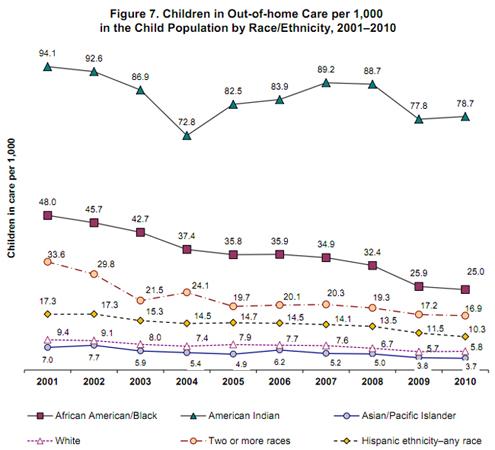
St. Paul, Minn. — Each year about 1,500 American Indian children in Minnesota spend time in foster care or other out-of-home-care, often after allegations of neglect or substance abuse by a parent.           In Minnesota, American Indian children are 14 times more likely to be placed in out-of-home care than white children - the widest such gap in the nation. Officials place 66 percent of the children with relatives or with American Indian foster families.
Even as the total number of Minnesota children in foster care dropped 44 percent in the last decade, the number of American Indian children placed in foster care dropped by only 16 percent.
That worries tribal officials like Erma Vizenor, chairwoman of the White Earth Band of Ojibwe. She said the tribes should be able to determine which of their families need intervention, and what kind.
"When we do not have the decision making and the authority and the control to determine what is best for them, it has become a major concern," Vizenor said.
Aiming to reduce the break-up of Indian families, the White Earth and the Leech Lake band of Ojibwe have taken over responsibility for child welfare on tribal lands. Now the White Earth, Minnesota's largest tribe, is now preparing to care for its children living hundreds of miles away in Hennepin County.
High poverty among American Indian families makes it more difficult to meet a child's basic needs, but that doesn't completely explain why Indian children are much more likely to be removed from their parents' care.
The tribes have questioned whether racial bias is a factor in such decisions, and they've worked with state officials to develop training for county workers to reduce bias in deciding which cases to investigate. The training also seeks to help outsiders understand the traditional role extended families play in raising Indian children.
Dawn Blanchard, the state's ombudsperson for American Indian Families, said removing American Indian children from their homes is "a daily reality."
Blanchard sorts cases into those she can solve over the phone, and those that require an investigation. She reports wide variation in how well counties follow a federal law designed to keep Indian children with other family members, or to at least place them with an Indian foster family.
Blanchard said the most common complaints she handles are disagreements between county social workers and tribes over where children should go.
"The tribe will say we want them to go to Aunt Betty and the county will say, 'we have problems with Aunt Betty. We think that she's not a good person,' " Blanchard said. "Maybe she's too old. 'We've heard' — that's a big one 'we've heard that she's drinking.' Is it substantiated? Do we know for sure if she has a history of drinking or was it 10 or 15 years ago and she's cleaned up her life now?"
Representatives of Minnesota's 11 tribes were so concerned that the needs of their children were not adequately addressed that late last year they sent letters to then-Gov. Tim Pawlenty and Gov.-elect Mark Dayton requesting immediate action to address the problem.
White Earth tribal officials want to take on responsibility for the tribe's children in Hennepin County, hundreds of miles south of the reservation. White Earth children make up a quarter of Hennepin County's American Indian caseload, or about 2 percent of the county's overall cases.
Margaret Thunder, a program manager for Hennepin County child protection, is enthusiastic about the tribe's effort.
"I think it's a huge deal," said Thunder, a member of the Red Lake band of Ojibwe. "They will have 100-percent say. Not that they don't already have a fair percent."
Tribes do have a seat at the table in child protection cases.
The 1978 federal Indian Child Welfare Act requires tribes be notified and involved in decision-making for their children. Hennepin County, with its large urban Indian population, has a high volume of these cases. The county gets high marks for complying with the act, and that's one of the reasons White Earth officials believe addressing the needs of the tribe's children there is a next logical step.
Transferring such cases to the tribe would give it complete control over American Indian cases such as a recent one heard in juvenile court.
Four children, ages 4, 2, 1 and one month, were placed in emergency foster care following reports that their parents were abusing drugs and neglecting the children. The parents didn't show up for the court hearing. Their father is a member of the White Earth band and their mother is enrolled in the Ho-Chunk Nation in Wisconsin.
"Her current address is technically St. Joseph's hospital where the treatment center was," said Mike Hogan, a courtroom monitor for the Minneapolis American Indian Center. "No one's quite sure where she is, even her attorney."
A Ho-Chunk attorney who joined the hearing by speaker phone said the tribe would prepare a list of relatives who could care for the children. White Earth officials agreed to let the mother's tribe take the lead, but they agreed to compile a list of paternal relatives.
A guardian ad litem said the children were doing well under the care of their foster care families.
Hogan's boss, Sheri Riemers, said the embrace of extended families offers the most hopeful outcome for children in such tough situations.
"We do believe when children are removed that their spirit is left behind," said Riemers, program director of Indian Child Welfare for the Minneapolis American Indian Center.
Other tribes around the state and around the country are watching closely.
Erin Sullivan Sutton, assistant commissioner of the state Department of Human Services, said she is not aware of another state transferring public child welfare from a state or county to a tribal system. But there are good reasons to do so, said Sutton, the state's point person on child welfare.
"We're thinking that if services can be provided in a cultural context to Indian families and by tribal agencies that there may be more success," she said.
For state and tribal officials success won't mean eliminating out-of-home placements. There will always be children who need to be removed from unsafe situations, but they hope more tribal involvement will reduce the disparate treatment of American Indian children.
Vizenor said the Hennepin County program could be the beginning of an ambitious venture to expand care for children living off the reservation.
"Without a doubt, I know we will be successful and gradually, we will phase in the metro area and eventually all our children in the state of Minnesota," she said.
White Earth and the state will present a report to the legislature in January. The timeline for the Hennepin County transfer, and the costs, are still to be determined.          

For more, listen:

http://minnesota.publicradio.org/display/web/2011/11/30/american-indian-children-foster-care/

click

Contact Trace

Name

Email *

Message *

NO MORE UPDATES

GO TO:  https://blog.americanindianadoptees.com/  for updates and news. THIS BLOG cannot be updated...