BLOGGER changed, not allowing us to UPDATE this back-up blog

(UPDATED 726/2025) issues with blogger are preventing this

Saturday, October 23, 2010

Adoption Legislation Primer (a must read!)

Special Guest Blog by Romany

HISTORY
Most sealed records legislation dates from the 1930s – 1950s.  At that time, birth certificates were public record, meaning that anyone could get a copy of anyone else’s birth certificate.  Court adoption documents were also public record.  Back then, adoption legislation allowed the state to seal original birth certificates once an amended birth certificate had been issued.  Court records of adoption were also sealed by state law.  In many states, the sealing did not initially prevent the parties to the adoption (parents, adoptive parents, and adoptee) from accessing records after they were sealed.  Eventually, however, even the parties to the adoption were prevented from accessing the records.

In many states, there have been ongoing attempts to restore access, some stretching back 20 to 30 years.  Most recently, access legislation that HAS passed has been through the efforts of a state senator or state assemblymember who is an adoptee.  This has happened in New Hampshire, Maine and Illinois.

THE OPPOSITION & THEIR POSITION:
The primary argument from the opposition is that relinquishing parents have an expectation of privacy that the state is morally (and/or legally) bound to protect.  The corollary argument is that without state-guaranteed protection of their privacy, some unknown number of women in a “crisis pregnancy” would choose to abort rather than place for adoption.
The opposition generally consists of some very strange bedfellows:
o        The National Council for Adoption (lobbying group for certain adoption agencies)
o        The Catholic Church (through each state’s Catholic Conferences of Bishops)
o        Some ACLU chapters
o        Some Planned Parenthood chapters
o        Some Right-To-Life organizations (RTL)
While RTL organizations tend to push the abortion angle, some Planned Parenthood chapters consider adoption a “reproductive choice” deserving of the same protection of anonymity as abortion.  ACLU chapters push the “expectation of privacy” with or without “reproductive choice”.

SO WHAT’S WRONG WITH THE “ABORTION ARGUMENT”?
Plenty.  The original hue and cry was how “abortion rates will skyrocket” if access legislation is passed.  We now have up to ten years of history in states that have restored access.  Abortion statistics from those states have shown NO uptick in abortion rates. 
There is also a survey by the Guttmacher Institute (“Concern for Current and Future Children”) that indicates at least SOME women choose abortion over adoption BECAUSE sealed records would not allow them to know what happened to the child they relinquished.
The arguments from RTL are now centered on a woman’s ability to choose a closed adoption rather than visions of the wholesale slaughter of innocents.  Even in a diminished capacity, this argument still holds sway with pro-life legislators.  We are now being asked to effectively guarantee that no woman will ever have an abortion because of access legislation.

THE “EXPECTATION OF PRIVACY” ARGUMENT
The gist of this is that some unknown number of parents were promised or BELIEVED that they were promised anonymity/confidentiality/privacy in that their identities would never ever be released to anyone.  For a long time, this myth was repeated in a vacuum.  The only real “evidence” anyone had was that a state law sealed records.  Everything else was based on the opposition telling legislators that they had received “a stack of anonymous letters” from parents.
On the other side are certain indisputable facts:
1.       Adoption records and OBCs do NOT seal upon relinquishment.  They seal upon ADOPTION.  They seal even in step-parent adoptions.
2.       Many women have been speaking out for years about how they never wanted anonymity from their own children.  They continue to be dismissed as “a tiny but vocal minority”.
3.       Adoption records may be opened by court order for “good cause shown”.  Even though it is presumably the parents’ identities at stake, there is no provision for the parents to voice their opposition to disclosure.  In most states, even waivers from those parents do not guarantee that the records will be unsealed.
4.       Information from confidential intermediaries has shown that the vast majority of parents contacted welcome the opportunity to reconnect with their children.
5.       Contact preference forms filed in Oregon and other states are overwhelmingly in favor of contact.
6.       The overwhelming majority of recent domestic adoptions have been OPEN adoptions because the vast majority of relinquishing parents are insisting upon open adoptions.
The opposition counters this with the “if only one…” argument.  They have convinced legislators that it is better to stick with the status quo of denying equal rights to millions of adoptees than to allow anyone’s life to be “ruined” by disclosure.
Recently however, certain documents have been making an impact among legislators.  First and foremost are actual surrender documents which have been collected by Prof. Elizabeth Samuels.  You would think that if anonymity/confidentiality/privacy was promised to a relinquishing parent, that promise would find its way into the primary document signed by that parent.  These surrender documents have been very enlightening, to say the least.  Promises are being made, but it is the parent who is doing the promising.  General provisions:
-          The parent is terminating ALL rights (parental and otherwise) with respect to the child and is, in turn, being released from all obligations with respect to said child.
-          The parent has no right to be notified if and when the child has been adopted, and by whom.
-          The parent promises not to search for or contact the child or the child’s adoptive family WHILE THE CHILD IS A MINOR.  This time limit was a big surprise to many people.
The second set of documents making an impact are contemporaneous notes, letters, policies and testimony from when the various legislatures were first considering passing laws to seal adoption records.  As stated before, the original legislative intent was to prevent the general public, and only the general public, from accessing the records.  We need to do more research in this area as each state’s legislative history is unique.

A WORD ABOUT DYSFUNCTIONAL LEGISLATURES
Many of those in the lobbying trenches have been stymied by the reality that power is concentrated in the hands of a few long-term politicians.  This does not just affect our legislation, of course.  One would THINK that when half of the Assemblymembers have signed on as SPONSORS of a bill (New York), then that bill would have long ago been released to the floor for an up-or-down-vote.  One would be very very mistaken.
We (adoptee rights advocates) have seen well-supported bills languish in committee for decades.  We have seen public hearings scheduled, re-scheduled or cancelled at the last minute with no explanation.  We have seen bills rewritten without the input of the adoptee rights lobby group who proposed the legislation in the first place.  We have seen bills containing access provisions completely gutted of those provisions prior to passage.  We have seen the outright railroading of attempts to schedule bills for a floor vote.
Much work needs to be done.  We need champions (preferably adoptees) in the various state legislatures.  We need more research into the original legislative intent.  This can take various forms, including contemporaneous newspaper articles extolling the virtues of sealed records.  We also need first parents to write letters to be included in lobby packets and we need them to request their surrender documents.  Together, we can be a force to be reckoned with in the 44 states (and DC) that do not allow adult adoptees unrestricted access to the single sheet of paper that recorded their births.

Our deepest gratitude to Romany. She will post more on this topic in the very near future. If we educate ourselves, we can change the world!

Wednesday, October 20, 2010

My recent book tour (October 2010)

I had a blast!
By Trace L. Hentz (formerly DeMeyer) 

 Sometimes it takes me awhile to process what just happened. In other words, I had to recover from my recent mini-book tour/road trip to Wisconsin.
    
 Driving is my therapy. I think best while driving. This time I used the 30+ hours to pray and ask “what should I read?”  Great Spirit answered loud and clear. Four times I read from One Small Sacrifice and each time was different!
  
The first time I visited the Menominee tribe in 2001, it was to attend the Wiping the Tears ceremony, led by the most sacred holy men Chief Arvol Looking Horse and Elder Chris Leith. Here I was, nine years later, back there with my own story. That ceremony for adoptees was the first one ever and the miracle I attended was not lost on me. My writing about Lost Birds feels like ceremony.
  
On Sept. 27, I met my friend Jackie in the Milwaukee suburb of Brown Deer and she shared recent updates about Ben-Ani, who is an adoptee currently incarcerated. I’ve known Jackie a few years and we talked about “abduction trauma,” while others may refer to this as “being adopted by non-Indians.”  Ben is Anishinabe-Menominee and he’s agreed to tell his story in my second book, Two Worlds: Lost Children of the Indian Adoption Projects..
  
Monday night Jackie and I drove to the Menominee rez and stayed at their casino (their new guestrooms are even fancier than casino hotel rooms out East).  Tuesday for breakfast, we met up with Colleen, a Lost Bird from the Menominee tribe, who went full circle – from a stranger adoption in Pennsylvania to a reunion with her tribal family and is back home living on her rez in Wisconsin. Colleen is my relative now and always will be. It was Colleen who graciously arranged for me to read at the tribe’s high school and then at their tribal college.
  
Tuesday: One of the saddest moments for me was when I asked the high school students how many of their parents had attended boarding school and practically all their hands shot up. Their parents had been sent as far away as Texas and California. Stranger (not traditional kinship) adoptions and traumatic boarding school experiences permeate every American Indian experience, one way or the other. I think of this as “generational trauma.”
  
Next stop: the audience at the Menominee Tribal College was perhaps keenest and most sensitive to the Lost Bird/adoptee experience. Colleen was sitting up front with me and told of her own experience to the surprised group. The hour-long talk was taped. I answered all their questions and they asked if my talk could be used later in their classrooms. Of course I said YES! (News from Indian Country will later post this video on their internet TV channel. I’ll post a link on my blog when it airs.)
  
Late Tuesday afternoon I drove north. I was going home. I’d see cousins, old friends and even friend’s parents who remembered me but lost contact when I moved away after college. This was going to be the real test, sharing my personal life. Writing at 4 a.m., I would often think about my friends and relatives and what I never told them about my childhood being raised by an alcoholic who molested me. If they read the memoir, they’ll know every single gory embarrassing detail. Even writing it, I felt nauseous.
  
My grade school classmate Julie helped me to process this by letting me talk. I stayed with her and her husband Mike in Billings Park. By the time I read at the Superior Public Library, I was truly calm. (Thanks Julie!) Former mayor of Duluth and Superior, my awesome SSHS classmate Herb Bergson, was there to introduce me. Herb promoted my Twin Ports readings with emails and an update on Howie’s blog: http://www.howiehanson.com/?p=49616.
  
Wednesday morning, I was interviewed by the local National Public Radio (NPR) affiliate at the University of Wisconsin in Superior: that interview was broadcast on National Native News later! Even my friends John and Sara heard me in Tuba City, Arizona. This was fantastic!
  
On Wednesday night at the Public Library, I read a few chapters about my younger days in Superior as a rock musician and even had 'em laughing. I also showed them the shawl my adoptee friend Kim Peterson gifted me for high school graduation. Across the street from the library was the apartment building where Kim was murdered. I’ll never forget Kim, I told them, and her photo is where I can see her every single day. Kim is who I credit for surviving my troubled teens, and why I dedicated my book to her.
  
That hour went by so fast at the library, I barely remember details. There were a few tears. I did survive emotionally, I told them. What irony I was reading on the birthdays of my favorite uncle, Chet McIntyre, and my own birthmother, Helen Thrall. Neither of them lived long enough to see this homecoming or know I wrote about them in my memoir.
  
 On Friday, the reading at Jitters in Duluth felt so good, it didn’t seem like a book reading. I caught up with new friends from Facebook and met classmates from high school. Gary, the awesome Jitters coffeehouse owner, made Julie and me his famous Mocha Malt. I have to admit, if every reading went this smooth, I’d never stay home.
  
 That week I had dinner with my first cousins Scott and Mary Margaret and had lunch with a family friend, Faye from Allouez. They gave me the greatest gift of all – their memories. They shared stories that made me so full and happy, I felt a profound peace. I do hope they realize this “troubled kid” can see her parents as people now. That gift, peace of mind, I wish I could give to every adoptee I know.
  
 I didn’t catch the bug going around during my week in Wisconsin but my sore throat was a sign it was time to head home to western Massachusetts.
  
To wrap up my talk, I shared this story with the high school students on the Menominee rez:  “The old story goes there was a farmer who found a wounded eagle and placed him in a chicken coop to recover. The eagle started to act like a chicken, he bobbed his head like a chicken, he ate like a chicken, and otherwise thought he was a chicken. Until one day an Indian came along and asked what the eagle was doing with the chickens. The farmer told him the story, and the Indian asked if he could remove the eagle. The Farmer gave his permission to do so. So the Indian took the eagle to the mountain and said, “You have to know who you are and what you stand for...” The eagle started to flex his wings. His keen eyesight started to return, and the strength in him started to come back. The eagle flew and soared and everything came back to him, who he was and that he wasn’t a chicken. He gained everything back he lost because of where he was placed.”
  
I told the students Lost Birds are that eagle and every adoptee raised away from their tribe and traditions needs to return home.

Thanks to everyone who helped make the readings of One Small Sacrifice a success: Colleen, Dale K and the Menominee Tribal Nation, Janet and Maggie at the Superior Public Library, Gary at Jitters, Mike Savage and Kalisha at UWS, the honorable Herb Bergson, Faye and her Allouez Book Club, my friends Julie, Mike, Jackie, and JRey, my cousins who I love so much, and my heartfelt thanks to everyone who showed up!


Tuesday, September 21, 2010

Road Trip: BOOK TOUR 2010

By Trace L. Hentz (formerly DeMeyer)

I hear this: “Oh, you wrote a book? When do you hit the road to read it?”
            I plan to share the story about American Indian adoptees with my hometown of Superior, Wisconsin and Duluth, Minnesota on my “book tour” next week. 
            Hardly anyone knows this story, unless you’re an American Indian adoptee or an American Indian family who lost a child to adoption during the Indian Adoption Projects.
            Back in 2008 I read from my manuscript at the Wisconsin Book Festival in Madison, Wisconsin. My friend Mark Anthony Rolo (Bad River Ojibwe) read from his book The Wonder Bull and we had a great big audience with great big questions. One young adoptee came up to me afterwards and said he’d never heard anyone say that adoptees have a “gratitude attitude” which we’re expected to display on demand, our entire life. And he thanked me!
            I told him, “Trust me, when we’re adopted, it’s expected. Once you move past gratitude, you’ll find yourself in unchartered waters, torn between acceptance, anger, love and despair…you might even have to break a few laws to find your own parents.”  This young man was afraid to move forward and open his adoption because he imagined it would hurt his adoptive mother.
            How perplexing, I thought, since I’d been there myself, as I handed him my email address. I advised him to be totally prepared and do his adoption search without telling anyone in his family. I know. I wish every day I didn’t have to say this. 
           
If you’ve read One Small Sacrifice, you know that many parts of the book are truly painful.  My 89-year-old neighbor Karolyn read my book and calls the Indian Adoption Project an atrocity and an outrage.
            What my hand wrote down at 4 a.m. – it was the best I could do. Every page was a canvas, a place to exorcise trauma and stir up ghosts.
            Slowly, the topic of adoption has shifted away from what I call “the gratitude attitude” to a more realistic discussion. Simply look at the numerous articulate writings by adoptees out there. This topic has grown up as we have grown up. Adoptees have sprouted new wings. Adoptees just need other people to hear us and read us. Perhaps then archaic atrocious adoption laws might change.
            So I’m planning a road trip. I am not managed or sponsored by a giant publisher…I’m simply a journalist who scoured adoption history and blended in some personal experience for a book.  
            That is really where the road trip began.  I had to look for strangers. I had to stop being afraid I might hurt someone if I found my family. I had to stop worrying how I might make people uncomfortable. I had to stop being afraid of the truth. 
             I decided I had to grow up.

            Trace’s reading schedule:
            Superior Public Library (on Tower & Belnap) Superior, Wisconsin, Wed., Sept. 29, 6:30 p.m.
            Jitters Coffee, Superior Street, Duluth, Minnesota, Friday, October 1, 5 p.m.
             (Trace will blog again after her road trip!) 

Check out my friend Mark's new book: THE WONDER BULL

Wednesday, September 15, 2010

Ain’t Life Crazy?

Mind Masons

            By Trace Hentz (blog editor)

Words, words, words. That’s what a blog is, right? Words.
            
 Yet I don’t think of this as writing words but sharing actual experience, my adoption experience, my American Indian experience, and my overall ain’t-life-crazy experience.
             
Life is crazy when you think about it. Lots of ideas became American products which started out as patents and experiments: for example – adoption was an experiment and now we’re finding out for those who were the recipients of being adopted aren’t quite tickled pink about their experience. Few in the adoption business want to change anything. They prefer to be known as “do-gooders.”
             
Secrecy permeates lots of experiments. I put this Albert S. Wei’s quote in my book: “My problem is secrecy. I believe that perpetually secret adoptions assure un-accountability and lack of transparency. And secret adoptions are only the tip of the iceberg. The secrecy permeates the process: secret identities, secret parents, secret records, secret foster care providers, secret social workers, secret judges and lawyers (all their identities are sealed, typically), secret physicians, secret statistics and, in the case of some adoption-oriented organizations, secret budgets and secret boards of directors. In any social practice, when people in positions of power hide behind masks, one can be pretty sure that they have something to hide.”  Wei is special advisor to the Bastard Nation Executive Committee.
            
 I had no idea how much was secret. Without the internet and light bulbs, I might still be in the dark.
            
 I write lots of words no one will ever see or read. Why? Writing has been a trusted friend and I consider some of my ideas secret.
             
Writing is a way to work things out in my head. A way to reason, looking at things one way and then another. If I find out it’s a bad idea, I change my mind.
             
Too bad those who could change things for adoptees haven’t had this happen yet.

Saturday, September 11, 2010

Living a mystery


          By Trace L Hentz (blog editor)

Grief grows when someone’s missing. My “someone” was Helen, the woman who grew me in her womb. Helen decided to sign me away to be raised by total strangers.
            What type of blind faith was that? What was required for her to decide to make me an orphan? How could she know I’d be safe? Someone must have told her.
            Maybe the Catholics convinced her. The Catholics arranged everything for her and for me.
             Why doesn’t America know being orphaned hurts the baby in a profound way? Prisons and psychiatric wards are filled with orphans and adoptees, some of the scariest and most violent offenders. Why haven’t we heard about this? 
            Losing Helen did hurt me in a profound way, but not enough to kill someone.
            Adoption was an experiment. Remember this. No one really knew how closed adoption would turn out. Our mothers never imagined how this could hurt us as much as it hurt them. Mothers were assured giving us up would be ok, and we'd be better off. 
             CUB Mothers are rewriting history and fighting to get us back and fighting adoption secrecy. (CUB means concerned united birthparents). An important essential book on America's unregulated adoption industry is Stork Market (there is a link on this blog). Riben's book will open your eyes in ways you cannot imagine.
            Then I find out our government forgets to count adoptees.  As a journalist, I was disappointed but not surprised to find out their U.S. figures are not recent, reliable or computed systematically. We’re not that important, I guess.
            Writing One Small Sacrifice, I was confronted with one reality then another. I woke up. I lived in a mystery novel. I can say now with certainty, it was an adventure solving the mystery.
             With obvious fear, I opened my adoption, even if it got me banished from my adoptive family or arrested for criminally trespassing in my own family tree!
            What lawmakers decide about unsealing adoption records in 2010, if they were not adopted and if they know their names, they may not get it. Expecting an adoptee to be ok with living a mystery is crazy.
            When you think about this, it’s obvious. The tree roots of trauma takes its hold in children. Orphans roots are scarred. My roots are scarred.
            I don’t think it should be so hard to find the woman who grew you in her womb. I don’t think an adoptee should be denied their name and their family tree and their relatives.
            I think about a lot of things but I pray that moms and dads across the planet can raise their own children and those children become strong and healthy moms and dads. 


** An adoptee wrote on Facebook: My sister and I have so many issues that a shrink wouldn't know where to start… Another wrote: I shut down my emotions at a very early age. Because I agreed with them, I wrote Ghost Shell and posted it on this blog on July 1.

Thursday, September 9, 2010

Scraps - by Loud Blood

Trace wishes to thank Loud Blood for her wonderful guest blog... 


(excerpt from upcoming book, "Loud Blood")
I have been fed, clothed, sheltered, yet, my spirit must live off cultural scraps that I go begging where Native people gather -- a story, a song, a weave, a smile... where I feel a resonance, filled, soothed, but sadly, also invisible, broken, culturally orphaned; lonely. 

Will I forever be a guest among my own people?   Who will celebrate my joys and triumphs with me?  Who will mourn my sorrows? Who will laugh at some shared history?  Not my adoptive family -- our non-connection continued and became stronger in adulthood. I want to join in the Native community, to participate, to serve and share what I have and to receive recognition and feel valued.  But even on this side, there are those Indians that I thought were friends who walk past blankly in fuller-blood situations, or those who look at me in public settings with flash card eyes as they calculate their racist arithmetic with no thought of how they’ve adopted the blood-quantum mentality constructed by the colonists.  I yearn to feel welcome somehow.  I need to heal myself enough to come forward to work, for otherwise I remain immobilized, hollow, invisible. 

I can hear the critical thoughts of others; I think them myself -- Get over it.  Geesh, move on.  Stop feeling sorry for yourself. 

I’d love to.  The same as someone uses crutches when they are injured, or someone wears bandages after surgery, or someone wears glasses to compensate for not being able to see on one’s own; I am doing the best I can under the circumstances.  But I need to be my own auntie and tell myself, ‘Chin up.  Get over it.  Move on with life.’  This I can do.  It’s the smiles, nods, and hugs that are harder.  My grandmother’s spirit did come with me, but she cannot hold me connected alone.  When I am acknowledged with a smile, a hug, a nod -- these small acts mean so much to me, reminding me that I am here, less hollow, less invisible. 

I must expect nothing.  This is not my business, not my community.   So what am I doing here?  What is the draw?  It used to be my honeymoon, my infancy of native identity.  What didn’t take hold?  What connections failed?  I am not connected to these people, we are connected as human beings, but not as relatives.  I am a guest.

Because my mother was taken into the dominators boarding school and brainwashed and culturally broken, she gave me over to a white man’s church-people with the hopes they would find a wonderful family for me.  I am indebted my adoptive parents, Ole and Arleta, who did choose to parent me, and raise me in the best way they knew how.  But I must accept that I am henceforth a guest among my tribe.  Anyway, my lack of tribal knowledge and family history must make me seem like some sort of imbecile in a place where the connected members are at home.  It is as though when my mother said, “Goodbye,”  all conscious Native training ceased. When I reconnected with my Native family, and began listening to Native stories, songs, and conversations, my life as a Native resumed.   So I gather scraps, like Yvonne, an educator and Chehalis master weaver who collects cedar bark scraps from the weaving tables because she soaks and blends them and makes them into functional, spirited cedar paper.  I want to gather the bits and pieces of my life and process them into something functional and spirited.  I can’t wait to get over this deep-seated wound of detachment and melancholy.  I want to heal and live fully the life that isn’t about solving disconnection.  Once this is healed and resolved, what will I be writing about?  What work comes next?  Who am I in another context?  I long to find out.

It has been so soothing to be present at Native gatherings --witnessing tribal connections, witnessing families, witnessing powerful leaders; seeing Indian faces after growing up among blondes.  When attending the 150 Year Anniversary of Treaties Symposium in The Evergreen State College Longhouse, one word stood out:  “Quyana”, the speaker said.  Thank you in my mother’s original language.  Quyana, I heard.  Quyana, I comprehended.  Quyana, I felt run down my cheek. 

Quyana to you, Alaska Native speaker Sally Smith. 

A group of young speakers from the Makah Nation stood together at the microphone to share stories about their life and relations. Afterward, I wrote to them:

Thank you for appreciating the beauty of your culture and tribal connections.  As a person who was given away from her family and tribe as a newborn baby, who feels so alone in this world, who has no family connections to celebrate big days, like the births of my three babies who are strangers to the people who would be their grandparents, aunts, and uncles.  I also mourn my losses alone.  This is a heavy burden; a wound I don’t know if will ever heal.  But perhaps it will, because when I see young people like you that love and appreciate the connections you have to each other and your culture, this beauty gives me healing.

Thank you for appreciating knowing the names of your grandparents and great-grandparents, aunties, uncles, cousins.

Thank you for speaking.

I fully support my birthmother’s pseudo-decision to release me to adoption.  What choices were there?  How is it that she and I are one set among over 100,000 others (check for numbers) that experienced this?  Whose genocidal plan conceived this “solution?” Instead of creating or supplementing support systems for mothers in great need, they were set up to break contact with their family’s next generation; en masse.

Part of my story is finding out that there are so many others.  It changes everything.  I experienced myself as an Indian who stood alone, yet now I know there are hundreds of thousands of other Indians directly affected, and hundreds of thousands more affected in the aftermath.  This fact produces in me an empathetic stupor for us hundred thousand humans dispersed and scattered into strangers homes.

On a Dakota-Lakota-Nakota site, a link reads,
            For the Children in Exile. 
I feel the exile pain. Though I’m not a child anymore, the exile remains.  I live free, moving to many places.  A tumbleweed.  Free. Just the same, the longing for connections to my people, my tribe, my familiar blood, rises in waves like a daily tide. The exile is not punishment from my tribe, but a natural consequence of the benign genocidal practices of the colonists. 

In our lives, the security of connection to parents, aunts, uncles, grandparents is absent.  I’ve no older relations to call up and ask important questions or drop-in to witness, observe, share.

According to a quote by the International Indian Treaty Council from the 57th session of the UN Commission on Human Rights in 2001, as Agenda item #13: Rights of the Child, it seems that all or a majority of us have suffered extreme loss:
Current studies have investigated the damaging effects of transracial placement which include psychological damage, ethnic identity confusion, self-concept formation difficulties, and adolescence repercussions such as alcoholism and high rates of suicide.

Growing up, I thought something was very wrong with me -- not looking like others, not thinking like others, and when I could feel, not wishing to live.  But fortunately, I didn’t feel often. 

Ok!  Enough of that!  Beloved Upper Skagit elder, Vi Hilbert came to the microphone to give an even shorter variation on her signature “Ten line story” about Lady Louse.  
Lady Louse was a sponge.  Lady Louse became self-absorbed, and that was the end of Lady Louse.

I am going to be ok.  I am willing and able to work, I just also need to heal enough to not fall into that huge gaping wound at my core and walk and talk.  I see the hole now and can go around, jump over, build bridges of songs, stories, smiles, hugs, drumbeats, actions, and continue to listen, learn, light up the bridges and work around it.  I have encountered many full wings -- on my own, with my husband, the spirit of my grandmother, all my spirit helpers -- all lifting me up. 

I do have my immediate family to celebrate with, to laugh at shared history with, to mourn tragedies with -- my brilliant husband, and three beautiful daughters, each bestowed with multiple intelligences.

The day I stepped off the plane and met my mother, brother, and sisters, then, I looked like someone.  I met cousins, aunts, uncle, and cousin’s children.  From that point, I looked like a lot of people and something began to settle.  Some new sense of belonging, visibility, and authenticity rose above feeling detached and unseen and mismatched.  With this strength growing inside, I must squeeze the self-absorbed sponge, and focus outward.
Aho.
To contact the author, email:  LoudBloodAK@gmail.com

Tuesday, September 7, 2010

Lost Siblings

    My definition of being lost is being separated from your natural family, your genetic first family. I know a few Lost Birds who were placed into adoption with a sister or brother. In many ways I consider them fortunate because they had each other. But being adopted is no less traumatic. If you don’t believe me, read my memoir.
      I had a dream this morning about an adoptee in Australia has 20 (?) siblings who are also lost. Now they are searching for each other. Can it be true?
            This was enough to get me out of bed at 4 am. Then I thought: how many siblings are separated, lost, and not together?  Why would social workers and adoption agencies separate siblings?  That seems inhuman.
            Their answer is somewhat obvious: they can’t find or place that many kids with one adoptive family. A social worker might place one or two children together but not often. Why? The childless couple only wishes to adopt one. The agencies and adopters didn’t put much weight on our blood connection and how we are a natural family who would never choose to be separated nor would we wish to be adopted out separately.
            Being separated from your natural parent(s) is hard enough but being separated from siblings – that is a nightmare - especially when you knew them and remember them. This feeling of being lost can truly be a nightmare for those in a closed adoption.
            I feel this way because I was told I have a sister. She was lost to adoption, when my natural mother Helen had her four years prior to me, and she was adopted out. Then a psychic told me Jewel-Jules-Julie was already dead. The psychic saw their family tombstone that read Russo. I dreamt about this sister a long time. I wanted to know what she was like and see her face. I wanted to know she was ok.
            Really, I love stories about reunions with siblings, when you meet your long-lost brothers and sisters.
            In my reunion with my natural dad, he had five kids after I was born so I have five in my dad’s family, 4 boys and 1 girl. They never knew about me until I met them.
            When you meet someone who looks like you, it’s PRICELESS.
            When you hear their stories, it’s like a place in your heart is finally filled. This made me feel less alone in this tough cruel world.
            Why states and provinces in North America have not opened adoption records and files to reunite lost siblings – it’s not just a crime of humanity, it’s absolutely obscene.
            So a dream of lost siblings in Australia was the reason I woke up early. Siblings need to find one other. That alone is reason enough for countries to change their laws and open adoption records.
            It’s not about privacy, it’s about love.

American Indian girls should be with siblings

 (online source Red Lake Nation News)

LITTLE ROCK, Arkansas -- Twin girls with American Indian heritage should be placed in the custody of their mother's third cousin in keeping with the guidelines of the Indian Child Welfare Act, the state Appeals Court ruled Wednesday.
The opinion overturned a decision in 2001 by Van Buren County Circuit Judge Linda P. Collier to award custody of the 9-year-old sisters to their mother's fourth cousin in Arkansas.
The appeals court said the girls should be with their four siblings, who live with the mother's third cousin, also in Arkansas. The court noted the Indian Child Welfare Act gives preference in child custody disputes to extended family members, other members of the Indian child's tribe or other Indian families.
While neither cousin is Indian, the appeals court said the third cousin has custody of the twins' four siblings and their Indian tribe recommended they be together. The court pointed to a brief the Tohono O'odham Nation filed that said: "The only family the children have in Arkansas are each other, and their placement together is the closest approximation of placement with 'extended family' intended by the Act."
The twins' mother, Tina Gaspar, has at least 13 children, the appeals court said. The twins and four other children have the same father, Ruben Sanders, who is a member of the Tohono O'odham Nation.
Gaspar sent the girls to live with her third cousin in Van Buren County in August 2002 after Sanders abandoned the children, and Gaspar gave her relative "a signed, written statement conveying the guardianship of all six children," the court opinion said. Gaspar made the arrangements because of concern the state of Arizona would take the children from her when she went to prison in that state, the court said.
Because Sanders fathered the six children and then abandoned them, they qualify for enrollment in the Nation and the Indian Child Welfare Act applies to the custody issue, according to the opinion written by Judge Robert J. Gladwin.
Gaspar's fourth cousin then visited her in Arizona in late 2002, and obtained the mother's signature relinquishing custody of the twins to her. The fourth cousin filed the document in Van Buren County and got custody of the twins with the help of law enforcement officials.
The appeals court questioned the legitimacy of the second document and noted that "the Nation clearly and repeatedly states that its preference is for all six of the siblings to be together with appellant."
While both cousins "are on equal footing when it comes to the preferences," Gaspar's third cousin had an advantage because she has custody of the twins' four siblings. The court said she also has remained in closer contact with the Tohono O'odham Nation.

Friday, September 3, 2010

Losing your right to be Indian

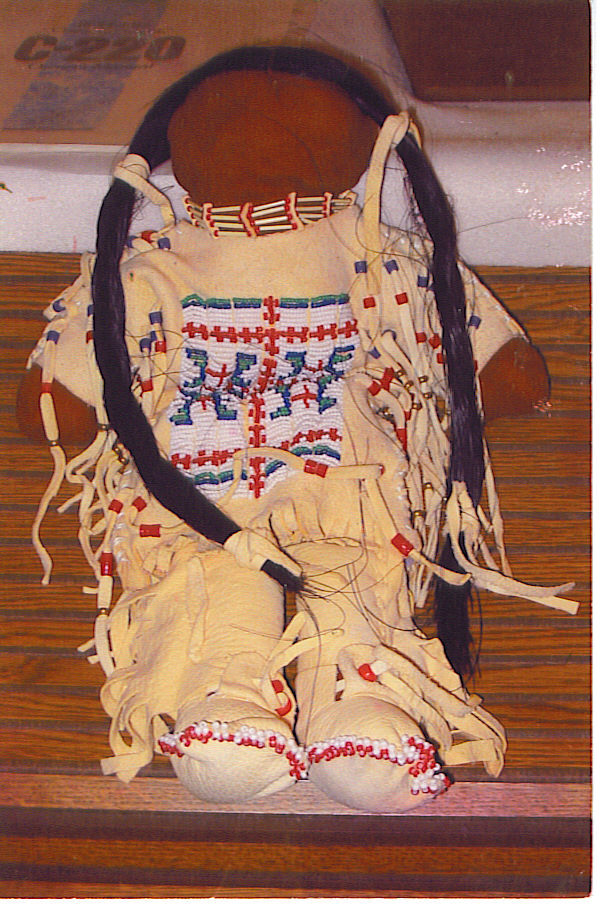
Ellowyn Locke's doll
     I’ve been thinking how some things have not changed significantly in Indian Country. The following testimony happened in 1974, when Indian leaders decided to stop the wholesale removal of Indian children to boarding schools and for adoption to non-Indian families.  Mr. Byler spoke eloquently to Senator Bartlett and Senator Abourezk about detribalization.  The result  was the Indian Child Welfare Act of 1978, which is meant to prevent non-Indians from adopting American Indian children.

            Excerpt:
            Senator BARTLETT. Do you feel that the boarding school removes some of the parental responsibility …that it creates a gap between the children and the parents, in which it makes the job of the parents more difficult and harder to achieve?

            Mr. BYLER. Yes; I think this is very much the case. In addition, I would say also we can really take the whole educational experience. Dr. Edward P. Dozier criticized Headstart programs for some Indian communities on the ground that an Indian child has such a short time in his life to learn how to behave in his own environment, to pick up the cultural and behavioral patterns of his parents. It was bad enough to start school at five or six because that bobtailed the opportunity the kids had to learn this. Now with Headstart in some communities, that age is down to 3 years, so these preschool experiences denied the children the opportunity to learn how to function properly in their own society.
            And it demoralizes the whole functioning of families when those children who grow up in a boarding school become parents themselves and have not had the opportunity to observe normal child rearing.
            In some of the early poverty programs funded under OEO, Indian tribes asked for funds to train their teenagers to be parents because they didn’t know what it was like because they had been away in boarding school.

Senator BARTLETT. What should be the structure for facing up to the emotional needs of Indian children and also in meeting the educational needs?

Mr. BYLER. I believe that in terms of the educational needs, that would be contracting the Indian schools with tribes that wish to contract for those schools. Where the tribes have taken over those schools, and there are not many yet, the educational result has been dramatic.
            For example, in Florida the Miccosukees had never had a school at all, none of their children attended school until 1961 or 1962. They took over their school about 4 years ago and, 1 year after the tribe itself had taken over the school, the comparative educational achievements of the children improved by 50 percent.
            Dropout rates have dramatically been reduced in the Busby school on Northern Cheyenne, and the Rocky Boy school, both in Montana, since Indian tribes have taken them over. So, I do think that educational needs can be met more adequately by the Indian community controlling the schools themselves.
            In terms of the emotional needs, I think perhaps one of the most central things to the emotional life of the Indian family and the Indian child, is to remove from that family the threat that their children will be taken away from them. I think this is the most dangerous aspect. It has a far greater impact on Indian emotional life than any other single factor.
            I think that in societies throughout the United States, and Indian societies, not all impoverished children or families suffer this kind of family breakdown. Among the Miccosukees, children are not taken from their parents, nor among the Coushattas of Louisiana; it’s unknown, the kind of breakdown that one sees in some Indian communities. It’s not because of Indian poverty. There are many societies in the world that are much more poverty stricken than the average American Indian community, but exhibit little or none of the family breakdown.
            I think it’s a copout when people say it’s poverty that’s causing family breakdown. I think perhaps the chief thing is the detribalization and the deculturalization, Federal and State and local efforts to make Indians white. It hasn’t worked and it will never work and one of the most vicious forms of trying to do this is to take their children. Those are the great emotional risks to Indian families.
            [More of this testimony is available at: www.liftingtheveil.org/byler]


            So what happened years ago, its effects are still being felt today. Loss of culture and language could have destroyed Indian Country but it has not. We may be wobbly but we’re still working…
            For adoptees that went through what I did, we look in a mirror and know something is wrong, yet we feel helpless to change it.  Who can discuss identity issues with you if you’re not a part of your tribal nation? I’m troubled tribes are so busy surviving they don’t reach out and search for their lost tribal members, like adoptees.
            I am so troubled by this disconnect, I try to connect adoptees to each other since we share the feeling of being lost. Our grief can’t be healed until we’re united successfully with family, relatives and tribe. Many have succeeded. Many more are trying.
            Many Native American adoptees are opening up and talking. Our identity is not mirrored back to us. We lost more than culture. We lost our right to be Indian. We have to fight to regain it. And with sealed adoption records, we may never be able to…

click

Contact Trace

Name

Email *

Message *

NO MORE UPDATES

GO TO:  https://blog.americanindianadoptees.com/  for updates and news. THIS BLOG cannot be updated...